






Corvette trouble

Thread Starter
Navigator

Joined: Oct 2008
Posts: 9
Likes: 0
 Corvette trouble
I own a 2001 C5 with 41500 miles on it. The mulitple problems I am having with it are the following:
When driving in town the temp will go as high as 220 degrees. Driving on the highway here in Germany the temp goes down to 196 degrees.
I did have a Varam air intake installed a few years back and the people who did the work never put back the radiator shroud. Even so the temp did not rise that high.
Second while driving on the highway my vehicle has turned off! I pull over turn off the car and it starts right back up. When the vehicle does shut down I loose all power. Could this be the battery? As far as I know it has never been replaced.
Thrid is every now and then when I try to accelerate, the engine dies down. I let off the gas then floor it. The car respondes like it should.
I have broken down and taken it to a chevy dealer here in Germany twice and I still have the same problem! I have paid over $2000 and it still does not work! I had the dealer change the coolant, transmission,and rear axel fluid. The also said that they had to replace secondary air inlet valve left and right.
Any help would be greatly appreciated! This is why I registered with corvette forum. Thanks in advance.
When driving in town the temp will go as high as 220 degrees. Driving on the highway here in Germany the temp goes down to 196 degrees.
I did have a Varam air intake installed a few years back and the people who did the work never put back the radiator shroud. Even so the temp did not rise that high.
Second while driving on the highway my vehicle has turned off! I pull over turn off the car and it starts right back up. When the vehicle does shut down I loose all power. Could this be the battery? As far as I know it has never been replaced.
Thrid is every now and then when I try to accelerate, the engine dies down. I let off the gas then floor it. The car respondes like it should.
I have broken down and taken it to a chevy dealer here in Germany twice and I still have the same problem! I have paid over $2000 and it still does not work! I had the dealer change the coolant, transmission,and rear axel fluid. The also said that they had to replace secondary air inlet valve left and right.
Any help would be greatly appreciated! This is why I registered with corvette forum. Thanks in advance.

Le Mans Master


Joined: Jul 2002
Posts: 7,370
Likes: 8
From: Slave to the evil empire
Cruise-In V Veteran
St. Jude Donor '04
For the first problem, 220 degrees is not overheating or hot, the first cooling fan isn't programmed to come on until the car reaches 225 degrees but yes the shroud should be reinstalled.
For the other two problems you'll need to retrieve the fault codes, follow this link and it will explain how you can retrieve the codes, then post them here and we can help you figure out whats going on.
https://www.corvetteforum.com/techti...D=26&TopicID=1
For the other two problems you'll need to retrieve the fault codes, follow this link and it will explain how you can retrieve the codes, then post them here and we can help you figure out whats going on.
https://www.corvetteforum.com/techti...D=26&TopicID=1

Tech Contributor


Joined: Dec 1999
Posts: 32,910
Likes: 2,402
From: Anthony TX
CI 6,7,8,9,11 Vet
St. Jude Donor '08
Sar shuts off and looses all power! Hmmmm, start with the battery terminals. remove them and clean them. They need to be reinstalled and torqued to 11 FT/LBS!!!! Try to rotate them by hand. If they move, the fastener isnt tightening correctly and may be too long.
Another problem that will cause the car to CUT OFF is a faulty ignition switch. I have a post that detaild a self repair for that switch if you determine that you think it is being caused by that switch.
Reading the DTCs will be your biggest asset. If there are LOTs of them, once you write them all down,,,clear ALL of them and see what ones come back.
I strongly recommend getting that shroud and also making sure that there isnt any sand or dirt in the fins or in between the radiator and condensor blocking air flow. Use a water hose on strong stream and back flush the dirt out. It will help.
BC
BC
Another problem that will cause the car to CUT OFF is a faulty ignition switch. I have a post that detaild a self repair for that switch if you determine that you think it is being caused by that switch.
Reading the DTCs will be your biggest asset. If there are LOTs of them, once you write them all down,,,clear ALL of them and see what ones come back.
I strongly recommend getting that shroud and also making sure that there isnt any sand or dirt in the fins or in between the radiator and condensor blocking air flow. Use a water hose on strong stream and back flush the dirt out. It will help.
BC
BC

Pro

Joined: Sep 2007
Posts: 735
Likes: 7
From: Bucks County Pa
++++++++++++++++++++++++++++++++++
DIC Onboard Diagnostics Show DTCs U1016, U1064 and U1096 in History #PI00043 - (Jun 19, 2002)
DIC Onboard Diagnostics Show DTCs U1016, U1064 and U1096 in History
.
When servicing the vehicle with the VIN you entered, the following diagnosis might be helpful if the vehicle exhibits the described symptoms.
Condition/Concern:
DTCs U1016, U1064 and U1096 may be present when scrolling through the onboard diagnostics via the instrument cluster Driver Information Center (DIC).
Recommendation/Instructions:
This is a normal software function as long as the DTCs have a history status upon ignition cycling. No repair attempts should be made.
Please follow this diagnosis process thoroughly and complete each step. If the condition exhibited is resolved without completing every step, the remaining steps do not need to be performed. If these steps do not resolve the condition, please contact GM TAC for further diagnostic assistance. This diagnostic approach was developed for the vehicle with the VIN you entered and should not be automatically be used for other vehicles with similar symptoms.
+++++++++++++++++++++++++++++++++++
It sounds like you are losing electrical power at intermittant times. The best place to start is by making sure you have a good battery,(load test), then make sure the cables to the batt, ground, starter lug, and uh fuseblock are clean and tight as BC suggested. Then check the wires and connectors in the accordions between the doors and body pillar, they can short out intermittantly and kill all electric power, just pull back the boots and take a close look for bare wires, and finally clean all the ground points in the car. If the problem still persists, you may have to repair or replace the ig switch.
Good Luck
++++++++++++++++++++++++++++++++++

Tech Contributor
Joined: Dec 1999
Posts: 32,910
Likes: 2,402
From: Anthony TX
CI 6,7,8,9,11 Vet
St. Jude Donor '08
Thread Starter
Navigator
Joined: Oct 2008
Posts: 9
Likes: 0
I just had the ignition switch replaced along with the battery so I hope that takes care of the problem, although when I got the car back and stepped on the gas it did hesitate a little. After that it seemed to be working fine.
I did take a look at the old switch and saw the burn marks on the inside. Do you think the alternator could be at fault as well? Let me know what you think and thanks for the help.
I did take a look at the old switch and saw the burn marks on the inside. Do you think the alternator could be at fault as well? Let me know what you think and thanks for the help.
Corvette Stories
The Best of Corvette for Corvette Enthusiasts

Every 2027 Corvette Engine Explained
Joe Kucinski
Designer Imagines A Corvette That Looks More Like a Corvette Than the Corvette
Verdad Gallardo
10 Ugly Corvettes That We Still Kinda Love
Joe Kucinski
Top 10 Most Expensive Corvettes Ever Sold on Bring A Trailer
Brett Foote
10 Things Every Corvette Owner Needs (2026 Edition)
Michael S. Palmer
8 Most "Only Corvette Owners Understand" Quirks and Problems
Pouria Savadkouei
10 Reasons the C6 Z06 is Still A Performance Benchmark After 20 Years
Joe Kucinski
How Much Horsepower Every Corvette Engine "LOST" in 1972
Joe Kucinski
Top 10 DOs and DON'Ts for Protecting Your Convertible Top!
Michael S. Palmer
Tech Contributor

Joined: Dec 2006
Posts: 10,962
Likes: 29
From: Van Buren Arkansas
Wounded Warrior Escort '11
For the hesitation, if I understand you correctly, you are giving it the gas/throttle and its dropping off and so on. Take a look at the PCV valve connection tube to the intake manifold. They can and do collapse with a hole in them. Make sure you look or feel the bottom of the tube.

Tech Contributor


Joined: Oct 1999
Posts: 41,063
Likes: 9,826
From: Charlotte, NC (formerly Endicott, NY)
Here are a few things to check if the car is hesitating:
Hesitation, Sag, Stumble
Inspection/Tests
Action
DEFINITION: Momentary lack of response as the accelerator is pushed down. Can occur at any vehicle speed. Usually more pronounced when first trying to make the vehicle move, as from a stop. May cause the engine to stall if severe enough.
Preliminary
Inspect the engine thermostat for proper operation and for proper heat range. Refer to Thermostat Diagnosis in Engine Cooling.
Additional Inspections
Inspect the generator output voltage. Refer to Diagnostic System Check - Engine Electrical in Engine Electrical for the procedure. Repair the charging system if the generator output voltage is less than 9 volts or more than 16 volts.
Bill
Hesitation, Sag, Stumble
Inspection/Tests
Action
DEFINITION: Momentary lack of response as the accelerator is pushed down. Can occur at any vehicle speed. Usually more pronounced when first trying to make the vehicle move, as from a stop. May cause the engine to stall if severe enough.
Preliminary
- Refer to Important Preliminary Inspections Before Starting in Symptoms - Engine Controls .
- Search for bulletins.
- Verify that the powertrain control module (PCM) grounds are clean, tight, and in the proper locations. Refer to Engine Controls Schematics .
- Inspect the manifold absolute pressure (MAP) sensor operation.
- An extended travel brake switch that is mis-adjusted or an extended travel brake circuit that is open causes a perceived misfire under heavy load conditions from a stop. Use a scan tool in order to monitor the extended travel brake switch parameter. If the scan tool displays extended travel brake switch applied when the brake pedal is released, refer to DTC P1575 in Cruise Control.
- Inspect for incorrect fuel pressure. Refer to Fuel System Diagnosis .
- Inspect for a restricted fuel filter. Refer to Fuel System Diagnosis .
- Inspect for a contaminated fuel condition. Refer to Alcohol/Contaminants-in-Fuel Diagnosis .
- Verify that both fuel injector fuses are not open. An open fuel injector fuse causes four ignition coils and four fuel injectors not to operate. Inspect the ignition coil circuits and the fuel injector circuits for an intermittent short to ground. Refer to Circuit Testing and Wiring Repairs in Wiring Systems. Replace the fuse.
- Inspect the fuel injectors. Refer to Fuel Injector Coil Test .
- Inspect for the following that may cause the engine to run rich:
- Notice
Refer to Heated Oxygen and Oxygen Sensor Notice in Cautions and Notices.
Water intrusion in the HO2S connector - Engine oil contaminated by fuel
- An EVAP canister purge condition
- Incorrect fuel pressure--Refer to Fuel System Diagnosis .
- A leaking fuel pressure regulator--Refer to Fuel System Diagnosis .
- Leaking fuel injectors--Refer to Fuel System Diagnosis .
- An inaccurate mass air flow (MAF) sensor
- Blockage on the inlet screen of the MAF sensor
- Vacuum hoses that are split, kinked, improperly connected, or routed--Refer to Emission Hose Routing Diagram .
- An air intake duct that is collapsed or restricted
- An air filter that is dirty or restricted--Refer to Air Cleaner Element Replacement .
- Notice
- Inspect for the following conditions that may cause the engine to run lean:
- Notice
Refer to Heated Oxygen and Oxygen Sensor Notice in Cautions and Notices.
Water intrusion in the HO2S connector - An exhaust leak between the HO2S and the engine--Refer to Exhaust Leakage in Engine Exhaust.
- Vacuum leaks
- Incorrect fuel pressure--Refer to Fuel System Diagnosis .
- Restricted fuel injectors--Refer to Fuel Injector Balance Test with Special Tool or Fuel Injector Balance Test with Tech 2 .
- An inaccurate MAF sensor
- Fuel contamination--Refer to Alcohol/Contaminants-in-Fuel Diagnosis .
- Vacuum hoses that are split, kinked, improperly connected or routed--Refer to Emission Hose Routing Diagram .
- Notice
- Soak the secondary ignition system with water from a spray bottle. Soaking the secondary ignition system may help locate damaged or deteriorated components. Look and listen for arcing or misfiring as you apply water. Monitor the Misfire Current Counters while driving the vehicle in the conditions that the misfire occurred. If a misfiring cylinder can be located, use the DTC P0300 table for diagnosis. Refer to DTC P0300 .
- Test for proper ignition voltage output with the J 26792 Spark Tester . Refer to Electronic Ignition (EI) System Diagnosis for the procedure.
- Remove the spark plugs and check for the following:
- Correct heat range
- Wet plugs
- Cracks
- Wear
- Improper gap
- Burned electrodes
- Heavy deposits
- An improper spark plug gap will cause a driveability problem. Gap the spark plugs using a wire gauge gap tool. Refer to Spark Plug Replacement .
- Determine the cause of the fouling before replacing the spark plugs.
- Inspect for loose ignition coil grounds. Refer to Electronic Ignition (EI) System Diagnosis .
Inspect the engine thermostat for proper operation and for proper heat range. Refer to Thermostat Diagnosis in Engine Cooling.
Additional Inspections
Inspect the generator output voltage. Refer to Diagnostic System Check - Engine Electrical in Engine Electrical for the procedure. Repair the charging system if the generator output voltage is less than 9 volts or more than 16 volts.
Bill
Thread Starter
Navigator
Joined: Oct 2008
Posts: 9
Likes: 0
For the hesitation, if I understand you correctly, you are giving it the gas/throttle and its dropping off and so on. Take a look at the PCV valve connection tube to the intake manifold. They can and do collapse with a hole in them. Make sure you look or feel the bottom of the tube.
Thanks for the help.
Thread Starter
Navigator
Joined: Oct 2008
Posts: 9
Likes: 0
Thanks for the help, but I am wondering where exactly the PCV vale is. I have a vara ram air intake installed and wondering if what you are talking about is in the black tube that connects the MAF to the air filter. Thanks.
Tech Contributor
Joined: Dec 1999
Posts: 32,910
Likes: 2,402
From: Anthony TX
CI 6,7,8,9,11 Vet
St. Jude Donor '08
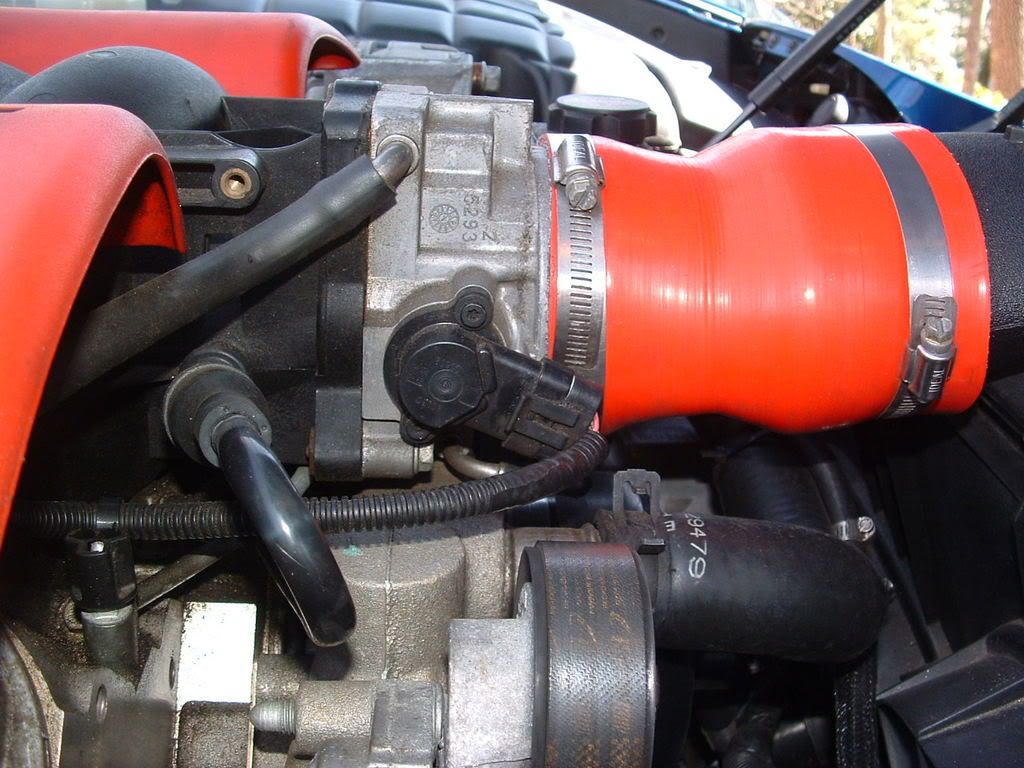
The U shaped tube on the intake manifold "directly aft of the throttle body" is the PCV Valve assembly. Be sur eto replace the intire tube if its dry rotted or damaged.
BC
BC
Thread Starter
Navigator
Joined: Oct 2008
Posts: 9
Likes: 0
o2 sensor
My question is how many o2 sensors are there? Please help. Thanks!
