




What has been Done?
Thread Starter
Drifting


Joined: Mar 2010
Posts: 1,628
Likes: 15
From: Seattle WA

To all who have helped thus far: THANKS! We've already identified, what, $1500-2000 worth of parts? The only question remaining for me is, what could have been done that isn't so easy to tell, such as the cam? Once again keep in mind I am a total noob here, I come from the 6.2l detroit diesel world where anyone who screws with their cams or ports their heads or .... etc etc is ridiculed because it provides nothing extra. How would I ever know these things unless I pull the motor apart, which is not bloody likely....

Safety Car


Joined: Oct 2007
Posts: 3,903
Likes: 1
From: You know your drunk when you swerve to miss the tree then you realize its your air freshener! Covington Ga
You would know if it had a cam in. Unless it has a LS6 cam but I doubt it. One really easy way is pull the vavle cover and look at the springs if they are stock then more than likely its a stock cam. Her is mine at idle with a cam bad sound but you get the point  And I know how the wife thing goes. I have to buy a clutch so that means I have to buy her something!!
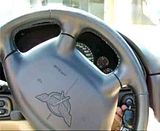
And I know how the wife thing goes. I have to buy a clutch so that means I have to buy her something!!
Thread Starter
Drifting
Joined: Mar 2010
Posts: 1,628
Likes: 15
From: Seattle WA
Well, my vette sounds mean but not that mean. I think the tuner might come sooner rather than later. My only other issue now is the fuel gauge stuck on empty after my last fill at a non-top-tier gas station. Threw some gumout fuel system cleaner in there and its still stuck on E. I must say it's pretty ridiculous that its that finicky.
Safety Car
Joined: Oct 2007
Posts: 3,903
Likes: 1
From: You know your drunk when you swerve to miss the tree then you realize its your air freshener! Covington Ga
Use Cheveron with techron. Mine did that and I ran a bottle through it and it fixed the problem. Also if you have a OBD scanner clear the codes even if it says they isnt any.

Melting Slicks

Joined: Aug 2000
Posts: 2,618
Likes: 5
From: Overland Park KS
The tire pressure warning system working at least tells me the previous owner(s) didn't cut corners.
I just thought you should know the plate frame was missing

Would be interesting to see what you have under for exhaust...what's between the headers and exhaust, H pipe or a nice X pipe, probably stock cats or maybe high flow cats?
You could check out your crank pulley, if it's an underdrive pulley then you probably have a cam because the underdrive crank pulley is something you do while changing the cam because it's a pita. Once the crank pulley is off, the cam just takes about 10 more minutes in labor. The crank pulley will have two belts and the stock pulley will typically have rust on it, an underdrive pulley is typically black or machined metal and doesn't rust very much. Probably the easiest way to explain it to someone who isn't familiar with the LS1 motor.
You should be able to pull up on the red beauty cover (not the one with the fuel line going thru it. This will give you a good look at the coil packs (black/stock), spark plug wires and you should be able to get a good view of the heads.
Thread Starter
Drifting
Joined: Mar 2010
Posts: 1,628
Likes: 15
From: Seattle WA
The tire pressure warning system working at least tells me the previous owner(s) didn't cut corners.
I just thought you should know the plate frame was missing
Would be interesting to see what you have under for exhaust...what's between the headers and exhaust, H pipe or a nice X pipe, probably stock cats or maybe high flow cats?
You could check out your crank pulley, if it's an underdrive pulley then you probably have a cam because the underdrive crank pulley is something you do while changing the cam because it's a pita. Once the crank pulley is off, the cam just takes about 10 more minutes in labor. The crank pulley will have two belts and the stock pulley will typically have rust on it, an underdrive pulley is typically black or machined metal and doesn't rust very much. Probably the easiest way to explain it to someone who isn't familiar with the LS1 motor.
You should be able to pull up on the red beauty cover (not the one with the fuel line going thru it. This will give you a good look at the coil packs (black/stock), spark plug wires and you should be able to get a good view of the heads.
I just thought you should know the plate frame was missing
Would be interesting to see what you have under for exhaust...what's between the headers and exhaust, H pipe or a nice X pipe, probably stock cats or maybe high flow cats?
You could check out your crank pulley, if it's an underdrive pulley then you probably have a cam because the underdrive crank pulley is something you do while changing the cam because it's a pita. Once the crank pulley is off, the cam just takes about 10 more minutes in labor. The crank pulley will have two belts and the stock pulley will typically have rust on it, an underdrive pulley is typically black or machined metal and doesn't rust very much. Probably the easiest way to explain it to someone who isn't familiar with the LS1 motor.
You should be able to pull up on the red beauty cover (not the one with the fuel line going thru it. This will give you a good look at the coil packs (black/stock), spark plug wires and you should be able to get a good view of the heads.
Might pull into a Jiffy Lube or such place just so I can get an easy look at the bottom of the car, if they'll let me down there that is. I hear $$ talk? Anything in particular I should look at/snap pics of down there if I get the chance?
Hoping to get a tune done sooner rather than later.

Pro

Joined: Sep 2007
Posts: 547
Likes: 2
From: Clinton Twp. Michigan
Reading the manual is a must for a NEWBE!!
Don't forget to hold the traction control button down for 5+ seconds to turn trac control off and turn on competive mode. Then take it out for a ride. Remember you have to do this each time you restart the car. Have fun. 

If this was sold to you as a Z06 ( written on the paperwork ) it was misrepresented and they owe you some money. It was thier job to know what they were selling. You paid for what you thought was a car that was Z06 equiped plus some add ons.
If this was sold to you as a Z06 ( written on the paperwork ) it was misrepresented and they owe you some money. It was thier job to know what they were selling. You paid for what you thought was a car that was Z06 equiped plus some add ons.
Last edited by Double G; Mar 31, 2010 at 04:20 AM. Reason: extra info
Corvette Stories
The Best of Corvette for Corvette Enthusiasts

Top 10 Most Expensive Corvettes Ever Sold on Bring A Trailer
Brett Foote
10 Things Every Corvette Owner Needs (2026 Edition)
Michael S. Palmer
8 Most "Only Corvette Owners Understand" Quirks and Problems
Pouria Savadkouei
10 Reasons the C6 Z06 is Still A Performance Benchmark After 20 Years
Joe Kucinski
How Much Horsepower Every Corvette Engine "LOST" in 1972
Joe Kucinski
Top 10 DOs and DON'Ts for Protecting Your Convertible Top!
Michael S. Palmer
Top 10 Most Explosive Corvettes Ever Made: Power-to-Weight Ratio Ranked!
Joe Kucinski
150 hp to 1,250 hp: Every Corvette Generation Compared by the Specs That Matter
Joe Kucinski
8 Coolest Corvette Pace Cars (and Replicas) of All Time
Verdad Gallardo
Melting Slicks
Joined: Aug 2000
Posts: 2,618
Likes: 5
From: Overland Park KS
Well, my vette sounds mean but not that mean. I think the tuner might come sooner rather than later. My only other issue now is the fuel gauge stuck on empty after my last fill at a non-top-tier gas station. Threw some gumout fuel system cleaner in there and its still stuck on E. I must say it's pretty ridiculous that its that finicky.
http://www.stengel.net/diccodes.htm
good luck...

Melting Slicks

Joined: Jan 2009
Posts: 3,181
Likes: 286
From: Puyallup Washington
Join us on April 17
If you want to learn some about your car, we in the Northwest are having a get together on April 17. We are going to a place in Kirkland where a bunch of collector cars are stored in a nice display setting. Go to the Pacific Northwest regional forum and you will find details there. If you can't make the 17th, a group of us are doing something on the 24th of April, also. Come join some other Corvette enthusiasts. Keith
Thread Starter
Drifting
Joined: Mar 2010
Posts: 1,628
Likes: 15
From: Seattle WA
Don't forget to hold the traction control button down for 5+ seconds to turn trac control off and turn on competive mode. Then take it out for a ride. Remember you have to do this each time you restart the car. Have fun.
If this was sold to you as a Z06 ( written on the paperwork ) it was misrepresented and they owe you some money. It was thier job to know what they were selling. You paid for what you thought was a car that was Z06 equiped plus some add ons.
If this was sold to you as a Z06 ( written on the paperwork ) it was misrepresented and they owe you some money. It was thier job to know what they were selling. You paid for what you thought was a car that was Z06 equiped plus some add ons.
I paid retail blue book for a Coupe w/ this mileage plus a bit since I was upside down on my trade.
If you go into your DIC codes. Hold in the options button and then press the fuel button 4 times quickly it will display codes on the DIC just above the steering wheel. If you go through and write down each code on a piece of paper and then hold the reset button down until you hear a beep under each of the different modules your gauge should start working again. You can search on the codes and it will give you a a rough idea what it is. If there is an H after the code that is History and a C means Current. There are several articles on how to navigate thru the codes and what they mean and here is a link to one of them:
http://www.stengel.net/diccodes.htm
good luck...
http://www.stengel.net/diccodes.htm
good luck...
If you want to learn some about your car, we in the Northwest are having a get together on April 17. We are going to a place in Kirkland where a bunch of collector cars are stored in a nice display setting. Go to the Pacific Northwest regional forum and you will find details there. If you can't make the 17th, a group of us are doing something on the 24th of April, also. Come join some other Corvette enthusiasts. Keith
Thanks again all.



Tech Contributor


Joined: Dec 1999
Posts: 32,910
Likes: 2,402
From: Anthony TX
CI 6,7,8,9,11 Vet
St. Jude Donor '08
Heres how to read and clear your own DTCs. This is VERY handy.
READING YOUR Engine Diagnostic Trouble Codes (DTC)
This procedure should be carried out any time you experience a problem with your C5. Most inexpensive store bought aftermarket code readers will ONLY read power train DTC’s. Reading the DTC’s with the C5 built in code reader will allow you to read ALL the modules in the vehicle.
The Diagnostic Display Mode is entered with the following procedure:
1) Turn on the ignition but don't start the engine.
2) Press the RESET button to turn off any warning messages. (i.e. door open, trunk open ect)
3) Press and hold the OPTIONS button
4) While holding OPTIONS, press FUEL button four times within a 10 -second period.
Initially, the on-board diagnostics go into an Automatic Mode which will cycle through each module and shows diagnostic codes in a pre-set sequence: PCM - TCS - RTD - BCM - IPC - RADIO - HVAC - LDCM - RDCM - SCM - RFA. All codes will be displayed for each module. ( i.e. PCM = 4 codes) If none are present in a given module, you will see No More Codes on the display.
There are two types of diagnostic codes, Current and History designated with a letter suffix, “C” or “H”. A current code indicates a malfunction is present in the module displaying data. A history code indicates a problem existed sometime in the last 40 or 50 ignition cycles. When not accompanied by a current code of the same number, it's potential evidence of a previous problem, now resolved, that was not removed by clearing the codes. More likely it's an indication of an intermittent malfunction.
Intermittent codes are the most challenging of the diagnostics. An intermittent code may have happened once, may have happened more than once but is inconsistent or may be happening on a regular basis but not at the time the codes are displayed. History codes can also be caused by a current malfunction in a system that is not operating at the time codes are displayed. An example is the rear window defogger which doesn't operate until the Body Control Module detects engine rpm. For history codes set by a module that does not operate with the key on and engine off, a special diagnostic tool called a Scan Tester is necessary to properly diagnose the malfunction.
Once the system has displayed all modules, it goes into the manual mode which allows selection of each module using combinations of Driver Information Center buttons. Manual mode can also be entered during the automatic sequence by pressing any button except E/M. Once the display shows Manual Diagnostics, select a module by pressing the OPTIONS button to go forward or the TRIP button to go back. Once a module is selected, a code is displayed, and if more than one are present; press GAGES to go forward or FUEL to go back.
To exit the diagnostic mode at any time, press E/M. If you want to erase codes in a given module, press RESET To reset the codes once in manual mode, press and hold RESET until it displays NO CODES Press OPTIONS to go to the next module. Repeat the steps until you have reset the codes in all the computer modules.
NOTE!! Only reset the codes IF you want to - it is NOT necessary to do this. Clearing a code does not repair a problem. You are simply erasing the evidence of it in the module's memory. If you clear the code/s, and extinguish the Check Engine Light, your emissions status ready will NOT allow you to pass an emissions test until you have completed the required driving cycles. There are a few body module DTC’s that if set will prevent the module from operating properly. Once the DTC is cleared, the module will return to full function. This is not true for power train DTCs.
If you have never read and cleared your codes, there will probably be a lot of old history DTCs. It is recommended that you clear your codes and see if any come back during a driving cycle. Those are the ones that you need to concentrate on diagnosing.
Once you have the codes, the next question is: What to do with the information?
First, consult the factory service manual. Any serious C5 Do-It-Yourself owner should invest in the Corvette Service Manual of the appropriate model year. The Service Manual is really a requirement if you want to understand and work on your C5.
NOTE and a WARNING. You can read the DTCs while the engine is running. I pull mine up all the time while driving.
WARNING. Don’t become distracted while reading DTCs while your driving and cause an accident!!!!! Use common sense and drive safe.
These are some very good C5 Diagnostic Trouble Code (DTC) explanation web sites!!! They also explain how to read the DTCs
Here are some very good sites that explain what DTC mean:
http://www.gearchatter.com/viewtopic11755.php
http://www.obd-codes.com/trouble_cod...d-ii-codes.php
Make sure to include the H or C suffix when you post your DTCs!!
Before you get a tune, MAKE SURE you research your tuner and fully understand what he will or will not do for your PCM. If they LOCK the PCM, find another tuner.
There are several very common things that should be done when tuning. There are plenty of people here that can point you to a great C5 trusted tuner in your area.
Drive the car for a while and get use to it and see what quirks it has. See if it throws and DTCs. If it does, post and solve each one before you tune.
Run a couple of tanks of fuel with a can Chevron Techron + in each tank. One or both of your fuel level sending units has sulfur deposits on them. The Techron will help remove the deposits. Yep, you have to clear the DTCs before it will work again.
One of the BEST pieces of advice that I can give you,,,,Read your Owners Manual to fully understand all the functions of your car.
 It will go a LONG way towards you enjoying your car.
CONGRATS AND Drive safely!
BC
READING YOUR Engine Diagnostic Trouble Codes (DTC)
This procedure should be carried out any time you experience a problem with your C5. Most inexpensive store bought aftermarket code readers will ONLY read power train DTC’s. Reading the DTC’s with the C5 built in code reader will allow you to read ALL the modules in the vehicle.
The Diagnostic Display Mode is entered with the following procedure:
1) Turn on the ignition but don't start the engine.
2) Press the RESET button to turn off any warning messages. (i.e. door open, trunk open ect)
3) Press and hold the OPTIONS button
4) While holding OPTIONS, press FUEL button four times within a 10 -second period.
Initially, the on-board diagnostics go into an Automatic Mode which will cycle through each module and shows diagnostic codes in a pre-set sequence: PCM - TCS - RTD - BCM - IPC - RADIO - HVAC - LDCM - RDCM - SCM - RFA. All codes will be displayed for each module. ( i.e. PCM = 4 codes) If none are present in a given module, you will see No More Codes on the display.
There are two types of diagnostic codes, Current and History designated with a letter suffix, “C” or “H”. A current code indicates a malfunction is present in the module displaying data. A history code indicates a problem existed sometime in the last 40 or 50 ignition cycles. When not accompanied by a current code of the same number, it's potential evidence of a previous problem, now resolved, that was not removed by clearing the codes. More likely it's an indication of an intermittent malfunction.
Intermittent codes are the most challenging of the diagnostics. An intermittent code may have happened once, may have happened more than once but is inconsistent or may be happening on a regular basis but not at the time the codes are displayed. History codes can also be caused by a current malfunction in a system that is not operating at the time codes are displayed. An example is the rear window defogger which doesn't operate until the Body Control Module detects engine rpm. For history codes set by a module that does not operate with the key on and engine off, a special diagnostic tool called a Scan Tester is necessary to properly diagnose the malfunction.
Once the system has displayed all modules, it goes into the manual mode which allows selection of each module using combinations of Driver Information Center buttons. Manual mode can also be entered during the automatic sequence by pressing any button except E/M. Once the display shows Manual Diagnostics, select a module by pressing the OPTIONS button to go forward or the TRIP button to go back. Once a module is selected, a code is displayed, and if more than one are present; press GAGES to go forward or FUEL to go back.
To exit the diagnostic mode at any time, press E/M. If you want to erase codes in a given module, press RESET To reset the codes once in manual mode, press and hold RESET until it displays NO CODES Press OPTIONS to go to the next module. Repeat the steps until you have reset the codes in all the computer modules.
NOTE!! Only reset the codes IF you want to - it is NOT necessary to do this. Clearing a code does not repair a problem. You are simply erasing the evidence of it in the module's memory. If you clear the code/s, and extinguish the Check Engine Light, your emissions status ready will NOT allow you to pass an emissions test until you have completed the required driving cycles. There are a few body module DTC’s that if set will prevent the module from operating properly. Once the DTC is cleared, the module will return to full function. This is not true for power train DTCs.
If you have never read and cleared your codes, there will probably be a lot of old history DTCs. It is recommended that you clear your codes and see if any come back during a driving cycle. Those are the ones that you need to concentrate on diagnosing.
Once you have the codes, the next question is: What to do with the information?
First, consult the factory service manual. Any serious C5 Do-It-Yourself owner should invest in the Corvette Service Manual of the appropriate model year. The Service Manual is really a requirement if you want to understand and work on your C5.
NOTE and a WARNING. You can read the DTCs while the engine is running. I pull mine up all the time while driving.
WARNING. Don’t become distracted while reading DTCs while your driving and cause an accident!!!!! Use common sense and drive safe.
These are some very good C5 Diagnostic Trouble Code (DTC) explanation web sites!!! They also explain how to read the DTCs
Here are some very good sites that explain what DTC mean:
http://www.gearchatter.com/viewtopic11755.php
http://www.obd-codes.com/trouble_cod...d-ii-codes.php
Make sure to include the H or C suffix when you post your DTCs!!
Before you get a tune, MAKE SURE you research your tuner and fully understand what he will or will not do for your PCM. If they LOCK the PCM, find another tuner.
There are several very common things that should be done when tuning. There are plenty of people here that can point you to a great C5 trusted tuner in your area.
Drive the car for a while and get use to it and see what quirks it has. See if it throws and DTCs. If it does, post and solve each one before you tune.
Run a couple of tanks of fuel with a can Chevron Techron + in each tank. One or both of your fuel level sending units has sulfur deposits on them. The Techron will help remove the deposits. Yep, you have to clear the DTCs before it will work again.
One of the BEST pieces of advice that I can give you,,,,Read your Owners Manual to fully understand all the functions of your car.
It will go a LONG way towards you enjoying your car.CONGRATS AND Drive safely!
BC
