




Need electrical help! Code P1637

Thread Starter
Instructor


Joined: Mar 2010
Posts: 130
Likes: 2
From: Saint Louis MO
 Need electrical help! Code P1637
I am really hoping someone can help with this - its getting very frustrating.
Car is a 2000 convertible.
At startup, car sets code P1637 - generator L-terminal fault. Originally, it was fairly intermittent, and would sometimes be accompanied by "service vehicle soon" message on DIC - back in like May.
Now, I get the code and message at almost every ignition. After a few minutes of running, the code usually clears itself and shows only as a history code, not current, and the "service vehicle soon" message stops.
1: Alternator has been tested good by Advance Auto Parts on a bench test
2: Went ahead and replaced alternator anyway thinking maybe it was bad - it tests good as well.
3: Continuity has been checked on L-terminal circuit from the connector on top of alternator back to red PCM harness.
4: When operating, car shows good voltage of 13V - 14.5V on voltmeter in instrument cluster.
Unfortunately, I took the car to the stealership, and they said they ran the flow chart from the service manual (same one I read) and got the result that the alternator is bad - it isn't. They didn't even test the alternator, just said that was the flow chart result. Basically, they were making excuses in my opinion, and wanted to sell me an alternator.
The flow chart in the service manual basically appears to give three possible outcomes - bad alternator, bad wiring on the circuit, or bad PCM.
Alternator tests good, circuit continuity tests good - I can't believe the PCM would be bad since the car otherwise runs absolutely fine.
Any ideas? Does this make any sense? Please, those with electrical experience, please help!
-David
Car is a 2000 convertible.
At startup, car sets code P1637 - generator L-terminal fault. Originally, it was fairly intermittent, and would sometimes be accompanied by "service vehicle soon" message on DIC - back in like May.
Now, I get the code and message at almost every ignition. After a few minutes of running, the code usually clears itself and shows only as a history code, not current, and the "service vehicle soon" message stops.
1: Alternator has been tested good by Advance Auto Parts on a bench test
2: Went ahead and replaced alternator anyway thinking maybe it was bad - it tests good as well.
3: Continuity has been checked on L-terminal circuit from the connector on top of alternator back to red PCM harness.
4: When operating, car shows good voltage of 13V - 14.5V on voltmeter in instrument cluster.
Unfortunately, I took the car to the stealership, and they said they ran the flow chart from the service manual (same one I read) and got the result that the alternator is bad - it isn't. They didn't even test the alternator, just said that was the flow chart result. Basically, they were making excuses in my opinion, and wanted to sell me an alternator.
The flow chart in the service manual basically appears to give three possible outcomes - bad alternator, bad wiring on the circuit, or bad PCM.
Alternator tests good, circuit continuity tests good - I can't believe the PCM would be bad since the car otherwise runs absolutely fine.
Any ideas? Does this make any sense? Please, those with electrical experience, please help!
-David

Instructor
Joined: May 2010
Posts: 117
Likes: 2
From: Providence RI
Found this for you...maybe it will help you??
http://www.z06vette.com/forums/f55/d...e-p1637-99707/
Possibly could be the PCM based on the link I read in Post# 8
http://www.z06vette.com/forums/f55/d...e-p1637-99707/
Possibly could be the PCM based on the link I read in Post# 8
Last edited by FirethornC5; Aug 8, 2010 at 01:17 AM.
Thread Starter
Instructor
Joined: Mar 2010
Posts: 130
Likes: 2
From: Saint Louis MO
Firethorn:
Thank you very much for posting that link. Unfortunately, that is the exact data I already have from the service manual, and yes, a bad PCM is one possible outcome from the flow chart.
I am hoping that Bill Curlee or EvilTwin will weigh in on this. I saw in EvilTwin's previous posts that he commented that the alternator used in certain model years is very sensitive, and that when getting a replacement, one needs to get an genuine NEW alternator and not a rebuilt unit because the circuitry in the alternator is extra sensitive - in other words, it will test good as far as output of power, but the communication circuits may be bad.
I am concerned that while my old and new alternators tested as good at Advanced Auto Parts, I know from the VIN history that neither one was the original alternator. The code was happening every once in a while with the old alternator, and almost every ignition with the new alternator - I am suspecting that maybe both were failing as far as this circuitry was concerned.
Hopefully Bill or EvilTwin can comment on this, and if it turns out they think the problem is actually the alternator, where can I get a guaranteed BRAND NEW, not remanufactured Valeo unit?
-David
Thank you very much for posting that link. Unfortunately, that is the exact data I already have from the service manual, and yes, a bad PCM is one possible outcome from the flow chart.
I am hoping that Bill Curlee or EvilTwin will weigh in on this. I saw in EvilTwin's previous posts that he commented that the alternator used in certain model years is very sensitive, and that when getting a replacement, one needs to get an genuine NEW alternator and not a rebuilt unit because the circuitry in the alternator is extra sensitive - in other words, it will test good as far as output of power, but the communication circuits may be bad.
I am concerned that while my old and new alternators tested as good at Advanced Auto Parts, I know from the VIN history that neither one was the original alternator. The code was happening every once in a while with the old alternator, and almost every ignition with the new alternator - I am suspecting that maybe both were failing as far as this circuitry was concerned.
Hopefully Bill or EvilTwin can comment on this, and if it turns out they think the problem is actually the alternator, where can I get a guaranteed BRAND NEW, not remanufactured Valeo unit?
-David
Instructor
Joined: May 2010
Posts: 117
Likes: 2
From: Providence RI
I was just looking at Acdelco's catalog on their site and there are a few different alternators, pretty much requiring the OE number to get the correct one. Sounds like that because you're not sure if your's is the original that may be a problem. Perhaps if you gave Gene @ gmpartshouse.com your VIN it may filter out the exact alternator your car was built with?
Thread Starter
Instructor
Joined: Mar 2010
Posts: 130
Likes: 2
From: Saint Louis MO
Had battery fully charged and load tested out of the car at store today - still getting the code almost every ignition.
Please, someone with electrical expertise - any advice?
-David
Please, someone with electrical expertise - any advice?
-David

Tech Contributor


Joined: Dec 1999
Posts: 32,910
Likes: 2,402
From: Anthony TX
CI 6,7,8,9,11 Vet
St. Jude Donor '08
I see this too very often. Your battery and alternator are connected THRU the starter solenoid. That connection frequently gets dirty/corroded/loose /corrupted. Take your pick.
The poorer the connection is, the more you will see charging system fault and voltage fluctuations.
Try this to prove that out:
Start the engine. Connect the leads of the voltmeter between the battery terminals and the alternator BATT terminal. Polarity will not matter with a digital volt meter.
The optimum reading should be ZERO volts. The higher the DC volt reading, the more degraded the connection between the alt and battery is.
Try that first and see what you find.
THEN
Connect a heavy gage wire from the POSITIVE battery cable to the BATT terminal on the back of the alternator under the black boot. (I have used a jumper cable in the past.)
IF,,,, the symptoms improve or go away, that could be all of the issue. Clean/ repair/or replace the solenoid connections depending on what you find wrong. If you want to see how bad the connection really is, use a DC Volt meter to see the VOLTAGE DROP across that connection.
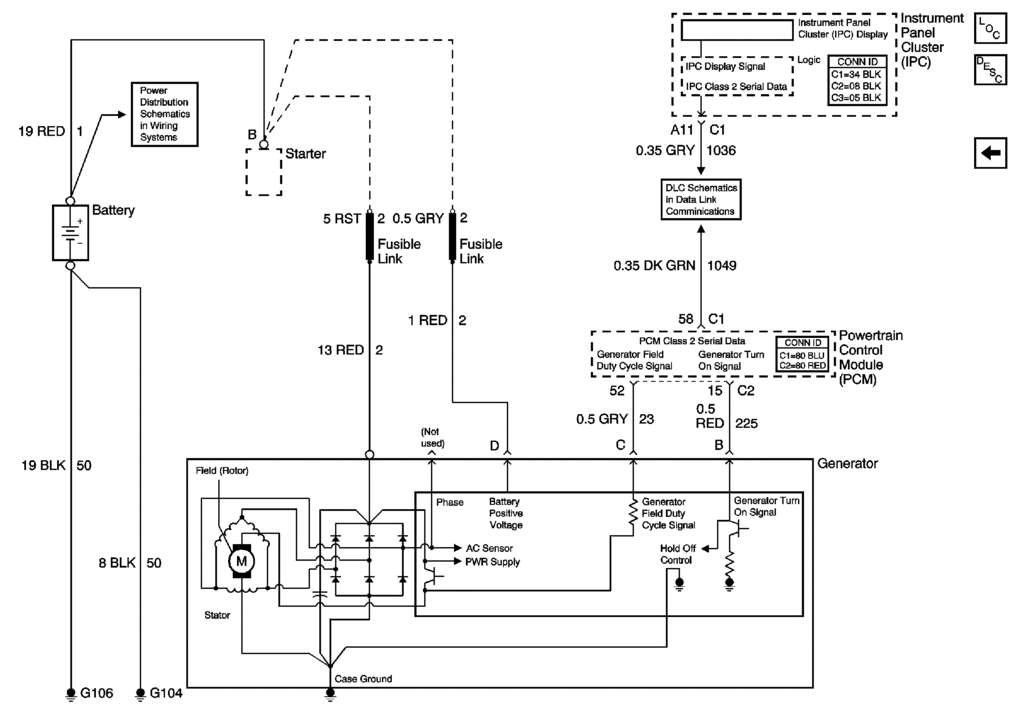
Heres the generator schematic you need:
BC
The poorer the connection is, the more you will see charging system fault and voltage fluctuations.
Try this to prove that out:
Start the engine. Connect the leads of the voltmeter between the battery terminals and the alternator BATT terminal. Polarity will not matter with a digital volt meter.
The optimum reading should be ZERO volts. The higher the DC volt reading, the more degraded the connection between the alt and battery is.
Try that first and see what you find.
THEN
Connect a heavy gage wire from the POSITIVE battery cable to the BATT terminal on the back of the alternator under the black boot. (I have used a jumper cable in the past.)
IF,,,, the symptoms improve or go away, that could be all of the issue. Clean/ repair/or replace the solenoid connections depending on what you find wrong. If you want to see how bad the connection really is, use a DC Volt meter to see the VOLTAGE DROP across that connection.
Heres the generator schematic you need:
BC
Last edited by Bill Curlee; Jul 29, 2015 at 04:30 PM.
Tech Contributor
Joined: Dec 1999
Posts: 32,910
Likes: 2,402
From: Anthony TX
CI 6,7,8,9,11 Vet
St. Jude Donor '08
Also Pin "D" should read the same as battery voltage.  Remember! If you read across two points (connections) on a wire or across the two test points on a fuse,, the voltage reading should be ZERO. If you see voltage, there is RESISTANCE between the points where your reading.
Remember! If you read across two points (connections) on a wire or across the two test points on a fuse,, the voltage reading should be ZERO. If you see voltage, there is RESISTANCE between the points where your reading.
Corvette Stories
The Best of Corvette for Corvette Enthusiasts

Top 10 Most Expensive Corvettes Ever Sold on Bring A Trailer
Brett Foote
10 Things Every Corvette Owner Needs (2026 Edition)
Michael S. Palmer
8 Most "Only Corvette Owners Understand" Quirks and Problems
Pouria Savadkouei
10 Reasons the C6 Z06 is Still A Performance Benchmark After 20 Years
Joe Kucinski
How Much Horsepower Every Corvette Engine "LOST" in 1972
Joe Kucinski
Top 10 DOs and DON'Ts for Protecting Your Convertible Top!
Michael S. Palmer
Top 10 Most Explosive Corvettes Ever Made: Power-to-Weight Ratio Ranked!
Joe Kucinski
150 hp to 1,250 hp: Every Corvette Generation Compared by the Specs That Matter
Joe Kucinski
8 Coolest Corvette Pace Cars (and Replicas) of All Time
Verdad Gallardo
Thread Starter
Instructor
Joined: Mar 2010
Posts: 130
Likes: 2
From: Saint Louis MO
Bill:
Thank you so much for providing your insight into this. Just to make sure I am doing this right:
First test is connect one lead from voltmeter to the output wire on the alternator, and the other lead to which battery terminal? Negative, right?
Or, am I supposed to just connect postitive on both ends, and should get zero volts?
You are saying I should get a reading of ZERO volts when I do that?
Please clarify, as I am a bit of a novice on this.
-David
Thank you so much for providing your insight into this. Just to make sure I am doing this right:
First test is connect one lead from voltmeter to the output wire on the alternator, and the other lead to which battery terminal? Negative, right?
Or, am I supposed to just connect postitive on both ends, and should get zero volts?
You are saying I should get a reading of ZERO volts when I do that?
Please clarify, as I am a bit of a novice on this.
-David
Tech Contributor
Joined: Dec 1999
Posts: 32,910
Likes: 2,402
From: Anthony TX
CI 6,7,8,9,11 Vet
St. Jude Donor '08
One end of the meter lead on the BATTERY POSITIVE TERMINAL & the other meter lead on the ALTERNATOR BATT Terminal. A good reading is zero volts. The more voltage you read the worse the connection is somewhere between the alternator and the battery.
BC
BC
Thread Starter
Instructor
Joined: Mar 2010
Posts: 130
Likes: 2
From: Saint Louis MO
Bill:
Test complete - here is what I found:
With the car running, connecting the voltmeter between the positive battery terminal and the output wire on the alternator gave a reading of 0.60 V.
As you advised, I then connected a jumper cable between positive and alternator output, and tested that voltage - down to 0.09 V.
Here is some more data that may help. At startup, I set the DIC display to show battery voltage. Immediately upon startup, the readout was 11.2 V, immediately climbing to 11.3, 11.5, 11.6, 11.8, etc.
Immediately upon hitting 12 V, the message "service vehicle soon" displayed, flashed twice or whatever, and went back to the voltage display, which had at that point risen to 13.2, 13.4, eventually settling between 13.5 and 13.8 V, depending on the ignition cycle - I did this 4 or 5 times to see if the results were the same - they were. This process of rising voltage took 5 seconds or so.
So what's next? Inspect the starter connections? Where is that, and how do I access it? I have jackstands and a floorjack.
Hopefully this gives you some data to advise me further.
-David
Test complete - here is what I found:
With the car running, connecting the voltmeter between the positive battery terminal and the output wire on the alternator gave a reading of 0.60 V.
As you advised, I then connected a jumper cable between positive and alternator output, and tested that voltage - down to 0.09 V.
Here is some more data that may help. At startup, I set the DIC display to show battery voltage. Immediately upon startup, the readout was 11.2 V, immediately climbing to 11.3, 11.5, 11.6, 11.8, etc.
Immediately upon hitting 12 V, the message "service vehicle soon" displayed, flashed twice or whatever, and went back to the voltage display, which had at that point risen to 13.2, 13.4, eventually settling between 13.5 and 13.8 V, depending on the ignition cycle - I did this 4 or 5 times to see if the results were the same - they were. This process of rising voltage took 5 seconds or so.
So what's next? Inspect the starter connections? Where is that, and how do I access it? I have jackstands and a floorjack.
Hopefully this gives you some data to advise me further.
-David
Tech Contributor
Joined: Dec 1999
Posts: 32,910
Likes: 2,402
From: Anthony TX
CI 6,7,8,9,11 Vet
St. Jude Donor '08
Heres where most of here your problems lie:
The STARTER SOLENOID on the passenges side of the block:
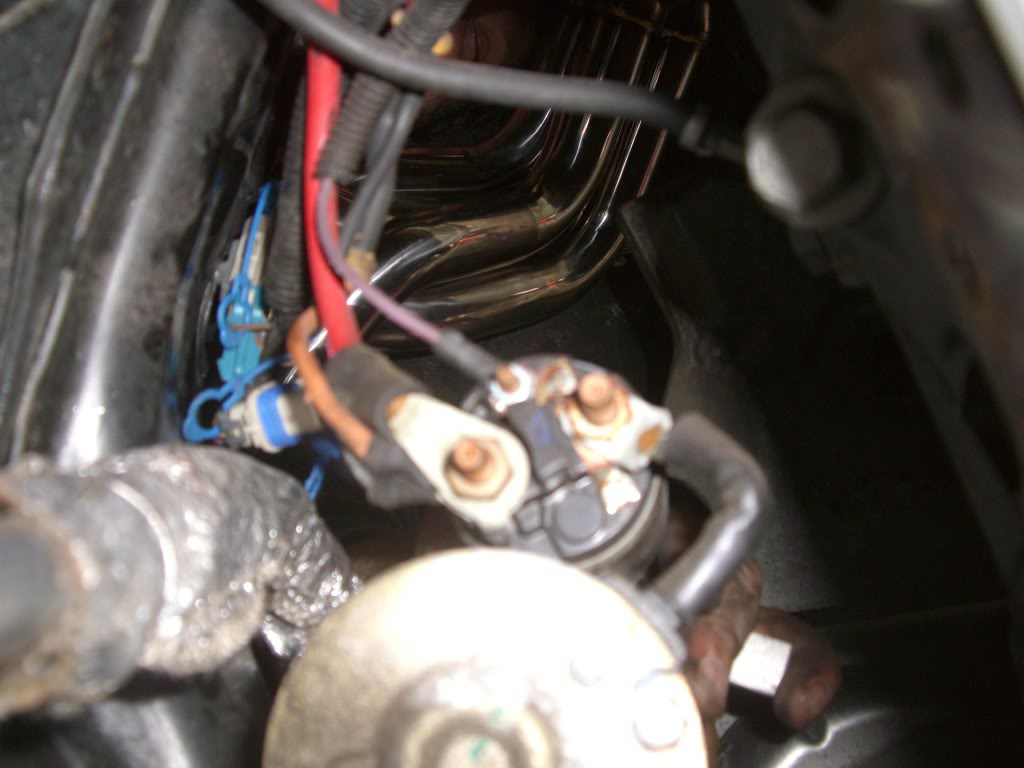
The connection on the LEFT is the ones that you need to clean but while your down there clean them ALL.
IF,,,,,,,,,,,,, you still have that voltage issue, your ignition switch could very well be contributing to that problem.
-C5 ignition Switch repair - http://forums.corvetteforum.com/c5-t...ch-repair.html
BC
The STARTER SOLENOID on the passenges side of the block:
The connection on the LEFT is the ones that you need to clean but while your down there clean them ALL.
IF,,,,,,,,,,,,, you still have that voltage issue, your ignition switch could very well be contributing to that problem.
-C5 ignition Switch repair - http://forums.corvetteforum.com/c5-t...ch-repair.html
BC
Thread Starter
Instructor
Joined: Mar 2010
Posts: 130
Likes: 2
From: Saint Louis MO
Ok, just got the car back from a local shop that replaced the starter motor and cleaned all of the wire connections.
Start it up, and guess what? I still get code P1637.
I haven't had a chance to re-check the voltage across the postive terminals of the alternator and battery, but at least the new starter did not solve the P1637 issue.
Any other ideas? Bill, you're my last hope!
-David
Start it up, and guess what? I still get code P1637.
I haven't had a chance to re-check the voltage across the postive terminals of the alternator and battery, but at least the new starter did not solve the P1637 issue.
Any other ideas? Bill, you're my last hope!
-David

Tech Contributor


Joined: Jan 2007
Posts: 19,470
Likes: 1,170
From: Dyer, IN
Ok, just got the car back from a local shop that replaced the starter motor and cleaned all of the wire connections.
Start it up, and guess what? I still get code P1637.
I haven't had a chance to re-check the voltage across the postive terminals of the alternator and battery, but at least the new starter did not solve the P1637 issue.
Any other ideas? Bill, you're my last hope!
-David
Start it up, and guess what? I still get code P1637.
I haven't had a chance to re-check the voltage across the postive terminals of the alternator and battery, but at least the new starter did not solve the P1637 issue.
Any other ideas? Bill, you're my last hope!
-David
Tech Contributor
Joined: Dec 1999
Posts: 32,910
Likes: 2,402
From: Anthony TX
CI 6,7,8,9,11 Vet
St. Jude Donor '08
Look on the schematic posted above and at pin "D" on the alternator plastic connector. That is the SENSE wire at tells the alternator what the system voltage is. Make sure that the fusable link at the starter where the wire attaches to the solenoid, the connection at the starter solenoid and at the plug on the alternator are 100 % good condition and make good connections.
BC
BC
Thread Starter
Instructor
Joined: Mar 2010
Posts: 130
Likes: 2
From: Saint Louis MO
The shop actually did exactly what I requested - clean the connections and replace the starter with a new one I provided to them.
While I did get the code upon first taking the car back, I did not get it on the next two ignitions this afternoon, going to and from lunch.
Also, yes, all of the connections are good, and pin D on the alternator connector shows 12 V.
I'll drive a bit more tonight and we'll see if the code comes back.
While I did get the code upon first taking the car back, I did not get it on the next two ignitions this afternoon, going to and from lunch.
Also, yes, all of the connections are good, and pin D on the alternator connector shows 12 V.
I'll drive a bit more tonight and we'll see if the code comes back.
Thread Starter
Instructor
Joined: Mar 2010
Posts: 130
Likes: 2
From: Saint Louis MO
Bill:
Our friend 1637 is back, but I believe I have more data for you. Using my autoenginuity tool, I have been able to get more data, including the L-terminal readout thanks to the folks at autoenginuity adding it for me (wasn't supported for my car normally in their software).
Let's walk through the diagnostic flow chart from the service manual:
Start at step 4, as 1637 fails almost every ignition.
Step 4: Yes, the test lamp illuminates for both the power wire at the alternator to ground as well as the sense circuit to ground. Go to Step 5.
Step 5: L-terminal inactive? Let's say yes, as it is inactive when the code sets, but sometimes it doesn't fail every ignition. Go to Step 6.
Step 6: Monitor F-terminal output with key on, engine off. Value should be less than 40%.
Here's where it gets interesting: Generally, the reading is 18%. However, every 5 seconds or so, it goes crazy and starts bouncing all over the place, ranging from as low as 7% to as high as 60%. Then, after bouncing all around, it goes back to 18, stays for a few seconds, then goes crazy again.
Because of this, let's say no, the value is not below 40% - it will momentarily go as high as 60%, but basically is all over the place. Go to step 13.
Step 13: If I disconnect the 4-way connector, does F-terminal read 0%? Yes. Go to step 21.
Step 21 is replace the generator. This is the same recommendation that the dealership gave me when I originally took it in for them to run the diagnostic.
Here's where I am again confused: The alternator is a brand new remanufactured unit from Advance Auto Parts. It tests good on their bench test.
I've checked the continuity on the F-terminal and L-terminal wires back to the PCM, and they are rock solid - 1 ohm or less resistance.
Here's a bit more: When the 1637 code does trip, and I monitor the L-terminal with my scan tool, it will generally read inactive, but then seems to intermittently flick back and forth to active, but generally remains inactive. When the code clears itself while driving, I am able to verify with my scan tool that the L-terminal is again active.
These results seem to point to a bad alternator - so if we accept that, then how to I guarantee I am getting a good one, since the rebuilt one tests as fine? The dealer wanted $800 to install an alternator - I got my rebuilt one for less than $150.
-David
Our friend 1637 is back, but I believe I have more data for you. Using my autoenginuity tool, I have been able to get more data, including the L-terminal readout thanks to the folks at autoenginuity adding it for me (wasn't supported for my car normally in their software).
Let's walk through the diagnostic flow chart from the service manual:
Start at step 4, as 1637 fails almost every ignition.
Step 4: Yes, the test lamp illuminates for both the power wire at the alternator to ground as well as the sense circuit to ground. Go to Step 5.
Step 5: L-terminal inactive? Let's say yes, as it is inactive when the code sets, but sometimes it doesn't fail every ignition. Go to Step 6.
Step 6: Monitor F-terminal output with key on, engine off. Value should be less than 40%.
Here's where it gets interesting: Generally, the reading is 18%. However, every 5 seconds or so, it goes crazy and starts bouncing all over the place, ranging from as low as 7% to as high as 60%. Then, after bouncing all around, it goes back to 18, stays for a few seconds, then goes crazy again.
Because of this, let's say no, the value is not below 40% - it will momentarily go as high as 60%, but basically is all over the place. Go to step 13.
Step 13: If I disconnect the 4-way connector, does F-terminal read 0%? Yes. Go to step 21.
Step 21 is replace the generator. This is the same recommendation that the dealership gave me when I originally took it in for them to run the diagnostic.
Here's where I am again confused: The alternator is a brand new remanufactured unit from Advance Auto Parts. It tests good on their bench test.
I've checked the continuity on the F-terminal and L-terminal wires back to the PCM, and they are rock solid - 1 ohm or less resistance.
Here's a bit more: When the 1637 code does trip, and I monitor the L-terminal with my scan tool, it will generally read inactive, but then seems to intermittently flick back and forth to active, but generally remains inactive. When the code clears itself while driving, I am able to verify with my scan tool that the L-terminal is again active.
These results seem to point to a bad alternator - so if we accept that, then how to I guarantee I am getting a good one, since the rebuilt one tests as fine? The dealer wanted $800 to install an alternator - I got my rebuilt one for less than $150.
-David
Tech Contributor
Joined: Dec 1999
Posts: 32,910
Likes: 2,402
From: Anthony TX
CI 6,7,8,9,11 Vet
St. Jude Donor '08
WOW Dave! Thats some outstanding info. Well Done! If you have a warranty with autozone, get another alternator. I bet their bench test doesnt test for whats wrong with your alternator.
Why would you take the car to the dealer to have the alternator changed????? Its a three bolt one plug swap. Can you change it your self??
Im going to take a look in the schematic and see if I can see any other things to look at that may help.
Bill
Why would you take the car to the dealer to have the alternator changed????? Its a three bolt one plug swap. Can you change it your self??
Im going to take a look in the schematic and see if I can see any other things to look at that may help.
Bill
Thread Starter
Instructor
Joined: Mar 2010
Posts: 130
Likes: 2
From: Saint Louis MO
Bill:
Thanks again for looking at this. I have every intention of doing the work myself - I changed the alternator with the rebuilt unit a month ago thinking that would solve the problem - it just got worse. I was just pointing out the absurdity of the dealer pricing.
Originally, this code was a very intermittent thing, only every 20 or so ignitions, if that.
I changed the alternator with the rebuilt unit from advance auto parts thinking that might be it - the problem simply got worse, and now I get the code almost every ignition.
I'm thinking that my original alternator was just beginning to fail, but this rebuilt one has a flaw that is even worse - maybe some sort of circuitry that sends these L and F terminal signals.
What do you make of the F-terminal signal bouncing all over the place?? Does that sound like normal behavior, or should that readout be more stable?
-David
Thanks again for looking at this. I have every intention of doing the work myself - I changed the alternator with the rebuilt unit a month ago thinking that would solve the problem - it just got worse. I was just pointing out the absurdity of the dealer pricing.
Originally, this code was a very intermittent thing, only every 20 or so ignitions, if that.
I changed the alternator with the rebuilt unit from advance auto parts thinking that might be it - the problem simply got worse, and now I get the code almost every ignition.
I'm thinking that my original alternator was just beginning to fail, but this rebuilt one has a flaw that is even worse - maybe some sort of circuitry that sends these L and F terminal signals.
What do you make of the F-terminal signal bouncing all over the place?? Does that sound like normal behavior, or should that readout be more stable?
-David
Tech Contributor
Joined: Dec 1999
Posts: 32,910
Likes: 2,402
From: Anthony TX
CI 6,7,8,9,11 Vet
St. Jude Donor '08
Dave
There are TWO types of alternators that LOOK the same but are different.
The one we need is a FRENCH made unit (VALEO) and works properly with the PCM L terminal. The other I think is made in Mexico and doesnt.
PM forum member "Evil Twin" (ET) and discuss the issue with him. We need to make SURE that you have the CORRECT C5 alternator that is PCM L terminal compliant and its working as designed before we get completly out of the box..
Evil Twin is the FORUM ALTERNATOR EXPERT. I will continue to try to come up with an answer to your question above.
Bill
There are TWO types of alternators that LOOK the same but are different.
The one we need is a FRENCH made unit (VALEO) and works properly with the PCM L terminal. The other I think is made in Mexico and doesnt.
PM forum member "Evil Twin" (ET) and discuss the issue with him. We need to make SURE that you have the CORRECT C5 alternator that is PCM L terminal compliant and its working as designed before we get completly out of the box..
Evil Twin is the FORUM ALTERNATOR EXPERT. I will continue to try to come up with an answer to your question above.
Bill