







Heavy trans fluid leak..please help.

Thread Starter
Advanced

Joined: Sep 2010
Posts: 66
Likes: 0
 Heavy trans fluid leak..please help.
Just bought my 1st vette. 1997 155K miles. Has alot of tranny fluid leaking out onto my garage floor after driving. Im not a mechanic of any sorts....i mean i do my own oil changes...change my own brake pads and rotors and what not...but when it comes to more indepth auto repair i know im not a mechanic. Can anyone give me some pointers about this problem? Or does anyone know of a GOOD corvette repair shop in the Indianapolis Indiana area? I dont want just any run of the mill chevy dealer looking at it. Thanks to anyone that replys to this.

Instructor
Joined: May 2009
Posts: 129
Likes: 0
From: A.R.
I don't have access to my car at the moment but it seems like the tranny lines run right by the oil pan and that their are connectors there and then they go up and over the torque tube.At least thats how my a4 is not sure about a manual.Is it towards the front of the car? or the back?towards the front,probably the lines towards the back,the tranny itself or the pan.
Thread Starter
Advanced
Joined: Sep 2010
Posts: 66
Likes: 0
It is an automatic. The fluid seems to be dripping from the front of the trans/back of the motor. I was suprised when i found out i couldnt check the trans fluid myslef via a dip stick. Seems i have lots to learn about owning a vette. Not that checking it would fix anything but shoot it would be nice to know how much or how little i have in it now.
Thread Starter
Advanced
Joined: Sep 2010
Posts: 66
Likes: 0
Figiured out the problem. Wasnt Trans fluid after all. I wasnt aware that the coolent had a reddish cast to it. Just had to tighten a clamp down on a rubber hose just under the coolent fill tank. MAJOR relief to know it wasnt a leaking transmission or worse..and btw it feels pretty darn good to ride around in a shiney red vette even if it is 97 with 155K on it. Couldnt tell by looking at or by driving it. C-5 is ok with me.

Safety Car


Joined: Jan 2001
Posts: 4,387
Likes: 691
From: Boise ID
FYI, the tranny is not next to the motor, it's next to the rear end.
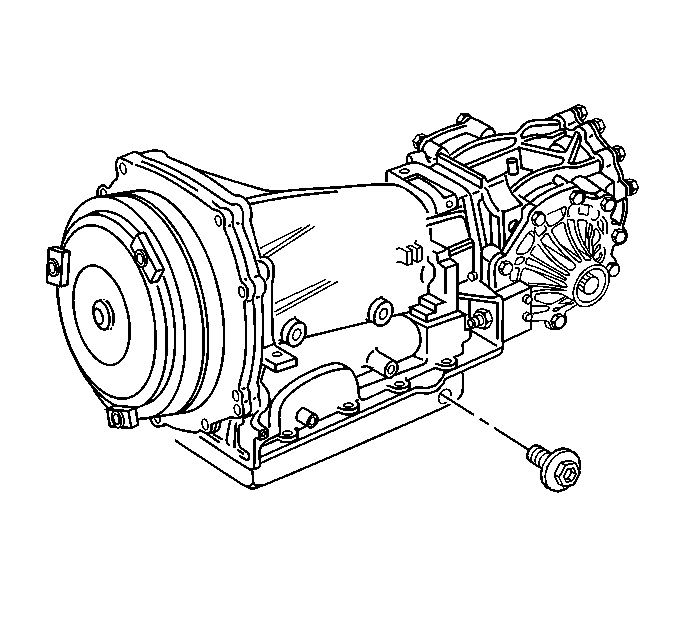
Below is the auto transmission fluid level check procedure.
Caution
When the transmission is at operating temperatures, take necessary precautions when removing the check/fill plug, to avoid being burned by draining fluid.
Raise and suitably support the vehicle. Refer to Lifting and Jacking the Vehicle in General Information.
Start and run the engine at idle.
Apply the brakes.
Shift the transmission into each gear for at least 2 seconds per gear.
Shift the transmission into NEUTRAL and continue to idle the engine for 3 minutes to stabilize the transmission fluid level.
After allowing the fluid level stabilization time and while still in NEUTRAL (engine still running at idle), check the transmission fluid temperature on the driver information center. Specification
Transmission fluid level temperature: 30 to 50°C (86 to 122°F)
If the fluid temperature is above specification, turn off the engine and allow the transmission to cool, then repeat the procedure to this point before proceeding.
With the engine still running at idle, loosen the check/fill plug on the LH side of the transmission oil pan.
Inspect the fluid level:
Any excess fluid will drain when the check/fill plug is loosened.
If no fluid drains, remove the check/fill plug and fill the transmission with DEXRON®-III transmission fluid until the fluid begins to overflow.
Install the check/fill plug. Tighten
Tighten the fill plug to 30 N·m (22 lb ft).
Notice
Use the correct fastener in the correct location. Replacement fasteners must be the correct part number for that application. Fasteners requiring replacement or fasteners requiring the use of thread locking compound or sealant are identified in the service procedure. Do not use paints, lubricants, or corrosion inhibitors on fasteners or fastener joint surfaces unless specified. These coatings affect fastener torque and joint clamping force and may damage the fastener. Use the correct tightening sequence and specifications when installing fasteners in order to avoid damage to parts and systems.
Shift the transmission into PARK.
Release the brakes.
Turn off the engine.
Lower the vehicle.
Below is the auto transmission fluid level check procedure.
Caution
When the transmission is at operating temperatures, take necessary precautions when removing the check/fill plug, to avoid being burned by draining fluid.
Raise and suitably support the vehicle. Refer to Lifting and Jacking the Vehicle in General Information.
Start and run the engine at idle.
Apply the brakes.
Shift the transmission into each gear for at least 2 seconds per gear.
Shift the transmission into NEUTRAL and continue to idle the engine for 3 minutes to stabilize the transmission fluid level.
After allowing the fluid level stabilization time and while still in NEUTRAL (engine still running at idle), check the transmission fluid temperature on the driver information center. Specification
Transmission fluid level temperature: 30 to 50°C (86 to 122°F)
If the fluid temperature is above specification, turn off the engine and allow the transmission to cool, then repeat the procedure to this point before proceeding.
With the engine still running at idle, loosen the check/fill plug on the LH side of the transmission oil pan.
Inspect the fluid level:
Any excess fluid will drain when the check/fill plug is loosened.
If no fluid drains, remove the check/fill plug and fill the transmission with DEXRON®-III transmission fluid until the fluid begins to overflow.
Install the check/fill plug. Tighten
Tighten the fill plug to 30 N·m (22 lb ft).
Notice
Use the correct fastener in the correct location. Replacement fasteners must be the correct part number for that application. Fasteners requiring replacement or fasteners requiring the use of thread locking compound or sealant are identified in the service procedure. Do not use paints, lubricants, or corrosion inhibitors on fasteners or fastener joint surfaces unless specified. These coatings affect fastener torque and joint clamping force and may damage the fastener. Use the correct tightening sequence and specifications when installing fasteners in order to avoid damage to parts and systems.
Shift the transmission into PARK.
Release the brakes.
Turn off the engine.
Lower the vehicle.
Thread Starter
Advanced
Joined: Sep 2010
Posts: 66
Likes: 0
Thanks for the tips...and ok i feel like a knuckle head for not even knowing where my transmission is at...I may not be a mechanic but i know more about cars than this thread would let on...just never been around a vette before, i guess half the fun for me will be learing about it. Other than the pesky coolent hose leak this car/engine is dry as a bone and clean as can be...chevy must have really sealed this thing up good..and this is with 155k on it.
Now who wants to tell me why my oil pressure is sky high? ive heard alot about this being a common problem and is proably the sending unit...Any truth to that??
Thanks again for any and all replies.
Now who wants to tell me why my oil pressure is sky high? ive heard alot about this being a common problem and is proably the sending unit...Any truth to that??
Thanks again for any and all replies.
Corvette Stories
The Best of Corvette for Corvette Enthusiasts

Top 10 Most Expensive Corvettes Ever Sold on Bring A Trailer
Brett Foote
10 Things Every Corvette Owner Needs (2026 Edition)
Michael S. Palmer
8 Most "Only Corvette Owners Understand" Quirks and Problems
Pouria Savadkouei
10 Reasons the C6 Z06 is Still A Performance Benchmark After 20 Years
Joe Kucinski
How Much Horsepower Every Corvette Engine "LOST" in 1972
Joe Kucinski
Top 10 DOs and DON'Ts for Protecting Your Convertible Top!
Michael S. Palmer
Top 10 Most Explosive Corvettes Ever Made: Power-to-Weight Ratio Ranked!
Joe Kucinski
150 hp to 1,250 hp: Every Corvette Generation Compared by the Specs That Matter
Joe Kucinski
8 Coolest Corvette Pace Cars (and Replicas) of All Time
Verdad Gallardo If the pressure is reading 80psi, that would most likely be a sending unit issue.
Thread Starter
Advanced
Joined: Sep 2010
Posts: 66
Likes: 0
Yeah my oil pressure guage is pegged at 80psi and the dash board display reads 129psi.
Is it extremely bad for the engine to drive the car this way?...or can i still cruise it around town untill i get her fixed up?
Also ive only heard that it could be the sending unit causing this problem...i still dont know anything about where its located or how to chage/fix it. Any info would be very much appreciated.
Is it extremely bad for the engine to drive the car this way?...or can i still cruise it around town untill i get her fixed up?
Also ive only heard that it could be the sending unit causing this problem...i still dont know anything about where its located or how to chage/fix it. Any info would be very much appreciated.

Pro

Joined: Nov 2009
Posts: 606
Likes: 18
From: burke va
My sons' oil pressure gauge has been pegged out for over a year and he drives it every day. As long as it is not leaking I would think you are OK. It is located on top of the motor behind the intake manifold by the firewall. (you can't really see it well without removing the intake) There are many threads and write-ups on this as it is one of the most common problems.

Racer


Joined: Jul 2010
Posts: 328
Likes: 0
From: Noblesville Indiana
Definately a sending unit problem. Have to pull the intake forward to get to it. There are some awesome posts on here on how to do it. If you need an extra set of hands let me know I'm from Noblesville.
Congrats on the new Vette!

Congrats on the new Vette!
Thread Starter
Advanced
Joined: Sep 2010
Posts: 66
Likes: 0
01'indyvette thanks for the info and the offer.
Have you changed one b4?
I've heard that you had to pull the intake to get to it.
Wouldn't mind doing this myself but with my Trans Am i learned that anything i had to do once i could usually do twice as fast the 2nd time.

Have you changed one b4?
I've heard that you had to pull the intake to get to it.
Wouldn't mind doing this myself but with my Trans Am i learned that anything i had to do once i could usually do twice as fast the 2nd time.