



Help...Hard to find rough idle problem.!

Thread Starter
8th Gear

Joined: Jun 2011
Posts: 8
Likes: 0
 Help...Hard to find rough idle problem.!
I recently purchased a 1998 C5 coupe. It has 120,000 miles, long tube headers, with new Billy-Boat-Bullet exhaust all the way back.
No stock exhaust at all… but this problem was there before the exhaust went in. It has a custom tune, and been on the dyno.
My car has a “miss” at idle. The car seems to run fine past idle, or I just can’t feel the miss. I don’t know if it’s fuel or electrical related.
When this car was sold to me, the old owner said the rough idle is from needing plugs or wires.... my bad... I believed him.!
I changed all the plugs, and all the wires, still no difference. I didn’t want to spend the $$$$ for me to guess on a coil, or bad fuel injector. So I took it to a speed shop, known for doing quality performance work.
The ODB-2 scanner said # 5 cylinder has a problem.
They tried the plugs and wires again, no change.!
They replaced the coil, and fuel injector for Cyc # 5, no change.!
They did a compression and leak down test, they both came back good.!
They thought the valve spring might be weak, or bent valve.
They took off the valve cover… springs are good, no bent valves.!
Now they think it might be a bad lobe on the cam…????
That is when I stopped bleeding $$$$$$. And had them stop guessing.
Can you make a suggestion on what you might think the problem is, or what I should do next.
Could this be as simple as a crank / cam positioning sensor?
I live in Northern Illinois, and welcome suggestions on a new shop.
Thanks in advance for all the info….I really need to find this rough idle problem.
Matt
No stock exhaust at all… but this problem was there before the exhaust went in. It has a custom tune, and been on the dyno.
My car has a “miss” at idle. The car seems to run fine past idle, or I just can’t feel the miss. I don’t know if it’s fuel or electrical related.
When this car was sold to me, the old owner said the rough idle is from needing plugs or wires.... my bad... I believed him.!
I changed all the plugs, and all the wires, still no difference. I didn’t want to spend the $$$$ for me to guess on a coil, or bad fuel injector. So I took it to a speed shop, known for doing quality performance work.
The ODB-2 scanner said # 5 cylinder has a problem.
They tried the plugs and wires again, no change.!
They replaced the coil, and fuel injector for Cyc # 5, no change.!
They did a compression and leak down test, they both came back good.!
They thought the valve spring might be weak, or bent valve.
They took off the valve cover… springs are good, no bent valves.!
Now they think it might be a bad lobe on the cam…????
That is when I stopped bleeding $$$$$$. And had them stop guessing.
Can you make a suggestion on what you might think the problem is, or what I should do next.
Could this be as simple as a crank / cam positioning sensor?
I live in Northern Illinois, and welcome suggestions on a new shop.
Thanks in advance for all the info….I really need to find this rough idle problem.
Matt

Tech Contributor
Joined: Aug 2008
Posts: 2,902
Likes: 21
From: Oak Hill Virginia
I recently purchased a 1998 C5 coupe. It has 120,000 miles, long tube headers, with new Billy-Boat-Bullet exhaust all the way back.
No stock exhaust at all… but this problem was there before the exhaust went in. It has a custom tune, and been on the dyno.
My car has a “miss” at idle. The car seems to run fine past idle, or I just can’t feel the miss. I don’t know if it’s fuel or electrical related.
When this car was sold to me, the old owner said the rough idle is from needing plugs or wires.... my bad... I believed him.!
I changed all the plugs, and all the wires, still no difference. I didn’t want to spend the $$$$ for me to guess on a coil, or bad fuel injector. So I took it to a speed shop, known for doing quality performance work.
The ODB-2 scanner said # 5 cylinder has a problem.
They tried the plugs and wires again, no change.!
They replaced the coil, and fuel injector for Cyc # 5, no change.!
They did a compression and leak down test, they both came back good.!
They thought the valve spring might be weak, or bent valve.
They took off the valve cover… springs are good, no bent valves.!
Now they think it might be a bad lobe on the cam…????
That is when I stopped bleeding $$$$$$. And had them stop guessing.
Can you make a suggestion on what you might think the problem is, or what I should do next.
Could this be as simple as a crank / cam positioning sensor?
I live in Northern Illinois, and welcome suggestions on a new shop.
Thanks in advance for all the info….I really need to find this rough idle problem.
Matt
No stock exhaust at all… but this problem was there before the exhaust went in. It has a custom tune, and been on the dyno.
My car has a “miss” at idle. The car seems to run fine past idle, or I just can’t feel the miss. I don’t know if it’s fuel or electrical related.
When this car was sold to me, the old owner said the rough idle is from needing plugs or wires.... my bad... I believed him.!
I changed all the plugs, and all the wires, still no difference. I didn’t want to spend the $$$$ for me to guess on a coil, or bad fuel injector. So I took it to a speed shop, known for doing quality performance work.
The ODB-2 scanner said # 5 cylinder has a problem.
They tried the plugs and wires again, no change.!
They replaced the coil, and fuel injector for Cyc # 5, no change.!
They did a compression and leak down test, they both came back good.!
They thought the valve spring might be weak, or bent valve.
They took off the valve cover… springs are good, no bent valves.!
Now they think it might be a bad lobe on the cam…????
That is when I stopped bleeding $$$$$$. And had them stop guessing.
Can you make a suggestion on what you might think the problem is, or what I should do next.
Could this be as simple as a crank / cam positioning sensor?
I live in Northern Illinois, and welcome suggestions on a new shop.
Thanks in advance for all the info….I really need to find this rough idle problem.
Matt
So I'm assuming the code returned by the scanner was P0305 for a missfire on cylinder five. Is this a recurring code or a history code (if you clear it does it come back)? If it doesn't it may be left over from before you plug/wire change.
What other DTC codes are present? You can check them from the DIC, you do not need an OBDII scanner (note the built in scanner will not return individual cylinder missfire codes, you will see P0300). When you post the codes be sure to include the H or C suffix.
Thread Starter
8th Gear
Joined: Jun 2011
Posts: 8
Likes: 0
I bought this from a private party in Florida.... ya... drove all the way down to Orlando get this C5.
Just to clarify: The "Service Engine" light is not on.
I don't know of any current codes.
I will search on how to use the DIC to read codes, if there are any present, I will post.
Thanks
Just to clarify: The "Service Engine" light is not on.
I don't know of any current codes.
I will search on how to use the DIC to read codes, if there are any present, I will post.
Thanks

Tech Contributor


Joined: Dec 1999
Posts: 32,910
Likes: 2,402
From: Anthony TX
CI 6,7,8,9,11 Vet
St. Jude Donor '08
Remove the valve cover, attach a dial indicator the the head, measure the rocker lift above the valve for that cyl and a known good cylinder while you turn the engine over by hand.
That will prove or disprove the lobe theory. Is the PUSH ROD/s for that cylinder straight and undamaged?
BC
That will prove or disprove the lobe theory.
Is the PUSH ROD/s for that cylinder straight and undamaged?BC
Tech Contributor
Joined: Aug 2008
Posts: 2,902
Likes: 21
From: Oak Hill Virginia
I bought this from a private party in Florida.... ya... drove all the way down to Orlando get this C5.
Just to clarify: The "Service Engine" light is not on.
I don't know of any current codes.
I will search on how to use the DIC to read codes, if there are any present, I will post.
Thanks
Just to clarify: The "Service Engine" light is not on.
I don't know of any current codes.
I will search on how to use the DIC to read codes, if there are any present, I will post.
Thanks
Here's the procedure for checking them courtesy of Mr. Bill Curlee:
POST DTCS!!!
READING YOUR Engine Diagnostic Trouble Codes (DTC)
This procedure should be carried out any time you experience a problem with your C5. Most inexpensive store bought aftermarket code readers will ONLY read power train DTC’s. Reading the DTC’s with the C5 built in code reader will allow you to read ALL the modules in the vehicle.
The Diagnostic Display Mode is entered with the following procedure:
1) Turn on the ignition but don't start the engine.
2) Press the RESET button to turn off any warning messages. (i.e. door open, trunk open ect)
3) Press and hold the OPTIONS button
4) While holding OPTIONS, press FUEL button four times within a 10 -second period.
Initially, the on-board diagnostics go into an Automatic Mode which will cycle through each module and shows diagnostic codes in a pre-set sequence: PCM - TCS - RTD - BCM - IPC - RADIO - HVAC - LDCM - RDCM - SCM - RFA. All codes will be displayed for each module. ( i.e. PCM = 4 codes) If none are present in a given module, you will see No More Codes on the display.
There are two types of diagnostic codes, Current and History designated with a letter suffix, “C” or “H”. A current code indicates a malfunction is present in the module displaying data. A history code indicates a problem existed sometime in the last 40 or 50 ignition cycles. When not accompanied by a current code of the same number, it's potential evidence of a previous problem, now resolved, that was not removed by clearing the codes. More likely it's an indication of an intermittent malfunction.
Intermittent codes are the most challenging of the diagnostics. An intermittent code may have happened once, may have happened more than once but is inconsistent or may be happening on a regular basis but not at the time the codes are displayed. History codes can also be caused by a current malfunction in a system that is not operating at the time codes are displayed. An example is the rear window defogger which doesn't operate until the Body Control Module detects engine rpm. For history codes set by a module that does not operate with the key on and engine off, a special diagnostic tool called a Scan Tester is necessary to properly diagnose the malfunction.
Once the system has displayed all modules, it goes into the manual mode which allows selection of each module using combinations of Driver Information Center buttons. Manual mode can also be entered during the automatic sequence by pressing any button except E/M. Once the display shows Manual Diagnostics, select a module by pressing the OPTIONS button to go forward or the TRIP button to go back. Once a module is selected, a code is displayed, and if more than one are present; press GAGES to go forward or FUEL to go back.
To exit the diagnostic mode at any time, press E/M. If you want to erase codes in a given module, press RESET To reset the codes once in manual mode, press and hold RESET until it displays NO CODES Press OPTIONS to go to the next module. Repeat the steps until you have reset the codes in all the computer modules.
NOTE!! Only reset the codes IF you want to - it is NOT necessary to do this. Clearing a code does not repair a problem. You are simply erasing the evidence of it in the module's memory. If you clear the code/s, and extinguish the Check Engine Light, your emissions status ready will NOT allow you to pass an emissions test until you have completed the required driving cycles. There are a few body module DTC’s that if set will prevent the module from operating properly. Once the DTC is cleared, the module will return to full function. This is not true for power train DTCs.
If you have never read and cleared your codes, there will probably be a lot of old history DTCs. It is recommended that you clear your codes and see if any come back during a driving cycle. Those are the ones that you need to concentrate on diagnosing.
Once you have the codes, the next question is: What to do with the information?
First, consult the factory service manual. Any serious C5 Do-It-Yourself owner should invest in the Corvette Service Manual of the appropriate model year. The Service Manual is really a requirement if you want to understand and work on your C5.
NOTE and a WARNING. You can read the DTCs while the engine is running. I pull mine up all the time while driving.
WARNING. Don’t become distracted while reading DTCs while your driving and cause an accident!!!!! Use common sense and drive safe.
These are some very good C5 Diagnostic Trouble Code (DTC) explanation web sites!!! They also explain how to read the DTCs
Here are some very good sites that explain what DTC mean:
http://www.gearchatter.com/viewtopic11755.php
http://www.obd-codes.com/trouble_cod...d-ii-codes.php
Make sure to include the H or C suffix when you post your DTCs!!
READING YOUR Engine Diagnostic Trouble Codes (DTC)
This procedure should be carried out any time you experience a problem with your C5. Most inexpensive store bought aftermarket code readers will ONLY read power train DTC’s. Reading the DTC’s with the C5 built in code reader will allow you to read ALL the modules in the vehicle.
The Diagnostic Display Mode is entered with the following procedure:
1) Turn on the ignition but don't start the engine.
2) Press the RESET button to turn off any warning messages. (i.e. door open, trunk open ect)
3) Press and hold the OPTIONS button
4) While holding OPTIONS, press FUEL button four times within a 10 -second period.
Initially, the on-board diagnostics go into an Automatic Mode which will cycle through each module and shows diagnostic codes in a pre-set sequence: PCM - TCS - RTD - BCM - IPC - RADIO - HVAC - LDCM - RDCM - SCM - RFA. All codes will be displayed for each module. ( i.e. PCM = 4 codes) If none are present in a given module, you will see No More Codes on the display.
There are two types of diagnostic codes, Current and History designated with a letter suffix, “C” or “H”. A current code indicates a malfunction is present in the module displaying data. A history code indicates a problem existed sometime in the last 40 or 50 ignition cycles. When not accompanied by a current code of the same number, it's potential evidence of a previous problem, now resolved, that was not removed by clearing the codes. More likely it's an indication of an intermittent malfunction.
Intermittent codes are the most challenging of the diagnostics. An intermittent code may have happened once, may have happened more than once but is inconsistent or may be happening on a regular basis but not at the time the codes are displayed. History codes can also be caused by a current malfunction in a system that is not operating at the time codes are displayed. An example is the rear window defogger which doesn't operate until the Body Control Module detects engine rpm. For history codes set by a module that does not operate with the key on and engine off, a special diagnostic tool called a Scan Tester is necessary to properly diagnose the malfunction.
Once the system has displayed all modules, it goes into the manual mode which allows selection of each module using combinations of Driver Information Center buttons. Manual mode can also be entered during the automatic sequence by pressing any button except E/M. Once the display shows Manual Diagnostics, select a module by pressing the OPTIONS button to go forward or the TRIP button to go back. Once a module is selected, a code is displayed, and if more than one are present; press GAGES to go forward or FUEL to go back.
To exit the diagnostic mode at any time, press E/M. If you want to erase codes in a given module, press RESET To reset the codes once in manual mode, press and hold RESET until it displays NO CODES Press OPTIONS to go to the next module. Repeat the steps until you have reset the codes in all the computer modules.
NOTE!! Only reset the codes IF you want to - it is NOT necessary to do this. Clearing a code does not repair a problem. You are simply erasing the evidence of it in the module's memory. If you clear the code/s, and extinguish the Check Engine Light, your emissions status ready will NOT allow you to pass an emissions test until you have completed the required driving cycles. There are a few body module DTC’s that if set will prevent the module from operating properly. Once the DTC is cleared, the module will return to full function. This is not true for power train DTCs.
If you have never read and cleared your codes, there will probably be a lot of old history DTCs. It is recommended that you clear your codes and see if any come back during a driving cycle. Those are the ones that you need to concentrate on diagnosing.
Once you have the codes, the next question is: What to do with the information?
First, consult the factory service manual. Any serious C5 Do-It-Yourself owner should invest in the Corvette Service Manual of the appropriate model year. The Service Manual is really a requirement if you want to understand and work on your C5.
NOTE and a WARNING. You can read the DTCs while the engine is running. I pull mine up all the time while driving.
WARNING. Don’t become distracted while reading DTCs while your driving and cause an accident!!!!! Use common sense and drive safe.
These are some very good C5 Diagnostic Trouble Code (DTC) explanation web sites!!! They also explain how to read the DTCs
Here are some very good sites that explain what DTC mean:
http://www.gearchatter.com/viewtopic11755.php
http://www.obd-codes.com/trouble_cod...d-ii-codes.php
Make sure to include the H or C suffix when you post your DTCs!!

Tech Contributor


Joined: Jan 2007
Posts: 19,565
Likes: 1,207
From: Dyer, IN
The ODB-2 scanner said # 5 cylinder has a problem.
They tried the plugs and wires again, no change.!
They replaced the coil, and fuel injector for Cyc # 5, no change.!
They did a compression and leak down test, they both came back good.!
They thought the valve spring might be weak, or bent valve.
They took off the valve cover… springs are good, no bent valves.!
Now they think it might be a bad lobe on the cam…????
They tried the plugs and wires again, no change.!
They replaced the coil, and fuel injector for Cyc # 5, no change.!
They did a compression and leak down test, they both came back good.!
They thought the valve spring might be weak, or bent valve.
They took off the valve cover… springs are good, no bent valves.!
Now they think it might be a bad lobe on the cam…????
Thread Starter
8th Gear
Joined: Jun 2011
Posts: 8
Likes: 0
Well.... I can take the valve cover off, and attach a dial indicator. (I am a machinist by schooling, so I have several of them.)
measure the rocker lift above the valve for that cylinder, then compare.
Great thought..! But for the $$$ I paid, and what the mechanic told me, I hope they did this in order to make the statement that the springs were good, and no bent push-rods.
But I can check their work.
measure the rocker lift above the valve for that cylinder, then compare.
Great thought..!
But for the $$$ I paid, and what the mechanic told me, I hope they did this in order to make the statement that the springs were good, and no bent push-rods. But I can check their work.
Thread Starter
8th Gear
Joined: Jun 2011
Posts: 8
Likes: 0
Just a few more facts I thought of :
When the shop thought the problem might be valve related... I had them do a compression test and leak down test.
They said that both tests were good.
So I am hoping to steer away from an internal problem... valve, push-rods, springs, lifters..ect.
Could this be a crank / cam positioning sensor?
Something to do with Knock sensors?
The car does not smoke, or use oil, the exhaust tips are clean. The spark plug looked nice and marshmellow brown.
Thanks for your input.
Matt
When the shop thought the problem might be valve related... I had them do a compression test and leak down test.
They said that both tests were good.
So I am hoping to steer away from an internal problem... valve, push-rods, springs, lifters..ect.
Could this be a crank / cam positioning sensor?
Something to do with Knock sensors?
The car does not smoke, or use oil, the exhaust tips are clean. The spark plug looked nice and marshmellow brown.
Thanks for your input.
Matt
Corvette Stories
The Best of Corvette for Corvette Enthusiasts

5 Best & 5 Worst Corvette Daily Drivers
Joe Kucinski
The Headlights of Every Corvette Generation Explained
Joe Kucinski
5 Best & 5 Most Overrated Corvette Track Packages of All Time!
Joe Kucinski
Every 2027 Corvette Engine Explained
Joe Kucinski
Designer Imagines A Corvette That Looks More Like a Corvette Than the Corvette
Verdad Gallardo
10 Ugly Corvettes That We Still Kinda Love
Joe Kucinski
Top 10 Most Expensive Corvettes Ever Sold on Bring A Trailer
Brett Foote
10 Things Every Corvette Owner Needs (2026 Edition)
Michael S. Palmer
8 Most "Only Corvette Owners Understand" Quirks and Problems
Pouria Savadkouei
Le Mans Master

Joined: Nov 2005
Posts: 6,993
Likes: 25
Put a vaccum guage on it and see if the idle vacuum is steady or not.
http://www.secondchancegarage.com/public/186.cfm
http://www.secondchancegarage.com/public/186.cfm

Tech Contributor
Joined: Aug 2008
Posts: 2,902
Likes: 21
From: Oak Hill Virginia
Also, inspect all of your vacuum and PCV lines. If you you can switch between A/C modes and do not have air blowing out of all vents at all times then you don't have a leak in your hvac vacuum lines. Check the PCV line off the passenger side of the intake close to the throttle body. Check the brake booster line on the drivers side rear of the engine bay. Check the line at the booster, where it connects to the back of the intake and the line itself for breaks/rotting...
Tech Contributor
Joined: Dec 1999
Posts: 32,910
Likes: 2,402
From: Anthony TX
CI 6,7,8,9,11 Vet
St. Jude Donor '08
Well............ If it is truely isolated to ONE cylinder,,, there are thinga that you can check that can cause it to misfire that you bave not yet.
1, Start with spraying some brake parts cleaner around the area where the intake manifold meets the head. If the miss changes or goes away, you have a vacuum leak.
2, Get a meter and start measuring ALL the voltages and ground wires on the connector for that coil and injector. Heres the schematic. MAKE SURE that the voltages are proper and the ground are not compromised and the FEMALE pins in the connetor are not damaged or corroded.
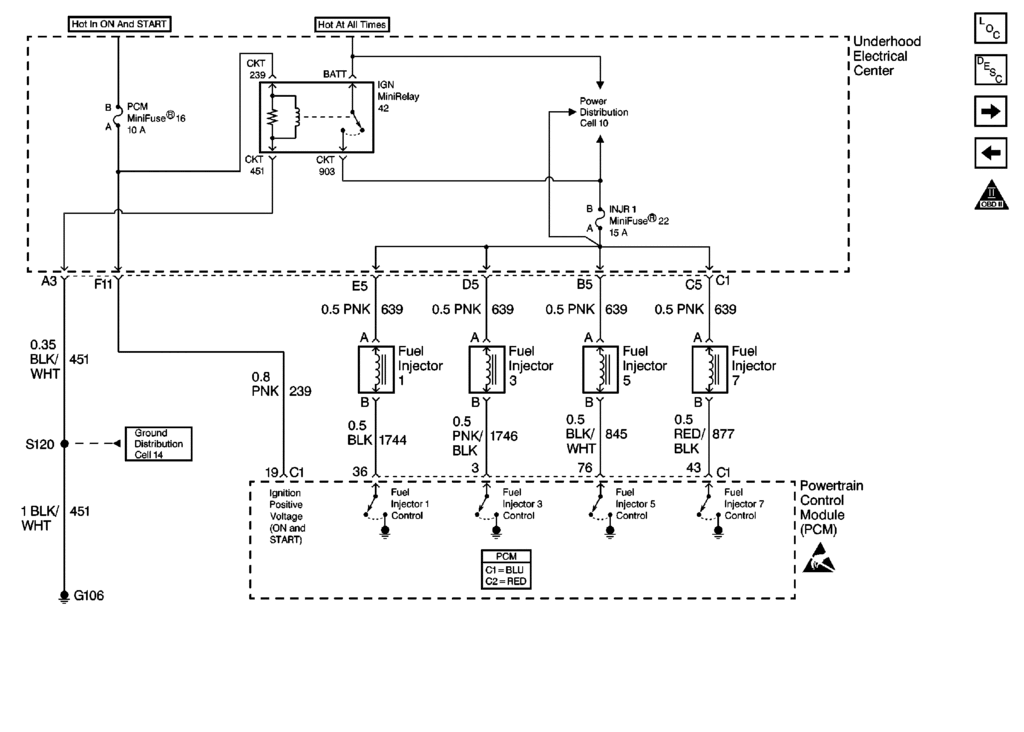
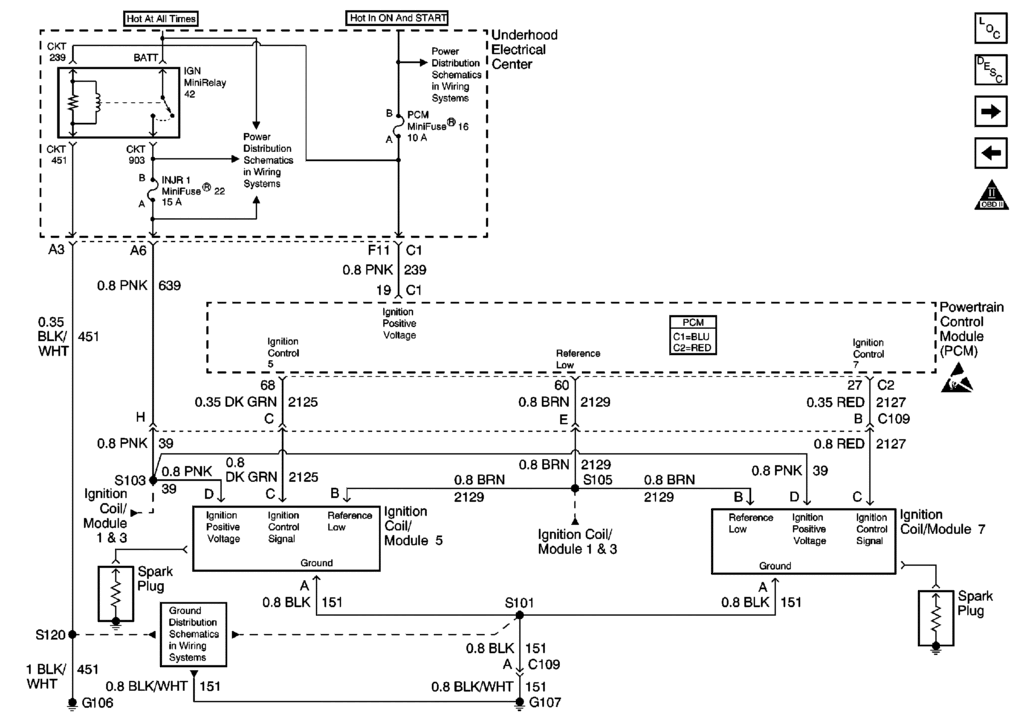
Make sure that the coil power is the same as battery voltage/
BC
1, Start with spraying some brake parts cleaner around the area where the intake manifold meets the head. If the miss changes or goes away, you have a vacuum leak.
2, Get a meter and start measuring ALL the voltages and ground wires on the connector for that coil and injector. Heres the schematic. MAKE SURE that the voltages are proper and the ground are not compromised and the FEMALE pins in the connetor are not damaged or corroded.
Make sure that the coil power is the same as battery voltage/
BC

Burning Brakes


Joined: Jul 2004
Posts: 1,172
Likes: 71
From: MA
The easiest thing to check first is the electronics. Here are a few simple things to help isolate problems.
1. Get yourself an induction timing light and put the probe sequentially around each plug wire. Start the car and look at the timing light. If it skips beats on any plug you have a problem with that circuit.
2. Once you have isolated the cylinder, get a digital voltmeter (Sears has some good inexpensive ones) and check the resistance of that plug wire. You can look on the web for the expected resistance. It should be given in ohms/foot.
3. Check the resistance of the coil packs using the voltmeter. When they go you can typically detect this by their resistance.
4. Remove your fuel rail covers and put your car in a very dark garage. Wait a few minutes for your eyes to adjust to the darkness. Start your car and let it idle. You may have a shorting coil pack or plug wires. You will be able to see this.
As a side note, a mechanic with a good engine diagnostic tool (not just software) should be able to diagnose your ignition system and tell you what is wrong.
Hope this helps.
As a PS, LS1 engines have a slight lope due to the firing order.
1. Get yourself an induction timing light and put the probe sequentially around each plug wire. Start the car and look at the timing light. If it skips beats on any plug you have a problem with that circuit.
2. Once you have isolated the cylinder, get a digital voltmeter (Sears has some good inexpensive ones) and check the resistance of that plug wire. You can look on the web for the expected resistance. It should be given in ohms/foot.
3. Check the resistance of the coil packs using the voltmeter. When they go you can typically detect this by their resistance.
4. Remove your fuel rail covers and put your car in a very dark garage. Wait a few minutes for your eyes to adjust to the darkness. Start your car and let it idle. You may have a shorting coil pack or plug wires. You will be able to see this.
As a side note, a mechanic with a good engine diagnostic tool (not just software) should be able to diagnose your ignition system and tell you what is wrong.
Hope this helps.
As a PS, LS1 engines have a slight lope due to the firing order.

Melting Slicks

Joined: Jun 2005
Posts: 3,088
Likes: 61
From: NY- 2013 Corvette Challenge Champion-2013 Index Combo Champion 2015 CC/MM Champion
St. Jude Donor '07
I had that happen to me.The white plug that plugs into the coil packs,One of the male pins wasn't making contact into the female pin.I bent the pin alittle and dielectric grease and solved the problem.I don't know if that is what you have,But you can try it..........Paul
Last edited by DRIVER456; Sep 26, 2011 at 06:31 PM.
Tech Contributor
Joined: Dec 1999
Posts: 32,910
Likes: 2,402
From: Anthony TX
CI 6,7,8,9,11 Vet
St. Jude Donor '08
I had that happen to me.The white plug that plugs into the coil packs,One of the male pins wasn't making contact into the female pin.I bent the pin alittle and dye electric grease and solved the problem.I don't know if that is what you have,But you can try it..........Paul
 Good advice!
BC
Melting Slicks
Joined: Jun 2005
Posts: 3,088
Likes: 61
From: NY- 2013 Corvette Challenge Champion-2013 Index Combo Champion 2015 CC/MM Champion
St. Jude Donor '07
Tech Contributor
Joined: Jan 2007
Posts: 19,565
Likes: 1,207
From: Dyer, IN