Headlight question
Thread Starter
Racer

Joined: Sep 2011
Posts: 379
Likes: 0
From: Central Valley California
 Headlight question
I never noticed this before but I recently switched out my headlights from the fixed style and now I am back to the pop-ups. My question is, after I finished installing them, when I turn the headlights on, they come up about half way, pause for a second, then continued until they are fully popped up. Is this normal? I seem to remember when I bought the car that when I turn the headlights on, they pop up without any hesititation. I'm not hearing any grinding or other noises. What gives?

Melting Slicks


Joined: Aug 2003
Posts: 2,786
Likes: 7
From: Iowa
not sure what the problem is, but its definitely not normal. they should come up smoothly.
does it stop at the exact same point each time?
do both lights do it or just one?
I'd check the arms that move the lights and make sure they are unobstructed. its possible you have a bad spot in the gears also, but unlikely it would be both of them.
the only thing that I can think of that's common to both would be the headlight door control module. they do go bad but that's an odd symptom.
does it stop at the exact same point each time?
do both lights do it or just one?
I'd check the arms that move the lights and make sure they are unobstructed. its possible you have a bad spot in the gears also, but unlikely it would be both of them.
the only thing that I can think of that's common to both would be the headlight door control module. they do go bad but that's an odd symptom.
Thread Starter
Racer
Joined: Sep 2011
Posts: 379
Likes: 0
From: Central Valley California
I just checked them 4 times. Every time they stop at the same spot, or what appears to be the same spot, and both headlights do it. I manually opened and closed each light and they operate smooth. Is there any special way to reinstalling the motors other than making sure the arms go into the motor slots accordingly?
Tech Contributor


Joined: Dec 2003
Posts: 19,384
Likes: 87
From: Horncastle Lincolnshire, England
2023 C5 of the Year Finalist - Unmodified
They should come up smoothly.
This is the extract from the book for reinstalling the motors:
Position the headlamp motor/actuator to the headlamp assembly.
Install the pivot arm to the motor.
Place the pivot arm in the position noted prior to removal.
Loosely install the nut retaining the headlamp assembly pivot arm to the motor/actuator.
Install the headlamp motor/actuator bolts.
Tighten the headlamp motor/actuator mounting bolts to 7 N·m (62 lb in).
Tighten the headlamp motor/actuator to pivot arm nut to 6 N·m (53 lb in).
If they are turning smoothly it doesn't sound like there's a problem with the gears, particularly as both headlights are hesitataing at the same point.
It strikes me that it has to be a problem with how the pivot arms have been reinstalled. I've not done the job myself so I'm guessing but is it possible to put them on in the wrong way? Reversed on the motor shaft maybe? The book makes a point about reinstalling them in the same position as they were removed. There must be a reason for that.
This is the extract from the book for reinstalling the motors:
Position the headlamp motor/actuator to the headlamp assembly.
Install the pivot arm to the motor.
Place the pivot arm in the position noted prior to removal.
Loosely install the nut retaining the headlamp assembly pivot arm to the motor/actuator.
Install the headlamp motor/actuator bolts.
Tighten the headlamp motor/actuator mounting bolts to 7 N·m (62 lb in).
Tighten the headlamp motor/actuator to pivot arm nut to 6 N·m (53 lb in).
If they are turning smoothly it doesn't sound like there's a problem with the gears, particularly as both headlights are hesitataing at the same point.
It strikes me that it has to be a problem with how the pivot arms have been reinstalled. I've not done the job myself so I'm guessing but is it possible to put them on in the wrong way? Reversed on the motor shaft maybe? The book makes a point about reinstalling them in the same position as they were removed. There must be a reason for that.
Last edited by DeeGee; May 10, 2012 at 01:58 AM.
Race Director


Joined: Apr 2007
Posts: 11,152
Likes: 890
From: South Western Ontario
The arm can be installed either way on the motor. Turning the arm 180 degrees on the motor shaft is an easy way to test or get the motor working again if the gear is just starting to fail. It might not work so good on a badly stripped gear though.
I would suspect the wiring or the headlight switch. Do any of the lights flicker when this pause occurs?
I would suspect the wiring or the headlight switch. Do any of the lights flicker when this pause occurs?
Tech Contributor
Joined: Dec 2003
Posts: 19,384
Likes: 87
From: Horncastle Lincolnshire, England
2023 C5 of the Year Finalist - Unmodified
The arm can be installed either way on the motor. Turning the arm 180 degrees on the motor shaft is an easy way to test or get the motor working again if the gear is just starting to fail. It might not work so good on a badly stripped gear though.
I would suspect the wiring or the headlight switch. Do any of the lights flicker when this pause occurs?
I would suspect the wiring or the headlight switch. Do any of the lights flicker when this pause occurs?
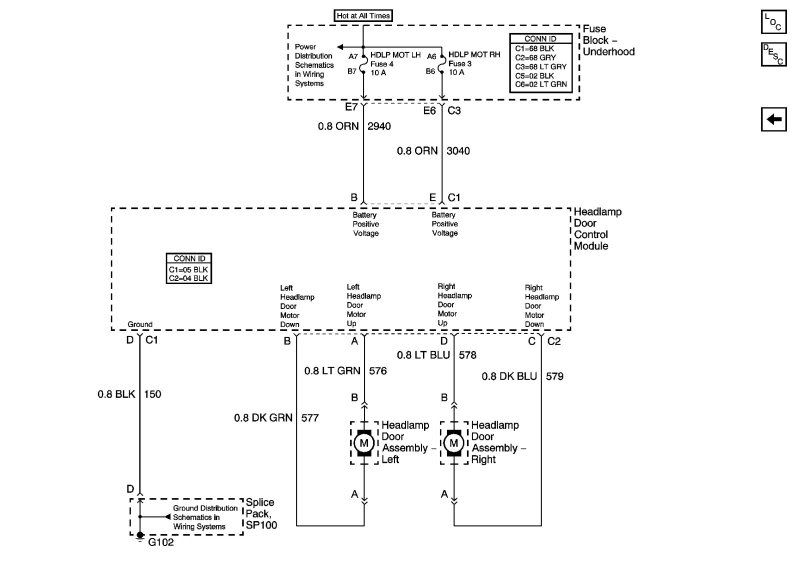
This is the wiring diagram. The signal goes through independent circuits to each motor. To get both motors to hesitate at the same time would need a discontinuity somewhere upstream of the headlamp door control module. From the diagram, the motors are fused individually at the footwell fuse panel. It's also strange that it occurs at exactly the same point in the cycle. I just can't imagine a wiring fault being that predictable. I also can't see why the switch would be the problem as it only applies a voltage onto the circuit. It's more common to see total loss of functions when the switch fails.
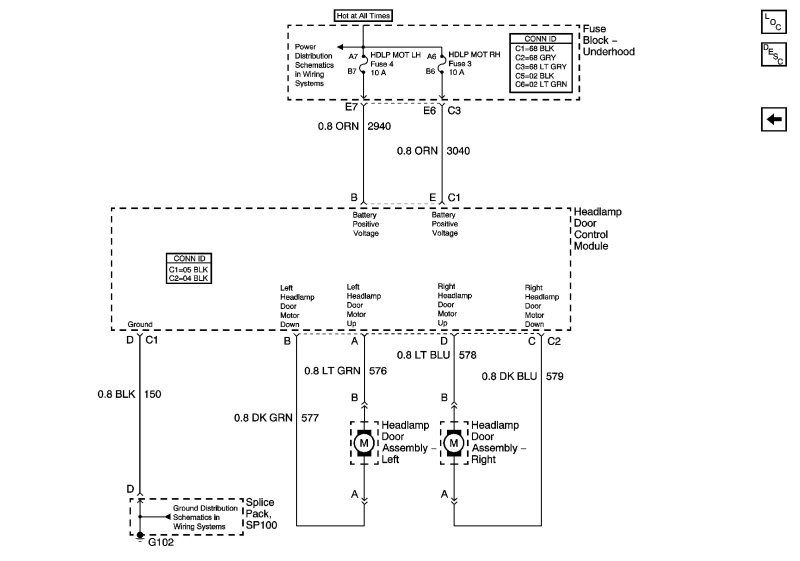
Just guessing based on the symptoms which have been described. It's an unusual problem
Last edited by DeeGee; May 11, 2012 at 03:14 AM.
Thread Starter
Racer
Joined: Sep 2011
Posts: 379
Likes: 0
From: Central Valley California
I will start troubleshooting today. I do know that I manually raised each light about halfway before I bolted the mounting arms to the motors (not sure if that matters). Out of curiosity, is there a point at which the motor stops turning if you operate it manually?
Corvette Stories
The Best of Corvette for Corvette Enthusiasts

5 Best & 5 Worst Corvette Daily Drivers
Joe Kucinski
The Headlights of Every Corvette Generation Explained
Joe Kucinski
5 Best & 5 Most Overrated Corvette Track Packages of All Time!
Joe Kucinski
Every 2027 Corvette Engine Explained
Joe Kucinski
Designer Imagines A Corvette That Looks More Like a Corvette Than the Corvette
Verdad Gallardo
10 Ugly Corvettes That We Still Kinda Love
Joe Kucinski
Top 10 Most Expensive Corvettes Ever Sold on Bring A Trailer
Brett Foote
10 Things Every Corvette Owner Needs (2026 Edition)
Michael S. Palmer
8 Most "Only Corvette Owners Understand" Quirks and Problems
Pouria Savadkouei
Melting Slicks


Joined: Nov 2009
Posts: 2,922
Likes: 219
From: West Branch, MI
Yes, you can manually raise or lower the lights and if you continue you will get to a point where you cannot turn the **** anymore. There are stops on the side of the motor that prevents it from going beyond a certain point and when you lower the light, it will also only go so far. You'll feel the **** tighten up when you reach these points.
Race Director
Joined: Apr 2007
Posts: 11,152
Likes: 890
From: South Western Ontario
That is not the complete diagram. Where are the wires that tell the module to put the lights up and down? The signal wires will be common for both motors.
The motors can rotate forever if the arm is removed. The arm can go on the shaft either direction. The motor has a worm gear on it and this drives a round gear with teeth all the way around it. There is a rubber insert in the gear to absorb shocks and the output shaft has ears that insert into the rubber to drive it.
I highly doubt the motors would both mechanically jamb at the same spot. Also, the control box senses the extra current when the motor is stopped and shuts off the power to it. So, if the motor was mechanically jambed to a stop it would have the power cut and not be powered again to full-open.
That's why I suspect an electrical issue is temporarily cutting the signal to raise the lights or momentarily telling them to drop and then raise again so they try to reverse just long enough to stop before continuing up.
Do you happen to have HID lights in this car?
I highly doubt the motors would both mechanically jamb at the same spot. Also, the control box senses the extra current when the motor is stopped and shuts off the power to it. So, if the motor was mechanically jambed to a stop it would have the power cut and not be powered again to full-open.
That's why I suspect an electrical issue is temporarily cutting the signal to raise the lights or momentarily telling them to drop and then raise again so they try to reverse just long enough to stop before continuing up.
Do you happen to have HID lights in this car?
Tech Contributor
Joined: Dec 2003
Posts: 19,384
Likes: 87
From: Horncastle Lincolnshire, England
2023 C5 of the Year Finalist - Unmodified
There are about 5 as you work down the system. I tried to post the relevant diagram.
It's at the T/S switch. I'll try to dig it out.
Last edited by DeeGee; May 15, 2012 at 01:35 PM.