





High voltage charging issue

Thread Starter
Pro

Joined: Dec 2007
Posts: 663
Likes: 0
From: Show me lower taxes Missouri
 High voltage charging issue
Haven't posted for ever but I have an issue with high voltage. Voltage is normal for a while and then climes to 17-18 volts. I pull the car over shut it off and the problem goes away for a while. The problem has now got to the point that it is almost constant. I have a new battery and a new alternator (which I'm about to put on). The alternator has been making noise and my gut tells me that is the problem.
Question I have is where is the voltage regulator located?
Any comments are much appreciated. Oh, 402 w/supercharger.

Question I have is where is the voltage regulator located?
Any comments are much appreciated. Oh, 402 w/supercharger.

Le Mans Master

Joined: Mar 2011
Posts: 6,835
Likes: 302
From: Columbia SC
I agree. Also make sure you have not let the battery leak due to overcharging. Check it and if it has, access the PCM and check it and the connectors. If you see evidence of leakage there, clean everything up. You can use some battery cleaning solvent (sparingly, so as not to get into the PCM). You can use a cotton Q-tip to clean the connectors.
Thread Starter
Pro
Joined: Dec 2007
Posts: 663
Likes: 0
From: Show me lower taxes Missouri
Thanks, I thought the regulator was in the alternator. Just thought I would throw it out there. I did perform a lot of searches and didn't come up with anything.
Thanks again!
Thanks again!

Pro
Joined: May 2011
Posts: 580
Likes: 1
From: Chicago Suburb
St. Jude Donor '13
.....just make sure the P/N & manufacturer of the new alternator IS THE SAME as the old. Better yet, have the old alternator rebuilt. Many C5's are real particular about new alternators. If you research parts sites, you'll find that some years have 2 or 3 GM P/N's listed for the same car and vice-versa.

Tech Contributor


Joined: Dec 1999
Posts: 32,910
Likes: 2,402
From: Anthony TX
CI 6,7,8,9,11 Vet
St. Jude Donor '08
Your problem may NOT be resolved.
The alternator interfaces with the BATTERY thru the starter solenoid. There is a voltage SENSE WIRE that comes off the alternator plactic connector on top and that red wire samples the B+ Battery buss voltage at those terminals on the solenoid to keep the voltage in spec..
Recommend that you REMOVE the wires from the starter solenoid and clean all the wire eyelet terminals and make sure that the bolts that secure the wires are properly tightened. becareful not to break the bakealite insulator.
Your battery terminals also MUST be properly torqued to 11 FT/LBS 97-2003 C5
The large red wire on the back of the alternator (BATT Terminal) must also be properly tightened.
Bill
The alternator interfaces with the BATTERY thru the starter solenoid. There is a voltage SENSE WIRE that comes off the alternator plactic connector on top and that red wire samples the B+ Battery buss voltage at those terminals on the solenoid to keep the voltage in spec..
Recommend that you REMOVE the wires from the starter solenoid and clean all the wire eyelet terminals and make sure that the bolts that secure the wires are properly tightened. becareful not to break the bakealite insulator.
Your battery terminals also MUST be properly torqued to 11 FT/LBS 97-2003 C5
The large red wire on the back of the alternator (BATT Terminal) must also be properly tightened.
Bill
Corvette Stories
The Best of Corvette for Corvette Enthusiasts

Top 10 Most Expensive Corvettes Ever Sold on Bring A Trailer
Brett Foote
10 Things Every Corvette Owner Needs (2026 Edition)
Michael S. Palmer
8 Most "Only Corvette Owners Understand" Quirks and Problems
Pouria Savadkouei
10 Reasons the C6 Z06 is Still A Performance Benchmark After 20 Years
Joe Kucinski
How Much Horsepower Every Corvette Engine "LOST" in 1972
Joe Kucinski
Top 10 DOs and DON'Ts for Protecting Your Convertible Top!
Michael S. Palmer
Top 10 Most Explosive Corvettes Ever Made: Power-to-Weight Ratio Ranked!
Joe Kucinski
150 hp to 1,250 hp: Every Corvette Generation Compared by the Specs That Matter
Joe Kucinski
8 Coolest Corvette Pace Cars (and Replicas) of All Time
Verdad Gallardo
Heel & Toe


Joined: May 2012
Posts: 23
Likes: 1
From: Scottsdale Arizona
B+
Hi All,
Even thought this is my first reply, I have not heard the term B+ in quite some time. With that being said, Bill, did you work on equipment that was vacuum operated or is it just age related?
I own a 2001 coupe, 6 speed and read the tech site quite often. Bill has usually provided sufficiet guidance via the forum that I have been able to do my own repairs to date from using the search function.
Thanks, Bill.
Joe
Even thought this is my first reply, I have not heard the term B+ in quite some time. With that being said, Bill, did you work on equipment that was vacuum operated or is it just age related?
I own a 2001 coupe, 6 speed and read the tech site quite often. Bill has usually provided sufficiet guidance via the forum that I have been able to do my own repairs to date from using the search function.
Thanks, Bill.
Joe
Tech Contributor
Joined: Dec 1999
Posts: 32,910
Likes: 2,402
From: Anthony TX
CI 6,7,8,9,11 Vet
St. Jude Donor '08
Joe
Anything wired BATTERY,, HOT AT ALL TIMES is considered B+
It is referenced in the service manuals
YES,,,,,,,,,,,,,,,,,, I HAVE VACUUM TUBE background
This should give you a flash back (negative with respect to Cathode) and or (Grid Voltage)
LOL
Anything wired BATTERY,, HOT AT ALL TIMES is considered B+
It is referenced in the service manuals
YES,,,,,,,,,,,,,,,,,, I HAVE VACUUM TUBE background
This should give you a flash back (negative with respect to Cathode) and or (Grid Voltage)
LOL

Instructor
Joined: Apr 2012
Posts: 111
Likes: 0
From: Arvada Colorado
High Voltage Also!
Yesterday I was driving my '99 for an hour and about 50 min into my trip I saw the voltage climbing. It finally settled in at 16.1V. Yikes! Since I was only 10 min away I said I would pull over if it got above 16.5V at any point but luckily it didn't. This morning, another hour drive, about 45 min into it it jumped to 14V and settled there. I have done research and come up with either loose battery terminal connections, loose alternator connections, loose starter solenoid connections, or a bad voltage regulator in the alternator.
I replaced the starter solenoid after it cracked about 4 months ago so I will start there and see if I find anything.
I will report back with anything I find. Any input is appreciated.
I replaced the starter solenoid after it cracked about 4 months ago so I will start there and see if I find anything.
I will report back with anything I find. Any input is appreciated.
Instructor
Joined: Apr 2012
Posts: 111
Likes: 0
From: Arvada Colorado
So I went through the process of trying to fix this and when checking my battery positive vs alternator B+ I had .75 volts, so definitely some voltage loss. I bench tested the alternator twice and it was good. I then found a loose connection on the little stud on the starting solenoid and tightened it. I didn't have any codes after and my P1637 stayed away for 2 days but its back and so are my high voltage issues. I now have 1V between battery positive and alternator B+. Any ideas anyone?
Le Mans Master
Joined: Mar 2011
Posts: 6,835
Likes: 302
From: Columbia SC
So I went through the process of trying to fix this and when checking my battery positive vs alternator B+ I had .75 volts, so definitely some voltage loss. I bench tested the alternator twice and it was good. I then found a loose connection on the little stud on the starting solenoid and tightened it. I didn't have any codes after and my P1637 stayed away for 2 days but its back and so are my high voltage issues. I now have 1V between battery positive and alternator B+. Any ideas anyone?
Remember your issue is happening after everything is getting hot. You can't replicate that on a bench test. Just like some failing starters will not work once they are hot, resistance goes up.
Instructor
Joined: Apr 2012
Posts: 111
Likes: 0
From: Arvada Colorado
Sorry about that. I did a volt meter test across battery positive and alternator B+ (the big red wire on the back of the alternator) while running so It would measure any voltage drop between the two points.
The issue with it only happening when it gets hot is out because it jumped to 15 this morning about 2 min after driving (57 degrees out).
The issue with it only happening when it gets hot is out because it jumped to 15 this morning about 2 min after driving (57 degrees out).
Tech Contributor
Joined: Dec 1999
Posts: 32,910
Likes: 2,402
From: Anthony TX
CI 6,7,8,9,11 Vet
St. Jude Donor '08
The wiring in the starter /solenoid area can get heat damaged The wires also have inline fuses. The small wire that goes to terminal "D" is the wire that you need to physically test for proper continuity and functionality.
Check out the schematic and test all the wires.
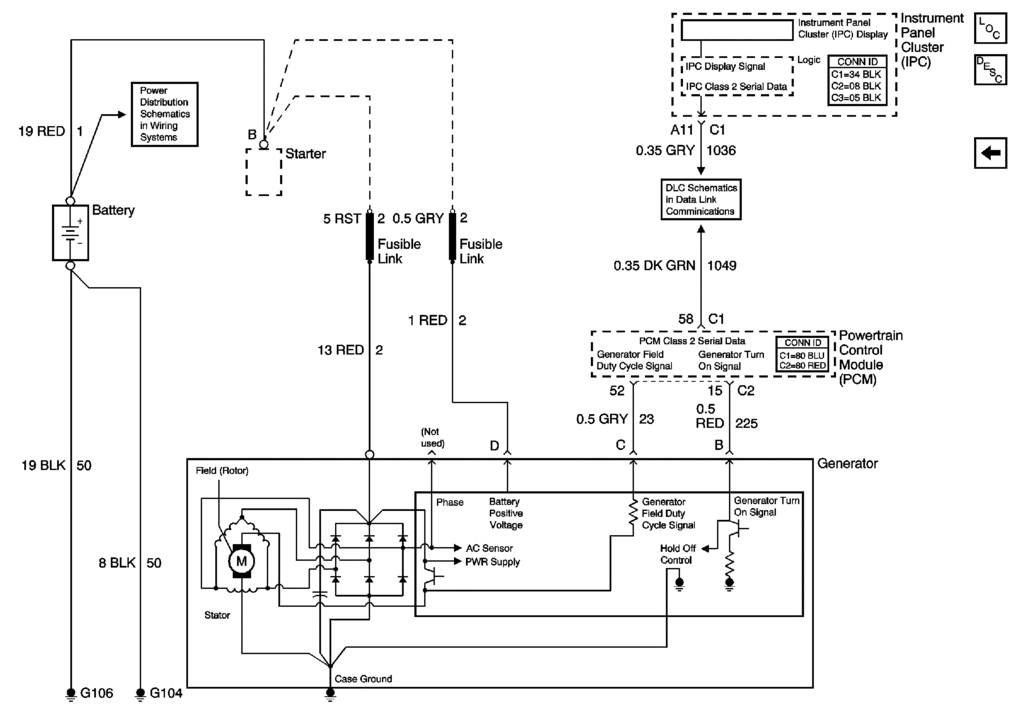
Bill
Check out the schematic and test all the wires.
Bill
Le Mans Master
Joined: Mar 2011
Posts: 6,835
Likes: 302
From: Columbia SC
You have not said you have inspected the grounds. Check all 3 but the case ground should be ok since you have removed the alternator twice. I will assume the engine block ground is ok since you have no other issues going on.
If the grounds are good, I would remove the battery positive terminal and measure the resistance from the positive terminal to the alternator plug connection D. If that looks good (we can discuss what value that is and I can check it on my car also) check the resistance from the battery negative connection to the actual frame.
The FSM says the voltage difference you measured should not be more than .5 volts.
I have some other ideas if the above does not pan out.
If the grounds are good, I would remove the battery positive terminal and measure the resistance from the positive terminal to the alternator plug connection D. If that looks good (we can discuss what value that is and I can check it on my car also) check the resistance from the battery negative connection to the actual frame.
The FSM says the voltage difference you measured should not be more than .5 volts.
I have some other ideas if the above does not pan out.
Instructor
Joined: Apr 2012
Posts: 111
Likes: 0
From: Arvada Colorado
I checked the grounds about 4 months ago and cleaned them but it can't hurt to give them another look. I will make some measurements after work and reply back. Thank u for the help I appreciate it greatly.
Le Mans Master
Joined: Mar 2011
Posts: 6,835
Likes: 302
From: Columbia SC
Ok, I checked the resistance on my car from the battery positive terminal to the generator connector (disconnected from the alternator) on both the circuits with the fusible links. I also removed the positive terminal from the battery to totally isolate the circuits Each one registered from .5 to .7 ohms which is about what I expected. This should give you a good idea of what to expect in the circuits when you check the resistance. Let me know what you get and we will go from there. Mr. Sam
Instructor
Joined: Apr 2012
Posts: 111
Likes: 0
From: Arvada Colorado
Ok so I just checked the resistances of the wires with the fusible links.
Battery positive to the larger red wire on the back of the alternator was 0.5 Ohms
Battery positive to pin D was 2.2 Ohms.
My lowest resolution on my multimeter goes to 200 Ohms so not great accuracy.
I wouldnt think that this means a fusable link is blown? Wouldn't that cause it not to run tho?
Thanks again for all the help!
Battery positive to the larger red wire on the back of the alternator was 0.5 Ohms
Battery positive to pin D was 2.2 Ohms.
My lowest resolution on my multimeter goes to 200 Ohms so not great accuracy.
I wouldnt think that this means a fusable link is blown? Wouldn't that cause it not to run tho?
Thanks again for all the help!
Last edited by tycksena; Jul 31, 2013 at 07:26 PM.

Melting Slicks


Joined: Nov 1999
Posts: 2,347
Likes: 857
From: MI
Cruise-In VI Veteran
Yesterday I was driving my '99 for an hour and about 50 min into my trip I saw the voltage climbing. It finally settled in at 16.1V. Yikes! Since I was only 10 min away I said I would pull over if it got above 16.5V at any point but luckily it didn't. This morning, another hour drive, about 45 min into it it jumped to 14V and settled there. I have done research and come up with either loose battery terminal connections, loose alternator connections, loose starter solenoid connections, or a bad voltage regulator in the alternator.
I replaced the starter solenoid after it cracked about 4 months ago so I will start there and see if I find anything.
I will report back with anything I find. Any input is appreciated.
I replaced the starter solenoid after it cracked about 4 months ago so I will start there and see if I find anything.
I will report back with anything I find. Any input is appreciated.
The charging system provides voltage to the battery and to the vehicle electrical systems. The generator's voltage regulator controls the rotor's field current to meet these needs.
Current flows (1) through the slip rings (8) to the rotor winding (2) in order to create a magnetic field (3). The engine-driven rotor (4) is rotated by the engine within the stator (5). This rotation creates an alternating current (AC) voltage in the stator windings (6). The AC voltage goes to the rectifier bridge (7). The rectifier bridge converts this AC voltage to direct current (DC) voltage. The DC voltage is delivered from the generator's output terminal to the battery and the electrical systems through a fusible link (11). The regulator grounds circuit 225 (10) when the charging system voltage is abnormal. This information causes the PCM to send a class 2 message to the instrument panel cluster, which activates the CHECK GAGES lamp.
The voltage regulator limits system voltage by controlling the rotor field current. When the field current is on, the regulator switches the rotor field on and off at a fixed rate of about 400 cycles per second. By varying the overall on/off time, correct average field current for proper system voltage control is maintained. At high speeds, the on time may be 10 percent and the off time may be 90 percent. At low speeds, and with high electrical loads, the on/off time may be 90 percent and 10 percent respectively. The voltmeter reads battery voltage when the engine is not running and reads charging system voltage when the engine is running. The normal indication is between 11 and 16 volts.
The generator uses only two connections-battery positive and the L terminal, in addition to the ground path through the generator bracket. Use of P, I, and S terminals is optional. The P terminal is connected to the stator and may be connected externally to a tachometer or other devise. The I terminal can be connected directly to battery voltage to power the generator instead of, or in addition to, the L terminal which must be stepped down. This S terminal may be connected to an external voltage source, such as voltage near the battery, for voltage control. If the S terminal is not used, internal generator voltage is used for control.