




Solid mount diff?

Thread Starter
Burning Brakes


Joined: Apr 2002
Posts: 1,105
Likes: 114
From: Lawrenceburg, KY
 Solid mount diff?
Hi,
New to vettes so best to ask. I see people install poly mounts (ex: HPE mount on rear of diff), but is there a reason (other than perhaps noise/vibration) that the diff can't be solid mounted?
The reason I'm asking is that I've always run rod ends on my solid axle vehicles (F-bodies, trucks, etc.) and solid bushings on my IRS vehicles (E46 M3, Z4). So personal preference is to have the diff solid to the frame/body to remove all "give" out back.
Side question, looking around it seems like the diff and trans are only supported (at the back) by a single bushing. Is the "front" of the diff/trans supported by the torque tube/bellhousing)?
Thanks,
Chris
New to vettes so best to ask. I see people install poly mounts (ex: HPE mount on rear of diff), but is there a reason (other than perhaps noise/vibration) that the diff can't be solid mounted?
The reason I'm asking is that I've always run rod ends on my solid axle vehicles (F-bodies, trucks, etc.) and solid bushings on my IRS vehicles (E46 M3, Z4). So personal preference is to have the diff solid to the frame/body to remove all "give" out back.
Side question, looking around it seems like the diff and trans are only supported (at the back) by a single bushing. Is the "front" of the diff/trans supported by the torque tube/bellhousing)?
Thanks,
Chris
Last edited by ChrisLSx; Sep 18, 2017 at 01:01 AM.

Tech Contributor


Joined: Dec 1999
Posts: 32,910
Likes: 2,402
From: Anthony TX
CI 6,7,8,9,11 Vet
St. Jude Donor '08
The C5, C6 and C7 drive trains are supported by the TWO engine mounts and the differential mount All mounts are attached to the front and rear K members.
The engine causes the entire drive train to flex. The mounts allow that flex to be controlled and to eliminate NVH into the cabin. Adding poly mounts limits that flex but there is still some controlled flex and increased NVH.
IF, you solid mount the differential to the K member, you will add unwanted stress to parts of the differential, trans, TT and the inherently weak Bell housing.
The Trans/Diff/TT, bell housing and engine are a ridged unit:
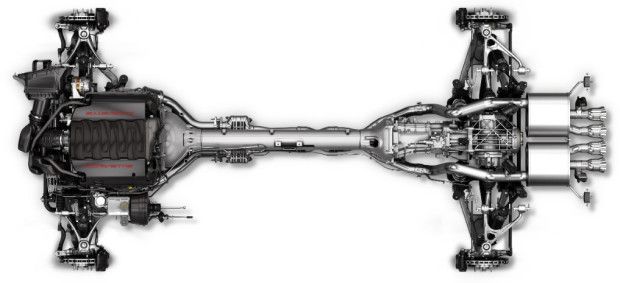
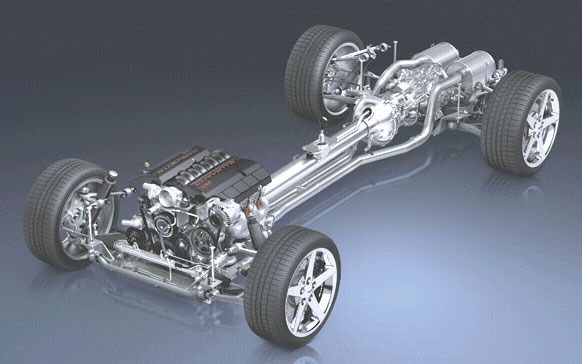
The engine causes the entire drive train to flex. The mounts allow that flex to be controlled and to eliminate NVH into the cabin. Adding poly mounts limits that flex but there is still some controlled flex and increased NVH.
IF, you solid mount the differential to the K member, you will add unwanted stress to parts of the differential, trans, TT and the inherently weak Bell housing.
The Trans/Diff/TT, bell housing and engine are a ridged unit:
Race Director


Joined: Apr 2007
Posts: 11,152
Likes: 890
From: South Western Ontario
I suppose you could if you used something like a rod end to only constrain it from moving up/down and back/forth.
The differential end of the drive train needs to be able to rotate around the driveshaft a bit and also to be able to rotate in the plane of the axle shafts a bit. these are the directions it needs to move so there is no abnormal stresses applied in it as the car is driven.
Hard fixing it to the cross member would cause a lot of stress on that mount as the engine moved around or when the chassis flexed.
You can hard fix differentials in other vehicles because the differential is stand-alone and all the mounts are close together so there is almost no chassis flex between the mounting points.
The differential end of the drive train needs to be able to rotate around the driveshaft a bit and also to be able to rotate in the plane of the axle shafts a bit. these are the directions it needs to move so there is no abnormal stresses applied in it as the car is driven.
Hard fixing it to the cross member would cause a lot of stress on that mount as the engine moved around or when the chassis flexed.
You can hard fix differentials in other vehicles because the differential is stand-alone and all the mounts are close together so there is almost no chassis flex between the mounting points.
Thread Starter
Burning Brakes
Joined: Apr 2002
Posts: 1,105
Likes: 114
From: Lawrenceburg, KY
Thanks guys, that all makes sense. So with the knowledge that the diff needs some "flex" but that I want to minimize unnecessary flex, what is the best way to approach the "problem?"
Tech Contributor
Joined: Dec 1999
Posts: 32,910
Likes: 2,402
From: Anthony TX
CI 6,7,8,9,11 Vet
St. Jude Donor '08
Order and install a PFADT Style differential mount.
See picture of the mount in #3 reply:
https://www.corvetteforum.com/forums...earancing.html
I would also look into new OEM engine mounts OR some better poly engine mounts.
See picture of the mount in #3 reply:
https://www.corvetteforum.com/forums...earancing.html
I would also look into new OEM engine mounts OR some better poly engine mounts.

.


Joined: Apr 2013
Posts: 5,042
Likes: 1,157
From: Oregon
St. Jude Donor '14-'15-'16-'17-'18-'19-'20-'21-'22-'23
aFe has them now.... http://store.afecontrol.com/afe-cont...-97-04-orange/
I have the Hinson mounts in the car atm, trying to decide if I want to try the Pfadt mounts or not
I have the Hinson mounts in the car atm, trying to decide if I want to try the Pfadt mounts or not

Safety Car


Joined: Mar 2016
Posts: 3,534
Likes: 432
From: Atlantic Beach FL.
I would think that you would want matching engine mounts so that the torsional movement would be about the same on both ends.
If the diff mount is stiff and the engine mount is soft I would think that the engine would be wanting to move more than the diff causing more stress.
If the diff mount is stiff and the engine mount is soft I would think that the engine would be wanting to move more than the diff causing more stress.
Thread Starter
Burning Brakes
Joined: Apr 2002
Posts: 1,105
Likes: 114
From: Lawrenceburg, KY
I would think that you would want matching engine mounts so that the torsional movement would be about the same on both ends.
If the diff mount is stiff and the engine mount is soft I would think that the engine would be wanting to move more than the diff causing more stress.
If the diff mount is stiff and the engine mount is soft I would think that the engine would be wanting to move more than the diff causing more stress.
Corvette Stories
The Best of Corvette for Corvette Enthusiasts

Top 10 Most Expensive Corvettes Ever Sold on Bring A Trailer
Brett Foote
10 Things Every Corvette Owner Needs (2026 Edition)
Michael S. Palmer
8 Most "Only Corvette Owners Understand" Quirks and Problems
Pouria Savadkouei
10 Reasons the C6 Z06 is Still A Performance Benchmark After 20 Years
Joe Kucinski
How Much Horsepower Every Corvette Engine "LOST" in 1972
Joe Kucinski
Top 10 DOs and DON'Ts for Protecting Your Convertible Top!
Michael S. Palmer
Top 10 Most Explosive Corvettes Ever Made: Power-to-Weight Ratio Ranked!
Joe Kucinski
150 hp to 1,250 hp: Every Corvette Generation Compared by the Specs That Matter
Joe Kucinski
8 Coolest Corvette Pace Cars (and Replicas) of All Time
Verdad Gallardo
Acct Suspended APR 2026 by request
Joined: Dec 2010
Posts: 10,367
Likes: 1,272
2020 Corvette of the Year Finalist (performance mods)
C5 of Year Winner (performance mods) 2019
I had pfadt motor and diff mounts in my car and I like them, it cured my wheelhop/drivetrain shake issues and helped keep the drivetrain alive... I put c6z drivetrain in the car about a year and a half ago so I no longer have the diff mount but the motor mounts are still there, they have been installed close to 7 years and still going strong
Thread Starter
Burning Brakes
Joined: Apr 2002
Posts: 1,105
Likes: 114
From: Lawrenceburg, KY
Acct Suspended APR 2026 by request
Joined: Dec 2010
Posts: 10,367
Likes: 1,272
2020 Corvette of the Year Finalist (performance mods)
C5 of Year Winner (performance mods) 2019
maybe with a lot of heat due to uncoated headers or poorly designed headers that sit too close to the mounts... you could always reuse the heatshields or make your own... both sets of headers I have had were coated and like I said no issues in close to 7 years

Drifting


Joined: May 2007
Posts: 1,547
Likes: 210
From: Huntersville, NC
don't forget that the whole drive train is rather monolithic, effectively one long piece. So, thermal growth needs to be accomodated somehow. I get (envelope calc) roughly .12 inches growth when the temp of the drivetrain goes from 72 to 160 dgF (uniformly). So be careful solidly mounting the drivetrain. It needs a little "slop" in addition to damping vibration.

Drifting
Joined: Jul 2015
Posts: 1,844
Likes: 375
From: San Jose, CA
When you talk about "unnecessary" flex, remember that the engineers who designed this car spent a lot of time thinking about it. What goals, specifically, do you have, in going to a harder mount? Are you willing to put up with the added NVH? Remember, you're basically stuck with this decision until you replace the mounts, so maybe the first thousand miles you won't mind, but then ...
For a street-driven C5, I see no need for poly mounts. The car shakes enough as it is. For competitive events, you may want poly mounts. I have not yet seen a good reason for solid mounts unless you're doing something crazy.
For a street-driven C5, I see no need for poly mounts. The car shakes enough as it is. For competitive events, you may want poly mounts. I have not yet seen a good reason for solid mounts unless you're doing something crazy.
Safety Car
Joined: Mar 2016
Posts: 3,534
Likes: 432
From: Atlantic Beach FL.
That's what I was thinking. The OEM mounts even had some heat shielding.
Thread Starter
Burning Brakes
Joined: Apr 2002
Posts: 1,105
Likes: 114
From: Lawrenceburg, KY
Again, this is just my experience.