



Lambda sensor (o2) question.

Thread Starter
Instructor


Joined: Jul 2007
Posts: 202
Likes: 9
From: Coventry, Warwickshire,
 Lambda sensor (o2) question.
Hi, my 1999 C5 struggles to pass emissions each year due to 'Lambda' results a little high. As I use the car fairly infrequently (1100 miles last year) I guess the sensor itself needs cleaning (or replacing). I understand that there are four sensors on the C5.......but which ones do I need to replace. I am currently over in the States on holiday and hope to pick some up......where would you suggest I go to get replacements. Incidentally, I had planned to try a 'cleaner additive' in my fuel for a while to see if that helped......but it might be more effective to just replace the dirty sensor (if that infact is what the problem is). By the way.......car has done 35,000 miles.
Last edited by ukmac; Apr 12, 2018 at 07:42 AM. Reason: Add further detail

Melting Slicks


Joined: Feb 2001
Posts: 2,806
Likes: 359
From: Northville, MI
The front oxygen sensors are the ones to be replaced. If you are running any type of ethanol gas, the current designed O2 was designed to handle to better handle the effacts of alcohol. The original Vette O2 were designed before E10 was really prevalent in the states. Bosh and NGK are the preferred brands and stay away from the china brands.

Tech Contributor


Joined: Dec 1999
Posts: 32,910
Likes: 2,402
From: Anthony TX
CI 6,7,8,9,11 Vet
St. Jude Donor '08
Regardless of what brand O2 sensor that you run, they should last well over 50,000 miles befor showing any signs of degrading on a mostly stock engine
HOWEVER, that said, if they are failing prematurely, you have issues. The HEATER CIRCUIT for the sensors MUST work properly for the sensors to function and not fail prematurely.
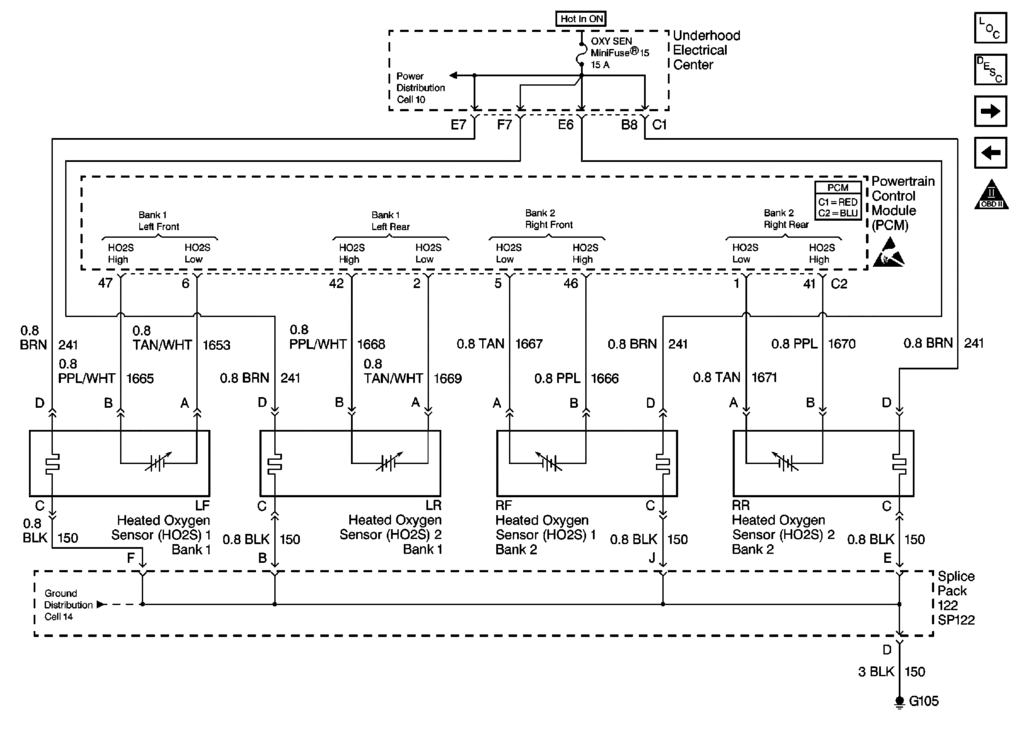
IF, your are failing like that, I bet you a cold one that your heater voltage is NOT functioning properly. I will attach the schematic that you need to troubleshoot this circuit. You have to make sure that you have FULL BATTERY VOLTAGE on the O2 sensor heater FUSE when the IGNITION SWITCH is ON and have a fully functioning ground circuit to chassis ground.
The COMMON failure points are:
Faulty ignition switch: The Switch supplies the (HOT in RUN/ON) voltage to the FUSE when the key is ON!! You should see FULL battery voltage on the two test points on top of the FUSE to chassis ground. If you don't, the ignition switch is BAD!!!
The ground path for the circuit and have corroded points in the Splice Pack and or the actual chassis ground.
If it were ME, that's where I would start, even before you install the new O2 sensors.
BOSH and NGK are the brands that I would go with!
I run BOSH and have NOT had any complaints and I have a heavily modded engine.. They last a LONG time in my car!!
SCHEMATIC:
Bill
HOWEVER, that said, if they are failing prematurely, you have issues. The HEATER CIRCUIT for the sensors MUST work properly for the sensors to function and not fail prematurely.
IF, your are failing like that, I bet you a cold one that your heater voltage is NOT functioning properly. I will attach the schematic that you need to troubleshoot this circuit. You have to make sure that you have FULL BATTERY VOLTAGE on the O2 sensor heater FUSE when the IGNITION SWITCH is ON and have a fully functioning ground circuit to chassis ground.
The COMMON failure points are:
Faulty ignition switch: The Switch supplies the (HOT in RUN/ON) voltage to the FUSE when the key is ON!! You should see FULL battery voltage on the two test points on top of the FUSE to chassis ground. If you don't, the ignition switch is BAD!!!
The ground path for the circuit and have corroded points in the Splice Pack and or the actual chassis ground.
If it were ME, that's where I would start, even before you install the new O2 sensors.
BOSH and NGK are the brands that I would go with!
I run BOSH and have NOT had any complaints and I have a heavily modded engine.. They last a LONG time in my car!!
SCHEMATIC:
Bill
Last edited by Bill Curlee; Apr 12, 2018 at 11:58 AM.
Thread Starter
Instructor
Joined: Jul 2007
Posts: 202
Likes: 9
From: Coventry, Warwickshire,
That looks complicated!
Hi, thanks for your reply. To be honest I was not aware that anything else may effect the sensor themselves. Now I am caught in two minds as to what to do next. I may well look to pick up a couple of sensors whilst over here........it is not the sort of thing I would be able to get easily in the UK.
Not sure if this helps.......but the readings were only very slightly high.....but high enough to effectively cause it to fail. The only way we could get the reading to come within spec was to raise the engine revs quite high....around 4000.....it gradually fell and just crept within spec. However, it appears to be getting closer to the point of failing. The garage said they thought it was due to the type of driving I generally do.....just short leisure driving rather than out on the motorway......it is generally used for fine days only.
Not sure if this helps.......but the readings were only very slightly high.....but high enough to effectively cause it to fail. The only way we could get the reading to come within spec was to raise the engine revs quite high....around 4000.....it gradually fell and just crept within spec. However, it appears to be getting closer to the point of failing. The garage said they thought it was due to the type of driving I generally do.....just short leisure driving rather than out on the motorway......it is generally used for fine days only.
Tech Contributor
Joined: Dec 1999
Posts: 32,910
Likes: 2,402
From: Anthony TX
CI 6,7,8,9,11 Vet
St. Jude Donor '08
Type of driving has NOTHING to do with shortening the life of the sensors.
Things that cause them to fail are.
- Running leaded fuel
- Failed heater circuits
- Running very rich
- Burning a lot of oil. (engine oil consumption problems)
- High Mileage
BC
Things that cause them to fail are.
- Running leaded fuel
- Failed heater circuits
- Running very rich
- Burning a lot of oil. (engine oil consumption problems)
- High Mileage
BC

Burning Brakes


Joined: May 2014
Posts: 764
Likes: 215
From: Detroit
Hi, thanks for your reply. To be honest I was not aware that anything else may effect the sensor themselves. Now I am caught in two minds as to what to do next. I may well look to pick up a couple of sensors whilst over here........it is not the sort of thing I would be able to get easily in the UK.
Not sure if this helps.......but the readings were only very slightly high.....but high enough to effectively cause it to fail. The only way we could get the reading to come within spec was to raise the engine revs quite high....around 4000.....it gradually fell and just crept within spec. However, it appears to be getting closer to the point of failing. The garage said they thought it was due to the type of driving I generally do.....just short leisure driving rather than out on the motorway......it is generally used for fine days only.
Not sure if this helps.......but the readings were only very slightly high.....but high enough to effectively cause it to fail. The only way we could get the reading to come within spec was to raise the engine revs quite high....around 4000.....it gradually fell and just crept within spec. However, it appears to be getting closer to the point of failing. The garage said they thought it was due to the type of driving I generally do.....just short leisure driving rather than out on the motorway......it is generally used for fine days only.
The reason I ask is that I suspect that your sensors are fine, and that your catalytic converters are what is starting to fail. If you're revving to pass inspection, you are bringing the cat's temperature up, increasing conversion and bringing you within emissions spec.
Thread Starter
Instructor
Joined: Jul 2007
Posts: 202
Likes: 9
From: Coventry, Warwickshire,
Hi, yes....it is the reading from their probe that is inserted into one of the tailpipes. What are your thoughts knowing that it is from there that the reading is showing high?

Acct Suspended APR 2026 by request
Joined: Dec 2010
Posts: 10,367
Likes: 1,272
2020 Corvette of the Year Finalist (performance mods)
C5 of Year Winner (performance mods) 2019
if it was high hydrocarbons it could be failing cats as mentioned above... since you mentioned you drive it short and leisurely it very well may have excessive carbon buildup in the combustion chambers and that could also be the cause... if you have seafoam in the uk try running a can of that through the intake and when done properly it will burn off the carbon buildup... that will be easier and cheaper to do than throwing money at o2 sensors that you may not need or replacing the cats prematurely
Corvette Stories
The Best of Corvette for Corvette Enthusiasts

5 Best & 5 Worst Corvette Daily Drivers
Joe Kucinski
The Headlights of Every Corvette Generation Explained
Joe Kucinski
5 Best & 5 Most Overrated Corvette Track Packages of All Time!
Joe Kucinski
Every 2027 Corvette Engine Explained
Joe Kucinski
Designer Imagines A Corvette That Looks More Like a Corvette Than the Corvette
Verdad Gallardo
10 Ugly Corvettes That We Still Kinda Love
Joe Kucinski
Top 10 Most Expensive Corvettes Ever Sold on Bring A Trailer
Brett Foote
10 Things Every Corvette Owner Needs (2026 Edition)
Michael S. Palmer
8 Most "Only Corvette Owners Understand" Quirks and Problems
Pouria Savadkouei
Burning Brakes

Joined: Jan 2006
Posts: 788
Likes: 105
From: Olathe Kansas
If they are just testing tailpipe emissions, then you may just need some good old
TLC. Maybe Filters, fluids, Ignition Tune Up..
Your plugs and wires may not be 100% causing higher emissions.. And even
having dirty/old oil can cause higher emissions.. Do the simple maintenance first
TLC. Maybe Filters, fluids, Ignition Tune Up..
Your plugs and wires may not be 100% causing higher emissions.. And even
having dirty/old oil can cause higher emissions.. Do the simple maintenance first
Tech Contributor
Joined: Dec 1999
Posts: 32,910
Likes: 2,402
From: Anthony TX
CI 6,7,8,9,11 Vet
St. Jude Donor '08
If they are just testing tailpipe emissions, then you may just need some good old
TLC. Maybe Filters, fluids, Ignition Tune Up..
Your plugs and wires may not be 100% causing higher emissions.. And even
having dirty/old oil can cause higher emissions.. Do the simple maintenance first
TLC. Maybe Filters, fluids, Ignition Tune Up..
Your plugs and wires may not be 100% causing higher emissions.. And even
having dirty/old oil can cause higher emissions.. Do the simple maintenance first
Product example below:

Do some good ole high performance acceleration runs (you don't have to do 200 mph to clean out the combustion chambers) Just some 0-60 WOT runs.
If all that fails, you may have to do new replacement CATs
Bill
Last edited by Bill Curlee; Apr 15, 2018 at 05:01 PM.

Le Mans Master

Joined: Aug 2005
Posts: 5,375
Likes: 328
From: CA.
St. Jude Donor '13-'14-'15
My experience has been this
An engine with high hydro carbons is simply running to RICH at P/T or in what they call "closed loop" Closed loop is where the front 02's have full command on your engines fueling and makes adjustments based on the front 02 voltages by making corrections to your fueling using your "fuel trims" The ECM at P/T is always trying to achieve the STOICH fuel ratio of 14.68-1
Many things can cause your engine to run rich
bad or slow front 02 sensors
Not working front 02 heaters
Carbon'd up combustion chambers
Too much oil in your intake manifold coming from your PCV system
Fouled MAF caused by oil fouling from a cold air oiled filter
I would 1st seafoam your engine--one can into a full tank and another can into a quick pour into your intake manifold via your brake booster line
Typically a BAD CAT will increase mostly your NOX readings and not so much your hydrocarbons
Someone with a wideband set up can read your actual P/T AFR ratio --that will give you a head start on what may be wrong
ALSO anyone with a basic scanner can read real time 02 voltages to see in fact if they are working properly A 02 sensor voltage should rapidly "oscillate " or change between .100 to .950 millivolts With an AVERAGE voltage between .400 and .500
A bad 02 will flat line at .450 or oscillate very slowly
Do you have LT headers ???? If so THAT is your problem and requires a whole other fix
An engine with high hydro carbons is simply running to RICH at P/T or in what they call "closed loop" Closed loop is where the front 02's have full command on your engines fueling and makes adjustments based on the front 02 voltages by making corrections to your fueling using your "fuel trims" The ECM at P/T is always trying to achieve the STOICH fuel ratio of 14.68-1
Many things can cause your engine to run rich
bad or slow front 02 sensors
Not working front 02 heaters
Carbon'd up combustion chambers
Too much oil in your intake manifold coming from your PCV system
Fouled MAF caused by oil fouling from a cold air oiled filter
I would 1st seafoam your engine--one can into a full tank and another can into a quick pour into your intake manifold via your brake booster line
Typically a BAD CAT will increase mostly your NOX readings and not so much your hydrocarbons
Someone with a wideband set up can read your actual P/T AFR ratio --that will give you a head start on what may be wrong
ALSO anyone with a basic scanner can read real time 02 voltages to see in fact if they are working properly A 02 sensor voltage should rapidly "oscillate " or change between .100 to .950 millivolts With an AVERAGE voltage between .400 and .500
A bad 02 will flat line at .450 or oscillate very slowly
Do you have LT headers ???? If so THAT is your problem and requires a whole other fix

Moderator, Tech Contributor

Joined: Sep 2013
Posts: 15,669
Likes: 4,093
From: Cape Coral, Florida
Hi, my 1999 C5 struggles to pass emissions each year due to 'Lambda' results a little high. As I use the car fairly infrequently (1100 miles last year) I guess the sensor itself needs cleaning (or replacing). I understand that there are four sensors on the C5.......but which ones do I need to replace. I am currently over in the States on holiday and hope to pick some up......where would you suggest I go to get replacements. Incidentally, I had planned to try a 'cleaner additive' in my fuel for a while to see if that helped......but it might be more effective to just replace the dirty sensor (if that infact is what the problem is). By the way.......car has done 35,000 miles.
Doubtful your O2 sensors are bad after 35K. CEL illuminated ??... Do you have a scanner where you can read O2 sensors, and long/short fuel trims ??...without interpreting this info you are pretty much shooting in the dark...O2 sensor circuit pretty easy to diagnose (heater and signal)..now which "readings" are you talking about...tailpipe emissions ??...now as far as raising engine speed and seeing your "readings" improve normally would be a vacuum leak...you would see this by your long term/short term fuel trim improving as RPM increased...like I said without being able to see this info you're be just shotgunning !!
Last edited by C5 Diag; Apr 17, 2018 at 05:29 PM.