When you click on links to various merchants on this site and make a purchase, this can result in this site earning a commission. Affiliate programs and affiliations include, but are not limited to, the eBay Partner Network.
Been chasing this for a while, just wondering what a normal vette looks like while cranking. All my warning lamps cut out while cranking and voltage drops right down.
Has new battery and ton of other parts I already threw at it No codes either.
The VERY FIRST thing you need to do is read and post your DTCs. If you don't know how, Here's the write up-
List ALL the DTCs and the letters after the DTC example (PCM-0300 H)
If you have a TON of old DTCs CLEAR all of them and then read them again when the issue happens. Its best to read the DTCs before you turn the ignition switch off. If you have messages in the DIC window, press and HOLD clear until the messages go away.
READING YOUR Engine Diagnostic Codes
The Diagnostic Display Mode is entered with the following procedure:
1) Turn on the ignition but don't start the engine. NOTE! You can read the DTCs with the engine running and or driving down the road but it can distract you. BE careful! Some DTCs clear themselves when you turn the ignition OFF!
2) Press the RESET button to turn off any warning messages. (i.e. door open, trunk open ect)
3) Press and hold OPTIONS
4) While holding OPTIONS, press FUEL four times within a 10-second period.
Initially, on-board diagnostics go into an Automatic Mode which shows diagnostic codes in a pre-set sequence: PCM - TCS - RTD - BCM - IPC - RADIO - HVAC - LDCM - RDCM - SCM - RFA. All codes will be displayed for each. ( i.e. PCM = 4 codes) If none are present in a given module, you will see No More Codes on the display.
There are two kinds of diagnostic codes, Current and History designated with a letter suffix, “C” or “H”. A current C code indicates a malfunction is present and active in the module displaying data. A history code indicates a problem existed sometime in the last 40 or 50 ignition cycles. When not accompanied by a current code of the same number, it's potential evidence of a previous problem, now resolved, that was not removed by clearing the codes.
More likely it's an indication of an intermittent malfunction.
Intermittent codes are the most challenging of the diagnostics. An intermittent code may have happened once, may have happened more than once but is inconsistent or may be happening on a regular basis but not at the time the codes are displayed. History codes can also be caused by a current malfunction in a system that is not operating at the time codes are displayed. An example is the rear window defogger which doesn't operate until the Body Control Module detects engine rpm. For history codes set by a module that does not operate with the key on and engine off, a special diagnostic tool called a Scan Tester is necessary to properly diagnose the malfunction.
Once the system has displayed all modules, it goes into the manual mode which allows selection of each module using combinations of Driver Information Center buttons. Manual mode can also be entered during the automatic sequence by pressing any button except English/Metric (E/M). Once the display shows Manual Diagnostics, select a module by pressing the OPTIONS button to go forward or the TRIP button to go back. Once a module is selected, a code is displayed, and if more than one are present; press GAGES to go forward or FUEL to go back.
To exit the diagnostic mode at any time, press E/M. If you want to erase codes in a given module, press and hold the RESET button To reset the codes once in manual mode, press and hold RESET until it displays NO CODES Press OPTIONS to go to the next module. Repeat the steps until you have reset the codes in all the computer modules.
NOTE!! Only reset the codes IF you want to - it is NOT necessary to do this. Clearing a code does not repair a problem. You are simply erasing the evidence of it in the module's memory. If you clear the code/s, and extinguish the Check Engine Light, your emissions status ready will NOT allow you to pass an emissions test until you have completed the required driving cycles.
Once you have the codes, the next question is: What to do with the information?
First, consult the factory service manual. Any serious C5 Do-It-Yourself owner should invest in the Corvette Service Manual of the appropriate model year. The Service Manual is really a requirement if you want to understand and work on your C5. You can GOOGLE the DTC and also find information on it.
Yes,, all the gages dropping out during the crank phase is normal BUT, I do NOT like the way the voltage gage reacts when you let the key go back to RUN. It could be a sign that you have a defective ignition switch.
The Volt meter in the Instrument panel DOES NOT show you actual TRUE battery voltage. It shows you the voltage that is coming out of the IGNITION SWITCH. If it slow reacting and below the actual battery voltage, the switch contacts are corroded/burnt.
Measure the actual battery voltage on the battery terminals to see what true battery voltage is. You can also measure it at the CIGAR Lighter socket.
There are no codes displayed from IPC H or C, I'm using HP Tuners to pull any DTC's besides IPC. I also have a new Ignition Switch.
A while back you had exchanged some ideas in another post. This is a swap car but everything from a C5 is retained. Harnesss, Fuse panels, PCM, BCM, TAC, column etc, basically a deskinned vette. I do have some modules such as door and seat modules that aren't used so I get no comms on those modules which should shouldn't affect the starting since they aren't hooked up. I wouldn't think it would matter I do have a rear mounted battery?
It has run before as is and no mods were made since, one day it just wouldn't start and I haven't got to the bottom of it yet.
Originally Posted by Bill Curlee
The VERY FIRST thing you need to do is read and post your DTCs. If you don't know how, Here's the write up-
List ALL the DTCs and the letters after the DTC example (PCM-0300 H)
If you have a TON of old DTCs CLEAR all of them and then read them again when the issue happens. Its best to read the DTCs before you turn the ignition switch off. If you have messages in the DIC window, press and HOLD clear until the messages go away.
READING YOUR Engine Diagnostic Codes
The Diagnostic Display Mode is entered with the following procedure:
1) Turn on the ignition but don't start the engine. NOTE! You can read the DTCs with the engine running and or driving down the road but it can distract you. BE careful! Some DTCs clear themselves when you turn the ignition OFF!
2) Press the RESET button to turn off any warning messages. (i.e. door open, trunk open ect)
3) Press and hold OPTIONS
4) While holding OPTIONS, press FUEL four times within a 10-second period.
Initially, on-board diagnostics go into an Automatic Mode which shows diagnostic codes in a pre-set sequence: PCM - TCS - RTD - BCM - IPC - RADIO - HVAC - LDCM - RDCM - SCM - RFA. All codes will be displayed for each. ( i.e. PCM = 4 codes) If none are present in a given module, you will see No More Codes on the display.
There are two kinds of diagnostic codes, Current and History designated with a letter suffix, “C” or “H”. A current C code indicates a malfunction is present and active in the module displaying data. A history code indicates a problem existed sometime in the last 40 or 50 ignition cycles. When not accompanied by a current code of the same number, it's potential evidence of a previous problem, now resolved, that was not removed by clearing the codes.
More likely it's an indication of an intermittent malfunction.
Intermittent codes are the most challenging of the diagnostics. An intermittent code may have happened once, may have happened more than once but is inconsistent or may be happening on a regular basis but not at the time the codes are displayed. History codes can also be caused by a current malfunction in a system that is not operating at the time codes are displayed. An example is the rear window defogger which doesn't operate until the Body Control Module detects engine rpm. For history codes set by a module that does not operate with the key on and engine off, a special diagnostic tool called a Scan Tester is necessary to properly diagnose the malfunction.
Once the system has displayed all modules, it goes into the manual mode which allows selection of each module using combinations of Driver Information Center buttons. Manual mode can also be entered during the automatic sequence by pressing any button except English/Metric (E/M). Once the display shows Manual Diagnostics, select a module by pressing the OPTIONS button to go forward or the TRIP button to go back. Once a module is selected, a code is displayed, and if more than one are present; press GAGES to go forward or FUEL to go back.
To exit the diagnostic mode at any time, press E/M. If you want to erase codes in a given module, press and hold the RESET button To reset the codes once in manual mode, press and hold RESET until it displays NO CODES Press OPTIONS to go to the next module. Repeat the steps until you have reset the codes in all the computer modules.
NOTE!! Only reset the codes IF you want to - it is NOT necessary to do this. Clearing a code does not repair a problem. You are simply erasing the evidence of it in the module's memory. If you clear the code/s, and extinguish the Check Engine Light, your emissions status ready will NOT allow you to pass an emissions test until you have completed the required driving cycles.
Once you have the codes, the next question is: What to do with the information?
First, consult the factory service manual. Any serious C5 Do-It-Yourself owner should invest in the Corvette Service Manual of the appropriate model year. The Service Manual is really a requirement if you want to understand and work on your C5. You can GOOGLE the DTC and also find information on it.
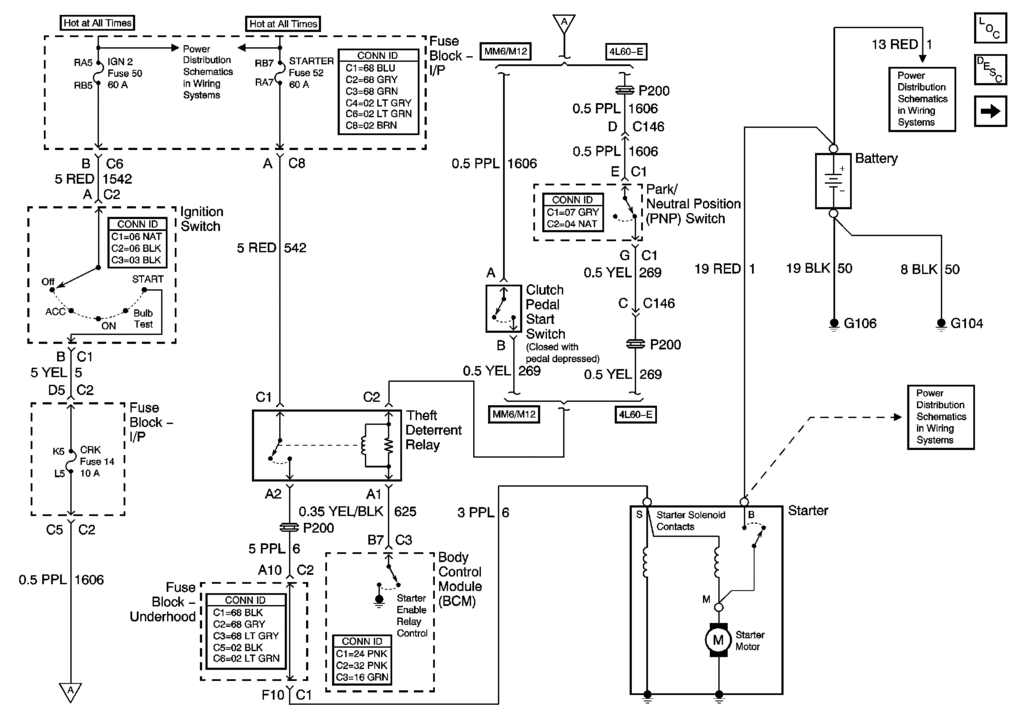
THIS,,, Is you starter CRANK circuit. The Theft Deterrent Relay is the HEART of the circuit. Take some readings and see if the low voltage low current side of the relay is working when you go to crank.
What is the security light in the IPC doing when you are in key ON??
IF, you jump the TDR RED and PURPLE wires, does the starter crank.
NOTE/WARNING!!! Make sure the car is out of GEAR prior to jumping those wires or it will move on its own!!!!!!!! If the key is in RUN the engine should crank and RUN!
Crank Position Sensor is my guess.. Mine didn't set any codes when I got stranded...
Not for several times failing anyway.. It would start and run intermittently
I have VATS disabled using HP Tuners. I've also replaced the CKPS as suggested by a few other posts. I have RPM's logging while cranking too.
Originally Posted by 8VETTE7
From his video in post #1 the security light goes out with key in ON. And the engine cranks but does NOT fire and run. So Security logic should not be an issue. ie when security is an issue there is NO CRANK.
Items I would check are that there is fuel getting to the injectors and that there is spark to the plugs. Could also be the crank position sensor is not working and did not set a code. Have seen that happen.
I can jump the TDR, it does the same, cranks no start. I have spark at all the plugs and inj pulse on the noid lights too. I've even tried another PCM same result.
Originally Posted by Bill Curlee
THIS,,, Is you starter CRANK circuit. The Theft Deterrent Relay is the HEART of the circuit. Take some readings and see if the low voltage low current side of the relay is working when you go to crank.
What is the security light in the IPC doing when you are in key ON??
IF, you jump the TDR RED and PURPLE wires, does the starter crank.
NOTE/WARNING!!! Make sure the car is out of GEAR prior to jumping those wires or it will move on its own!!!!!!!! If the key is in RUN the engine should crank and RUN!
See if while cranking you have some tach movement. If you do your cam/crank is ok...next see if you have spark...if good spray some brake clean or propane into your brake booster line...if car tries to start or runs you are looking at a fuel delivery issue...keep us advised !!
In the vid, when I crank all the gauges zero out, no Tach movement. Can you see RPM on your tach while cranking? In HP Tuners logs I can see it has RPM's while cranking.
I tried with spray still a no start. I feel like the PCM isn't getting the right voltage to do it's magic.
Originally Posted by rwobs777
See if while cranking you have some tach movement. If you do your cam/crank is ok...next see if you have spark...if good spray some brake clean or propane into your brake booster line...if car tries to start or runs you are looking at a fuel delivery issue...keep us advised !!
I have an 02ZO6. I have had events where it will crank all day but NOT start and run. Here is the resolve that I found.
Some additional issues that were seen during the event:
- Door windows would not function
- Weird gage readings
Actual issue: CORRUPTED SERIAL DATA BUS> (Caused by a damaged door wiring harness connector) The Doors have two connectors.. One for signal data and one for POWER. The power connector is a SIX PIN connector. IF,,,,,, The female pins are damaged (spread apart),, it will cause the door module to loose and gain power rapidly and that causes the serial data buss to become corrupted.
Look in the passengers foot well. Pull up the toe board that covers the fuse box. To the left of the fuse box is the Body Control Module (BCM)
To the left of the BCM are TWO thin connectors. Find the one with FOUR WIRES and pop the top shorting buss off of the connector. Then see if the car will start.
To get to the connectors, POP OUT the rubber accordion tube between the door and body. Pull the harnesses up and out of the body A pillar hole. separate the six pin connector and see if any of the female pins are spread apart which will cause them to make poor contact with the male pins. Thus the intermittent connection and corrupted serial data buss.
In my case I don't have door modules, and no comms on the IPC since they don't exist. I also have star connector 2 disconnected.
Here are two readings first one with key on, show's 12.2 volts, second is it cranking, voltage drops as low as 8v while cranking.
Originally Posted by Bill Curlee
To get to the connectors, POP OUT the rubber accordion tube between the door and body. Pull the harnesses up and out of the body A pillar hole. separate the six pin connector and see if any of the female pins are spread apart which will cause them to make poor contact with the male pins. Thus the intermittent connection and corrupted serial data buss.
In the vid, when I crank all the gauges zero out, no Tach movement. Can you see RPM on your tach while cranking? In HP Tuners logs I can see it has RPM's while cranking.
I tried with spray still a no start. I feel like the PCM isn't getting the right voltage to do it's magic.
Cool !!...it looks like you have a cam/crank signal so you should be getting fuel (like you mentioned) and ignition...DO you have spark ??...air, fuel, ignition...that's all you need in a nutshell !!...maybe check if you're getting power and signal to your injectors...all the same color wires are your feed...pink I believe...the other wires are your control (ground side switched) side. Easily tested with INCANDESCENT test light. Also check your 5 volt ref.If the 5 volt ref. gets shorted to ground you get NADA...no start, no injector pulse, possibly no spark, possibly "NO MIL" ...which I didn't see in your video...I guess you can start unplugging anything with a 5 volt ref...BBB Industries has some OK FREE wiring diagrams...Good luck Brother !!
Just for the sake of checking,,, Pull a couple of plugs from each bank and make sure that you have compression. I KNOW it sounds dumb, but it seems to be turning over very fast.
So you say you have FUEL PRESSURE. Is it actually spraying out the injectors???????? When you pull the plugs examine them and if its not starting, it/they should be wet or smell of fuel.
Spark. Actually check the spark on each bank. See what it looks like. Should be nice blue spark and able to jump a good pug gap
If you have fuel, spark and compression, it should RUN!
RECHARGE the battery!! 8 VDC during cranking is VERY VERY LOW!! The module low voltage cut off is around 8 VDC!!
Bill
Last edited by Bill Curlee; Apr 18, 2018 at 04:53 PM.
Just for the sake of checking,,, Pull a couple of plugs from each bank and make sure that you have compression. I KNOW it sounds dumb, but it seems to be turning over very fast.
So you say you have FUEL PRESSURE. Is it actually spraying out the injectors???????? When you pull the plugs examine them and if its not starting, it/they should be wet or smell of fuel.
Spark. Actually check the spark on each bank. See what it looks like. Should be nice blue spark and able to jump a good pug gap
If you have fuel, spark and compression, it should RUN!
RECHARGE the battery!! 8 VDC during cranking is VERY VERY LOW!! The module low voltage cut off is around 8 VDC!!
Bill
Yes, he has fuel pressure he said but FIRST we have to know if he's getting spark !!...he tried the brake cleaner in the intake I think he mentioned...if he had spark it should have at least tried to start...isn't it great troubleshooting in front of a computer...LOL !!! p.s. No MIL LIGHT during start and dead panel cluster concerns me...wish I had a picoscope !!!







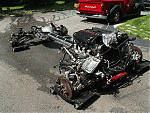


 Cranks will not start vid
 No codes either.