



PCV/Catch Can routing for LS3/L92 C5

Thread Starter
Drifting


Joined: Apr 2015
Posts: 1,893
Likes: 295
From: Buffalo NY
 PCV/Catch Can routing for LS3/L92 C5
I'm almost ready to fire up my C5 for the first time after swapping in an L92. Just need to figure out the PCV system. The car will see a fair amount of time on local road courses so I want to install a catch can as well to prevent oil from entering the intake manifold, which was an issue when I ran the car with the old LS1.
The car has an L92 from an '08 Escalade. The valley towers (normally used for VVT) have been plugging with NPT plugs and the engine uses the typical L92 valley cover with the 8 o-rings underneath it as extra security. The valley cover does NOT have the PCV nipple like the LS6 valley cover has.
How should I route my catch can and PCV system?
Do I need a separate external PCV valve?
I want to eliminate any and all oil consumption, especially on track.
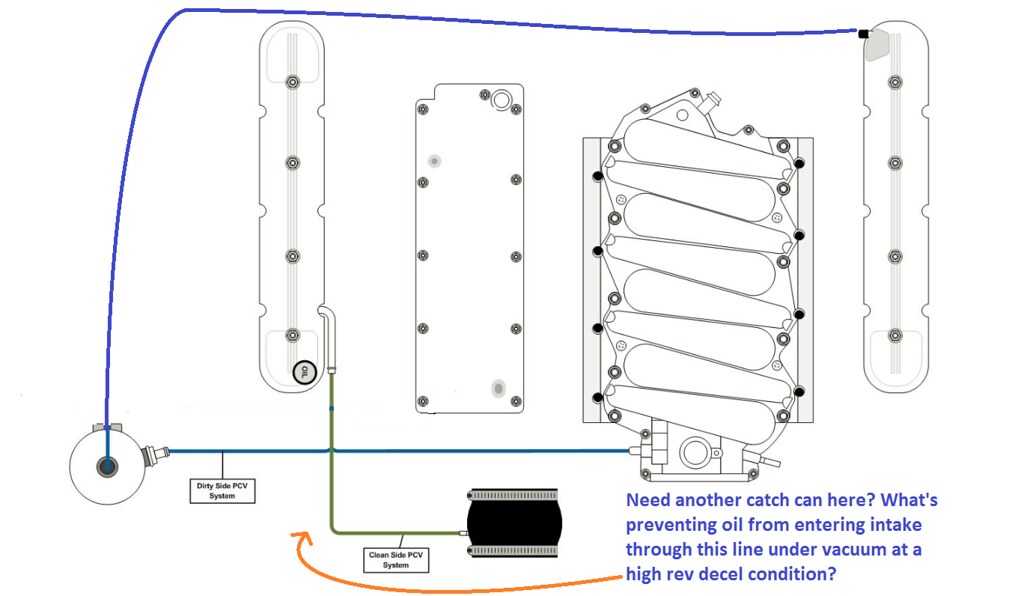
This is the rough draft I came up with.
The car has an L92 from an '08 Escalade. The valley towers (normally used for VVT) have been plugging with NPT plugs and the engine uses the typical L92 valley cover with the 8 o-rings underneath it as extra security. The valley cover does NOT have the PCV nipple like the LS6 valley cover has.
How should I route my catch can and PCV system?
Do I need a separate external PCV valve?
I want to eliminate any and all oil consumption, especially on track.
This is the rough draft I came up with.

Racer


Joined: Jun 2004
Posts: 270
Likes: 67
From: Montana
Racer
Joined: Jun 2004
Posts: 270
Likes: 67
From: Montana
On your drawing, you had a question and arrow pointing to the clean side, on high rev decel vacuum sucking oil back into thru the intake. A check valve will help prevent oil from entering intake on the clean side.

Pro


Joined: May 2013
Posts: 740
Likes: 83
From: MN
No, don't run a check valve on the clean side of your PCV system!
tl;dr: Doing that could harm your engine by increasing crankcase pressure at WOT.
Full explanation: Since that port should be plumbed to the intake in front of the throttle body (as shown in your diagram) it will never see appreciable vacuum, thus the high rev decel (high vacuum) scenario you mentioned is not a problem. Also, since you didn't mention any kind of forced induction, I think it's safe to assume it will never see any boost either. The green line will almost always be flowing clean filtered air from the intake into the valve cover, to make up for the air sucked out of the crankcase through the PCV orifice by intake vacuum. The only time that flow through the green line may stop, or even reverse (and possibly get oil into your intake) is at WOT, when intake vacuum drops to near zero and blowby can cause crankcase pressure to build. That oily air will need somewhere to go, and flowing backwards through the green line is a much lower restriction path than through the PCV orifice. You could add a catch can on the clean side to keep that oil from reaching your intake, and since you're doing track days, it's probably a good idea. If you put a check valve there though, the only outlet for blowby at WOT would be through the little PCV orifice, which is going to cause crankcase pressure to build up, which is bad news.
Check the barb on the rear of your driver's side valve cover. It should have a fixed orifice in it for PCV. Thus you do not need a PCV valve; it works just like the fixed orifice in the LS6 valley cover. Yes, you should put a catch can on that side too, that's the one that's going to suck oil on high rev decel like you were saying. Good luck!
tl;dr: Doing that could harm your engine by increasing crankcase pressure at WOT.
Full explanation: Since that port should be plumbed to the intake in front of the throttle body (as shown in your diagram) it will never see appreciable vacuum, thus the high rev decel (high vacuum) scenario you mentioned is not a problem. Also, since you didn't mention any kind of forced induction, I think it's safe to assume it will never see any boost either. The green line will almost always be flowing clean filtered air from the intake into the valve cover, to make up for the air sucked out of the crankcase through the PCV orifice by intake vacuum. The only time that flow through the green line may stop, or even reverse (and possibly get oil into your intake) is at WOT, when intake vacuum drops to near zero and blowby can cause crankcase pressure to build. That oily air will need somewhere to go, and flowing backwards through the green line is a much lower restriction path than through the PCV orifice. You could add a catch can on the clean side to keep that oil from reaching your intake, and since you're doing track days, it's probably a good idea. If you put a check valve there though, the only outlet for blowby at WOT would be through the little PCV orifice, which is going to cause crankcase pressure to build up, which is bad news.
Check the barb on the rear of your driver's side valve cover. It should have a fixed orifice in it for PCV. Thus you do not need a PCV valve; it works just like the fixed orifice in the LS6 valley cover. Yes, you should put a catch can on that side too, that's the one that's going to suck oil on high rev decel like you were saying. Good luck!
Last edited by TastyBacon; May 14, 2018 at 02:36 AM.
Thread Starter
Drifting
Joined: Apr 2015
Posts: 1,893
Likes: 295
From: Buffalo NY
No, don't run a check valve on the clean side of your PCV system!
tl;dr: Doing that could harm your engine by increasing crankcase pressure at WOT.
Full explanation: Since that port should be plumbed to the intake in front of the throttle body (as shown in your diagram) it will never see appreciable vacuum, thus the high rev decel (high vacuum) scenario you mentioned is not a problem. Also, since you didn't mention any kind of forced induction, I think it's safe to assume it will never see any boost either. The green line will almost always be flowing clean filtered air from the intake into the valve cover, to make up for the air sucked out of the crankcase through the PCV orifice by intake vacuum. The only time that flow through the green line may stop, or even reverse (and possibly get oil into your intake) is at WOT, when intake vacuum drops to near zero and blowby can cause crankcase pressure to build. That oily air will need somewhere to go, and flowing backwards through the green line is a much lower restriction path than through the PCV orifice. You could add a catch can on the clean side to keep that oil from reaching your intake, and since you're doing track days, it's probably a good idea. If you put a check valve there though, the only outlet for blowby at WOT would be through the little PCV orifice, which is going to cause crankcase pressure to build up, which is bad news.
Check the barb on the rear of your driver's side valve cover. It should have a fixed orifice in it for PCV. Thus you do not need a PCV valve; it works just like the fixed orifice in the LS6 valley cover. Yes, you should put a catch can on that side too, that's the one that's going to suck oil on high rev decel like you were saying. Good luck!
tl;dr: Doing that could harm your engine by increasing crankcase pressure at WOT.
Full explanation: Since that port should be plumbed to the intake in front of the throttle body (as shown in your diagram) it will never see appreciable vacuum, thus the high rev decel (high vacuum) scenario you mentioned is not a problem. Also, since you didn't mention any kind of forced induction, I think it's safe to assume it will never see any boost either. The green line will almost always be flowing clean filtered air from the intake into the valve cover, to make up for the air sucked out of the crankcase through the PCV orifice by intake vacuum. The only time that flow through the green line may stop, or even reverse (and possibly get oil into your intake) is at WOT, when intake vacuum drops to near zero and blowby can cause crankcase pressure to build. That oily air will need somewhere to go, and flowing backwards through the green line is a much lower restriction path than through the PCV orifice. You could add a catch can on the clean side to keep that oil from reaching your intake, and since you're doing track days, it's probably a good idea. If you put a check valve there though, the only outlet for blowby at WOT would be through the little PCV orifice, which is going to cause crankcase pressure to build up, which is bad news.
Check the barb on the rear of your driver's side valve cover. It should have a fixed orifice in it for PCV. Thus you do not need a PCV valve; it works just like the fixed orifice in the LS6 valley cover. Yes, you should put a catch can on that side too, that's the one that's going to suck oil on high rev decel like you were saying. Good luck!
Yup, no boost, this is a regular cam'd street motor, stock bottom end and heads minus springs.
Sounds like the ideal setup is 2 catch cans, one on clean and one on dirty side. I'll probably just run without them for the initial start and break in, to get used to the setup, and add them once I've shaken out all the bugs.

Supporting Vendor
Joined: Aug 2013
Posts: 1,375
Likes: 303
From: Virginia
IMO the ideal setup is not two catch cans.
as much as i do enjoy selling them, i would rather fix a problem with one vs. two.
missing info, what catch can is it you are trying to install? that will answer how it needs to be installed.
as much as i do enjoy selling them, i would rather fix a problem with one vs. two.
missing info, what catch can is it you are trying to install? that will answer how it needs to be installed.
Corvette Stories
The Best of Corvette for Corvette Enthusiasts

Every 2027 Corvette Engine Explained
Joe Kucinski
Designer Imagines A Corvette That Looks More Like a Corvette Than the Corvette
Verdad Gallardo
10 Ugly Corvettes That We Still Kinda Love
Joe Kucinski
Top 10 Most Expensive Corvettes Ever Sold on Bring A Trailer
Brett Foote
10 Things Every Corvette Owner Needs (2026 Edition)
Michael S. Palmer
8 Most "Only Corvette Owners Understand" Quirks and Problems
Pouria Savadkouei
10 Reasons the C6 Z06 is Still A Performance Benchmark After 20 Years
Joe Kucinski
How Much Horsepower Every Corvette Engine "LOST" in 1972
Joe Kucinski
Top 10 DOs and DON'Ts for Protecting Your Convertible Top!
Michael S. Palmer
Supporting Vendor
Joined: Aug 2013
Posts: 1,375
Likes: 303
From: Virginia
its all about why the clean side gets dirty, and stopping that from happening.
too much air, too fast blowing out, or too much air, too fast being sucked out.
some of my setups is possible to isolate the clean side from dirty side completely, so there is never any flow (even can be check valved) on that side, so air only enters and never leaves, including any possible oil
too much air, too fast blowing out, or too much air, too fast being sucked out.
some of my setups is possible to isolate the clean side from dirty side completely, so there is never any flow (even can be check valved) on that side, so air only enters and never leaves, including any possible oil
Pro
Joined: May 2013
Posts: 740
Likes: 83
From: MN
Check-valving the clean side or restricting air flow on either side sounds like a recipe for crankcase pressure to me, but maybe I don't fully understand. If what you're talking about is proprietary, that's okay, I don't expect you to reveal trade secrets.
Supporting Vendor
Joined: Aug 2013
Posts: 1,375
Likes: 303
From: Virginia
Pro
Joined: May 2013
Posts: 740
Likes: 83
From: MN
Thanks, now I see what you're talking about. The MM can goes between the crankcase and the PCV valve, so it can provide a lower-restriction path to vent crankcase gases during WOT/boost. Most of the blowby gases should then be flowing into the can and out its breather filter instead of out the clean side, so the clean side should not need its own catch can. I guess that means you could put a check valve on the clean side without hurting anything then too, huh?
Looks like you're using a check valve on the breather filter to make it "exit-only". What's the cracking pressure/back pressure on this check valve? Seems like it would have to be really, really low. Or, maybe it's set up so that intake vacuum sucks it shut? Sorry for hijacking this thread, just curious how this works.
Looks like you're using a check valve on the breather filter to make it "exit-only". What's the cracking pressure/back pressure on this check valve? Seems like it would have to be really, really low. Or, maybe it's set up so that intake vacuum sucks it shut? Sorry for hijacking this thread, just curious how this works.
Thread Starter
Drifting
Joined: Apr 2015
Posts: 1,893
Likes: 295
From: Buffalo NY

I did add a small tube inside one of the barbed fittings to extend down about 3" into the catch can, to prevent any "short cycling" that might occur if the fittings were right next to each other in the lid of the can.
Supporting Vendor
Joined: Aug 2013
Posts: 1,375
Likes: 303
From: Virginia
any can like that one is better than nothing, but as you can imagine is far less efficient than one with (any sort of) technology going on inside.
that should be used in-line of an existing pcv strategy, either in-line of the fresh air pipe or on the return side (return side is where the daily driving and engine braking oil is) between intake manifold and driver valve cover or valley plate year depending.
that should be used in-line of an existing pcv strategy, either in-line of the fresh air pipe or on the return side (return side is where the daily driving and engine braking oil is) between intake manifold and driver valve cover or valley plate year depending.
Thread Starter
Drifting
Joined: Apr 2015
Posts: 1,893
Likes: 295
From: Buffalo NY
Ok, I installed my cheapo catch can according to the diagram in the first post.
-Catch can was filled with stainless steel scouring pads (saw this trick elsewhere on the 'net) to act as a filtering media
-Added a small barbed fitting and 2" length of hose inside the "IN" port to prevent short cycling
Car seems to run the same as before, I will report back with what it "catches" after a week or two.
-Catch can was filled with stainless steel scouring pads (saw this trick elsewhere on the 'net) to act as a filtering media
-Added a small barbed fitting and 2" length of hose inside the "IN" port to prevent short cycling
Car seems to run the same as before, I will report back with what it "catches" after a week or two.

Instructor

Joined: Aug 2008
Posts: 103
Likes: 8
I'm not as familiar with your valve covers (internal view), but it looks to me like you might want to switch your clean and dirty connections. Usually port on the rear driver's side is a big connection that is wide open. I think that the passenger front PCV port is baffled. A dual can setup is nice, even if the clean side (hopefully) ends up being a visual indicator. I wouldn't try to orifice my own track motor PCV system. It's better, in my opinion to let the vapors vent. If you can monitor what's coming out then you have another tool to keep an eye on the relative health of your setup over time.
Last edited by mikehimself; Jun 25, 2018 at 04:47 PM.
Thread Starter
Drifting
Joined: Apr 2015
Posts: 1,893
Likes: 295
From: Buffalo NY
Update - I just did a track day with the setup shown in the original post and still had oil consumption issues, though not as bad as it used to be. There was a significant amount of oil being sucked into the duct:
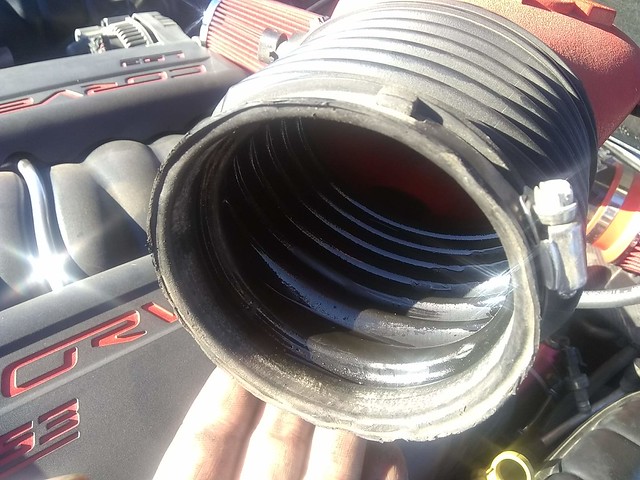
The next step is to add another catch can in that line, unless there's a way to prevent the oil from getting sucked through (as Mike mentioned, switch lines since the driver's rear is wide open, and the passenger front is baffled?)
The next step is to add another catch can in that line, unless there's a way to prevent the oil from getting sucked through (as Mike mentioned, switch lines since the driver's rear is wide open, and the passenger front is baffled?)
Last edited by nsogiba; Jul 8, 2018 at 04:52 PM.
Supporting Vendor
Joined: Aug 2013
Posts: 1,375
Likes: 303
From: Virginia
drivers rear does not connect to the air bridge in your diagram.
if you are getting oil from your passenger cover into the air bridge it is from
- too much crankcase flow, blowing oil out with it
- too much vacuum caused by a restrictive or clogged air filter assembly, sucking oil out of it
- an imbalanced oiling system, where there is too much oil sent to the valve-train, usually from increasing oil pump volume without restrictor pushrods
if you are getting oil from your passenger cover into the air bridge it is from
- too much crankcase flow, blowing oil out with it
- too much vacuum caused by a restrictive or clogged air filter assembly, sucking oil out of it
- an imbalanced oiling system, where there is too much oil sent to the valve-train, usually from increasing oil pump volume without restrictor pushrods