When you click on links to various merchants on this site and make a purchase, this can result in this site earning a commission. Affiliate programs and affiliations include, but are not limited to, the eBay Partner Network.
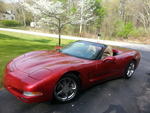
I bought a 1999 FRC with 61k miles on it about 8 weeks ago. I noticed about week 2 that when I put my foot down it would feel like I just backed off the throttle between 2100 an 2900 RPM. The air filter was filthy so I just swapped in a brand new K&N, thinking it was having trouble breathing. Now it does the same thing but around 2900-3200 rpm. It idles fine, doesn't surge while cruising, may be slightly worse when it's warmed up. No DIC warnings, no OBD2 codes. Has anyone encountered this before? I'm not sure where to look from here.
What RPM range are you starting with when you are accelerating, from a dead stop while cruising at 30-40 mph, etc. Also is the car stock or have an aftermarket air intake system, has it had a tune before you acquired it, is it a stick or an auto?
It could be anything from a slight air leak after the MAF, DBW throttle lag, Torque reduction via PCM, etc.
Under the car, drivers side frame rail, outboard of the transmission ( between the trans and the frame rail) If you have two fuel lines coming off the fuel rail, you have a NON REGULATED fuel filter. The newer C5 have one line off the fuel rail and the regulator is inside the fuel filter. DO NOT get that filter. The regulated filter will have THREE fittings on it.
My DIC buttons don't work, so i can't access whatever menu shows the codes, i thought it would tell me by itself.
I'm not spinning the tires, car is a manual, no tune that I know of, factory intake, happens when accelerating from speed or from a stop. When I start from around 2500 rpms the dead range is a few hundred higher sometimes.
Next weekend I will clean the MAF and replace the fuel filter, also will try and get mixture numbers from the OBD2, Ill let y'all know what i find, and thanks for the help!
I looked at the fuel trim with my OBDII, I don't really understand what it's showing. The numbers jumped around randomly between -6% and +9%. I'm using Torque Lite. Do those numbers mean anything to anyone?
I looked at the fuel trim with my OBDII, I don't really understand what it's showing. The numbers jumped around randomly between -6% and +9%. I'm using Torque Lite. Do those numbers mean anything to anyone?
-6% means whatever bank you are looking at is the O2 sensor is seeing a RICH condition (above 450 mv) and subtracting fuel....6 % worth...you are probably looking at short term fuel trims ...+9% is the opposite...O2 sensor seeing a LEAN condition and adding fuel...increasing injector pulse width !!....without looking at some other data PIDS really doesn't tell one a whole lot !!
Alright, replaced the fuel filter. It's better, but not gone. Check out this photo. The graph of STFT1 shows two peaks at 21.9 and 32.8.
I started accelerating right at the left edge of the graph, then 32.8 is where I shifted. It randomly pulled power without me adjusting the throttle right at the 21.9 peak, so it suddenly went rich... Any thoughts?
Dave my Man !!...what are the 2 numbers up top...long term fuel trims bank 1 and 2 ?? (3.9/1.6)...and what are the MAF values ??... pounds/minute ??(36) I'm used to looking at grams/second...now the short terms fluctuate constantly due to changes in air/fuel ratio...they are immediate when you accelerate...now, does that scan tool show long term fuel trims too??….what you have to look at is short and long terms at idle and around 3000 RPM to diagnose...what are the long terms at idle ??....if they are around 0-5% at idle or negative and INCREASE at 3000 RPM it's either fuel delivery OR dirty MAF...clogged air filter and dirty MAF usually shows negative trim numbers though at idle...you said you changed the K&N filter...is that one oiled ??...I'm not familiar...I have a SLP Blackwing which is oiled and use just a little oil when I clean it...after some driving I'll reclean the MAF again ....if it is a vacuum leak the short terms decrease quickly and long terms will DECREASE gradually as RPM's increased. If not you might have a fuel delivery issue...the filter made it run a little better but your fuel pump might be on it's way out...do you have a fuel pressure gauge ??...good to not check not only pressure but VOLUME...there is a spec for that I believe...I checked my '01 a while back for F/P current and RPM...around 5.5 Amps at 5,300 RPM at idle...a quick check would be to have a fuel pressure gauge installed and with a snap acceleration fuel pressure should not drop !!...also are your Pre cat O2 switching between 200-800 mv at idle ??...if they showing LOW Mv they are reporting LEAN...positive fuel trims like yours.
EDIT: if fuel pump is "suspected" and power and ground check would be advisable...either one bad can cause low pump volume and hence a lean condition under load !!
It is unfortunate you cannot use the DIC to pull the DTC codes. In addition to all the above, one other item to pull timing on acceleration is if one or both of the knock sensors are bad. I will slightly pull timing so you feel the car is not accelerating at lower rpm's.
Fuel trims are not going to be much help in your situation under higher loads. You need to get the codes pulled on the car and see what is logged. Playing around replacing parts on a guess is just going to discourage you and lighten your wallet unnecessarily. It would be nice to know if the exp is closing the throttle or pulling timing when this happens you could have so many possible issues that it is a waste of time to discuss without getting codes for base line diagnostics.
Fuel trims are not going to be much help in your situation under higher loads. You need to get the codes pulled on the car and see what is logged. Playing around replacing parts on a guess is just going to discourage you and lighten your wallet unnecessarily. It would be nice to know if the exp is closing the throttle or pulling timing when this happens you could have so many possible issues that it is a waste of time to discuss without getting codes for base line diagnostics.
Hi !!
Just wondering why you think looking at fuel trims would not help in the diagnosis (higher loads/RPM)...your thoughts ??
Hi !!
Just wondering why you think looking at fuel trims would not help in the diagnosis (higher loads/RPM)...your thoughts ??
with my experience fuel trims are a excellent tool to base line a engine at idle but under load there are so many variables effecting them that they are not as accurate as a diagnostic tool. For example if you are throwing a lean code you can look at the trims at idle and they will usually be +/- 0 to 8 percent but when throwing a lean code they will be excessively positive indicating lean. Now you can use something combustible like brake kleen and spray around the intake post throttle body all the way to the heads until the trims drop negative. When they drop you found your leak. Now under load everything from fuel you use, ambient temperature, coolant temperature, throttle percentage, load, intake and exhaust flow/ condition, humidity and many other factors will effect the trims. Your fuel trims will not reflect the same value on flat land as they will on a hill with all other variables the same. Basically any one variable off idle will cause a inconsistency in the fuel trim making it hard for you to use them as a diagnostic tool.
with my experience fuel trims are a excellent tool to base line a engine at idle but under load there are so many variables effecting them that they are not as accurate as a diagnostic tool. For example if you are throwing a lean code you can look at the trims at idle and they will usually be +/- 0 to 8 percent but when throwing a lean code they will be excessively positive indicating lean. Now you can use something combustible like brake kleen and spray around the intake post throttle body all the way to the heads until the trims drop negative. When they drop you found your leak. Now under load everything from fuel you use, ambient temperature, coolant temperature, throttle percentage, load, intake and exhaust flow/ condition, humidity and many other factors will effect the trims. Your fuel trims will not reflect the same value on flat land as they will on a hill with all other variables the same. Basically any one variable off idle will cause a inconsistency in the fuel trim making it hard for you to use them as a diagnostic tool.
Well in my experience interpreting fuel trims and O2 sensors are the MOST valuable diagnostic tool we have. Now at idle you said if you are "throwing a lean code" ….well let's say it's a P0171/P0174 the PCM will NOT throw this code at an 8% positive LTFT if that's what you were referring too...the LTFT have to be above 23% !!!...if below 23% the short terms will usually read "stoic" (450 mV)...LTFT #1 job is to keep the STFT at 0 !!!... now if you increase RPM to around 3,000 RPM and the LTFT decrease it's a vacuum leak. at higher RPM you can diagnose dirty MAF's, fuel delivery issues etc at the higher RPM's...yes, fuel trims will vary with all those thigs you mentioned but for me idle and 2500-3000 RPM gets the job done !!...now I had an experience with my '01 a while back...it was running just a little rough so I hooked up my scan tool...my LTFT's were around 16%...MMM !!...bought the RPM's up to 3000 and LTFT dropped to 0...ok, vacuum leak...I tried propane and brakekleen….nothing !!...hooked up my smoke machine and there was a pretty good leak out of the PCV connector where the "metal condensation band" comes out of the connector...what a crappy design !!...I bet a LOT of C5 owners have leaks there and don't know it...well anyway ripped out the metal band and used some high temp RTV...problem solved. Smooth as a babys' A$$.
Autozone will pull your codes for free and give you a printout if the codes. Do not listen to there diagnosis because they will tell you that you need a oxygen sensor. Then post the codes here and we will guide you in the direction of what needs looked at.







 1999 FRC pulls throttle