







Noise when brake pedal pressed while stopped

Thread Starter
Heel & Toe

Joined: Aug 2012
Posts: 18
Likes: 0
From: Bell Buckle, TN
 Noise when brake pedal pressed while stopped
I haven't been able to find anything online that corresponds to what I'm experiencing, so perhaps someone here has seen this before.
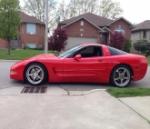
I have a 1999 C5 with approximately 75,000 miles. Early this morning, my air conditioning suddenly stopped working (blowing hot air), and so I was already planning on bringing the vehicle in for service. While running a few last minute errands before dropping it off, I began hearing and feeling a fairly loud grinding noise/vibration when the brake pedal is pressed at or near a complete stop. It sounds and feels remarkably similar to what you'd expect when brake rotors are damaged, but this occurs even when the vehicle is at a complete stop. Once you press on the brake pedal, at any speed and in any steering wheel position, the grinding and vibration starts, and remains present at a stop. It only ends after the brake pedal is released and the vehicle has achieved a speed of about 10-15 mph. Out of curiosity, I placed the vehicle in park at a traffic light, and the grinding continued, but interestingly, the grinding noise decreases significantly when the transmission was shifted into neutral. Once the vehicle is above about 15 mph, the vehicle accelerates and turns normally. All of the shift points appear to be normal.
I've had power steering issues before on vehicles when air conditioning compressors fail, probably due to belt slippage under heavy compressor load, and this has led to unusual noises or vibration while driving. But I've never seen anything like this connected to brake system operation. Any ideas?
I have a 1999 C5 with approximately 75,000 miles. Early this morning, my air conditioning suddenly stopped working (blowing hot air), and so I was already planning on bringing the vehicle in for service. While running a few last minute errands before dropping it off, I began hearing and feeling a fairly loud grinding noise/vibration when the brake pedal is pressed at or near a complete stop. It sounds and feels remarkably similar to what you'd expect when brake rotors are damaged, but this occurs even when the vehicle is at a complete stop. Once you press on the brake pedal, at any speed and in any steering wheel position, the grinding and vibration starts, and remains present at a stop. It only ends after the brake pedal is released and the vehicle has achieved a speed of about 10-15 mph. Out of curiosity, I placed the vehicle in park at a traffic light, and the grinding continued, but interestingly, the grinding noise decreases significantly when the transmission was shifted into neutral. Once the vehicle is above about 15 mph, the vehicle accelerates and turns normally. All of the shift points appear to be normal.
I've had power steering issues before on vehicles when air conditioning compressors fail, probably due to belt slippage under heavy compressor load, and this has led to unusual noises or vibration while driving. But I've never seen anything like this connected to brake system operation. Any ideas?
Thread Starter
Heel & Toe
Joined: Aug 2012
Posts: 18
Likes: 0
From: Bell Buckle, TN
I would have assumed pads and rotors too--that's exactly what it sounds like (having had that before)--but what wouldn't make sense about that is the fact that it still makes the noise even when the vehicle is stopped (and even in park). If the wheels aren't turning, the pads and rotors wouldn't make noise. In this case, they are. The brake pedal does indeed trigger the noise, but it does so when the vehicle is already at a stop.
Thread Starter
Heel & Toe
Joined: Aug 2012
Posts: 18
Likes: 0
From: Bell Buckle, TN
I hadn't thought about that but it makes complete sense. The ABS would be capable of functioning regardless of whether the vehicle is in motion, and that's really the key symptom here that's so odd. I would have immediately started removing the wheels and looking at rotor and pad condition if not for the fact that it does this with brake pedal application even when the vehicle is completely stopped. I could absolutely see the ABS doing this.
I'm assuming then that the air conditioning failure earlier in the day is just a random coincidence. I've seen stranger things happen.
I'm assuming then that the air conditioning failure earlier in the day is just a random coincidence. I've seen stranger things happen.
Thread Starter
Heel & Toe
Joined: Aug 2012
Posts: 18
Likes: 0
From: Bell Buckle, TN
I haven't definitively proven this to be the problem yet--though I'm leaning toward it--but I'm noticing that it's showing this as discontinued in GM's system. Is this something I'm likely to have to find salvage?

Administrator


Joined: Mar 2001
Posts: 368,136
Likes: 24,733
From: In a parallel universe. Currently own 2014 Stingray Coupe.
C7 of the Year - Modified Finalist 2021
MO Events Coordinator
St. Jude Co-Organizer
St. Jude Donor '03 thru '25
NCM Sinkhole Donor
CI 5, 8 & 11 Veteran
Moved to C5 Tech.
Corvette Stories
The Best of Corvette for Corvette Enthusiasts

How Much Horsepower Every Corvette Engine "LOST" in 1972
Joe Kucinski
Top 10 DOs and DON'Ts for Protecting Your Convertible Top!
Michael S. Palmer
Top 10 Most Explosive Corvettes Ever Made: Power-to-Weight Ratio Ranked!
Joe Kucinski
150 hp to 1,250 hp: Every Corvette Generation Compared by the Specs That Matter
Joe Kucinski
8 Coolest Corvette Pace Cars (and Replicas) of All Time
Verdad Gallardo
Top 10 Corvette Engines RANKED by Peak Torque (70+ Years of Muscle!)
Joe Kucinski
Corvette ZR1X Will Be Pacing the Indy 500, And Could Probably Race, Too!
Verdad Gallardo
Top 10 Corvettes Coming to Mecum Indy 2026!
Brett Foote
Top 10 C9 Corvette MUST-HAVES to Fix These C8 Generation Flaws!
Michael S. Palmer
Team Owner


Joined: May 2001
Posts: 87,337
Likes: 1,590
From: Western NY
Thread Starter
Heel & Toe
Joined: Aug 2012
Posts: 18
Likes: 0
From: Bell Buckle, TN
UPDATE:
I can't make this stuff up--I swear sometimes I'm living in some type of alternate reality when it comes to vehicle repairs because I keep getting very bizarre failures. I realized that I didn't have time to dig into this so I went ahead and took it to a local dealer service department. As an engineer, it pains me to do something like this, but I had to come to terms with the fact that for at least the next month or two, there aren't enough hours in the day for me to get to it. Here's what they found:
The harmonic balancer had somehow departed the engine, which caused the air conditioner belt to come off and get shredded (that's why there was no air conditioning earlier in the day). The loss of the harmonic balancer caused a vibration to transmit from the engine through the frame into a cross-member, which eventually found its way into some of the brake components. The resulting vibration appears to be at the resonant frequency of these components, and so some of them were greatly amplifying it, causing the steering and suspension components to vibrate almost exactly like you'd expect if you were running with damaged rotors. Pressing on the brake pedal increased the vibration further, which is why it occurred even at a stop. In fact, increasing the speed above about 15 mph tended to dampen the vibration. It all makes sense, but it seems so improbable as to almost not believe it.
I can't make this stuff up--I swear sometimes I'm living in some type of alternate reality when it comes to vehicle repairs because I keep getting very bizarre failures. I realized that I didn't have time to dig into this so I went ahead and took it to a local dealer service department. As an engineer, it pains me to do something like this, but I had to come to terms with the fact that for at least the next month or two, there aren't enough hours in the day for me to get to it. Here's what they found:
The harmonic balancer had somehow departed the engine, which caused the air conditioner belt to come off and get shredded (that's why there was no air conditioning earlier in the day). The loss of the harmonic balancer caused a vibration to transmit from the engine through the frame into a cross-member, which eventually found its way into some of the brake components. The resulting vibration appears to be at the resonant frequency of these components, and so some of them were greatly amplifying it, causing the steering and suspension components to vibrate almost exactly like you'd expect if you were running with damaged rotors. Pressing on the brake pedal increased the vibration further, which is why it occurred even at a stop. In fact, increasing the speed above about 15 mph tended to dampen the vibration. It all makes sense, but it seems so improbable as to almost not believe it.