When you click on links to various merchants on this site and make a purchase, this can result in this site earning a commission. Affiliate programs and affiliations include, but are not limited to, the eBay Partner Network.
Like I mentioned, 500 is right in that range where you can get away with some jank pseudo-cannon yet potentially entirely reliable ideas, if careful
The Aeromotive 340lph is intended to run at 60psi for 2,000run hours, in a 100% on-time 12v DC application
Lets see what it flows at ~12.2v and 60psi according to the chart... looks like around 260lph @ 13.5v , lets take 15 to 23% out for low voltage near 12.2v(260lph*.23 = 60~) or (260lph*.15 = 40~) we might have 190lph, 200lph to 220lph to work with after aging and wear depending on the minimal voltage being near 12.2 to 12.5v at the pump.
Since we are only looking for around 230LPH, its pretty damn close for 590BHP with a pretty awful BSFC of 0.63 on gasoline, even at 60psi with a voltage closer to 12.5v and some wear, and that is sort of what the Stealth pump was meant to do, get you up into the 600-700bhp bracket for cheap 2,000run hours even around 50 or 60psi while also being totally silent in the fuel tank the entire time. Believe me, this is quite an accomplishment as fuel pumps go from the 80s.
Injectors also got better... what is injector magic
Modern high flow quality injectors from fuel injector clinic, injector dynamics, and a few others, are much easier to control precisely than old injectors from the 80's.
Additionally the OEM ECU has several additional tables such as short pulse adder and delay via manifold pressure which stand-alone ECU do not have that may even further precisely help to control a modern injector.
Depending on what your ECU will handle you generally want the largest quality injector you can manage, within reason as I pointed out about double over the 80% duty requirement is good, so it winds up near 20 or 30%Duty Cycle max in the area approaching peak torque for that timing window(around 6.5 'Normal' (from 5.55) Injector timing in Gen3 ECU) which is quite advantageous, more than most realize it can add 50 or 100lbf-ft to some forced induction setups in that pre-peak Torque RPM band if you can get a short enough well timed pulse with plenty of fuel, that is alot of magic right there. But wait theres more
Lets do some math now to see what we can expect from various size fuel injectors in terms of pulse length, power, whatever we need to see before making a purchase
For this I will assume we want to be near 600bhp with 0.62gasoline BSFC, 372lb/hr of fuel for 8 injectors is exactly 46.5lb/hr fuel injectors @ 100Duty cycle times 8 of them.
Heres the thing about fuel injectors though. They are always rated at some fuel pressure, and manufacturers sometimes use that to their advantage. Here are two major manufacturers of injectors
On the left we see 1000CC injectors from FIC but they are 1000CC with 58psi of fuel pressure.
On the right is injector dynamics and note theirs flow 1050CC at 43.5psi of fuel pressure.
Really the fuel injector clinic injectors are marketed as 1000CC but they are actually 18%~ smaller than the 1000CC injectors offered by Injector dynamics because of the fuel pressure difference.
My experience In the performance industry for 20+ years since the invention of port injection and its mods, 43.5psi was considered the standard baseline fuel pressure for all forced induction vehicles and many non forced inducted factory OEM. This includes pretty much all of toyota nissan honda from the 80's all the way up and many still used it up until Direct Injection systems were implemented. there is no really good reason to use more than 40~psi of fuel pressure unless you need to make the injectors larger for some reason, usually because you cannot afford larger injectors. When I see a 60psi system I assume this is a budget project without funds for the correct fuel injectors, which would be much larger, to allow the fuel pressure to relax and take stress, heat, and voltage drop away from the fuel system. It is common sense like reducing blood pressure or transmission pressure or oil pressure, you don't need tons of pressure all the time, when you cruise or relax you want the pressure to relax also.
However sometimes adding a fuel return line is a hassle. For Corvette I assume there is some drop-in easy to install return line hat kit you can get, but maybe the line itself is often very difficult for some chassis, bending hardline and sourcing OEM rubbers and drilling holes for riv-nuts isn't exactly straightforward without practice. Sometimes an older vehicle has an additional Emissions related hardline that can be re-purposed into a fuel return line.
In any case, my point is this: because you say the magic number of around 500rwhp ish , a return line might not be absolutely necessary if you get the right injector and prep the tuning for the pressure loss which occurs with boost. Which is absolutely feasible and do-able if you know how to tune the ECU correctly for most of the early OEM LS ECU anyways, at least the 01+...
Sorry I know I said math , lets do some now to see the numbers of what I'm getting towards,
Lets say we acquire injectors that flow 40, 60, 80, 100lb/hr (roughly) but they are all rated at 60psi fuel pressure.
We need at least 46.5lb/hr at 0.62BSFC gasoline E0 for 600bhp (approaching 500rwhp dynojet) I know you said 550rwhp but lets just to reach 500 first
Next we need to account for duty cycle and 10% alcohol, it is going to add around 20% to that number. In other words,
46.5lb/hr / 0.8 is about 58lb/hr , and the E10 adds another 3% or so we wind up near 60lb/hr per injector
On the far right hand side circled in orange is what the duty cycle would be at 15psi of boost pressure, on a returnless 60psi fuel system, with the injector sizes listed in the column 'injector lb/hr'
For example 60lb/hr injectors will be approaching 90% duty cycle to meet the requirement of 46.5lb/hr when the fuel pressure is effectively reduced to 45psi due to boost pressure. This is why a reference is practically necessary in a forced induction application. Practically... but not always.
Notice we can just barely get away with it. How much power do we really have though?
Because this is a supercharged app, there is a 20-50hp penalty due to the parasite on the crankshaft.
If we had 600bhp with 15% drivetrain loss from this set of 8 60lb/hr injector at 15psi of boost on a returnless 60psi system pushing 91%~duty cycle,
We will make approx 600*.85 - 35~ = 470 to 490rwhp with this fuel flow after supercharger tax of 20 or 30hp. It could be more, though, sometimes 50 to 80 depending on the style of supercharger and how 'big' it is in relation to its rotational speed (overdriving a smaller supercharger vs under driving a larger unit vs more modern, efficiency centrifugal units, vs etc...) Note that turbochargers do not have this parasitic tax on the crankshaft, their drive method is quite alternative. But I digress
Notice that with 80lb/hr injectors you could easily cover the 15psi of boost spread and wind up near 67% duty cycle for 470 to 490rwhp dynojet. Assuming the engine can make at least that by 15psi of boost. This is what I would traditionally recommend for this setup to be in the clear as the cheapest possible injector, no smaller. The reason we don't like high duty cycles is because it strains the injector drivers and solenoids, heating up the circuits in the ECU and heating up the solenoids, it can lead to disaster, sudden failure or board burning, especially with sustained output. Some setups brush against 100% briefly, I know I did plenty of times on the dyno especially, without issue, but that was just for an instant. You won't want to leave it there at high duty it will burn something up. In the old days, we wanted the smallest injectors possible because large were difficult to control , but these days with modern LS ecu and onwards the largest injectors are typically much easier to control when they are quality specimens, brand new never used, don't ever buy used injectors and try not to need to ever clean them, e.g. prioritize filtering, get down near 3uM 2uM filtering, Injector dynamics sells a good filter but any quality OEM paper style filter like a Purolator 3/8" 300ZX Twin turbo filter will support 650bhp and filters extremely well. Change your filters, don't leave high alcohol content in the system for long or sitting, etc...
Lets try for 550rwhp this time, with a little more blower losses, lets see where the bleeding edge is
550rwhp is lets say 650bhp, plus we need 45hp to drive a blower
Lets use a likely 0.65BSFC for a little bit more boost as well, trying to take 550rwhp, actually we should find power to find boost first ideally
CID*rpm/3456 = CFM*.069 = lb/min with relatively warm air, do this first
350*6,100rpm/3456 = 617CFM * .069 = 42.6lb/min warm airflow at 100%VE
Lets assume a small cam like TFS30602001, the VE at 6,100rpm I happen to know will wind up near 80% with a stock LS1 head at most, lets under sell the VE a bit here to help rise the boost higher to tell kind of worst case scenario power per psi of boost
so really 42.6lb/min*0.8 = 37lb/min or 370bhp after drivetrain loss is (370*.85) = 314rwhp dynojet, I bet if we look up stock dynojets its near that
Lets scale with boost now , because the engine is making 320rwhp Naturally aspirated we expect it to take about 16 to 18psi of boost to double that, due to losses it will not be exactly 14.5 or 1-bar but always slightly higher. We also assume you've got a compressor able to support this flow rate or it won't work with this math either.
To get from 320rwhp to 550rwhp then(650bhp), including a blower loss of 40bhp, will be something like
550rwhp = 320rwhp*x - (40*.85) Solve for x
x = 1.82 , this is our pressure ratio with 100% adiabatic efficiency
Since correctly sized blowers can have a widerange of adiabatic depending on their design, we have to assume this some kind of blower now, lets say a centrifugal compressor which near the right sides of its island which is where you wana be on a daily driver / street car for a blower at its peak RPM, is about 70 to 72% adiabatic efficient when its new and clean and taken care of , its got a good air filter on it so the fins are in great shape, then this number is feasible.
Even though adiabatic doesn't exactly translate to loss, because we can recover a large chunk of that depending on the intercooling system, and this is where we have to start to consider the air temp and intercooler stuff. For now lets just say this vehicle has a large enough intercooler with an efficiency near 90% which is quite realistic and typical for cars with slightly over-sized intercoolers. But yours may not fit that case if you do not install that large enough or good enough positioning intercooling. Just keep in mind.
To take that 1.82 and apply ~70% adiabatic and ~90%intercooling efficiency is to multiply it by around 1.15 or basically a 15% hit to energy. I am roughly estimating because mathing out the density loss of compression and then energy loss going through an intercooler while changing density is additional math we don't really need, the boost is pretty low and I've lain out assumptions needed (intercooler efficiency and plenty of blower flow rate) to make it simple.
1.82 * 1.15 = 2.12, lets say 2.08 to 2.16 pressure ratio
Now we take 2.10(roughly middle) pressure ratio and even though we don't need to account for air filtering (compressor maps are rated in pressure ratio of inlet/outlet so inlet pressure is always lower than atmospheric when looking at the map and the better the air filtering and more PCV action the lower the pressure will become on the inlet, which is very good for cleaning the engine oil and keeping the engine reliable and keeping oil out of the intake system so you don't need a catch can anymore) you still need to be aware when looking at the compressor map the influence of a quality PCV system and air filtering system will have on pressure ratio.
You can do these maths for your engine vs compressor directly on matchbot https://www.borgwarner.com/aftermark...rgers/matchbot
Matchbot has the features we are discussing now, such as intercooler efficiency and inlet pressure air filter restriction
2.1pressure ratio is multiplied to your atmospheric barometric pressure , for example at sea level I am 14.5psi usually so 2.1*14.5 = 30.45psi absolute pressure into the intake manifold to reach this 550rwhp with 40bhp blower losses and 690bhp
30.45 - 14.5 = 16~psi of boost required to get from 320rwhp to 550rwhp this way.
Its about what I Expected but its always nice to see the numbers working out how you expect. But after 20+ years I am not surprised I knew before we started.
Anyways, now we can directly calculate the true fuel pressure kind of worst case, 16 or 17psi loss from the fuel system to actually achieve that 550rwhp goal
690bhp(550rwhp dynojet with 40hp blower loss on E10 with 0.62 BSFC) is 690*.62 = 427lb/hr fuel / 8 injectors = 53.3lb/hr injectors @ 100Duty cycle
60lb/hr will not cut it, not even close, with this returnless 60psi fuel system and no fuel reference regulator, the pressure drops to 43psi~ and it takes at least 80lb/hr injectors to clear the 53.3lb/hr requirement just barely by 80% duty cycle
Keep in mind what you really want is to shoot for about 40% duty cycle, so really 160lb/hr would be more ideal. But thats kind of a waste just to get max performance from a sub-par fuel system. You'd be better off at that point just doing the referenced regulator. So in this case if you came to be for consulting to build this kind of car I would say if you plan to keep the returnless system you could just spring 80 to 100lb injectors and be okay at least for the injectors.
However the issue is still with the fuel pump at just 340lph, it isn't quite enough.
427 lb/hr÷6.3 lb/gallon=67.78 gallons/hr
We still need to find at least 260liters per hour near 12v from the fuel pump at 61psi or its gg
The trick is to find the right pump,
the right pump is silent, PWM Controllable, and can meet your demands but not overly so. You don't want an A1000 !@*& save me from the a1000 crew.
I am not necessarily recommending a Walbro 450. This could be a bit of over-kill and daunting to control via PWM. And it could be rambunctious to daily this thing at full output with high voltage. It would over-heat the fuel. I am only providing this as an example and a potential pathway to meet the demands of your supercharger 550rwhp dream while keeping the pump with plenty of headroom for 12v alternator failure to protect the engine.
Notice, they list the 12v flow rates. As you get higher and higher performance in fuel systems generally the engineers know that you are interested in the worst case scenario of a 12v System so they publish these values readily to make our careful decisions easy.
The 450 can flow 287LPH at 12.000v which is more than enough to supply 590BHP even with a sour BSFC and E10 fuels, which is what we kind of really need in this example using a jank 60psi returnless system at this kind of output. Keep in mind this thing pulls 15 to 20 amps you will need to completely re-wire the fuel pump to the battery and use a large 60-amp relay , I got mine from a SAAB they have 60amp OEM relay boxes in some of those cars in the junkyard, very OEM and sealed weather proof relay box you can wire up for this job like an OEM feature.
Another thing to consider is that this pump can be PWM controlled https://www.corral.net/threads/how-t...tor-x.2505786/
This will allow to keep such a powerful pump, but reduce its output at idle and cruise, so the flow is less, and this will keep the fuel cool, and keep the pump cool, and current draw down for the fuel system, when its not in use. This is how I would try to get around using such a powerful pump. But i would probably use an Arduino and Solid State Relay to control the pump instead of a stand-alone because the OEM computer is much more suited for certain tasks on the mostly original LS engines. At least for 01+ they are.
I know we still have not gotten to water injection and a couple things but this is it for now, plenty here to trace and compare your injectors, fuel pressure, boost pressures, fuel system flows, etc... we pretty much went from one end to the other and just need to wrap up a couple things and if possible I can get into some tuning strategy for the ECU itself to also help with idle quality of life and economy improvements and so forth but I'm not sure this is the place for that.
So you got an GM OEM replacement instead of a Carter fuel pump? Sorry, I just wanted to confirm what you meant.
Also thank you for the boost advice, seems like I'll need to do a serious upgrade to the system to run boost.
The Carter is an OEM equivalent aftermarket pump assembly. So OEM specs.
Carter Replacement OE Electric Fuel Pumps P74985M
Also if you are planning on addiing a supercharger and are overwhlemed by the math, ECS and A&A can both walk you through options. I am a fan understanding the math behind engine mods even if you go with the recommended steps a vendor may recommend. The knowledge will help you understand your trade offs and future options. Racetronix also has drop in pump assemblies with higher flowing pumps so you don't have to modify the pump assembly to fit a new pump. If you plan on a supercharger, I'd read some build topics in the forced induction section.
To be era correct, we should spend some time to discuss what power is safe for stock LS1 engine and stock early 700/4l60e, and how to keep safely tuned.
And how we can rationalize the power and situation in terms of mileage, expectation, application and use
A brief summary
A. High quality air filtering, clean oil system practice, crankcase pressure monitoring or spot checking, paying close attention to temperatures of the oil, air, water, exhaust(egt), cylinder head(cht) etc.... data logging capability as much as possible and firmly held temperature targets
B. Setting up for success, as we've been doing calculate the flow of fuel to make sure there is always plenty of fuel, we do the same for air using compressor map to select the correct turbo/blower, the intercooler setup to keep temps low on gasoline, Exhaust insulation and shielding as needed to control component heating and underhood temps, know the chosen fuel behavior and the impact of compression, RPM, age, etc...
I should break this into 3 parts, First I will discuss cylinder pressure, stress, torque, rod bending and piston metallurgy, and the impact of tuning on these.
Second will be control tuning variables responsible for reliability, and some things we may not control easily.
Finally I will make a recommendation for a stock LS1 era correct engine with these in mind. here we go
Part I. Torque as an integral
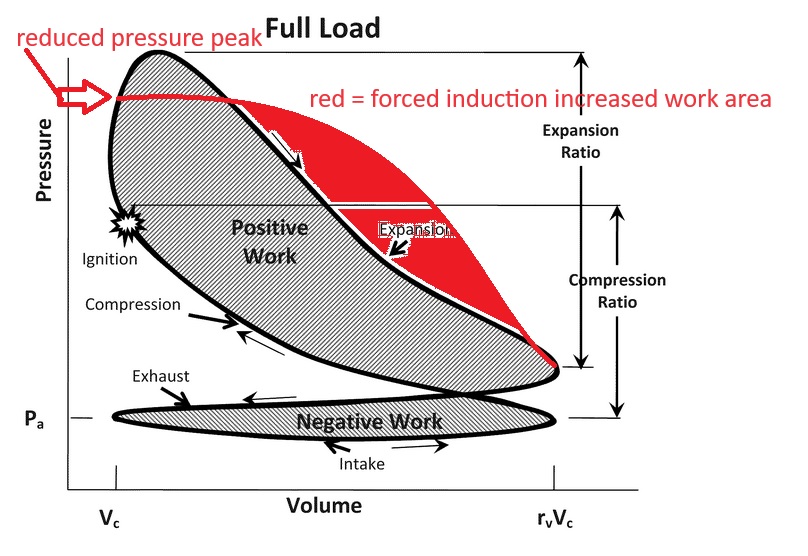
Shown is a spreadsheet I made to help visualize cylinder pressure over crankshaft degrees and how it influences torque and power output in terms of cylinder pressure over some useful range of crankshaft angles. I also included a image search picture from combustion pressure analyzer example to help visualize a modified pressure cycle, which is our goal with forced induction, to add work (red area) near appropriate crankshaft angles (at later angles) without adding any force to the piston (peak cyl pressure numbers).
Notice we can reduce the force (pressure) on the piston, reduce its peak, and take stress away from the piston, while simultaneously adding work and power to the tires.
If done properly, the engine won't even know its been forced inducted and can easily double its output in the process while reducing stress. Many people think that adding forced induction also has to increase the stress on the engine but this isn't necessary or very truthful for non-racing applications using stock engines with correct setup practices, where our tuning strategy involves cooling and slowing the reaction rate and to delay the reaction to later crankshaft angles, rather than trying to eek out every ounce of power to the max limit of the block to win some event.
This is our gold standard for reliability tuning any relatively stock engine and it can only be done by following a strict guidelines, which I will share as fast as I can type it. We wil discuss the theory of how torque is produced to understand how to get from theory to practical application.
Once again this is our tuning strategy from another point of view
We have to avoid knock
-metallurgy insert-
one good knock and its over, hole in piston or broken chunk. I call factory engines 1-mistake engines. The Turbocharged Toyota Supra engine 2jz-gte and Nissan Skyline engine RB26dett and almost every factory forced inducted engine from the 90's many of which still alive today at 150 to 200hp/liter all use the same piston materials as the LSx engines in this era including the resilient truck 4.8/5.3/6.0 variety, they are all basically supra/skyline pistons. The reason LS may seem more fragile even when tuned to less power output is partly because all of those small japanese turbo engines include piston oil squirts to help keep that brittle lattice intact, I will get into that now
Factory pistons for most engines are brittle fracture failure, meaning the process by which they are made creates an almost glass-like, low expansion alloy, that does not tolerate changes in diameter due to heating very well. High temp will kill the piston by destroying covalent bonds between atoms of its crystalline lattice, even if the piston isn't even moving and the engine is off, the bonds break at some high temperature because thermal expansion eventually rips the bonds apart trying to keep the piston from expanding in the bore. That creates internal cracks inside the piston, weakening it, which is what eventually chunks the weakest portion of a piston at some common angle for failure in that material. It can simply fall apart suddenly over time, even while just cruising, due to the building up of weaknesses and cracks deep in the materials from repeated abuse.
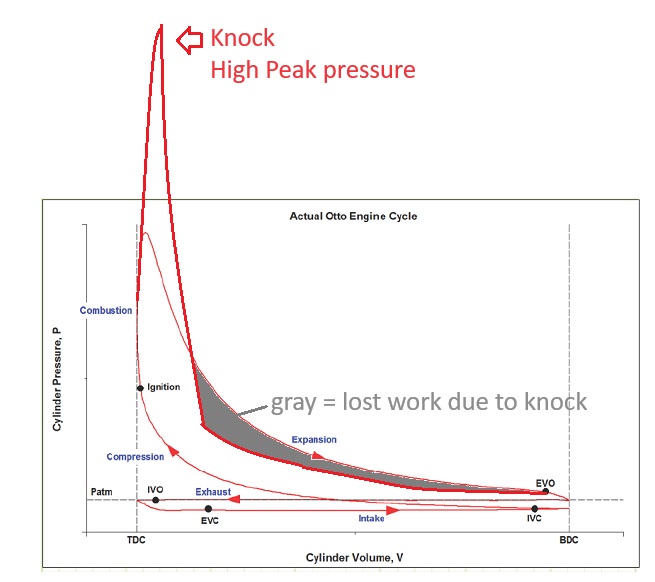
Similar, any sudden shock such as knock (above pictured spike in pressure) is going to destroy brittle piston, a fracture failure. Ductile (forged Al) materials can deform slightly and take some cushion, but factory pistons are brittle and do not deform easily under sudden shock they simple crumble to dust. A brittle piston needs a lower pressure and a slow steady push at low temperature for ideal longevity and this is going to be our focus for keeping 300,000 miles of reliability at 2x engine output.
The Strength of the factory piston is in it's lattice and tight covalent bonding, and it's weakness is any stress which damages those bonds permanently, heat and pressure. The factory pistons are ideal for daily drivers because they do not expand much in the bore, which means during cold starts at low temperature the blow-by is very low and you can run the engine hard soon after its been started without having to worry about damaging the bore. A Forged Al slug typically has a loose cold clearance and expands more in the bore as it is heating up, and this takes time usually 20 to 40 minutes of low load warming up gentle driving, you cannot just crank the cold engine and go boosting. So when it is cold those Forged Al pistons slap around and if cold and loaded up, even without boost, it can score and damage the bore because its too loose, creating streaks/gouges in the bore and skirt damage. Therefore forged pistons are generally unacceptable in daily driver applications - although there are exceptions depending on the size/alloy of the piston, environment it frequents, and careful planning of cylinder to piston clearance by setting upper limits on piston temperature and cooling jacket temperatures (cold lake water boat turbo engines which run 140*F coolant and 210*F oil set larger piston-wall iirc because of reduced expansion of the block at lower coolant temps). Another example is some Honda engines have forged alloy pistons factory, they are low expansion alloy and tiny piston with an unforgiving piston-wall that if over heated instead of damaging the piston it simply locks the piston in the bore seizing it from over-expansion. this is in comparison to aftermarket forged pistons which typically come with a larger than necessary piston-wall recommendation to make sure that when the engine is fully heated up from racing, the bore still have some space for the piston. This leads to engines that basically require a high temperature piston, gasoline style 'hot' racing fuels such as C16 and other primary branching chain hydrocarbon fuels, otherwise the piston cannot fully expand and the engine suffers dramatic blow-by and oil contamination quickly.
Torque
'Torque' is not a cylinder pressure number, that kind of torque is called instantaneous force times length (e.g. torque wrench, lug nuts, bolts, etc...)
Torque from an rotating engine is an integral of cylinder pressure over the rotational angles that the engine goes through in a single cycle, and if we look at 720* of rotational most of it is negative torque due to friction, only a small segment of rotational is torque added during power stroke.
in other words, Torque as measured through say, a 180 degree cycle of power stroke is calculated as the sum of all torque (the integration of torque at every infantesimal degree) divided by 180 degrees, minus friction/pumping loss from the rest of the cycle.
Torque is the cross product of force on the piston(e.g. lbs of force) and crankshaft lever arm length at some angle in degrees after top dead center (Force on piston in lbs times stroke/2 times the sine of the angle after top dead center where the angle theta is 0* starting from piston TDC)
Ex. Force on piston*Stroke/2/sin(theta) =[ 6,500lbs of force on the piston * 3.39"Stroke/2/sin(angle) / 12(convert to feet) ]
Notice near Top dead center, the sine of angles close to zero is approximately zero sin(0)=0. For example, with 15,000lbs of force on the piston at TDC , the engine will make torque = 0 even though we just bent the rod or blew the piston apart with so much force, it makes zero progress at the tire. This is the easy way to destroy an engine, too much force on the piston near TDC when the compression and temperature is able to be at its highest point. Right off the bat I'm going to point out that this is a major source of error for almost all novice 'tuners' and even professionals, will use a dyno generally a non-dynojet something with a steady state load to dial up the timing to find the highest brake torque possible for that load cell, and the continue on the next and so on. This leaves the engine tuned to a state of 'bleeding edge' per its fuel and temps, and is what will quickly ruin and destroy the engine over time as conditions, such as load(vehicle weight, different gears/ratios/tires), fuel quality(bad gas, wrong octane, etc...) , temperature (hot days, long drives, traffic heat soaking, high IAT, high fuel temps, etc...) So many variables will influence the cylinder pressure over time.
The coefficients which determine how much the cylinder pressure changes with those wandering conditions is primarily the ignition timing, rate of change of rpm, energy input, andfuel quality, these conditions wandering gradually are able to be 'stepping over the line' and creating cylinder pressure spikes that damage covalent bonds of brittle pistons bit by bit, leading to eventual failure. This is not how we tune factory engines for reliability, but it does give the best dyno results on paper that everybody wants to see. Its fine to wander around the timing on a dyno looking for the cleanest graph to show off, but this is not actually tuning the engine for reliability, peak numbers and reliability: those are completely different tuning ideology. All of my writing and advice and experience is with respect to reliability and safe tuning practices, not maximum power or racing applications, keep this in mind if you are reading and comparing methods, the safest method is always the lowest temperature and pressure possible and that is what we strive for with a stock engine.
We have to briefly cover these coefficients to understand their importance fully ignition timing
For reliability on cheap fuels, we always want to use the Minimum Best Timing , with a cap on energy input, I will get to that later.
This is simply the least amount of timing possible at every boost pressure that still results with a reasonable EGT and within 3 to 8% of peak possible torque. Torque and EGT trade off as a function of energy lost as heat to the exhaust when timing is being reduced, which is based on volume at the time of conversion of fuel to energy, it either goes to heat or pressure for the piston, partly absorbed by the crankshaft. Heat that cannot be converted to pressure on the piston is lost to the exhaust, when volume is larger (expanding gas but the piston is retreating too quickly down the bore for the mass of fuel being converted) more heat is evolved to rise CHT and EGT.
As ignition timing is advanced, the pressure begins to rise sharply near the TDC, which places tremendous stress on the rod and piston without actually adding much torque, and it can even reduce torque with some fuels. Alcohol fuels are especially susceptible to over-timing since they are reluctant to produce traditional knock (sudden spike 'ringing' the engine parts) while still producing very high cylinder pressures capable of damaging the engine.
Since ignition timing controls pressure, and fuel quality is constant, the only thing that can destroy an engine in terms of cylinder pressure is the timing ignition tuning.
In other words, with negative timing and constant (adequate) fuel quality, cylinder pressure will very low, to near zero and the engine cannot be harmed no matter how much boost and fuel is in the cylinder. This causes high EGT/CHT over time, which can melt the engine, but this takes time and during this time the engine won't be making any power so you are not going to just sit there at wide open throttle with zero power going to the tires and hold that rising the EGT to point it melts the engine. This is an understanding moment, not a tuning recommendation. You must realize that the timing controls the pressure and that pressure is only 1 of 2 ways to destroy the engine, the other being heat. We will discuss heat in the energy input section. You should for now take away from this example that there is no excuse for high cylinder pressure damaging any parts - that you are in control of the pressure via ignition timing, aslong as you control and aware of residual heating as a result of under-timing. A short burst of low timing that causes EGT to rise rapidly is not going to produce negative affects if its short and controlled. But sustained low output, low pressure cylinder with high EGT will melt and cause damage after some time has passed if you keep doing it. Just use common sense, low timing and short pulls to find the minimum. I will end with an example if I remember hopefully
rate of change of rpm
The faster an engine accelerates:
-the less time for leaking/blowby to calm the rising peak of cylinder pressure
-the more heat friction will be generated by compression
-the higher final inertial energy costs incur parasitic power loss (ending speed is higher when power is higher) and the higher friction costs become
-the faster a piston can escape expanding gasses compared to the previous power stroke
The slower an engine accelerates:
-more time for compression loss/leakage
-less heat input from friction of compression
-less energy lost to friction of rotating parts
-The faster gas pressure can buildup as it tries to push the piston down the bore
Another enormous discussion but I will try to summarize quickly. Believe me Im trying here rofl
You really need to know your engine behavior when trying for high RPM conditions with high output tuning, but that isn't so much an issue for dailydrivers because we limit the RPM to very reasonable numbers since we are not racing. High RPM is a deal breaker for oil systems(oil drainback / sump drained dry, lubrication flow rate failure, viscosity and temperature and bearing clearances play a role) unless steps are taken such as accusump, drainback mods, pan mods, windage mods, oil system mods(cleaning up the passages with delicate dentist tools, enlarging main orifices, increasing line diameters and filtering area, etc... ) there are all kinds of tricks you can employ to eek out a reliable 8,000rpm stocker but generally we just wana add the supercharger and go without taking apart the engine, so a safer practice is in order,
I like 6,200rpm max for 02-07 LS applications up to around 800rwhp when all the stock stuff is still in place.
I limit my daily to around 5,850rpm on the street and let out the leash for track and dyno days a bit as needed, but there is no reason to drive around 100% of the time with it set to 'kill' mode if you are not racing for money.
Okay, all that RPM talk aside, lets hit a couple key points within these topics
-more/less time for compression leakage/loss
As you turn the engine by hand, listen to it hisssssssssss and slow down as you try to rotate it with plugs in. There is leaking through the rings and sometimes valves.
The faster you rotate, the less time for leaking.
This might seem silly or negligible but actually there is a massive difference in cylinder sealing for some engines when comparing them at new 1,000 miles vs 150,000 miles.
The older the engine becomes, not only does it get a bit 'looser' the cylinders also tend to leak more and more.
This works out in our favor when adding forced induction. High mileage engines 100k+ are superior choices for daily driver forced induction when pushing some potential limitations of the displacement especially.
A brand new modern cylinder can seal up so well that it acts like a suction cup or syringe, building a massive cylinder pressure with an extremely tight synthetic oil ring seal under mild compression, easily can blow the head gasket or piston chunks even without boost, if you push too much timing. In other words, a brand new or tightly sealed perfectly round cylinders/pistons with modern synthetic oils and correct wall honing (factory does pretty good, usually) can easily be damaged without boost if enough timing is added, even with relatively low torque and power output.
again, timing is the pressure control, but the engine rate of change plays a role in how fast the gas evolution can escape while compression is increasing during the power stroke, especially near TDC.
-The slower/faster gas pressure can buildup as it tries to push the piston down the bore
Most of keeping an engine alive is keeping the pressure away from TDC, even if it means using negative timing values.
This might be a good place to show an example of such a feat
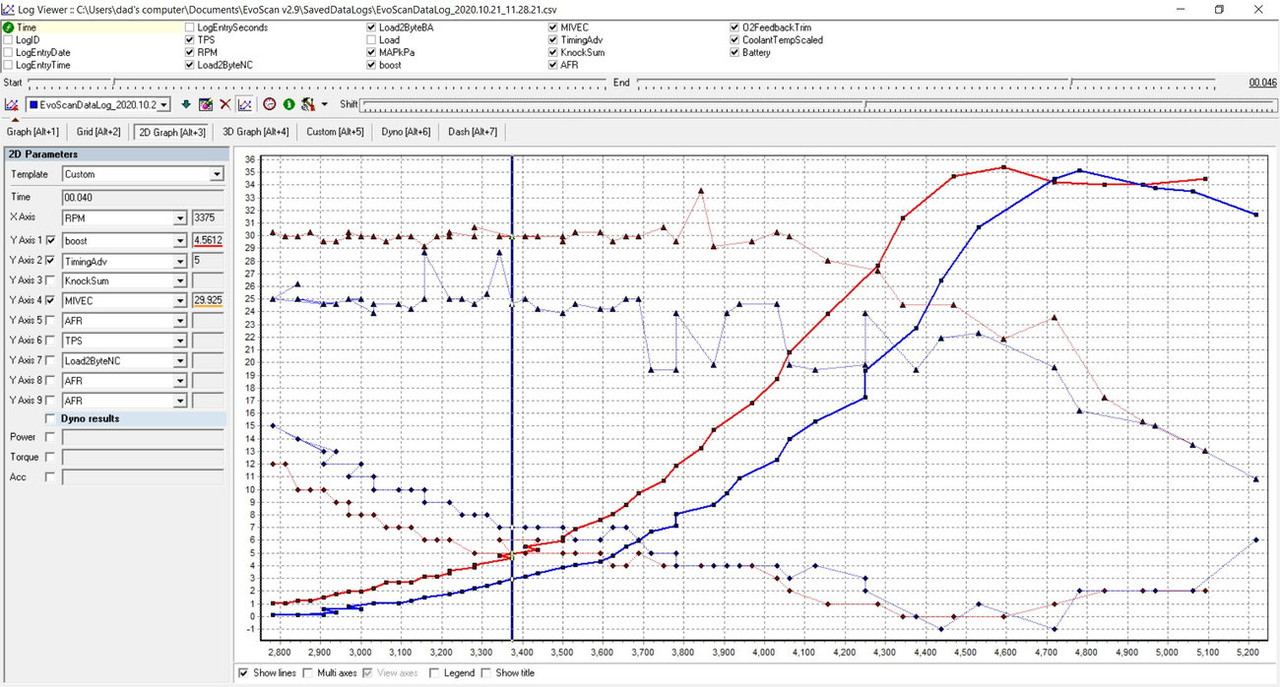
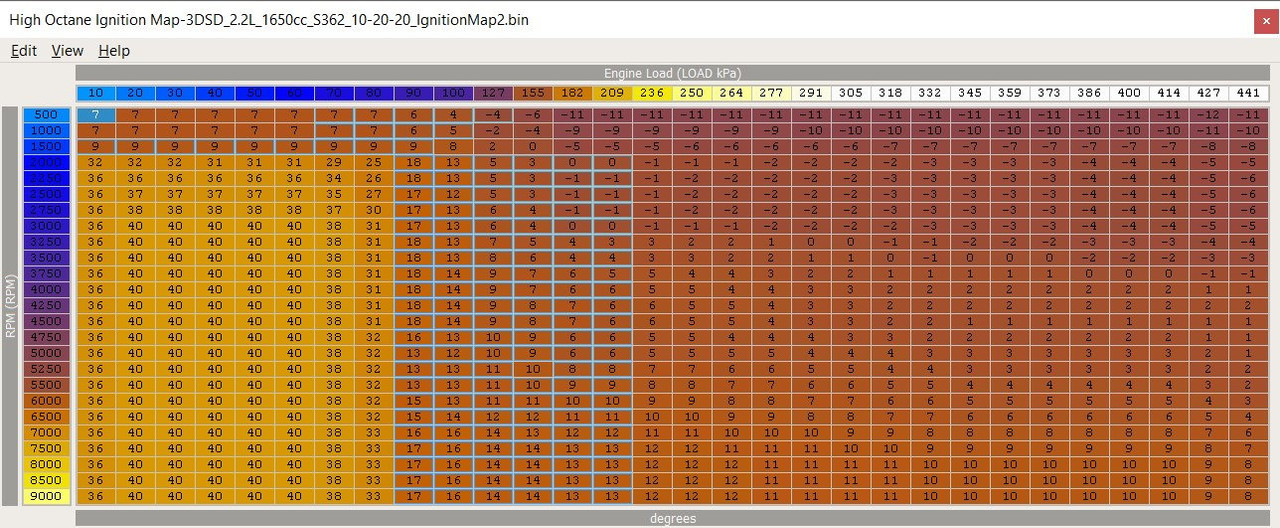
This is an 2L engine turbo with ~30psi of boost and 93 octane fuel
Timing values and desktop dyno done before real dynojet
timing map
Notice 32psi of boost and 93 octane is fine. Boost pressure is meaningless in terms of engine reliability, boost pressure really doesn't tell us anything about reliability and has nothing to do with performance other than its cost in terms of adiabatic efficiency and possibly creating leaks with high pressure or exploding plastic intakes etc...
high boost pressure on cheap fuels is absolutely easy if you know what you are doing and know your fuel. The key again is energy input & timing, plus to know your fuel behavior and the engine's cylinder head chamber design influence on combustion, and some little things like rod stroke ratio (TDC dwell) and other minor quarks such as potential hot spots or exhaust based features which limit energy input in other ways.
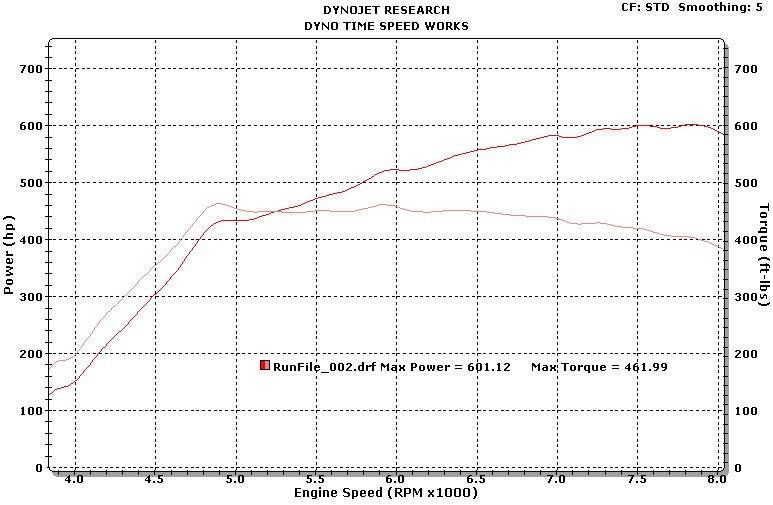
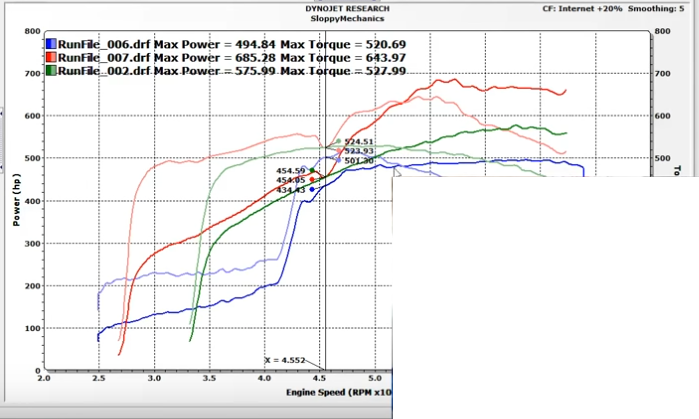
You may have heard that cylinder pressure at low rpm is what bends rods. That cylinder pressure at low RPM is bad and to rev the engine way up if you want to make torque safer. This is kind of a myth perpetuated and one need only look at the Torque curves from engines which use roots or screw/eaton style blowers to confirm that it is indeed nonsense. For example, from Sloppy mechanics, a 4.8L engine with blower at 2,500rpm and 500lbf-ft of torque on OEM 4.8L internals
Absolutely reliable at 2x to 3x factory output, even at low rpm and high torque.
Now we need to be careful here, low rpm is not the same thing as low rate of change of RPM. You can have a negative rate of change of RPM after peak power at very high RPM, the engine is decelerating as power is dropping even though it is still accelerating in general and MPH is increasing.
When the rate of change of the engine becomes negative, the timing values need to reflect the increasing expansion of combustion gasses building up behind the piston moving slower than the cycle before hand, timing should decrease.
Similarly, if the engine rate is increasing as the rpm is increasing, then the expanding gas cannot keep pace with the descending piston and the timing needs to be advanced. This is why many high rpm timing maps tend to advance timing with RPM while power and RPM are both increasing beyond a certain 'all-in' point as with a final timing via distributor. It is one of the advantages of having ECU controlled timing over mechanical.
Other factors of course such as energy input which we will get to next also play a role, right now we are assuming energy input is constant and the engine is either slowing down or speeding up, at high or low rpm.
The reason this section is so long is because this is one of myriad novice mistakes - tuning an engine in a specific gear ratio optimally.
Engines actually need different timing values for each gear, because each gear has its own rate of change and therefore its own rate of gas expansion & energy input vs piston acceleration.
The slower the engine accelerates (e.g. 5th 6th 7th gear, numerically lower ratios such as going from 1:1, 0.75:1, 0.5:1 , etc...) the less timing will be needed to keep pace with the accelerating piston. For example if we tuned the engine in 1:1 gear at wide open throttle from 60mph to 120mph using a high (higher than minimum) timing value, and then put it into over-drive and go again from 80 to 150mph, it could damage the engine over time because the slower rate of acceleration from over-drive combined with the high timing value tuned to the faster rate of acceleration will create more heat and pressure when its in overdrive and held for longer duration.
This is another reason why we tune for minimum timing in 1:1 gear, and sometimes even use overdrive gear for tuning if the vehicle will be frequently used at WOT in overdrive (6-speed Supras doing 180mph pulls in overdrive get tuned in overdrive finally)
Low RPM is a whole other issue which is reflected in the mass/inertia of the drivetrain & engine. As the piston tries to apply force to the crankshaft, the crankshaft resists turning because the flexplate, axles, driveshaft, transinternals, tires, differential, etc... all resist being turned. This resistance is what causes rods to bend at low rpm, caught between the piston and tire with no where to go it just bends a rod or pops the headgasket if you are lucky. the two keys here is fuel behavior and timing, again timing is the main controller over the pressure and its your own fault if timing causes a rod to bend. Most people do not realize you can use negative timing values to offset incredibly high cylinder pressure at low rpm to force the piston to create some volume by descent after which the timing coerces pressure to rise rapidly in that larger volume, so it does not bend the rod.
This all hinges on fuel behavior, which is goverend by energy input as well. So we have to discuss energy input and fuel behavior to understand this next
Soon I will get to energy input fuel quality / behavior
Then in no particular order I will cover many of these as possible
-max safe power ranges for the LS1 design in daily driver apps
-water injection
-transmission modifications and tuning strategy
-recommendation for specific setup (99' stock LS engine)
-I will cover intercooling in the energy input topic and probably put water injection in that section
-Couple example dynojets, timing maps, essential minimum timing tuning stuff
-Fuel economy tuning using student t-test in sample groups
-PCV / air filtering
I won't cover PCV and air filtering practices too much or other essentials that I Already provided in links above in this post, but I may briefly remind of their importance several times. Actually I will do a small section on PCV as it is perhaps the most misunderstood and essential topic to keeping a forced induction engine reliable and healthy, so there is that to look forward to.
- and more as i think of it
hopefully this thread will service a reservoir of esoteric topics essential to high performance reliability applications
To be era correct, we should spend some time to discuss what power is safe for stock LS1 engine and stock early 700/4l60e, and how to keep safely tuned.
And how we can rationalize the power and situation in terms of mileage, expectation, application and use
A brief summary
A. High quality air filtering, clean oil system practice, crankcase pressure monitoring or spot checking, paying close attention to temperatures of the oil, air, water, exhaust(egt), cylinder head(cht) etc.... data logging capability as much as possible and firmly held temperature targets
B. Setting up for success, as we've been doing calculate the flow of fuel to make sure there is always plenty of fuel, we do the same for air using compressor map to select the correct turbo/blower, the intercooler setup to keep temps low on gasoline, Exhaust insulation and shielding as needed to control component heating and underhood temps, know the chosen fuel behavior and the impact of compression, RPM, age, etc...
I should break this into 3 parts, First I will discuss cylinder pressure, stress, torque, rod bending and piston metallurgy, and the impact of tuning on these.
Second will be control tuning variables responsible for reliability, and some things we may not control easily.
Finally I will make a recommendation for a stock LS1 era correct engine with these in mind. here we go
Part I. Torque as an integral
Shown is a spreadsheet I made to help visualize cylinder pressure over crankshaft degrees and how it influences torque and power output in terms of cylinder pressure over some useful range of crankshaft angles. I also included a image search picture from combustion pressure analyzer example to help visualize a modified pressure cycle, which is our goal with forced induction, to add work (red area) near appropriate crankshaft angles (at later angles) without adding any force to the piston (peak cyl pressure numbers).
Notice we can reduce the force (pressure) on the piston, reduce its peak, and take stress away from the piston, while simultaneously adding work and power to the tires.
If done properly, the engine won't even know its been forced inducted and can easily double its output in the process while reducing stress. Many people think that adding forced induction also has to increase the stress on the engine but this isn't necessary or very truthful for non-racing applications using stock engines with correct setup practices, where our tuning strategy involves cooling and slowing the reaction rate and to delay the reaction to later crankshaft angles, rather than trying to eek out every ounce of power to the max limit of the block to win some event.
This is our gold standard for reliability tuning any relatively stock engine and it can only be done by following a strict guidelines, which I will share as fast as I can type it. We wil discuss the theory of how torque is produced to understand how to get from theory to practical application.
Once again this is our tuning strategy from another point of view
We have to avoid knock
-metallurgy insert-
one good knock and its over, hole in piston or broken chunk. I call factory engines 1-mistake engines. The Turbocharged Toyota Supra engine 2jz-gte and Nissan Skyline engine RB26dett and almost every factory forced inducted engine from the 90's many of which still alive today at 150 to 200hp/liter all use the same piston materials as the LSx engines in this era including the resilient truck 4.8/5.3/6.0 variety, they are all basically supra/skyline pistons. The reason LS may seem more fragile even when tuned to less power output is partly because all of those small japanese turbo engines include piston oil squirts to help keep that brittle lattice intact, I will get into that now
Factory pistons for most engines are brittle fracture failure, meaning the process by which they are made creates an almost glass-like, low expansion alloy, that does not tolerate changes in diameter due to heating very well. High temp will kill the piston by destroying covalent bonds between atoms of its crystalline lattice, even if the piston isn't even moving and the engine is off, the bonds break at some high temperature because thermal expansion eventually rips the bonds apart trying to keep the piston from expanding in the bore. That creates internal cracks inside the piston, weakening it, which is what eventually chunks the weakest portion of a piston at some common angle for failure in that material. It can simply fall apart suddenly over time, even while just cruising, due to the building up of weaknesses and cracks deep in the materials from repeated abuse.
Similar, any sudden shock such as knock (above pictured spike in pressure) is going to destroy brittle piston, a fracture failure. Ductile (forged Al) materials can deform slightly and take some cushion, but factory pistons are brittle and do not deform easily under sudden shock they simple crumble to dust. A brittle piston needs a lower pressure and a slow steady push at low temperature for ideal longevity and this is going to be our focus for keeping 300,000 miles of reliability at 2x engine output.
The Strength of the factory piston is in it's lattice and tight covalent bonding, and it's weakness is any stress which damages those bonds permanently, heat and pressure. The factory pistons are ideal for daily drivers because they do not expand much in the bore, which means during cold starts at low temperature the blow-by is very low and you can run the engine hard soon after its been started without having to worry about damaging the bore. A Forged Al slug typically has a loose cold clearance and expands more in the bore as it is heating up, and this takes time usually 20 to 40 minutes of low load warming up gentle driving, you cannot just crank the cold engine and go boosting. So when it is cold those Forged Al pistons slap around and if cold and loaded up, even without boost, it can score and damage the bore because its too loose, creating streaks/gouges in the bore and skirt damage. Therefore forged pistons are generally unacceptable in daily driver applications - although there are exceptions depending on the size/alloy of the piston, environment it frequents, and careful planning of cylinder to piston clearance by setting upper limits on piston temperature and cooling jacket temperatures (cold lake water boat turbo engines which run 140*F coolant and 210*F oil set larger piston-wall iirc because of reduced expansion of the block at lower coolant temps). Another example is some Honda engines have forged alloy pistons factory, they are low expansion alloy and tiny piston with an unforgiving piston-wall that if over heated instead of damaging the piston it simply locks the piston in the bore seizing it from over-expansion. this is in comparison to aftermarket forged pistons which typically come with a larger than necessary piston-wall recommendation to make sure that when the engine is fully heated up from racing, the bore still have some space for the piston. This leads to engines that basically require a high temperature piston, gasoline style 'hot' racing fuels such as C16 and other primary branching chain hydrocarbon fuels, otherwise the piston cannot fully expand and the engine suffers dramatic blow-by and oil contamination quickly.
Torque
'Torque' is not a cylinder pressure number, that kind of torque is called instantaneous force times length (e.g. torque wrench, lug nuts, bolts, etc...)
Torque from an rotating engine is an integral of cylinder pressure over the rotational angles that the engine goes through in a single cycle, and if we look at 720* of rotational most of it is negative torque due to friction, only a small segment of rotational is torque added during power stroke.
in other words, Torque as measured through say, a 180 degree cycle of power stroke is calculated as the sum of all torque (the integration of torque at every infantesimal degree) divided by 180 degrees, minus friction/pumping loss from the rest of the cycle.
Torque is the cross product of force on the piston(e.g. lbs of force) and crankshaft lever arm length at some angle in degrees after top dead center (Force on piston in lbs times stroke/2 times the sine of the angle after top dead center where the angle theta is 0* starting from piston TDC)
Ex. Force on piston*Stroke/2/sin(theta) =[ 6,500lbs of force on the piston * 3.39"Stroke/2/sin(angle) / 12(convert to feet) ]
Notice near Top dead center, the sine of angles close to zero is approximately zero sin(0)=0. For example, with 15,000lbs of force on the piston at TDC , the engine will make torque = 0 even though we just bent the rod or blew the piston apart with so much force, it makes zero progress at the tire. This is the easy way to destroy an engine, too much force on the piston near TDC when the compression and temperature is able to be at its highest point. Right off the bat I'm going to point out that this is a major source of error for almost all novice 'tuners' and even professionals, will use a dyno generally a non-dynojet something with a steady state load to dial up the timing to find the highest brake torque possible for that load cell, and the continue on the next and so on. This leaves the engine tuned to a state of 'bleeding edge' per its fuel and temps, and is what will quickly ruin and destroy the engine over time as conditions, such as load(vehicle weight, different gears/ratios/tires), fuel quality(bad gas, wrong octane, etc...) , temperature (hot days, long drives, traffic heat soaking, high IAT, high fuel temps, etc...) So many variables will influence the cylinder pressure over time.
The coefficients which determine how much the cylinder pressure changes with those wandering conditions is primarily the ignition timing, rate of change of rpm, energy input, andfuel quality, these conditions wandering gradually are able to be 'stepping over the line' and creating cylinder pressure spikes that damage covalent bonds of brittle pistons bit by bit, leading to eventual failure. This is not how we tune factory engines for reliability, but it does give the best dyno results on paper that everybody wants to see. Its fine to wander around the timing on a dyno looking for the cleanest graph to show off, but this is not actually tuning the engine for reliability, peak numbers and reliability: those are completely different tuning ideology. All of my writing and advice and experience is with respect to reliability and safe tuning practices, not maximum power or racing applications, keep this in mind if you are reading and comparing methods, the safest method is always the lowest temperature and pressure possible and that is what we strive for with a stock engine.
We have to briefly cover these coefficients to understand their importance fully ignition timing
For reliability on cheap fuels, we always want to use the Minimum Best Timing , with a cap on energy input, I will get to that later.
This is simply the least amount of timing possible at every boost pressure that still results with a reasonable EGT and within 3 to 8% of peak possible torque. Torque and EGT trade off as a function of energy lost as heat to the exhaust when timing is being reduced, which is based on volume at the time of conversion of fuel to energy, it either goes to heat or pressure for the piston, partly absorbed by the crankshaft. Heat that cannot be converted to pressure on the piston is lost to the exhaust, when volume is larger (expanding gas but the piston is retreating too quickly down the bore for the mass of fuel being converted) more heat is evolved to rise CHT and EGT.
As ignition timing is advanced, the pressure begins to rise sharply near the TDC, which places tremendous stress on the rod and piston without actually adding much torque, and it can even reduce torque with some fuels. Alcohol fuels are especially susceptible to over-timing since they are reluctant to produce traditional knock (sudden spike 'ringing' the engine parts) while still producing very high cylinder pressures capable of damaging the engine.
Since ignition timing controls pressure, and fuel quality is constant, the only thing that can destroy an engine in terms of cylinder pressure is the timing ignition tuning.
In other words, with negative timing and constant (adequate) fuel quality, cylinder pressure will very low, to near zero and the engine cannot be harmed no matter how much boost and fuel is in the cylinder. This causes high EGT/CHT over time, which can melt the engine, but this takes time and during this time the engine won't be making any power so you are not going to just sit there at wide open throttle with zero power going to the tires and hold that rising the EGT to point it melts the engine. This is an understanding moment, not a tuning recommendation. You must realize that the timing controls the pressure and that pressure is only 1 of 2 ways to destroy the engine, the other being heat. We will discuss heat in the energy input section. You should for now take away from this example that there is no excuse for high cylinder pressure damaging any parts - that you are in control of the pressure via ignition timing, aslong as you control and aware of residual heating as a result of under-timing. A short burst of low timing that causes EGT to rise rapidly is not going to produce negative affects if its short and controlled. But sustained low output, low pressure cylinder with high EGT will melt and cause damage after some time has passed if you keep doing it. Just use common sense, low timing and short pulls to find the minimum. I will end with an example if I remember hopefully
rate of change of rpm
The faster an engine accelerates:
-the less time for leaking/blowby to calm the rising peak of cylinder pressure
-the more heat friction will be generated by compression
-the higher final inertial energy costs incur parasitic power loss (ending speed is higher when power is higher) and the higher friction costs become
-the faster a piston can escape expanding gasses compared to the previous power stroke
The slower an engine accelerates:
-more time for compression loss/leakage
-less heat input from friction of compression
-less energy lost to friction of rotating parts
-The faster gas pressure can buildup as it tries to push the piston down the bore
Another enormous discussion but I will try to summarize quickly. Believe me Im trying here rofl
You really need to know your engine behavior when trying for high RPM conditions with high output tuning, but that isn't so much an issue for dailydrivers because we limit the RPM to very reasonable numbers since we are not racing. High RPM is a deal breaker for oil systems(oil drainback / sump drained dry, lubrication flow rate failure, viscosity and temperature and bearing clearances play a role) unless steps are taken such as accusump, drainback mods, pan mods, windage mods, oil system mods(cleaning up the passages with delicate dentist tools, enlarging main orifices, increasing line diameters and filtering area, etc... ) there are all kinds of tricks you can employ to eek out a reliable 8,000rpm stocker but generally we just wana add the supercharger and go without taking apart the engine, so a safer practice is in order,
I like 6,200rpm max for 02-07 LS applications up to around 800rwhp when all the stock stuff is still in place.
I limit my daily to around 5,850rpm on the street and let out the leash for track and dyno days a bit as needed, but there is no reason to drive around 100% of the time with it set to 'kill' mode if you are not racing for money.
Okay, all that RPM talk aside, lets hit a couple key points within these topics
-more/less time for compression leakage/loss
As you turn the engine by hand, listen to it hisssssssssss and slow down as you try to rotate it with plugs in. There is leaking through the rings and sometimes valves.
The faster you rotate, the less time for leaking.
This might seem silly or negligible but actually there is a massive difference in cylinder sealing for some engines when comparing them at new 1,000 miles vs 150,000 miles.
The older the engine becomes, not only does it get a bit 'looser' the cylinders also tend to leak more and more.
This works out in our favor when adding forced induction. High mileage engines 100k+ are superior choices for daily driver forced induction when pushing some potential limitations of the displacement especially.
A brand new modern cylinder can seal up so well that it acts like a suction cup or syringe, building a massive cylinder pressure with an extremely tight synthetic oil ring seal under mild compression, easily can blow the head gasket or piston chunks even without boost, if you push too much timing. In other words, a brand new or tightly sealed perfectly round cylinders/pistons with modern synthetic oils and correct wall honing (factory does pretty good, usually) can easily be damaged without boost if enough timing is added, even with relatively low torque and power output.
again, timing is the pressure control, but the engine rate of change plays a role in how fast the gas evolution can escape while compression is increasing during the power stroke, especially near TDC.
-The slower/faster gas pressure can buildup as it tries to push the piston down the bore
Most of keeping an engine alive is keeping the pressure away from TDC, even if it means using negative timing values.
This might be a good place to show an example of such a feat
This is an 2L engine turbo with ~30psi of boost and 93 octane fuel
Timing values and desktop dyno done before real dynojet
timing map
Notice 32psi of boost and 93 octane is fine. Boost pressure is meaningless in terms of engine reliability, boost pressure really doesn't tell us anything about reliability and has nothing to do with performance other than its cost in terms of adiabatic efficiency and possibly creating leaks with high pressure or exploding plastic intakes etc...
high boost pressure on cheap fuels is absolutely easy if you know what you are doing and know your fuel. The key again is energy input & timing, plus to know your fuel behavior and the engine's cylinder head chamber design influence on combustion, and some little things like rod stroke ratio (TDC dwell) and other minor quarks such as potential hot spots or exhaust based features which limit energy input in other ways.
You may have heard that cylinder pressure at low rpm is what bends rods. That cylinder pressure at low RPM is bad and to rev the engine way up if you want to make torque safer. This is kind of a myth perpetuated and one need only look at the Torque curves from engines which use roots or screw/eaton style blowers to confirm that it is indeed nonsense. For example, from Sloppy mechanics, a 4.8L engine with blower at 2,500rpm and 500lbf-ft of torque on OEM 4.8L internals
Absolutely reliable at 2x to 3x factory output, even at low rpm and high torque.
Now we need to be careful here, low rpm is not the same thing as low rate of change of RPM. You can have a negative rate of change of RPM after peak power at very high RPM, the engine is decelerating as power is dropping even though it is still accelerating in general and MPH is increasing.
When the rate of change of the engine becomes negative, the timing values need to reflect the increasing expansion of combustion gasses building up behind the piston moving slower than the cycle before hand, timing should decrease.
Similarly, if the engine rate is increasing as the rpm is increasing, then the expanding gas cannot keep pace with the descending piston and the timing needs to be advanced. This is why many high rpm timing maps tend to advance timing with RPM while power and RPM are both increasing beyond a certain 'all-in' point as with a final timing via distributor. It is one of the advantages of having ECU controlled timing over mechanical.
Other factors of course such as energy input which we will get to next also play a role, right now we are assuming energy input is constant and the engine is either slowing down or speeding up, at high or low rpm.
The reason this section is so long is because this is one of myriad novice mistakes - tuning an engine in a specific gear ratio optimally.
Engines actually need different timing values for each gear, because each gear has its own rate of change and therefore its own rate of gas expansion & energy input vs piston acceleration.
The slower the engine accelerates (e.g. 5th 6th 7th gear, numerically lower ratios such as going from 1:1, 0.75:1, 0.5:1 , etc...) the less timing will be needed to keep pace with the accelerating piston. For example if we tuned the engine in 1:1 gear at wide open throttle from 60mph to 120mph using a high (higher than minimum) timing value, and then put it into over-drive and go again from 80 to 150mph, it could damage the engine over time because the slower rate of acceleration from over-drive combined with the high timing value tuned to the faster rate of acceleration will create more heat and pressure when its in overdrive and held for longer duration.
This is another reason why we tune for minimum timing in 1:1 gear, and sometimes even use overdrive gear for tuning if the vehicle will be frequently used at WOT in overdrive (6-speed Supras doing 180mph pulls in overdrive get tuned in overdrive finally)
Low RPM is a whole other issue which is reflected in the mass/inertia of the drivetrain & engine. As the piston tries to apply force to the crankshaft, the crankshaft resists turning because the flexplate, axles, driveshaft, transinternals, tires, differential, etc... all resist being turned. This resistance is what causes rods to bend at low rpm, caught between the piston and tire with no where to go it just bends a rod or pops the headgasket if you are lucky. the two keys here is fuel behavior and timing, again timing is the main controller over the pressure and its your own fault if timing causes a rod to bend. Most people do not realize you can use negative timing values to offset incredibly high cylinder pressure at low rpm to force the piston to create some volume by descent after which the timing coerces pressure to rise rapidly in that larger volume, so it does not bend the rod.
This all hinges on fuel behavior, which is goverend by energy input as well. So we have to discuss energy input and fuel behavior to understand this next
Soon I will get to energy input fuel quality / behavior
Then in no particular order I will cover many of these as possible
-max safe power ranges for the LS1 design in daily driver apps
-water injection
-transmission modifications and tuning strategy
-recommendation for specific setup (99' stock LS engine)
-I will cover intercooling in the energy input topic and probably put water injection in that section
-Couple example dynojets, timing maps, essential minimum timing tuning stuff
-Fuel economy tuning using student t-test in sample groups
-PCV / air filtering
I won't cover PCV and air filtering practices too much or other essentials that I Already provided in links above in this post, but I may briefly remind of their importance several times. Actually I will do a small section on PCV as it is perhaps the most misunderstood and essential topic to keeping a forced induction engine reliable and healthy, so there is that to look forward to.
- and more as i think of it
hopefully this thread will service a reservoir of esoteric topics essential to high performance reliability applications
Lets do this part real quick because you may try to make a decision shortly, I don't want to slow that down -recommendation for specific setup (99' stock LS engine)
I will give my recommendation for you now based on everything so far , including the fact that I Am not the one tuning the engine and I do not know the current condition/ compression of the engine etc... and that the transmission is original and a 4l60e.
-I recommend the 340lph pump, either return or returnless system would be fine I think
-Limit power expectation to around 450rwhp~ for the sake of the transmission mostly
-Use a trans-go shift kit to extend the life of the transmission and raise the WOT shift pressure using a boost valve(sonnax) or by installing a mechanical gauge and fine tuning the EPC Solenoid with the ECU (more difficult more rewarding in theory)
-Keep boost pressure down to 7 to 10psi to preserve the transmission and keep away from the fuel pump limitation so it does not become an issue
-maximize the use of torque management... for the transmission sake. Like seriously turn it wayyy up there are a few settings I can share in the ECU if those tables are available.
-Absolutely intercooler the largest intercooler you can fit in the front mount position and upgrade the radiator/fan systems and replace/check/renew all duct work and air dam
-Relocate the IAT to the charge pipe before the intake manifold after the intercooler, use plastic insulating washer and quality OEM IAT sensor
-if possible pin the crank. Probably not needed for a small blower but... its not that hard to do and could save the crankshaft
-Replace the balancer, preferably with a ATI damper
-Setup the PCV system / air filtering using my directions(links + ask questions) and eliminate the catch can system. Target crankcase pressure is 0.5" to 2"Hg for wet sump V8 engines generally, you muse measure and set this your self. See links and search "kingtal0n pcv" in any search engine for probably a hundred results if you wish on various car forums.
-80lb/hr to 160lb/hr injectors from FIC, InjectorD, or similar high quality , do not buy amazon or ebay injectors, the most important purchase you will make besides a new transmission and 9.5" lockup converter is the injectors.
-Consider a probuilt 4l60e(700r4l60e.com) with 9.5" lockup 3200~ converter (will cost as much as a new car, but its the only semi-permanent solution)
-At 10psi of boost maybe 14 to 15* of timing 11.0 to 11.2 air fuel ratio gasoline is going to stick 1:1 gear very well
-You will use TR6 cheap copper NGK plugs for tuning, then toss them garbage, after its been tuned. Then, install new TR6 plugs, copper cheap TR6 again, and drive 700 to 5000miles, and take them all out. If they are all clean and look the same , and compression is straight across the board, and the engine is clean inside, you will go to heat range 7 iridium spark plugs for permanent install and lock the tune there, no more tuning. Never touch spark plugs with human skin contact. Then, they (iridiums 7) will last 50k to 100k miles from that point if kept clean (PCV, filtering, oil system, etc...).
Use only a tiny dab of anti-seize way up on the threads, away from the business ends of the plugs, it will ooze down over time. Never let anti seize touch the ends of the plugs, you have to throw it away.
Spark plugs serve as tuning and engine health diagnostic. First, they serve tuning, then engine health for the long term. I can do a section on cleaning the engine carbon and how the spark plugs change over time depending on the combustion character but for now, try to remember that tuning the engine lean for idle/cruise is preferable, say 15.2 to 15.8:1 air fuel ratio in open loop is ideal, this will keep spark plugs looking new and clean, and cut down on carbon buildup in the chambers. But it is difficult to pull off for non-tuners so it might not be an option for you currently. Perhaps take a look at Hptuners website and see if you want to get into tuning a little yourself, you can get it tuned and then unlock it yourself and play with spot adjustments such as shift points and work on the open loop tuning profile, which is the actual tune of the ECU outside of corrections caused by wandering in closed loop. Modern Stand-alone offer wideband closed loop but OEM ECU from this era does not so its an option but can be difficult for novices.
I'm sure I am leaving things out but this should get you started. The idea here is, limit boost and power for now to keep the relatively tiny fuel pump (340lph is tiny) happy and not run lean, large enough injectors to cover the spread of 40 to 60psi baselines even with that fuel pump, and help keep the transmission alive. Treat the transmission like glass. The lower boost will also help with IAT and help sneak a smaller intercooler in. If the engine has 100K+ miles it will be relatively stable and safe there even with mediocre tuning if the IAT and Oil temps are kept in check (read my links provided....)
I started on this. It was longer than I ever thought and I'm about halfway. Here is a taste, rough draft okay, the only post I should edit over time until I hit some character limit or picture limit
Energy input and fuel behavior
Starting with behavior of fuel and then looking at ways energy gets input and output from the various materials/fluids around an engine
Discuss two common fuel types for daily drivers: Gasoline (HC) and Ethanol (EtOH).
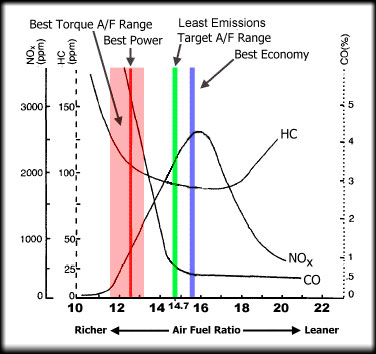
When you think of gasoline, word associate it with: heating, economy, efficiency, distance
For alcohol, words are: racing, cleaning, cooling, energy trashing, wasteful
Alcohol, Ethanol
Short carbon chain Alcohols are a racing fuel, ethanol particularly being safer and cleaner than gasoline for any application, when comparing the two fuels alcohol is superior in almost every way, it can even clean the combustion chamber. A major performance-related drawback to alcohol fuels is their terrible BSFC which means much more alcohol has to go into the engine (burn much more volume of alcohol from the fuel tank than gasoline branching carbon chain(hydrocarbon) fuels) to make the same power(kilowatts at the tire) as gasoline, so alcohol is a more wasteful, expensive option, which requires more powerful fuel pumps to provide that extra volume of alcohol, which increases fuel system complexity & cost. So you will burn more alcohol and spend more on alcohol and spend more setting up for alcohol fuels, and potentially have more issues with fuel system maintenance, with the reward that alcohol is absolutely an incredible racing fuel useful in almost any situation other than normal driving, cruising around trying to get MPG is terrible fuel economy the more alcohol content is involved.
Another potential drawback to alcohol, mainly E85 from a pump, is contamination of biomass which has been known to clog fuel filters. There are some warning on aeromotive website about that, but I've never seen it happen to any of the cars I tuned on EtOH.
Alcohol is also an incredible solvent, so fuel system with a layer of settled debris, dirt, slime, etc... anything thats been allowed to sit and collect in the tank out of the gasoline over time, if you suddenly add alcohol fuel to that tank it will dissolve all that goop slime sludge etc... and that will clog up the fuel filters immediately. SO if you plan to switch to alcohol from gasoline and the fuel tank is very old and only always had E10 gasoline in it... beware... you may need to flush and clean the original ancient fuel tanks first free from settled mud and slime, before increasing alcohol content very high.
Another potential problem with alcohol is that it can absorb quite a lot of water from the air, so when storing alcohol in a fuel tank the tank must be absolutely air tight via checkvalves which regulate tank pressure. A single open free flowing vent is sure to eventually cause water contamination and corrosion/rusting/oxidation type of problems inside the fuel tank when alcohol can sit for some length of time. The water carried by alcohol into the fuel rails will additionally eat and rust the injectors completely. Now THAT I have seen. When the vehicle has to sit for more than a few days, always flush with gasoline fuels. And if it will sit for weeks+ always put gasoline in the fuel tank and get rid of the alcohol imo.
Thus alcohol has some disadvantages which lead to increased fuel system maintenance and some issues to be aware of as well.
Alcohol is an ideal fuel, safer & Superior to gasoline, but it is a pain to plumb/maintain and more expensive
On terminology
When I say alcohol, I mean generally fuels as methanol, propanol, ethanol, etc... some of which are incredibly toxic. So 'alcohol fuels' includes methanol, ethanol, other alcohols in general which might be considered as fuel.
When I say ethanol I specifically refer to the Ethanol in vodka, hand sanitizer, and E85, ethanol is safe to handle unlike methanol which turns to formaldehyde in the presence of dehydrogenase enzyme (turns to fixation solution in your skin). I use methanol in my lab to fix tissues before embedding to paraffin for making slices into slides, the methanol instantly freezes cellular components in place, instant-death-stop. Even bacteria won't eat methanol fixed tissue anymore, its become unrecognizable, a sort of imperfect statue.
Ethanol on the otehr(other rofl) hand, is the type of alcohol the liver can process fully (correctly) into products CO2 and H2O, so it is safe to handle and drink, people drink ethanol with every kind of alcoholic beverage, it is the only safe alcohol I know of for drinking purposes, the more ethanol in the fuel system the safer to come into contact with it becomes in theory. Safer than gasoline and other fuels, anyways. Just remember E85 still has gasoline in it.
Methanol is extremely toxic and to be avoided, even though it is also an incredible racing fuel, I never recommend any methanol systems for daily drivers, unless extreme caution is taken to avoid contact and thorough rigorous replacement and inspections of the delivery are kept. In which case small doses of methanol have a protective function for fuel octane rating and boost gasoline's tolerance of high temperature in high output forced induction daily drivers being used at the fringes of their temperature capability. In other words, I always use methanol(50/50) because its incredibly effective sprinkled into gasoline engines, but I can get away with it because I understand how dangerous it is and how to protect myself from it. Much of what I recommend to any people for their performance cars is based on the longevity or danger of that thing, not whether its going to increase power; Removing an air filter will generally always increase power, but the cost is so high only an insane person would do it when they can see what is really in the air. If you could feed the engine purified air you wouldn't need an air filter... by making the air box so large that the filter no longer creates a pressure drop. But now the crankcase pressure will rise and create major problems with oil in the intake and oil leaking from seals.... you need a vacuum pump now if you refuse to create a vacuum with the air filter.
Flex-Fuel
Flex fuel gives our normal daily drivers with their inexpensive gasoline fuels a chance to switch over suddenly to high alcohol content without any disruption or re-tuning to normal operation, assuming you've been tuned using a flex-fuel sensor correctly.
We can put a daily driver into 'race mode' and turn up the boost/power by adding Ethanol content to the fuel tank and then when finished go back to regular old gasoline fuel to save money cruising around. Flex is ideal, a game changer for suitable power plants (the right engine setup to take advantage of the flex appropriately), as ethanol lends many performance benefits when used to the extent of its capability. Understanding the alcohol's ability is part of what I am going to discuss here so you can easily know whether it is needed for your intentions.
Because this is leading to the discussion about energy input I should point out that even if you change little in terms of performance parts when adding alcohol content, it may still perform better, safer, more reliably in demanding situations, on the alcohol rather than on gasoline(with alcohol tuning/supply), due primarily to the energy removal that alcohol provides in and near the combustion chamber as it evaporates in such high volumes after leaving an injection site near the engine. This of course kills the BSFC but it cools the engine to make it safer in high output, particularly long duration hard running conditions, therefore alcohol is always a clear winner if you can afford the alcohol / fuel system maintenance to help protect the engine from demanding conditions which may elevate temperatures on gasoline to un-safe levels. I have tuned vehicles running only E85 every day and their owners demand absolute max power every day and drive all over the place with that 8mpg or whatever, some people do that, never even touching gasoline unless emergency stranded, the cost of fuel is not a bother to them. On the other hand some people require 25mpg or 30mpg from their vehicles and drive long distances, and alcohol is not suitable for that if you don't like to spend money and stop for gas. That is the really the mind-set behind flex-fuel: Think about primarily using alcohol, and switching to gasoline only as a means to improve distance, mileage, save money, etc... You can use alcohol just fine to cruise and idle, it will even keep the engine cleaner than gasoline this way, help pass emissions test maybe, its just more expensive than gasoline currently. In Mad Maxx situations you want the gasoline to get high mileage from a tank volume, and alcohol is easily produced from sugar but gasoline not so much, you can make all the ethanol you want pretty easy in the backyard when gasoline becomes scarce...
Heat capacity vs Heat of Vaporization
Liquids have a heat capacity, and a heat of vaporization, these are separate properties. There is little literature on this subject in reference to injection systems for hobby level automotive application, it is usually hinted at but never fully addressed, I will now though
When fuel is injected initially it's temperature must be raised to boil, this is it's heat capacity absorbed energy.
Once the liquid has reached a boiling point it changes phase to gas and this is it's vaporization energy absorbed.
Energy may be input a number of other ways, convective, radiated, etc...
A. Shear forces as airflow creates turbulence and boundary separation occurring wildly helps break apart fluid droplets
B. Pressure changes, pressure waves (acoustic) and pressure scalar lowering during engine operation can help fluids evaporate
C. Convective heat transfer, this is the hot air we pre-warmed from earlier transferring heat to the fluids in the runner
D. Radiative heat transfer, the runner and valve is warm and this gives off radiated heat that enters the air/fuel mixture)
There is more to the phase transitioning of fuel than simply its heats of vaporization and heat capacity, this subject is energy input so we've got to think of other sources, for example high velocity fluid and turbulence will help whip and vaporize fuel into a gas, without much aid of temperature input form of energy. Nevertheless, the heat capacity and heat of vaporization have enormous implications and impact on the gasoline tuning of daily driver engines, for a variety of reasons.
For now I asked copilot to make a summary in different units for these, but in the future i'd like time to apply them finding heat removed in some various situations for a forced induction engine to show the cooling power of alcohol in it's sheer volume and high heat of vaporization at some inlet air temp T and compressor adiabatic vs intercooling, etc...
Why the critical distinction in the context of tuning
When fuel leaves an injector, it is liquid. If it is a very hot liquid, there will be less cooling effect.
Gasoline and Alcohol both can be cool liquids, with effective heat capacity. When fuels become very heated in the fuel system by powerful pumps and high pressure and exposure to exhaust energy, the effective heat capacity is lost because now instead of absorbing energy from the valve or cylinder, fuel is absorbing energy from the exhaust or electrical system.
The units for heat capacity is in J/g*K , Joules per gram*Kelvin
For example Gasoline at 70*F must boil by 180*F,
Lets say 12ms of fuel from a 100lb injector delivers by my rough calc 0.1514g of gasoline E0
8 of those injectors at 6000rpm should be 480lb/hr total fuel supply
BSFC .62 power output maybe 775bhp (remember E0 gasoline)
From 70*F to the boiling point of gasoline 180*F is about 20Joules of energy removed
From 100*F to the boiling of gasoline 180*F is about 14Joules
The heat of vaporization when 0.1514g gasoline turn to gas is about 53Joules
Thus the 70*F gasoline injection supplies around 36% of the energy removal as the heat of vaporization
Whereas 100*F injection only supplies 26% of the energy of vaporization
So a ~10% difference in energy removal, 5.4Joules per injection ,
If this is at 6000rpm for 10 seconds, that is 4,000 injections of 0.1514g gasoline
4000 times 5.3Joules is 21,600Joules
6L of engine oil 0.85kg/L = 5.1kg engine oil, with 2000J/kgK heat capacity
21,600J/(5.1kg*2000J/kgK) = 2.12*C = 3.82*F
It would rise the entire 6L volume of engine oil by around 4*F extra over the course of 10 seconds by injecting gasoline at 100*F instead of 70*F if all the extra heat went into the oil.
Around the pistons however, the oil is splashing, and dripping off. It is not in constant contact with engine oil flow at all engine speeds unless it has a oil squirter directed under the piston.
Instead, the oil covered area of 8 pistons is probably 0.123m^2 for 4inch piston with 2" exposed to oil (8 pistons)
With 50uM film thickness is around 6.5mL of oil , lets double that for natural splashing to 13mL engine oil.
13mL of engine oil with 21,600Joules invested is around 1700*F temperature increase!
now 13mL is quite small but you start to make it larger 50mL 100mL and so forth you will notice that the oil has a tremendous cooling influence and that even a tiny change to the fuel temperature can have implications for the temperature of oil around a piston, and the piston itself. Part of keeping the engine healthy and reliable is controlling the temperature of the piston, KNOWING your pistons are nice and cooled, and knowing how to know, because really its more of a feeling that you've done everything you could. But you will not be able to do everything you could have if you do not understand the heat capacity nature and vaporization ability of the fuel you are working with, nor the oil influence on a piston and the pressure around a piston (crankcase pressure) which changes how easily oil can drip and drain from the piston. Thus the fuel injection temperature is linked to crankcase pressure and engine reliability, oil burning, oil behavior.
A word on injection atomization, injection energy
The fuel injector nozzle may help to break apart liquid droplets. Some do very well, some are just pencil-like streams of liquid, or a fan spray,whatever.
The fuel pressure plays a role in the energy supplied during injection to help break apart the liquids if the nozzle allows / is designed this way.
When the fuel injection pressure helps fuel to vaporize, the energy of injection pressure is what drives the fluid to a gas state, instead of temperature.
In other words, temperature rises at the nozzle of the injector due to friction, instead of decreasing at the valve/cylinder.
To put this one more way, if an injection nozzle works with a high fuel pressure to help the fuel reach a gas state(instead of simply pooling the fuel onto a closed intake valve, for example), then the fuel loses its ability to cool whatever it touches (since its been already pre-broken apart nearing phase change by the nozzle)
You can think of it as if the fuel has some requirment for energy to turn to a gas, where does this energy come from?
If it comes from the valve, the fuel cools the valve.
If the energy supplied from the air in the cylinder as fuel enters the cylinder and vaporizes, then it cools the cylinder fluid.
And if the energy is supplied by the fuel pump inducted by nozzle friction heating, then the fuel no longer cools the valve or cylinder.
Extrapolate this idea to water injection systems and you will realize water needs to be a liquid when it enters the cylinder to have intended affect for piston cooling. And you should spend the time to look up WorldWar2 water injection strategies to read about how this is entirely the case of their use.
Low pressure injection to ensure a cool puddle of fluid can reach the intake valve has been an OEM staple in Japanese domestic market Turbocharged engines since the 80's leading up until direct injection.
If injecting to an open intake valve at later crankshaft angles (say 290 to 240* BTDCC) in the hopes of matching fluid momentum and boosting the influence of peak piston velocity with a high heat of vaporization fuel such as Ethanol that does not need to rely much on heat capacity in a given application, then the situation can be quite different, and more injection pressure with nozzle 'atomization' (it isn't turning to atoms rofl I don't like that word) could be beneficial. Although I will say in my Personal experience tuning Flex Ethanol engines the injection angle that seems to work best is pre-intake valve opening around 440 to 480* btdcc, usually the owner doesn't buy large enough injectors to fit everything within the necessary window near PPV and it winds up spraying into overlap which usually makes everything worse off, smell and performance wise. And particularly 4 and 6cylinder inline engines like the RB, 2J, SR20, 4G, do not seem to respond well to open intake valve (PPV) injection. Maybe because they have 4-valves per cylinder, I'm not sure. It seems mostly like a V8, 2-valve phenomenon and wow does it help to nail the injection timing in many cases.
getting to think about starting to knowing your fuel
I will assume boiling point of 150 to 180*F for gasoline, because it is a blend of so many different hydrocarbons they all have individual boiling points, it is impossible to say one exact value. Generally much of the gasoline components, especially fresh gas with many lightweight hydrocarbons, will begin to boil off before 150 to 180*F, gasoline is more volatile than ethanol for many reasons. Even just sitting in an open container the light chains are leaving rapidly diminishing the gasoline's quality, it 'going stale' or 'producing varnish' or whatever. Low quality heavy chains of gasoline evaporate more slowly, I call them lower quality because these are generally the more stable stacking flat hydrocarbons more resembling to engine oil than a quality light chain of gasoline. High quality low carbon chain gasoline fragments are usually branched as we will see and this aids in their evaporation due to lower surface interaction energy between hydrogens and carbons, as they do not stack well and get close to each other easily like the flatter, lower quality chains will.
Ethanol's hydrogen bonding and higher heat capacity lend it a lower vapor pressure, and ethanol has a higher boiling point than many of the hydrocarbons in gasoline, even though its 46g/mol compared to gasoline around 114g/mol. Alcohol liquid(ethanol) is more dense liquid than gasoline, even though less than half of it's molecular weight, due to hydrogen bonding which helps alcohol molecules pack tightly, along with very short 2-carbon chains they really pack well.
Gasoline is a heavier molecule and generally/usually (but not in this case) heavier means less volatility and less vapor pressure but the powerful influence of hydrogen bonding between alcohols those intermolecular forces help hold it together and keep it from evaporating rapidly like gasoline. In a cold engine, ethanol can be difficult to evaporate which makes it hard to start the vehicle, in extremely cold climates sometimes we use a little shot of gasoline to get things going, or a long delay after the initial prime pulse before cranking to give time for alcohol to turn to vapor. This same annoying cold start property of alcohol is what gives it the incredible knock resistance and high heat of vaporization. Gasoline on the other hand having branching structure(as opposed to flat stacking features like long chain fatty acids and n-heptane like variations of gasoline) and weak intermolecular forces of mostly neutral hydrogens and carbons allows it to vaporize quickly, where it can be attacked by oxygen radical in a gas phase and commit to combustion process in whole or in part, sometimes leaving unreacted carbon/oxygen radicals behind, gasoline products that do not react completely can leave black carbon coatings, hard diamond like or sticky tar-like substances that collect anywhere they can, circulate into engine oil, and lead to engine failure in various way, so again gasoline is kind of worse than alcohol in that alcohol because of its short chain length and solvating activity will rarely form unreacted conglomerates during combustion and often alcohol fuels may even clean carbon out of an engine over time, if an engine is very old and used gasoline for a long time it might be worth running high content alcohol for a while to clean it up if you dont plan to rebuild right away as an example. E.g. A carb engine that sat for years, the valves covered with hard carbon, jet it up and cruise around town for a couple weeks/months on E70 and like magic the valves may close again, the hard carbon dissolved and with that, compression returned and improved across the board.
Octane rating in gasoline
The Gasoline Branching structures lend steric hindrance which reduces the potential for a successful oxygen radical attack, the oxygen molecule by itself with a single electron collides with the fuel looking for a successful chemical reaction, stealing an electron and forming a bond with a new atom, either carbon or hydrogen (forming CO2 and H2O as combustion products).
The amount of unsuccessful collisions on behalf of an oxygen radical due to branching chain structures is what improves the octane rating of gasoline dramatically. Behold, two types of gasoline used to create the 'octane' rating
Thus, An octane rating of say, 72, means that the mixture reacts in a("their") test engine the way that a mixture of 72percent 2,2,4-trimethylpentane (2,2,4TMP) and 28 percent n-heptane would react. They key being the word 'would' since modern gasoline is a blend of more molecules than I can name comfortably so I won't even try. The point being that no matter whats 'inside' the gasoline you purchase, the octane rating is merely a badge of behavior for that batch of gasoline, not an ingredient list or guarantee fraction of specific molecules. One station's 93 could just as easily be a completely different mixture and still be labelled 93, the sufficient blend of unknown additives driving up the octane and replacing actual 2,2,4TMP. Alcohol for example, which raises gasoline octane, allows for less 2,2,4TMP to be used in the mixture.
Why is 2,2,4-TMP more expensive? Because it is highly branched, and creating the branching short chain hydrocarbons takes energy and costs money. It seems that whatever they pull out of the ground is mostly flat chains, like the n-heptane flat 0 octane, because that must be what crushing hydrocarbons does over millennia I guess.
Note that both of these are gasoline. There is 0 octane gasoline and 100octane gasoline available, and everything between and beyond probably.
They are roughly same molecular weight and properties as a liquid/gas, probably even smell similar. Gasoline's unique aroma I imagine is due to its composition and not a single hydrocarbon but I digress - If we have a container of 0 ZERO octane, 87, 93, and 100octane gasoline in front of us, it would be hard to tell which is which I think, at a temperature that they are all liquid anyways.
A chemical reaction of combustion can occur when oxygen radical successfully attacks a covalent bond between appropriate atoms disrupting its covalent attachment to another atom, the bond jumps to the oxygen, which breaks the receiving molecular apart into fragments facilitating additional accessibility for more oxygen radicals to collide. That is, the faster the initial onset of radical attack the faster the chemical reaction can proceed releasing heat and expanding gas.
This requires that the oxygen radical not only have enough velocity overcome the reaction energy barrier, it also needs to strike in an opportune location on the gasoline structure where the covalent bond of electrons is exposed at that exact instant. If we look at the branching structure, vs the flat chain hydrocarbon design, it should gradually become clear that the branching hinders the oxygen radical's access to opportune covalent bonds- the branching structure is called 'sterically hindered' by a concept known as steric hindrance, and this property of hydrocarbon soup that is gasoline directly controls it's octane rating as the more sterically hindered the hydrocarbons become the fewer oxygen radical collisions become productive and the slower the chemical reaction of combustion evolves over time... thus higher octane gasoline fuel are often referred to as 'slower burning' than their low octane counterparts, and this seems to be correct at least in the context of chemical chain reaction inside a combustion chamber with multiple sources of energy input. This is just one way to control the rate of chemical combustion: hinder the covalent bonds from oxygen radicals with branching hydrocarbon structure.
Ethanol has a boiling point 173*F very close by. I will keep 180*F interchangeably for both with all following discussions to keep the math simple, when I say 'fuel boiling at 180*F' I am referring to either/both fuels. Also, air pressure and an seemingly infinite number of possible energetic interactions (surface area, capillary action, membrane film, electrostatic field, turbulent air, reduced boundary layer, etc...) also affect/influence boiling point, so lets assume our engines all have same conditions inside, to keep it simple there as well.
When injected, fuel at first is a liquid. As the temperature increases, the fuel absorbs energy before it boils, this is based on its current temp and heat capacity.
Once the liquid is able to 'escape' - molecules of fuel with enough energy to break free from their liquid, closely interacting state, and ejected into the air as a gas state molecule by itself, this is known as 'sufficient escape velocity' and explains how ice cubes sublime in the freezer and why food becomes freeze dried. That is, water molecules, and fuel molecules, whether they are solid(ice) or liquid(gasoline/alcohol/water) there exists some percentage or population (statistics) of molecules with enough energy to leave the substrate, ejected into a gas state over time. Whenever a liquid molecules does this, gains energy to leave as a gas, it carries heat away with it because that heat invested itself as the energy needed for that gas molecule to suddenly take flight by itself. molecules closely interact, gasoline, alcohol, water, liquids are close together, to break free means to gain energy somehow to break those close interacting forces.
When the liquid turn to a gas finally, the heat they carry away is called 'heat of vaporization' and this is the primary way that alcohol fuels protect the gasoline internal combustion engine (ICE). Alcohol has a much higher heat of vaporization and you need more of it than gasoline, so its a kind of double whammy on heat. This of course ruins the engine's BSFC and ruins economy in the design (if designed for gasoline especially) but making performance and high output safer , and cleaning up in the process (short carbon chains less likely to create deposits; alcohol a powerful cleaning solvent, able to dissolve water soluble deposits, partially oxidized fuel remnants (partially reacted hydrocarbons containing oxygen), polar contaminants, some types of gum and varnishes etc...
Energy inputs
Heating
Molecules in liquid and gas are in constant motion and changing position rapidly, their internal energy(kinetic energy) at the moment of collision is a factor in the energy reaction barrier, more energetic molecules (higher temperature and moving faster, jostling and rotating etc...) are generally more likely to commit to a chemical reaction than slow moving, less energetic structures.
Heats of an engine
1. Compression/Boost is heating fluids due to friction, more compression is more energy input
When you think compression, think dynamic compression, i.e. compressing twice the mass of air will heat fluids more even at the same static compression ratio. Adding more boost = more compression = more heating.
'boost' is a strange term here because people often think of boost as power, i.e. more boost = more power. But this is not the case at all.
We can remove an intercooler from vehicle, and air temp will rise sharply, and so will boost pressure, but power is not going to change much at all assuming the extra heat does not damage the engine. The boost pressure has nothing to do with power, it being a measure of restriction and nothing else really. Forced induction is a pump, just like the engine, it moves fluids towards the engine, if the engine accepts all the fluids without resistance you have no boost pressure. The main reason we look at boost in terms of heating is that the friction generated by larger and larger boost numbers can add unwanted heat to the fluids of an engine and cause poor fuel behavior due to it's influence on energy input. In other words, two identical engines but one has a restrictor plate on the intake, the one with the restrictor will have a higher boost pressure to generate the same power, its like it has lost displacement, and so the air will contain additional heat generated by friction of having more boost even the same power, which could upset the fuel. So we are looking at boost as a heating concept, nothing more, and seek to reduce it anyway we can generally with intercooling techniques. But intercooling does more as we will see shortly as energy input section continues
2. Pumping; Pumps always add heat to their fluids. An engine will heat air even if you rotate it with a starter, just by compressing the air and moving it around. All fuel pumps add heat to their fuel, more pressure/volume = more heat, just like boost pressure, more friction heating and pump contact heating. Even with 0psi or -1psi of boost a supercharger will still add heat to its airflow as it moves through the compressor, it warms up. As boost increases more friction between air molecules also converts more of the fluid pumping energy into heat, you lose energy as heat into the fluid more and more with more boost, and if the air goes through an intercooler to remove this heat that energy is lost completely(not good for economy, we may discuss economy vs power later in terms of fluids heating). This is one reason why we like to keep boost as low as possible, reduce friction between air molecules as function of flow rate from the compressor by reducing boost pressure (i.e. restriction pressure). It is an essential component of energy input mathematics that we size the forced induction pump correctly in terms of it's adiabatic efficiency and most common operating conditions (angular velocity and flow rate of the pumping system) in order to minimize the pumping and friction heating components of forced induction where possible. However as we will see with intercooling there is some give and take with respect to adiabatic efficiency since intercoolers are extremely effective/efficient when used elegantly and compressor wheel mass can be reduced at the cost of adiabatic efficiency in some cases to free up parasitic losses(supercharger) and improve spool character(turbocharger) without much increased heat content in the final air temperature after an appropriately sized intercooler.
3. Air heating & Fuel heating
Besides boost/compression heating, the IAT can rise
-Underhood air temperatures and intake location
-heat transfer from plumbing & manifolds
-friction due to velocity in plumbing
-Residual heat of engine components e.g. piston, valves, cyl wall, engine oil, etc...
-spark plug heat range thermostatic influence on cyl residual temps
Similarly fuel is to be heated
-Pumping heat (all pumps add heat to their fluids, air is a fluid)
-fuel lines absorbing heat from nearby sources
-Fuel exposed to valve heat, manifold heat, cylinder heat, during injection
The final energy content of fluid containing fuel and air is a variable of chemical reaction rate, i.e. more heat = faster reaction. When the air and fuel is allowed to absorb and hold a high heat content it will cause the chemical reaction of combustion to more rapidly react, high enough eventually creating a pressure spike, knock, detonation, etc... not good, depending on the fuel behavior.
However if we remove all the heat the fluid turns to solid and does not move at all.
Furthermore the more heat we remove, the more energy is lost, which initially was provided from the fuel, so this will reduce fuel economy and engine efficiency.
Therefore we need to discuss heat carefully, on one hand it can be a catastrophic failure when escalated uncontrolled, but on the other hand if we keep everything ice cold all the time it can influence engine wear, carbon buildup/deposits and fuel economy dramatically. What we want is conservation of energy to maintain economy, efficiency, cleanliness, wherever possible, and then to remove heat during performance situations for safety of fuel behavior (if needed). Some racing engine with forged internals and methanol/racing fuels don't bother with intercooling and the IAT can reach 350*F or whatever, and its fine. That is, heat is fine if your engine and fuel can take it. The only reason we discuss heat and energy input carefully here is because the context is daily driver, reliability, cheap ornery fuels, economy, cleanliness, etc... you wouldn't normally care about in a racing application where the engine is frequently rebuilt and the fuel is so expensive that increasing the MPG isn't going to make significant difference to the cost of racing. In summary, I am maintaining strict guidelines in my presentation/work to address primarily daily drivers, reliable 200,000 miles applications with stock-bottom end, that also achieve semblance of economy, at least as far as feasible.
Heating of engine parts
As I discussed several places elsewhere the oil temperature, piston temp, cylinder temp, must be carefully controlled in stock engine situations whenever increasing power 2x 3x 4x factory outputs no matter what type of fuel is used.
Factory pistons hate to expand, hate to be over heated, in general. Controlling piston temp is the priority.
Japanese forced induction engines all have oil squirts for the pistons, helping to utilize oil as a coolant for the piston directly lowering its temp and keeping it from trying to expand in the bore.
Oil has a direct powerful influence on the piston temps and cyl temps and by far more important to maintain oil temps than coolant temps in general, down near the boiling point of water is generally ideal 200-215*F. You do not want to see higher than 223*F oil in a gasoline application forced inducted at 2x+ factory output, that is approaching piston failure condition for majority of brittle fracture failure(stock piston) engines whether 2L 3L 5L etc... no matter what the boost pressure is, the boost doesn't matter, only the heating matters. For example an engine that has factory 300hp, I do cam/head/intake now its 450hp then I add ~5psi of boost and its around 600hp, double 2x factory output. Even though Its only running 5psi the fact that the engine power has doubled means over twice the residual heat will be added to engine oil, quickly heating it up, remember you can think of power in terms of Watts or KW (kilo-watts) like a heater, making it unsafe unless steps are taken (oil cooler, piston oil squirts, water injection, different fuel type, ... ). Water injection is a quick fix to the piston heating problem, but it is difficult to tell if you are using enough, and only if liquid water can get into the cylinder just before the valve closes, otherwise steam erupts pushing oxygen out of the cylinder or runner when water boils off. If liquid evaporates before it can reach the cylinder then it cannot effectively cool the piston, so water injection systems just like fuel should be injected as close to the engine/valve as possible, ideally directly into each cylinder. The impractical nature of this demand plus the maintenance issues of hosting water/meth aux injections is why I generally do not recommend them, they are good in theory and can work quite well in the hands of an obsessive OCD mindset but the average owner will typically experience a failure and lose an engine because of some easily avoidable maintenance issues that went un-heeded after becoming used to the system always working and being fine for so long.
Fuels create the same issue if injected at the wrong timing, their sudden boiling displacing air and interrupting airflow momentum / flow work that would have filled the cylinder. Timing with injections is large part of the airflow momentum to succeed in raising cylinder VE, and a correctly timed injector with well directed spray can significantly improve the cylinder filling of air, like a mini-supercharging.
One of my favorite quotes from well known tuner I respect https://forum.hptuners.com/showthrea...l=1#post686907
I would argue that with my dying breath Boosted applications especially it is a VERY keen player - I have gained up to 120hp with injection timing alone on twin turbo setups below 3000 rpms
Heat is good
We discussed how fuel air and engine parts are being heated from various sources, and some way the heat can create engine failure. Now we need to discuss why heating is good, before we can look at how to manage it properly.
Heat is energy, and that energy derived from fuel.
If you use fuel to heat anything, whether its air, fuel, metal, that is money you spent on Watts of heating, just like when you heat a home or a stove/oven/grill.
In the context of racing, we don't care about the cost of heat loss, its part of the cost of racing. This entire section is quite different from the perspective of racing so don't get our wires crossed.
We are interested in this order: Reliability, Cleanliness, Efficiency, Economy, Power.
That is, sometimes you can still have a 1000hp stock engine, but there is only one way to do so efficiently, reliably, cleanly, we have to check those boxes off first or power doesn't matter because the engine is broken.
How heat plays a role in our concern
1. Fuel vaporization & heat capacity
2. Combustion efficiency
3. Economy
4. Parts spacing & oil viscosity (design, friction, wear)
5. Power
I'll go in order (they are not in any particular order)
Fuel vaporization on the topic of reliability (and performance)
Fuel vaporization is necessary to have a more or less complete, smooth combustion, and not a mis-fire or partial 'dirty' burn which will produce many unwanted sticky carbon side products, carbon partially reacted products create conglomerates, sticky hydrophobic deposits which occlude piston rings and circulate into engine oil gradually ruining an engine, sticking rings solid over time and blocking oil orifices, changing how oil flows over surfaces. We need the fuel to vaporize completely before the spark if we want any chance of a clean complete burn. When the engine is cold it may have difficulty vaporizing fuel, and this leads to hard starting and 'dirty' active carbon(as opposed to inert gas), the engine is producing exhaust products containing Hydrocarbon fragments. Cold OEM port injection engines advance the injector timing based on coolant temp so the fuel is deposited to the valve much earlier than when it is warmed up. If fuel is boiling into the intake runner too soon it will work its way up into the plenum and begin sharing with other cylinders creating imbalance of fuel distribution, clinging to intake runners, condensing back to a liquid sometimes up where the air is cooler in the manifold, away from the valve. When tuning an engine with a performance orientation and particular fuels & fuel system setup, it also is a requirement that one must consider the heat and energy input of the engine to understand how and when to inject fuel which we will dive into next
Part of tuning port injected engine is to decide where and how the fuel will be evaporating and thinking about the behavior of fluids as air and fuel as they enter the cylinder at some timing during the rotation of an engine. The OEM of every car manufacturer afaik will always place fuel directly on the intake valve, giving plenty of time where it can boil into a vapor before or just as the valve even opens. Most OEM engines pre-warm incoming air as well to help with the energy input, as IAT warming is a form of energy input to the engine cylinder and helps to warm and vaporize fuel to ensure smooth operation. Heat input as a form of energy into the ingested air will also improve economy since the fraction of heat required to vaporize fuel and maintain heat inside the cylinder during normal (non racing) operation is supplied by fuel which was turning to heat loss (lost heat = lost fuel) that the air picked up and now is helping to vaporize the fuel instead of simply being trashed, like an intercooler and other heat exchangers would. In other words, often there is a secondary power plant downstream of the primary which utilizes the waste heat from the first power plant, and in this way we can visualize our 'secondary power plant' as a function of heat which would be lost to the environment that we instead capture and utilize in some way - heat for the cylinder, heat for the fuel, heat for exhaust gas velocity, heat for intake air velocity and air expanding (again, useful at low speed cruise/idle operation). Another way to think of this is as insulation - modern vehicles use many insulating components as plastic intake manifolds and heavy thick wall exhaust manifolds and heat shielding and heavy insulating underhood panels and blankets and so on. In the aftermarket we always wish for high quality ceramic coatings, thick materials and if possible exhaust wrap(itchy wrap) and additional insulation wherever possible for the engine and exhaust system primarily as these are the primary benefactors and sequestrations of high temperature fluid, whereas on the intake side even though warmer air contains more energy and makes the engine more economical and possibly even cleaner, hot air and fuel has a powerful influence on fuel behavior so we tend to and try to trash some or most of the intake airflow's heat energy before it can reach the engine to help keep the fuel happy.
Liquid fuel and injection timing
Warming incoming airflow helps to ensure complete vaporization, which facilitates fuel/air distribution in often a predetermined manner(engine design), smooth engine operation, efficiency of combustion(complete & well timed burning rate). If liquid fuel is able to make its way into the ring pack or cylinder wall it can have disastrous consequences on oil film lubrication of the cyl wall and even damage the piston ring & piston, as fuel boiling off as it commits to the space between the rings interupts the natural flow of gas from top to bottom of the ring pack causing stress, blow-by due to poor ring behavior, and possible damage to the ring and piston.
We spend a lot of time emphasizing the vaporization of fuel and the heat energy input to fuel because one of the critical aspects tuning over-valve injection systems is making a decision about where to evaporate the fuel and where the fuel vaporization energy will come from, and this is the topic of this section, how to make this decision and the implications of a wrong injection timing table
As stated earlier most if not all OEM manufacturers inject fuel before the intake valve opens. Many aftermarket computers will use injection timing numbers that reference TDC compression, so for example in Haltech the ECU I tune most frequently, an injection timing valve of 180* would be bottom dead center on the compression stroke, and the number 360* would reference TDC exhaust, so we are working more and more backwards as the number increases, we can call it BTDCC (before top dead center compression) timing number reference. Furthermore the number can reference END of injection timing, or START, or MIDDLE of injection timing, depending on the ECU and settings. Generally what we want to tune by is END of injection timing, however start of injection can also be useful in some cases. The END Of injection timing is the time that the fuel injector closes, so injection pulse is back calculated from the desired end of injection timing.
The intake valve opens somewhere just before TDC exhaust, factory injection timing numbers often wind up around 400 to 440* BTDCC when fully warmed. Be sure to conceptualize why this is as the engine is rotating. A cold Engine may have even higher values ranging from 550 to 680*, placing fuel on the intake valve just after it closes and allowing it to sit and evaporate while the engine goes through the rest of it's 4-stroke cycle leading up to the intake stroke, forming a column of fuel and air mixture in the intake runner and possibly reaching to the plenum if it evaporates and mixes too quickly with incoming air waiting for the intake valve to open. If an intake valve leaks, say due to carbon buildup, some of the early fuel injected will be liquid and leaking past the valve into the cylinder, causing odd engine behavior such as misfire, backfire, and fuel smell when its cold. When an engine is fully warm the intake valve can boil gasoline rapidly so the fuel injection is more reliably placed near the time of valve opening where the gasoline can quickly finished boiling just as the valve opens.
but we've only just begin to discuss the nuance behaviors of injection timing strategy. It may seem at first that the optimal injection strat is simply ensure complete vaporization of fuel before the intake valve opens, and this is true for myriad/majority of OEM engines for a couple reasons, mostly based on engine smoothness, cleanliness and reliability. But it may not hold over true for performance engines and/or exotic fuels with long duration valve events as we will discuss later. Before we start to discuss the other injection timing methods and theories we should address the concept of atomization and fuel vaporization, to clearly have in our minds the goal and application of injection timing in a big picture.
If you are going to place fuel like the OEM onto the back ofan intake valve, then the atomization ability of a fuel injector is unimportant, as is the fuel pressure, since the fuel will be liquid and forming a puddle immediately, utilizing the heat of the runner/valve to vaporize(boil) off. high quality injector manufacturers should know this and it is not a selling point for their injectors as they will gladly point out when people online start saying that ugly word 'atomization' when you tell them to drop the fuel pressure
I couldn't have asked for a better response from Injector Dynamics, a leading manufacturer of highest quality fuel injectors.
The OEM Injection timing means that no matter how good the injector nozzle and how much fuel pressure it has, the fuel still collects and puddles on the valve and requires energy input from other sources. The variable sources available to help vaporize/distribute fuel in the runner/cylinder are, again
A. Shear forces as airflow creates turbulence and boundary separation occurring wildly helps break apart fluid droplets
B. Pressure changes, pressure waves (acoustic) and pressure scalar lowering during engine operation can help fluids evaporate
C. Convective heat transfer, this is the hot air we pre-warmed from earlier transferring heat to the fluids in the runner
D. Radiative heat transfer, the runner and valve is warm and this gives off radiated heat that enters the air/fuel mixture
With this in mind, the nozzle and atomization is not a factor in fuel injectors, and neither is pressure in these circumstances (OEM setup). What is far more important is the precise measurement of fuel delivery to each cylinder.
However when we modify an engine, we must ask ourselves what will happen if fuel boils from the intake valve and then the engine has a long duration valve overlap event, if there is sufficient exhaust scavenging that fuel is swept into the exhaust system once the intake valve starts to open, causing fuel smell and 'trailer hitching', the feeling like there is some slight misfire while trying to cruise at light load. Know this: Injection timing can make an engine run extremely poorly, consume extra and smell like fuel, and have poor throttle response and low power output.
A difference between a carb and a fuel injector is the 'when and where' to inject and with how much kinetic energy. When is the injection timing start and stop spray. Where is the injector location on the engine. And how much energy is based mostly on fuel pressure and to some extent I suppose the nozzles may vary friction, it could be significant between injectors.
The spray patterns may vary between injectors and depending on whether you decide to spray into an open intake valve or not will influence the importance and type of spray pattern you select, as well as the fuel pressure energy. Turbo compressors and Fuel pumps do the same thing: impart kinetic energy to fluids usually headed into an engine. A fuel injector is kind of like a mini-turbocharger, with enough fuel pressure and the right setup it can drastically increase the airflow of an engine using fuel instead of air. There are rules in some racing because of this that limit fuel pressure, otherwise it would rise to unsafe levels as everyone tries to make the highest possible pressure work for them, completely unnecessary danger must be regulated. Fuel pressure is a great way to blow some fuel lines apart and start a nice fire on engine by turning up the boost one day. In reliability applications, fuel pressure(and most pressures) really needs to stay as low as feasible to limit the danger and chaos of having high pressure, leaking & stress. At the same time, some setups with quality injectors in good spray pattern&position in compatible manifolds and valve events respond favorably(much more torque) to injection timing and even more favorably when the fuel pressure is cranked a bit. Finding these 'sweet spot' is Empirical using a dynometer and generally because boost is involved the pressure is already going to rise +25psi or more in modern forced induction setups so we like to keep it low as possible baseline to start. However natural aspirated applications do not have that boost-reference fuel pressure rise so they can start a bit higher fuel pressure like 50 or even 60psi. I consider 60psi extremely high for a over-valve injected natural aspirated engine for a couple reasons. First, the kinetic energy is only really valuable if you can fit the injected fuel within an appropriate window while the intake valve is open, and particularly near peak piston velocity. Doing this requires such a large injector that the fuel pressure becomes unimportant in the scheme of fueling the engine. So then why would somebody install huge injectors to hit the target intake valve opening window while also using such a high pressure? Actually it could pick up some 50lbf-ft of torque on a 5 or 6L N/A application with the right injector/position/spray and a bit of pressure, its a tuning 'secret' of EFI. If you ever saw a carb vs EFI test where the carb made extra hp it was because somebody didn't tune the EFI timing and injector size/pressure/position correctly as the injection will always be able to make the engine more power than any carb for a couple important reasons (kinetic energy injection + air density(fuel takes up the same space as air when evaporated)) particularly an injectors potential to get liquid fuel into a cylinder(generally much easier with gasoline than alcohol, gas will evaporate easily and maintain the heat near the cylinder well, the alcohol will cool the entry to the cylinder allowing liquid droplets to splatter the ring and cyl wall potentially causing wear, rusting, abnormal excessive friction, I usually place high alcohol contents on the back of a valve) before it fully vaporizes displacing air... if the fuel boiling on or near a valve is expanding air volume (extra gas going into the air)at a bad time (bad injection time) it will disrupt the airflow momentum an engine could have potentially benefited from, which costs significant power (8 to 20% imo) and fuel economy. So really 60psi is a mixed bag for natural aspirated apps. It helps the injector flow more on paper which is good if you have tiny injectors, so it helps with not being able to afford the correct injectors. But the majority of modern over-valve injected N/A applications are far under the injector ideal size to benefit from the increased pressure - thats the real point everybody seems to miss. They blindly wish to keep the OEM 60psi but then the injector spray is just sitting on the valve 70% of the time making it pointless to run that kind of pressure as there is no hopes of any gain from it with small injectors. If you are going to use a high pressure there should be some benefit. If the dyno does not show any boost for the increased pressure then it should not be used in the first place. This is part of tuning a vehicle that is frequently being skipped and it is one of the more important aspects to plan out when drawing up the designs for the perfect daily driver or race car whatever. Plan the injector duty, position, pressure ranges, etc... making good decisions
Practical injection timing tuning
AS a novice you will search up injector timing spreadsheets. Any version, anywhere, for any engine. Just look at them and get used to thinking about IVO and EVC and PPV(peak piston velocity) and after a few minutes/weeks of just looking at the various works you will begin to see patterns, valve events all happen around the same time for any engine and it takes time for fuel to flow from the injector and reach the valve and different mixes of gasoline and alcohol have different requirements in the scheme of things and even different computers will have sometimes unexplainable behaviors at numbers that should have worked etc... We are best served to build a flexible routine from which to start, and understand that there is rarely any exact mathematical method to input any specific value unless its already been done previously and even then sometimes the wires are crossed somewhere. It is best to tune this on the dyno after everything else has pretty much been finished. It will have an impact on afr so between the afr skew and dyno change you can easily quantify the adjustments, and once you have a few points you can easily tell where to go from there.
I Always try OEM(pre-IVO EOIT) and Post EVC SOIT(start of injection time) on pretty much every combo at least once. Some ECU prefer to work in SOIT like certain GM ECU, which helps push the injection late enough with little thought but offers no 3D mapping so it still sprays post IVC once the duty is high enough. A Stand-alone generally work in EOIT(end of inj) and typically offers 3D mapping of injection to move before/after the intake valve opening depending on the load and rpm, to take advantage of both late injection for low duty and early injection pre-IVO for high duty cycle. In any case, injection timing setup effort can flush out a torque curve like you would sometimes not believe and often overlooked as a global coefficient on torque and economy for afflicted engines
Remember these four types of energy input
A. Shear forces as airflow creates turbulence and boundary separation occurring wildly helps break apart fluid droplets
B. Pressure changes, pressure waves (acoustic) and pressure scalar lowering during engine operation can help fluids evaporate
C. Convective heat transfer, this is the hot air we pre-warmed from earlier transferring heat to the fluids in the runner
D. Radiative heat transfer, the runner and valve is warm and this gives off radiated heat that enters the air/fuel mixture
Are helping to vaporize fuel after its been injected. In particular the velocity and turbulence of airflow will enhance fuel vaporization, particularly gasoline. In engines with small runners that develop high velocity it can greatly improve fuel vaporization allowing a wide injection window for IVO. On the other hand large runners with low velocity better stick near Peak piston velocity (PPV) to help vaporize fuel. So again the injector size, position, pressure, nozzle, and the engine construction itself (compression energy also helps vaporize fuel. Spark plug heat range is a kind of 'thermostat' holding heat inside the cylinder which also helps vaporize fuel. And so on) all play a role in the injection timing, and especially the temperature. Don't inject into an open intake valve on a cold engine. When liquid fuel hits the cyl wall it removes oil and that will quickly wear the cylinder out. Getting an engine with a good air velocity and injector position etc... can greatly improve vaporization. So different engines will have different preferences this isn't a one-size-fits-all solution.
And this is all still fuel vaporization topic. Incredibly wide topic as you can see, every little part and placement makes a difference. And still we are scratching the surface.
In the context of reliability there is potential for abuse to an engine if liquid fuel is hitting anything with oil film inside the cylinder, as a result of low energy input, poor conservation of energy(oil/water cooling with no thermostat to keep a minimum temp), poor injection timing, anything that interferes with vaporization will potentially cause contamination of engine oil and engine wear. Again this is why almost all OEM pre-warm air into some pseudo torturous pathway of induction, to ensure smooth consistent airflow some pre-warming is often needed. If we remoe the pre-heating now there can be many distribution issues with air, some areas of the manifold will warm it more than others, and some engine firing order/patterns create more of a distribution skew to compound with the issue of unevenly heating the air, making the engine run awful and feel unbalanced or rough or sluggish etc... many unwanted engine behaviors can be traced back to 'cold air induction' and poor vaporization features all around. Because colder air taking up less space in runners it means reduced velocity which also creates imbalances and this is exascerbated by long duration camshafts which frequently reverse air into a runner at low speeds causing the air in another runner to stall or change due to the sudden shift in plenum or nearby runner contents(in terms of pressure over time, or rate of change of pressure, due to reversion from some other cylinder at some timing) for engines without individual runners, that causes poor low speed behaviors to persist despite all tuning efforts. That is because the tuning that needs to be done isn't inside the computer, it is inside the manifold and head. You need to tune the air velocity and air input energy to be fully successful in balancing an engine at long valve duration events, near low speeds and with long overlap periods, and the same can apply to the exhaust system depending on the valve timing and demand on exhaust energy and flow work being done at back of the exhaust valve when it opens etc...
The goal is to get even amounts of air and fuel into each cylinder, which can balance the engine behavior and output signals (wideband, egt, etc...) smoothing operation and giving us the same appearance on all spark plugs over long period of time.
Generally to do this and get used to the idea you must start with a stock engine, and simply maintain it. And over a long period of time, build a bridge in your mind between the appearance and condition of spark plugs, with the balance of the engine breathing fluids. And inside, converting those fluids....
2. Reliability in terms of Efficiency
Define: The conversion of fuel to products, if it is complete 100% I consider this 100% efficiency.
Modern engines approach very high efficiency 95 to 98% conversion to products CO2 and H2O.
Older carbed engines have around 80 to 90% conversion to products I believe.
Note that besides the inert gas CO2, the product of combustion is mostly water. We are mostly concerned with water since CO2 does relatively little in the crankcase, other than being a gas that can pressurize it and perhaps challenging buffers in the engine oil (pH changes via carbonic acid). Water product is absolutely dangerous to an engine and needs to be handled a number of ways to keep it out of oil. I discuss at length elsewhere. For this section I only want to focus on the conversion of products and what it means to reliability when the products are poor fraction or mishandled.
Two primary products of combustion ruin the engine oil system and cause unwanted wear/eventual failure:
A. Water
B. Carbon
The main job of the PCV system is to assist in controlling these two engine ruiners, one way or another.
There is always a bit of fuel that does not burn completely, and this constitutes some fraction of blow-by gas.
Blow by working its way down the ring pack has a chance to stick to the ring/piston, if it can cool down enough and settle to some nucleation, gradually building up over time to a visible deposit.
Try to imagine gas moving down the ring pack, but as it tries to exit the bottom of the piston, there is too much pressure in the crankcase, so it cannot get out of the piston fast enough, it cools and settles there at the bottom of the piston near or in the ring pack. After all, pressure is merely the collisions of gas molecules at some frequently - there are too many under the piston striking the ring area so gas trapped in the piston cannot exit effectively.
This is how so many engines are ruined long before their time, the burnt brown black appearance of deposits on the piston around the rings, causing ring to stick and score the cylinder walls. Even if you never over heated the engine, the pistons will develop a burnt looking carbon coating crust because blow-by loses energy before it can be pulled into the PCV system will simply stick somewhere and form a deposits, conglomerates(multiple molecule associated) forming increase the electrostatic appeal to other unreacted hydrocarbon chains (gasoline has nice long chains to form deposits with, alcohol not so much) which increases the rate of deposition over time. It is a cumulative and exponential(or at least logarithmic) issue.
Using a breather on an engine creates this exact situation because the energy source to drive the gas out of the crankcase is provided by the blow-by gas itself, forcing its way into the crankcase, blowing out with oil vapors from the breather, like a tire that has a leak. A tire is a great analogy here because scalar pressure inside a tire turns to flow energy when the number of gas molecule collisions at some exit point (like a hole in the tire) is greater than the number of collisions in the atmosphere. So the highest number of collisions happens to be right at the ring pack where it exits into the crankcase - that is the location of the highest resistance to flow, the most number of gas collisions per time, the highest incidence of deposits forming and pressure acting up against the ring, unseating the ring as it descends at the end of the power stroke, allowing even more blow-by to contaminate the crankcase. Remember that the scalar pressure is the energy source for flow, so just like inside the tire gas molecules cannot find the tiny exit until they randomly collide with the absence of the tire (the hole), and as such inside a crankcase the blow-by molecules being forced into the crankcase now must randomly bump into every surface inside the crankcase, blowby is going all over the entire engine, looking for that breather exit (hole in the tire). This is how a breather will contaminate the engine crankcase with blow-by and ruin the engine over time, forcing the blow-by to strike every surface trying to find an exit and forcing strongly against the piston ring seal.
At the bottom of the piston needs to be two things to enable a million mile engine:
¥ constant suction, pulling the rings down and pulling gas out of the ring pack as fast as possible
☼ constant flow streamlines leading away from the piston into the PCV system, such that blow-by gas has limited interaction with engine oil as it exits the crankcase, keeping oil separated from carbon products of blow-by as much as possible.
If you can do these two things effectively, the oil lifespan will dramatically increase and the deposit formation will be rare inside an engine, assuming you've got the flow rate and pressure set correctly to have actual PCV at all times, and keep those blow-by molecules from striking many surfaces on the way to the exit hole.
Pull the blow-by out of the engine rapidly, while it is still HOT and moving FAST, high energy flow, so it does not settle into deposits inside the crankcase.
The energy source to drive PCV must come from outside the crankcase. It can be the engine itself (OEM PCV),a vacuum pump (electric or belt), a venturi, whatever. As long as the mean free path under pistons is opened up and a flow gradient (velocity vector) is produced inside the crankcase with an external energy source, so the ring can function as intended, seal the cylinder at the end of power stroke correctly, and blow-by can be rapidly evacuated from the ring pack as it leaves rather than bunching up and colliding with crankcase gas and short mean free paths, inducting chaos, relinquishing combined velocity vectors for internal kinetic energy scalar behaviors of random gas collisions.
PCV is essentially an energy you provide from outside the crankcase which can organize the gas flow within the crankcase - allowing it to be pulled out before that blow-by gas can interact with engine oil and engine parts in the crankcase.
This in turn not only keeps the engine clean and piston ring health, oil quality up, it also prevents oil from getting into seals and leaking over time, just like you'd expect a tire with negative pressure to pull air in whenever there is a leak so does your crankcase when its got PCV action, sucking oil instead of blowing oil. It might seem strange that pulling suction on a crankcase will reduce the oil that leaves but this is essentially the working concept of all OEM PCV systems , and it is because of the reduced gas density which allows oil to return to the oil pan/suction away from parts in gravitational field on Earth, i.e. the gas being pulled out under vacuum contains fewer oil droplets and smaller oil droplet radius (see Millikan oil droplet experiment and look for radius and pressure variables)
Let us step back and revisit the concept of partially reacted carbon compounds to emphasize some things of importance in this big picture of engine reliability.
We know that blow-by generally contains some fragments of unreacted carbon. But how can we reduce the number of those fragments from forming in the first place?
Primarily fuel vaporization and distribution which we have extensively covered. Being distributed as a gas, warmed by incoming air and other energy input sources well enough to vaporize and distribute fully, will greatly assist the conversion of complete products CO2 and H2O from hydrocarbon based fuels. So, pre-warming, knowing your fuel temps and engine temps, assisting the vaporizing by injecting it early enough onto a hot enough or turbulent enough condition, etc... getting that fuel internal energy up high enough and the engine design correct, after all a poorly shape combustion chamber or bad port matching or wrong port configurations etc... can all lead to poor fuel distribution or poor vaporization. And this leads to more fragments, larger fractions of unreacted products, more unstable cylinders (more slight misfires likely) and those products are turning to sticky tar-like goo or hard diamond-like carbon coatings all over the engine, they circulate into oil and around the engine nucleating and forming deposits wherever. This is primarily why I A: recommend modern combustion chambers(Nissan/Toyota after 89' and Chevrolet after 02') and B: Prefer to keep the cylinder heads as-is factory bone stock in the chamber. Sometimes, knowing what you don't know is enough. I know that I do not know how modern computers generated combustion modelling for their advancing chamber designs, enough to be able to modify them with porting or cutting. Realizing this, I know better than to try and fool with it. I keep the stock head chamber design for the sake of PCV performance (conversion of product). Keep as many factory parts as possible on the combustion end of things, recapitulate that OEM conversion of fuel to complete products as possible which may help minimize carbon glue entering the ring packs.
Spark plugs and ignition power contribute to reactant conversion, as does compression. Compression is a form of energy input and it forcing molecules together helps facilitate their reactions. If the compression force is high enough it can react enough of the high enough temp reactants to suddenly spike heat and pressure causing engine damage, this is essentially why we don't like high compression in any reliability application, just as with heat and other forms of energy input the compression can react a cheap/poor fuel too quickly. Steric hindrance works because side chains deflect oxygen radicals but with sufficient input energy they cannot deflect the oxygen anymore, O.(oxygen radical O.) still reacts with -C-
A spark is only a timing trigger event, it does not set the speed of the reaction. In other words, as a reaction speeds up due to temp input and other energy inputs, pulling out timing cannot slow the reaction it can however start later and later to try increasing the volume of the cylinder at the time of relevant product formation, thus lowering the peak pressure if possible by expanding into a larger volume (later in the cycle when piston is deeper). This way energy can be released but more is lost as heat over time instead of suddenly as a hole in the piston.
Spark plug heat range is a residual heating component of the cylinder energy input as well. The hotter the plug the more heat will stay in the cylinder to help make the combustion reaction more efficient and form more fully reacted products. If the plug is very cold the cylinder can be too cold at low speeds low throttle to efficiently form completely reacted products and this leads to carbon buildup and oil contamination etc.... all those same problems develop as too much blow-by and too much crankcase pressure. You want to see heat from normal driving changing the color of at least a few threads of the spark plug reliably.
Tuning has the largest impact on reactant conversion to product when the hardware is all setup to do the job properly.
A lean air fuel ratio - 14.8 to 15.5:1 - is generally required and sometimes as far as 16:1 ranges can be necessary to Eeek out that last percent of product conversion.
HC product in exhaust is the sticky tar-like partially reacted carbon fuel base that was leftover at the end of combustion, and the PCV system's job is to re-circulate it right back into the cylinder for another goround.
The fewer HC products at lean air fuel ratios will make sense once you start to visualize the combustion chain reaction and becomes a tuning staple that I can no longer live without for one. The way auto manufacturers deal with HC products is catalytic oxidation by cat converters, which finish their conversion to products and being hot enough to resist the deposit formation of carbon nucleating conglomerates, as a cat is much higher temp operating than engine oil, but this is after they've already been in the engine and contaminated the oil so the engine oil still suffers while the environment lesser so from HC byproducts in a proper catalytic converter reaction.
Notice that when blow-by leaves the ring it is a hot, high velocity gas in the presence of water gas, and if the PCV system has short enough small enough diameter tubes, the velocity can be high enough to recirculate those products quickly back to the cylinder with water as a participating solvent(it does well at the temps and pressure of the crankcase and pcv system this way) along the way to help it stay fluid as opposed to deposit forming. If we interfere with say, larger lines or longer lines, water has a chance to collect as a liquid along with partially reacted blowby products and CO2 forming acidic solvents and carbon conglomerates that are then still gradually pulled into the PCV system, intake manifold, valves, and cylinder over time, just more slowly and after they've undergone monstrous chemical reactions in leiu of heat cycling and unlimited water/CO2.
Summary and rules of efficiency of conversion
1. Start out with a modern chamber that has good efficiency, late model ~01+ Chevrolet and 91+ Nissan/Toyota all share the ideal chamber strategy for gasoline over-valve injection era leading up to direct injection
Engines with poor conversion such as the old combustion chamber from SBC land require much more PCV 'help' to stay clean due to low conversion to complete products in the myriad customized state SBC tend to land and poor injection strategies, parts mismatching, energy input sins and so on, the SBC era is rife with oblivion above and below
2. Keep enough energy input to boil off injected fuel under whatever conditions you choose to inject it at
3. Balancing cylinder heat with input energy to ensure there is enough heat to vaporize and spread the air/fuel for a complete burning
4. knowing when the heat and energy input is too high, and needs to be dialed back somehow
Begin Impact of intercooling & Bernoulli's
Even though cool air is more dense than hot air - this is a forced induction primer and because of that single fact, pumping energy is constant at a given wheel speed. This is why we find many methanol injected racing engines without intercoolers running a high IAT - there is no benefit to cooling the air down, the fuel/engine does not care. Cooling air down would decrease performance of the vehicle, not only would it produce less power it would slow down the spool character and engine response having cooler intake air, unless the non-intercool setup is poorly implemented in the first place. Intercoolers decrease power output, they add friction(plumbing) which disorganizes air and causes pressure loss , as energy from the compressor turns to heat due to friction of any plumbing and disorganization works against the kinetic energy velocity component of fluid molecules which initially gained acceleration from pumping energy. Intercoolers do increase the density of air that they cool, of course, but the air just gets denser and this drops it's scalar gauge pressure (boost pressure drops). That is, matter is neither created nor destroyed in the process of intercooling, so if the air gets denser then the pressure drops and thats it, you still have the same mass of air as before, the plumbing gave up velocity energy to friction and the fluid gained density and is now more compact at a lesser pressure, same mass in a smaller volume but the volume didn't change of the plumbing so the pressure is simply less as a result. This is the law of conservation of mass, i.e. whatever enters the compressor inlet must exit the exhaust system of the engine. Thus at any time when we check the air mass entering the compressor of the super/turbocharger , we can do whatever want downstream - cool it or heat it, as long as the compressor is still moving the same mass of air inlet then the total mass downstream is also the same no matter how cold or hot it gets, no matter how high or low the pressure is as a result.
Intercoolers add friction and reduce power output directors cut
What I find typically confuses people when attempting to grasp the concept of conservation of mass inside a pumping system of automotive application is two basic ideas they rarely considered fully: Bernoulli's (energy equation), and wastegates. The wastegate is a few valve faces exposed to gas pressure, exhaust with one surface area, and a valve facing the intake pressure with another surface area, and a spring is often included to apply some initial holding force along with atmospheric or added (CO2, solenoid or 'dome') pressure on the spring-associated valve face to help it stay closed until some set balance of forces is achieved in operation. A wastegate essentially senses the intake and exhaust gas pressure simultaneously, and opens once the exhaust, intake, and atmospheric+spring(or dome) forces(pressures) balance.
Because the gate can sense intake pressure, it will know when you install an intercooler.
In other words, if you add an intercooler, pressure will drop due to friction and density change, and the gate will sense the pressure drop and clamp down on the exhaust wheel of the turbine causing it to spin faster.
This is the only way adding an intercooler can cause a situation for an increase power output: by demanding more energy from the turbocharger, and speeding up the turbo.
That is, intercoolers only take energy away, and the gate can sense this and compensate by increasing compressor wheel speed.
If the compressor wheel is tapped out (max speed, max flow rate, approaching mach limit of air, mechanical limit, etc...) then no extra power can be extracted by utilizing the intercooler. In other words, extra power is only available if you can demand more from the turbocharger system and raise its angular velocity to increase the energy input to the fluids.
Next, Bernoulli's equation I think everyautomotive mind should take a look and conceptualize. Bernoulli's is actually a modified form of the energy equation, which includes compressor & turbine energy terms as well as friction term. We don't need to do any math just take time to understand what each term means.
Just focus on Bernoulli's at first. There are 3 terms, one of them is negligible for automotive intake systems becuase the weight of air in a gravitational field at automotive height is generally negligible with respect to potential energy, so we don't need to worry about the z axis term or height of fluid term for our intercooling and forced induction conceptualizations. Therefore, we can focus on the pressure and velocity terms when conceptualizing intercooling and forced induction.
The pressure and velocity terms always must add up to a constant total energy supplied by the compressor pumping energy input, and we must consider friction which removes energy along the plumbing length as well as any minor component head losses which are items as turns/bends/corners and inefficient unions in the pipe, or some component in the way (throttle body butterfly, intake valves, air filters...) that will take some minor energy away from the fluid.
This is conservation of energy: We can exchange energy back and forth between velocity and scalar pressure, depending on the plumbing, but that energy input is an initial constant sum and there are friction losses along the pipe so energy is always dropping off over some length of plumbing.
take a narrowing or necking down of plumbing to form a 'venturi' of sorts
As the fluid speeding up, pressure is dropping. Velocity is gained in exchange for pressure. When the thin section ends, fluid then flows from a region of low pressure to high pressure as it slows and gains pressure by losing velocity after the thin section. Repeat that back in your mind a couple times to make sure you 'see' it: fluid does not flow from high to low pressure, fluid flows from high energy to low energy only. In this way you can visual Bernoulli's and answer a crucial question about supercharging which, unlike turbochargers, cannot speed or slow at behest of a wastegate.
also note that there is no venturi effect in the PCV system of any OEM engine I'm aware of. There may be a pitot tube in some engines, but I've never seen an actual venturi necking down anywhere. The OEM PCV system primarily is energized at wide open throttle body the air filter pressure drop energy, a scalar pressure gradient of energy differential applied to the crankcase which is less than that of the crankcase and can maintain the crankcase pressure below atmospheric.
There is a video in my youtube channel of how I measured the crankcase pressure at WOT on a turbo 5.3 using cheap junkyard map sensor, to determine it is below atmospheric easily and affordably.
A way to help visualize the energy input gradeline is given by fluid mechanics textbook.
The pressure & kinetic energy inputs from a turbo/superch compressor raises the energetic gradeline with velocity component (velocity term in the equation) and also it's hydraulic (scalar pressure term) gradeline, the total of both together being higher when the fluid has some velocity but only one of which is measured via boost gauge (we measure the scalar term with boost/oil/water/transmission pressure but not the velocity term of energy).
Since in supercharging the compressor energy input is constant, again we can see from Bernoulli's that adding an intercooler isn't going to give us a single hp no matter how well we can cool the air. Just imagine interposing an intercooler into the energetic gradelines, there is no energy input, its just extra pipe length, look at how the energy drops along the length of the pipe. Adding pipe length and making a smaller diameter(Friction) both cause energy loss and the energy gradelines to decrease. Pumping energy is finite and constant at a specific compressor wheel speed and age/condition assuming it can operate within some mechanical limitation. Adding an intercooler will add friction, and this will raise boost pressure between the intercooler and supercharger, as any restriction would, because now more of energy is being converted to scalar pressure due to resistance of adding the intercooler. The same thing would happen if you added just a regular pipe instead, you can think of intercoolers as simply a section of extra pipe that happens to have a really good heat exchange rate with the air at the cost of being far more restrictive than an actual single simple piece of pipe.
Because we've picked up pressure between the intercooler and fluid pump, there must be some loss in velocity to compensate, because energy is finite and constant. The velocity component is our flow rate - reduce the velocity in exchange for pressure is going to decrease our power. The intercooler then takes another chunk of energy in the form of friction, reducing the total power even further (however slightly. Remember these are truths even if they are negligible to us for our purposes, they are still true thermodynamics). And because the intercooler removes heat energy from fluids to make them more dense, that lost air temp is also taking some small chunk of pumping fluid energy input. So we lost power in at least 3 ways by intercooling: velocity, internal energy, and friction. And no wastegate to 'see' it and speed up the compressor. Of course, we can simply adjust the belt-drive ratio... but I digress lets move on
Again focusing on the two important terms, velocity and pressure, we can imagine another way to increase power with constant pumping energy input: Reduce the pressure in exchange for velocity.
Interestingly, pressure is a scalar, it has no direction. Velocity on the other hand has a specific direction.
The way centrifugal compressor works is by imparting kinetic energy (velocity with a specific direction) to fluid molecules, and whenever they 'stack up' friction between them generates heat and they condense and squeeze together increasing their density and pressure while gaining heat energy of friction from being forced together. The, hopefully, the density increase due to 'squeezing' pump energy out paces the density loss due to heating (expanding the gas), and you wind up with an overall net increase in fluid mass per unit volume. Remember once the energy has been turned to heat via friction it is unrecoverable by the pumping system(friction losses are permanent energy parasites to the pump) but heat energy around the engine can still be put to some small work such as helping to vaporize fuel.
The engine cylinders on the other hand just sort of either 'scoops' or 'allows' whatever is available from the runner/intake into its cylinder through whatever valve opening(s) are provided. This applies to N/A and forced induction. Stock cam timing engines tend to do more 'scooping' on the intake stroke whereas well timed performance valve timing events can take advantage of that kinetic energy velocity component of Bernoulli's and 'allow' the air to flow into and out of cylinders rather than having to 'scoop' it in or 'push' it out. In natural aspiration the energy input can be largely from momentum and flow work, the fluid in motion contains energy that helps bring in new fluid as it leaves or helping to cram more into the cylinder due to it's momentum which allows it to keep flowing even when the piston is coming up the bore. The natural atmosphere is simply a supercharger set to a constant pressure, but unlike centrifugal compressors the energy is provided as a scalar pressure instead of velocity kinetic energy component energy. That is, the atmosphere may provide energy to move air but only as a function of the difference in scalar pressure between two points which organizes the air and converts some of that scalar pressure energy to fluid velocity as we know from Bernoulli's. Whereas the centrifugal compressor starts out with velocity kinetic energy components and that eventually turns to boost or scalar pressure energy in exchange for velocity, it can actively compress air as needed to maintain energy input based on compressor wheel speed, while the atmosphere can only move air as a function of difference in pressure and friction against organizing the flow of that air.
If we start increasing the displacement of an engine attached to supercharger set to a specific drive ratio, most people understand the boost pressure will gradually decrease as displacement increases. If we look at Bernoulli's we can see that as the pressure is decreasing this is a sign that velocity is increasing, it must because energy input is constant from the compressor pump. The reason boost decreases is because air molecules can flow more freely through the larger displacement engine, restriction has decreased. We can achieve a similar affect by performing head/cam/intake system modifications to make an existing engine breath better without making its displacement larger. Either way, larger engine or better breathing engine, and the Constant input energy supplied by super/turbocharger pumping can put more energy into the velocity component and flow rate of the engine and less energy into the pressure component due to friction of some restriction.
If we make the engine breath well enough eventually we will have zero boost pressure, and it can even go negative, that is we could develop an vacuum even with the supercharger attached if the supercharger does not input enough energy to supply the engine with enough air to make boost pressure. In that case, the supercharger could act as the restriction and cause a power loss, like a dirty air filter or something, it turns into a bottle neck at some point.
However up until that point, as more energy is kept from turning into scalar pressure from velocity(opposite of 'atmospheric supercharging'), engine power will increase with velocity even as boost pressure is decreasing. This is simply conservation of energy principle at work: less boost pressure, more velocity flow, more power. People tend to think of it in reverse: more boost: more power, but this is backwards from how pumping actually works. What they really mean is more input energy(wheel speed): more power. Whether that input becomes boost or velocity makes no difference, e.g. you can add boost by increasing energy input and increase power, and then you can add engine displacement/breathing mods to decrease that boost and add even more power with the same energy input from the supercharger pump by keeping that energy from turning to boost pressure. But there is no way to decrease pumping energy or keep it the same and increase power while holding boost constant, as some compressor maps would have you believe. Compressor maps for centrifugal compressors have an interesting feature: their compressor speed lines can sometimes appear somewhat parabolic. This is partly due to how the maps are constructed, as they incorporate the velocity component into the pressure ratio term. As you trace a speed line from left to right, more energy is being converted to velocity, meaning that physically the pressure ratio (inlet/outlet ratio) is dropping as volumetric flow rate increases. However, because the velocity component is included in the term, the pressure ratio on the map remains high, giving the impression that boost pressure isn’t dropping much.
This can lead to confusion when attempting to calculate engine power as a direct result of boost pressure, especially via pressure ratio right off the compressor map, rather than CFM or mass rate as a function of wheel speed(energy input via compressor map location = volumetric flow rate potential), but once you understand Bernoulli’s principle, it becomes clear that you cannot maintain the same boost pressure as before while simultaneously increasing engine flow at any constant energy input from the supercharger or turbocharger pump.
Last edited by Kingtal0n; Apr 20, 2025 at 04:55 PM.
Lets do this part real quick because you may try to make a decision shortly, I don't want to slow that down -recommendation for specific setup (99' stock LS engine)
I will give my recommendation for you now based on everything so far , including the fact that I Am not the one tuning the engine and I do not know the current condition/ compression of the engine etc... and that the transmission is original and a 4l60e.
-I recommend the 340lph pump, either return or returnless system would be fine I think
-Limit power expectation to around 450rwhp~ for the sake of the transmission mostly
-Use a trans-go shift kit to extend the life of the transmission and raise the WOT shift pressure using a boost valve(sonnax) or by installing a mechanical gauge and fine tuning the EPC Solenoid with the ECU (more difficult more rewarding in theory)
-Keep boost pressure down to 7 to 10psi to preserve the transmission and keep away from the fuel pump limitation so it does not become an issue
-maximize the use of torque management... for the transmission sake. Like seriously turn it wayyy up there are a few settings I can share in the ECU if those tables are available.
-Absolutely intercooler the largest intercooler you can fit in the front mount position and upgrade the radiator/fan systems and replace/check/renew all duct work and air dam
-Relocate the IAT to the charge pipe before the intake manifold after the intercooler, use plastic insulating washer and quality OEM IAT sensor
-if possible pin the crank. Probably not needed for a small blower but... its not that hard to do and could save the crankshaft
-Replace the balancer, preferably with a ATI damper
-Setup the PCV system / air filtering using my directions(links + ask questions) and eliminate the catch can system. Target crankcase pressure is 0.5" to 2"Hg for wet sump V8 engines generally, you muse measure and set this your self. See links and search "kingtal0n pcv" in any search engine for probably a hundred results if you wish on various car forums.
-80lb/hr to 160lb/hr injectors from FIC, InjectorD, or similar high quality , do not buy amazon or ebay injectors, the most important purchase you will make besides a new transmission and 9.5" lockup converter is the injectors.
-Consider a probuilt 4l60e(700r4l60e.com) with 9.5" lockup 3200~ converter (will cost as much as a new car, but its the only semi-permanent solution)
-At 10psi of boost maybe 14 to 15* of timing 11.0 to 11.2 air fuel ratio gasoline is going to stick 1:1 gear very well
-You will use TR6 cheap copper NGK plugs for tuning, then toss them garbage, after its been tuned. Then, install new TR6 plugs, copper cheap TR6 again, and drive 700 to 5000miles, and take them all out. If they are all clean and look the same , and compression is straight across the board, and the engine is clean inside, you will go to heat range 7 iridium spark plugs for permanent install and lock the tune there, no more tuning. Never touch spark plugs with human skin contact. Then, they (iridiums 7) will last 50k to 100k miles from that point if kept clean (PCV, filtering, oil system, etc...).
Use only a tiny dab of anti-seize way up on the threads, away from the business ends of the plugs, it will ooze down over time. Never let anti seize touch the ends of the plugs, you have to throw it away.
Spark plugs serve as tuning and engine health diagnostic. First, they serve tuning, then engine health for the long term. I can do a section on cleaning the engine carbon and how the spark plugs change over time depending on the combustion character but for now, try to remember that tuning the engine lean for idle/cruise is preferable, say 15.2 to 15.8:1 air fuel ratio in open loop is ideal, this will keep spark plugs looking new and clean, and cut down on carbon buildup in the chambers. But it is difficult to pull off for non-tuners so it might not be an option for you currently. Perhaps take a look at Hptuners website and see if you want to get into tuning a little yourself, you can get it tuned and then unlock it yourself and play with spot adjustments such as shift points and work on the open loop tuning profile, which is the actual tune of the ECU outside of corrections caused by wandering in closed loop. Modern Stand-alone offer wideband closed loop but OEM ECU from this era does not so its an option but can be difficult for novices.
I'm sure I am leaving things out but this should get you started. The idea here is, limit boost and power for now to keep the relatively tiny fuel pump (340lph is tiny) happy and not run lean, large enough injectors to cover the spread of 40 to 60psi baselines even with that fuel pump, and help keep the transmission alive. Treat the transmission like glass. The lower boost will also help with IAT and help sneak a smaller intercooler in. If the engine has 100K+ miles it will be relatively stable and safe there even with mediocre tuning if the IAT and Oil temps are kept in check (read my links provided....)
Wow, thank you for the breakdown! I really appreciate the advice. Seems like I got quite a few things to address before SC the C5.
The goal is to replicate an OEM setup - to make the vehicle as if it was factory forced inducted, without making it worse via inexperience or copying others.
This by examining any successful factory forced induction engines from the last 30 years or so and copy their layouts, planning, PCV, fuel systems, compressor target ranges, etc... which are safe mechanical/material limitations , without aftermarket parts wherever possible.
For example lets say I go 'all out' and install twin fuel pumps with 8an braided ptfe and fancy fuel rails with a bunch of extra shiny fittings and hose ends and put a real expensive regulator with a bunch more fittings etc...
Did I really make it 'better'? It can flow more fuel, but that is not what 'better' means. Better for a daily is more reliable, more robust. What I have actually done in this case with all these new fittings and lines is make the fuel system less reliable, and more likely to leak, and more complex with more possible leaking points and more fittings that need to be checked for tightness over time and possible leaking under boost when fuel pressure rises sharply etc... Furthermore the braided hose ends when hand assembled can be unreliable over long time period, and AN fittings tend to accumulate grit/sand debris that gets ground into the threads when they are disturbed after being used like a normal car for a while, and they even get marked up by tools when you are impatient and dont own aluminum wrench sets with good access to the fitting. Braided hose is also known for allowing fuel smells to permeate around the vehicle, although I think most of the time people just have small leaks they are unaware of because I've done a few ptfe cars that do not smell at all even with alcohol run full time. The rubber braided on the other hand definitely permeates gasoline smell, do not use that for anything except short runs between a rail and hard line like any other rubber hose would on any other OEM vehicle.
Bottom line here is something that some people learn via experimentation and others never learn, but nobody is immune or aware of initially, and that is 1. high performance aftermarket parts are generally not 'better' or more reliable than factory similar-parts, unless produced by an OEM quality manufacturer, for example Garret and Borg Warner are excellent OEM manufacturers of turbochargers and their aftermarket units embody that level of quality. and 2. Power and Fuel flow increasing with aftermarket parts generally does not equate to "better" when it comes to daily drivers, and often many parts may not even necessary, they are a downgrade that people inflict upon themselves because they do not perform the math or copy from an OEM configuration.Try to copy the OEM intended design: example, use fuel hardline if possible. Is 8an really necessary? Do the math and find the velocity of fuel flow at max output and consider the pressure drop, the equation I posted numerous times and solved for all around many forums already for fuel and transmission flow friction. A 5/16" hardline will support more than 600rwhp on E10 in my experience. Yes the fuel pressure may drop a few psi between the pump and rail, but all that matters is that fuel pump chart which tells us how much the pump supports at that highest pressure and lowest voltage we will achieve in our planned setup and that it doesn't leak because we've minimized the number of fittings and used only lines and hardware that an OEM would trust, like fuel injection hose clamps instead of AN fittings.
How the OEM do fuel
If we compare to say, Toyota Supra, or Nissan Skyline, all same points can be logically addressed. For example Supra twin turbo fuel pump is capable of 500rwhp factory and includes a factory 10v voltage-drop circuit to keep the fuel pump and fuel cool during normal operation, running at 10v when not in demand, maintains a 44psi baseline fuel pressure which is pulled down to ~35psi fuel pressure at idle thanks to manifold reference and 18" vacuum. This factory feature of all forced inducted JDM engines of then emphasizes the importance of keeping a fuel pump cool and reducing its stress when not in demand. The vehicle uses fuel hardline with short runs of rubber fuel hose to the rail via hose clamp mostly in that era. They are always intercooled for safety with pump fuels and fairly low compression around 8.5:1 for additional safety, but we often rebuild those engines at 9 and 9.5:1 and use them the same way with the same fuel, since modern intercooling and compressor tech has come far enough that IAT rise is not as much of an issue when intercooling and pump sizing is done properly with the right equipment *Garret / Borg Warner*. The Supra and Skyline PCV OEM both include forced induction quality PCV valves (chevrolet oem is NOT sufficient) and are both setup to address the issue of 0.5" to 1.5" Hg crankcase pressure at wide open throttle which keeps oil inside the engine and keeps rings functioning well and clear of oil occlusion. These cars also limit the boost pressure far below what its capable of - running about half the boost that the fuel system and turbochargers could actually support. This is well within intended design strategy of maintaining headroom for extra fuel pump flow rate during a voltage drop, and aging/wear related issues over time, by running the equipment around half to 3/4 of it's capability. In essence the fuel and forced induction systems should be setup for say 20%~ to 35% headroom, e.g. a 1000hp setup that you only run at 750hp, the other 250 is on the table to cover any potential issues with the fuel or airflow pumping. Always include and plan extra fuel and air than you really intent to use or need.
Still working on that other missing section. Its a lot of information to fit into the scope of fuel systems and tuning efforts directed therein
Recently I discovered that my 1999 C5’s stalling issue is caused by low fuel pressure. The mechanic suggested that I get a new fuel pump. Does any have any suggestions on which fuel pump I should buy?
In my case a fuel pressure gauge ($30 at harbor freight) and 5 minutes told the tale. I had very low pressure and it fell to 0 instantly when the pump turned off. That pointed me straight at the pump. I found a ruptured softline between that pump and the hardline. $130 for a Delphi pump and about an hour of my time to fix it.