







PFADT Alignment specs

Racer


Joined: Apr 2013
Posts: 321
Likes: 55
From: Knoxville TN

Le Mans Master


Joined: Sep 2006
Posts: 6,619
Likes: 101
From: Prattville Alabama

When my first set of tires needed replacing on my Z I noted how worn the fronts were on just the very inside edge. Looked like way too much positive camber in the factory alignment. The rears were the opposite. The wear on them indicated too much negative camber. I purchase 4 new tires and had them installed. I had the tire shop use the Pfadt street specs when they did the wheel alignment after the tire install. Much to my dismay this set of tires lasted no longer than the first set and when removed they displayed the same wear characteristics as the first set. I then went to a different tire shop and had them check the alignment. I thought maybe tire shop number one ignored the specs I provided. However they confirmed my alignment was "within" the specs provided by Pfadt.
Kind of pisses me off that I'm only getting approximately 12,000 easy street miles out of my tires driving before cord is showing! The rest of the tire still has PLENTY of tread left though. I guess it's just one of those things you have to live with when owning a C6Z06.
U.M.
Kind of pisses me off that I'm only getting approximately 12,000 easy street miles out of my tires driving before cord is showing! The rest of the tire still has PLENTY of tread left though. I guess it's just one of those things you have to live with when owning a C6Z06.
U.M.
Le Mans Master
Joined: Sep 2014
Posts: 7,001
Likes: 988
From: lake havasu city arizona
Having just had the dealer do a 4 wheel alignment yesterday I am wondering how much the factory schedule differs from the one in this schedule.
I have the before and after schematic showing obviously, before and after settings and they vary, gobbly gook to me
NSF
I have the before and after schematic showing obviously, before and after settings and they vary, gobbly gook to me
NSF

Melting Slicks


Joined: Jul 2010
Posts: 3,001
Likes: 242
From: Surprise, Az
U.M., you didn't say what spec's you used, there are several from pfadt. You may want to look at your toe settings, toe seems to be the largest detriment to tire longevity. I had over 15k miles on my GS, not spectacular but then I also had more than 7 track days on them too. There was still enough tread on the tire to do another track day or two, no where near the belts. I figure one track day is the equivalent to 1,000 miles.
The tires were OE, GoodYear Supercar Runflats, Gen 1, same as what came on your Z, I used the Pfadt track settings with street tires and had total toe set pretty close to 0 to 1/16th toe in. Also, the Pfadt specs are the opposite of what most alignment shops expect so I use toe out or toe in instead of negative toe or positive toe.
The tires were OE, GoodYear Supercar Runflats, Gen 1, same as what came on your Z, I used the Pfadt track settings with street tires and had total toe set pretty close to 0 to 1/16th toe in. Also, the Pfadt specs are the opposite of what most alignment shops expect so I use toe out or toe in instead of negative toe or positive toe.
Le Mans Master
Joined: Sep 2014
Posts: 7,001
Likes: 988
From: lake havasu city arizona
NSF
Corvette Stories
The Best of Corvette for Corvette Enthusiasts

10 Reasons the C6 Z06 is Still A Performance Benchmark After 20 Years
Joe Kucinski
How Much Horsepower Every Corvette Engine "LOST" in 1972
Joe Kucinski
Top 10 DOs and DON'Ts for Protecting Your Convertible Top!
Michael S. Palmer
Top 10 Most Explosive Corvettes Ever Made: Power-to-Weight Ratio Ranked!
Joe Kucinski
150 hp to 1,250 hp: Every Corvette Generation Compared by the Specs That Matter
Joe Kucinski
8 Coolest Corvette Pace Cars (and Replicas) of All Time
Verdad Gallardo
Top 10 Corvette Engines RANKED by Peak Torque (70+ Years of Muscle!)
Joe Kucinski
Corvette ZR1X Will Be Pacing the Indy 500, And Could Probably Race, Too!
Verdad Gallardo
Top 10 Corvettes Coming to Mecum Indy 2026!
Brett Foote
Burning Brakes

Joined: Sep 2013
Posts: 882
Likes: 88
From: Livermore Ca
When my first set of tires needed replacing on my Z I noted how worn the fronts were on just the very inside edge. Looked like way too much positive camber in the factory alignment. The rears were the opposite. The wear on them indicated too much negative camber. I purchase 4 new tires and had them installed. I had the tire shop use the Pfadt street specs when they did the wheel alignment after the tire install. Much to my dismay this set of tires lasted no longer than the first set and when removed they displayed the same wear characteristics as the first set. I then went to a different tire shop and had them check the alignment. I thought maybe tire shop number one ignored the specs I provided. However they confirmed my alignment was "within" the specs provided by Pfadt.
Kind of pisses me off that I'm only getting approximately 12,000 easy street miles out of my tires driving before cord is showing! The rest of the tire still has PLENTY of tread left though. I guess it's just one of those things you have to live with when owning a C6Z06.
U.M.
Kind of pisses me off that I'm only getting approximately 12,000 easy street miles out of my tires driving before cord is showing! The rest of the tire still has PLENTY of tread left though. I guess it's just one of those things you have to live with when owning a C6Z06.
U.M.
You have that backwards. Inside of tire worn is negative camber, outside of tire is positive.
I would also look at toe. To much toe in/out will destroy tires more than camber will.

Instructor
Joined: Sep 2014
Posts: 237
Likes: 13
Well, do you have a copy of the print out of your alignments? I'm curious to see what it looks like. Like already said, camber doesnt necessarily eats the tires, just wears them out unevenly. If your toes are off, thats what would kill your tires. Fronts should last longer than the rears since nobody with a corvette seems to keep their foot off the gas pedal.
Le Mans Master
Joined: Sep 2014
Posts: 7,001
Likes: 988
From: lake havasu city arizona
Well, do you have a copy of the print out of your alignments? I'm curious to see what it looks like. Like already said, camber doesnt necessarily eats the tires, just wears them out unevenly. If your toes are off, thats what would kill your tires. Fronts should last longer than the rears since nobody with a corvette seems to keep their foot off the gas pedal.
I'll look at it tomorrow and see if I can figure out how to transfer the image for you info
NSF

Race Director


Joined: Dec 2013
Posts: 12,502
Likes: 3,629
Better ones for Pfadt, so the tech does not have wiggle room to be off instead.
http://www.pfadtracing.com/docs/camb...t-settings.pdf
http://www.pfadtracing.com/docs/camb...t-settings.pdf
Le Mans Master
Joined: Sep 2006
Posts: 6,619
Likes: 101
From: Prattville Alabama
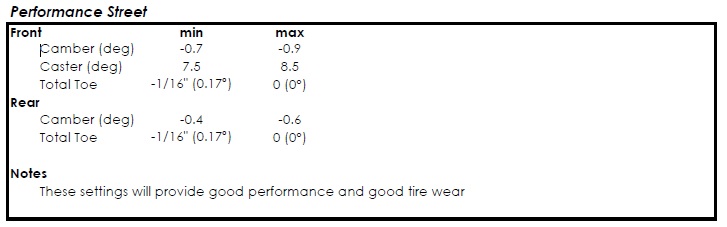

Better ones for Pfadt, so the tech does not have wiggle room to be off instead.
http://www.pfadtracing.com/docs/camb...t-settings.pdf
http://www.pfadtracing.com/docs/camb...t-settings.pdf
When I get home tonight I'll look at the paperwork and report back with the exact numbers.
U.M.

Melting Slicks
Joined: Apr 2008
Posts: 3,131
Likes: 12
From: Houston Tx
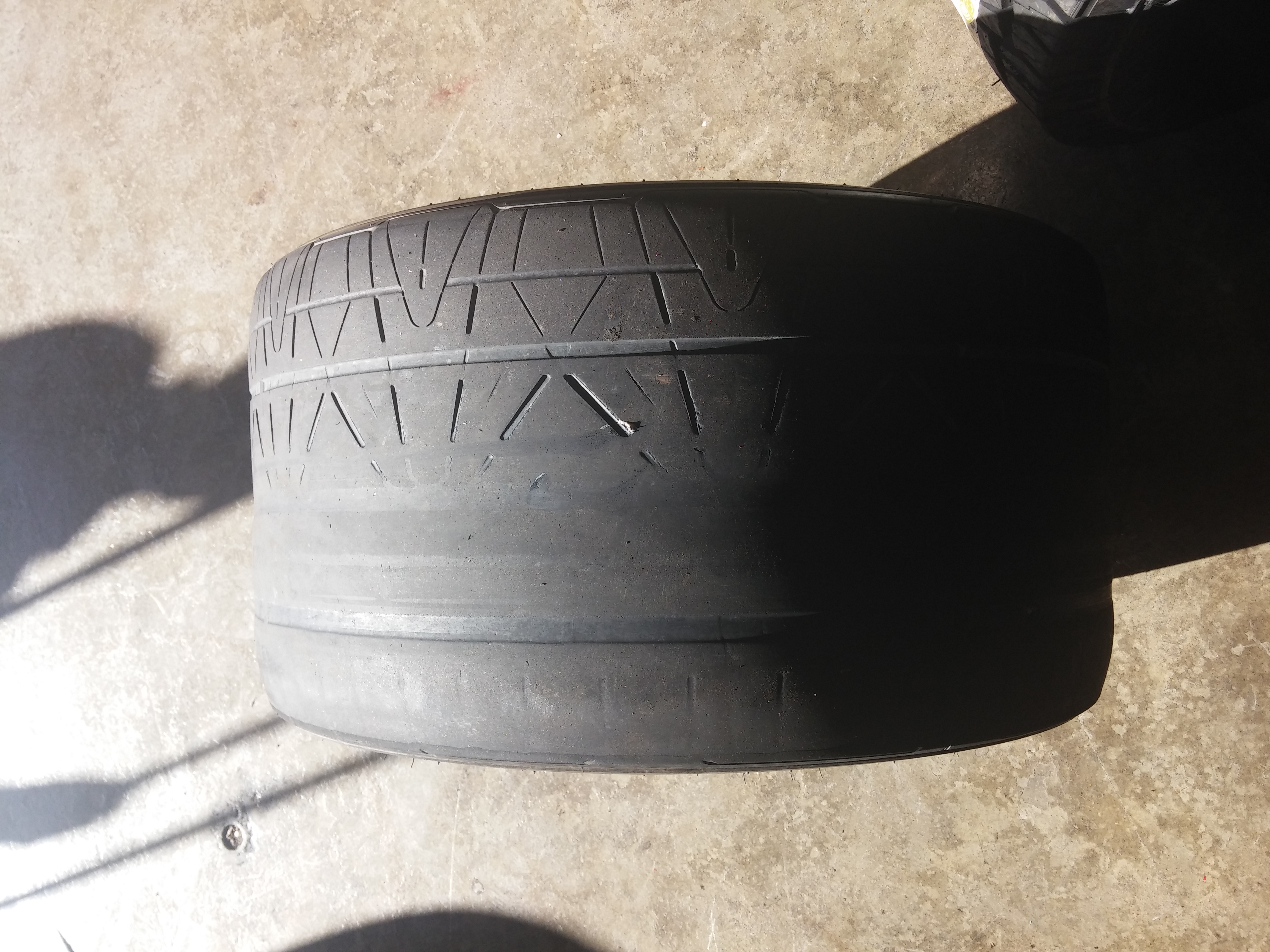
I got 25K miles out of my nitto invos with stock alignment with the car lowered on stock bolts. Here are my tires after 25k miles. This was with many burn outs, donuts and tons of spirited runs. As well as some fish tailing.


Race Director
Joined: Dec 2013
Posts: 12,502
Likes: 3,629
The oem/track alignments are set up for hard cornering, and when you are not hard corning with this alignment to wear the tires evenly, your going to burn the inside of the tires up faster than the outside.
Simply, figure out what you are going to use the car for, if all street driving, then run the Pfadt street alignment.
Melting Slicks
Joined: Apr 2008
Posts: 3,131
Likes: 12
From: Houston Tx
Looks about right if you had the alignment set up for oem/track (read factory or Pfadt track), and only used it on the streets instead.
The oem/track alignments are set up for hard cornering, and when you are not hard corning with this alignment to wear the tires evenly, your going to burn the inside of the tires up faster than the outside.
Simply, figure out what you are going to use the car for, if all street driving, then run the Pfadt street alignment.
The oem/track alignments are set up for hard cornering, and when you are not hard corning with this alignment to wear the tires evenly, your going to burn the inside of the tires up faster than the outside.
Simply, figure out what you are going to use the car for, if all street driving, then run the Pfadt street alignment.

Safety Car

Joined: Nov 2011
Posts: 3,555
Likes: 637
Looks about right if you had the alignment set up for oem/track (read factory or Pfadt track), and only used it on the streets instead.
The oem/track alignments are set up for hard cornering, and when you are not hard corning with this alignment to wear the tires evenly, your going to burn the inside of the tires up faster than the outside.
Simply, figure out what you are going to use the car for, if all street driving, then run the Pfadt street alignment.
The oem/track alignments are set up for hard cornering, and when you are not hard corning with this alignment to wear the tires evenly, your going to burn the inside of the tires up faster than the outside.
Simply, figure out what you are going to use the car for, if all street driving, then run the Pfadt street alignment.
Instructor
Joined: Sep 2014
Posts: 237
Likes: 13
According to Pfadt's settings, thats still too much toe. From their specs, look like they want you in the negative to 0 range (toe in). You're still toed out with .13*.
Also, have you tried to go to a different alignment shop? The alignment shop I first went to for mine showed me the print out and said everything is good. Took it for a ride and **** pulled right. Took it back to them, same thing. So I took it to another shop and they showed me its off. 2nd shop re-aligned it and never had an issue again.
Also, have you tried to go to a different alignment shop? The alignment shop I first went to for mine showed me the print out and said everything is good. Took it for a ride and **** pulled right. Took it back to them, same thing. So I took it to another shop and they showed me its off. 2nd shop re-aligned it and never had an issue again.

Tech Contributor


Joined: Oct 1999
Posts: 41,044
Likes: 9,808
From: Charlotte, NC (formerly Endicott, NY)
Remember the Pfadt Spec uses a negative sign for Toe In. Almost all alignment machines and the Chevy Alignment specs use a positive or no sign for Toe In. This can lead to confusion and a failure to communicate when getting your alignment done. It is always a good idea to copy the Pfadt specs onto another piece of paper and write the words Toe In or Toe Out to make sure you get what you think you are getting.
When I first got my C6Z I used the GY EMTs for track and street tires. I would purchase used EMTs from forum members and friends. The vast majority of the front tires I had were worn on the inside and the vast majority of the rear tires were worn on the outside.
This was with tires the seller swore were worn evenly.
Toe out and negative camber in the front could explain the inside wear but with the stock alignment the rear tires are set with more negative camber than the front and the outside edges were wearing not the inside. The only way I found to reduce the rear wear was to set the rear toe at 0 degrees.
I do my own alignments for street and track so change my alignments several times per year. This year I only did spring and fall track days and changed camber plates once so I only did 5 alignments Vs at least twice that number each year the previous 4 or 5 years.
Bill
When I first got my C6Z I used the GY EMTs for track and street tires. I would purchase used EMTs from forum members and friends. The vast majority of the front tires I had were worn on the inside and the vast majority of the rear tires were worn on the outside.
This was with tires the seller swore were worn evenly.
Toe out and negative camber in the front could explain the inside wear but with the stock alignment the rear tires are set with more negative camber than the front and the outside edges were wearing not the inside. The only way I found to reduce the rear wear was to set the rear toe at 0 degrees.
I do my own alignments for street and track so change my alignments several times per year. This year I only did spring and fall track days and changed camber plates once so I only did 5 alignments Vs at least twice that number each year the previous 4 or 5 years.
Bill
