




Another Brake Pas question.

Thread Starter
Le Mans Master


Joined: Jun 2011
Posts: 8,049
Likes: 330
From: Charlotte NC
St. Jude Donor '14-'15
 Another Brake Pas question.
I am currently using Advance Auto Platinum Professional Ceramic Brake pads on my DD. They are a good pad with very little brake dust. I am thinking about switching to Powerstop Evolution Z23-732 Pads because of the Carbon fiber content. My question is if anybody knows, is there a noticeable difference in stopping power (distance) over my current pad? My thanx to all that contribute to this thread. 

Race Director


Joined: Dec 2013
Posts: 12,502
Likes: 3,631
Carbotech 1521's, will give you the increased initial bite, better pedal feed back, but slightly lower working temps of the HD pads, will have less dusting like the current pads you are running (over the high dusting of OEM HD pads). Also, HD pads will wear out in about 30k, while will get longer life out of the 1521's isntead.
As for over all stopping power, Power breed the fluid in the brake system, including using a Tech II to cycle the ABS pump and Valves, to get the old fluid out of the as well. In less than a few years, the brake fluid leaches out the humidity in the air to cause water in the fluid and reduces the amount of force that pedal pressure will transfer to the calibers.
Bottom line with new fluid in the system (which should be changed every 2 years), should be able to get into the ABS system with what I consider 5/8 power braking pedal pressure on street tires to get them to initially lock and into the ABS system with the the base OEM pads. With R compound tires, little over 3/4 full on pedal pressure to get you into the ABS system instead using OEM base pads. Hence braking boils down to the tire grip on the car, since even the base brakes with Base pads, should be able to get you into the ABS well before you get even close to full (everything an older frail woman has in leg strength) pedal pressure on the brakes to initial lock the brakes up ,then have ABS kick in to stop the wheel lock skidding. The more the tire grip is, the deeper you can get into the pedal before tire lock up, and the faster you can stop instead. And again, even with R compound tires on a Base car with base pads, you are still able to lock the tires up, it just take more pedal pressure than it you are running street tires (if the brake fluid is not water saturated).
Now if we back up from there, then on the pads at less then full lock up, it comes down to the initial bite they have as you start to get on the pedal, the feed back that the pads are giving you are you get deeper in to the pedal before you lock the tires up, and then the over all working temps of the pads before you get them and the rotor's over the pads working temps to get them into pad fade.
As for over all stopping power, Power breed the fluid in the brake system, including using a Tech II to cycle the ABS pump and Valves, to get the old fluid out of the as well. In less than a few years, the brake fluid leaches out the humidity in the air to cause water in the fluid and reduces the amount of force that pedal pressure will transfer to the calibers.
Bottom line with new fluid in the system (which should be changed every 2 years), should be able to get into the ABS system with what I consider 5/8 power braking pedal pressure on street tires to get them to initially lock and into the ABS system with the the base OEM pads. With R compound tires, little over 3/4 full on pedal pressure to get you into the ABS system instead using OEM base pads. Hence braking boils down to the tire grip on the car, since even the base brakes with Base pads, should be able to get you into the ABS well before you get even close to full (everything an older frail woman has in leg strength) pedal pressure on the brakes to initial lock the brakes up ,then have ABS kick in to stop the wheel lock skidding. The more the tire grip is, the deeper you can get into the pedal before tire lock up, and the faster you can stop instead. And again, even with R compound tires on a Base car with base pads, you are still able to lock the tires up, it just take more pedal pressure than it you are running street tires (if the brake fluid is not water saturated).
Now if we back up from there, then on the pads at less then full lock up, it comes down to the initial bite they have as you start to get on the pedal, the feed back that the pads are giving you are you get deeper in to the pedal before you lock the tires up, and then the over all working temps of the pads before you get them and the rotor's over the pads working temps to get them into pad fade.
Thread Starter
Le Mans Master
Joined: Jun 2011
Posts: 8,049
Likes: 330
From: Charlotte NC
St. Jude Donor '14-'15
OK so I am running Michelin PS4 tires, the Best tire made to date. I also replaced the fluid recently.
My question is.......... Will these Carbon Fiber/Ceramic pads have better stopping than my current just Ceramic Pads. Seems like an easy question.
From what I see on YouTube the answer is yes, however I am just checking in here to see what other Corvette owners have to say about them.
My question is.......... Will these Carbon Fiber/Ceramic pads have better stopping than my current just Ceramic Pads. Seems like an easy question.
From what I see on YouTube the answer is yes, however I am just checking in here to see what other Corvette owners have to say about them.
Race Director
Joined: Dec 2013
Posts: 12,502
Likes: 3,631
Both sets of pads will get you into ABS lock up with a full pedal push/will allow the car to stop just as faster either way (again, grip of the tires what dictates how fast the car will stop), so is the question on the other pads, if they will get you into abs lock up with less pedal push pressure instead?
As for ceramic, verse carbon fiber, the ceramic pads will last longer. Between carbon fiber and Kevlar pads, kevlar pads have a slightly higher working temp range before you get into brake fade. but the carbon fiber pads have a little better initial bite instead.
So again, even base pads will get you into the ABS system, and the distance that it takes to stop the car, is all the grip of the tires until they begin to skid/you get into the ABS system. So in regards to pads since all them will lock up the tires with enough pedal push pressure, it comes down to initial bite, the feed back that will give you through the brake pedal on degrees of bit, and then the working temps of the pads before you get them hot enough to cause brake pad fade.
As for ceramic, verse carbon fiber, the ceramic pads will last longer. Between carbon fiber and Kevlar pads, kevlar pads have a slightly higher working temp range before you get into brake fade. but the carbon fiber pads have a little better initial bite instead.
So again, even base pads will get you into the ABS system, and the distance that it takes to stop the car, is all the grip of the tires until they begin to skid/you get into the ABS system. So in regards to pads since all them will lock up the tires with enough pedal push pressure, it comes down to initial bite, the feed back that will give you through the brake pedal on degrees of bit, and then the working temps of the pads before you get them hot enough to cause brake pad fade.

Instructor


Joined: Jul 2013
Posts: 185
Likes: 66
2021 C6 of the Year Finalist - Unmodified
I just replaced all my pads to Powerstop Extremes last week. I do not know what pads were on there before, but Powerstops made a big difference in stopping & so far NO DUST.

Supporting Vendor

Joined: Oct 2002
Posts: 50,281
Likes: 518
From: Cleveland OH
St. Jude Donor '11,'13
If you still live in Charlotte drive over to Carbotech Performance Brakes
4031 Dearborn Place N.W.
Concord, NC 28027
And get a serious performance low dust street pad the 1521
The Carbotech Bobcat 1521™ is our high performance street compound that is our most successful compound. The Bobcat compound is known for its awesome release and modulation, along with unmatched rotor friendliness. Like our AX™ & XP™ line of compounds, Bobcat 1521™ is a Ceramic based friction material offering minimal rotor damage and non-corrosive dust. Bobcat 1521™ offers outstanding performance, even when cold, low dusting and low noise with an excellent initial bite. This compound’s virtually perfect linear torque production provides incredible braking force without ABS intervention. Bobcat 1521™ operating range starts out at ambient and goes up to 900°F. Bobcat 1521™ is suitable for ALL street cars, perfect for your tow vehicle, police cruiser. The Bobcat 1521™ compound has been found to last two-three times longer than OE pads you can purchase at a dealership or national retailer. That’s one of the beauties of Carbotech Ceramic brake compounds. Bobcat 1521™ is NOT recommended for any track use.
4031 Dearborn Place N.W.
Concord, NC 28027
And get a serious performance low dust street pad the 1521
The Carbotech Bobcat 1521™ is our high performance street compound that is our most successful compound. The Bobcat compound is known for its awesome release and modulation, along with unmatched rotor friendliness. Like our AX™ & XP™ line of compounds, Bobcat 1521™ is a Ceramic based friction material offering minimal rotor damage and non-corrosive dust. Bobcat 1521™ offers outstanding performance, even when cold, low dusting and low noise with an excellent initial bite. This compound’s virtually perfect linear torque production provides incredible braking force without ABS intervention. Bobcat 1521™ operating range starts out at ambient and goes up to 900°F. Bobcat 1521™ is suitable for ALL street cars, perfect for your tow vehicle, police cruiser. The Bobcat 1521™ compound has been found to last two-three times longer than OE pads you can purchase at a dealership or national retailer. That’s one of the beauties of Carbotech Ceramic brake compounds. Bobcat 1521™ is NOT recommended for any track use.
Last edited by Carbotech Adam; Sep 27, 2020 at 09:31 AM.
Race Director
Joined: Dec 2013
Posts: 12,502
Likes: 3,631
Understand that there is a working temp range to any brake pad.
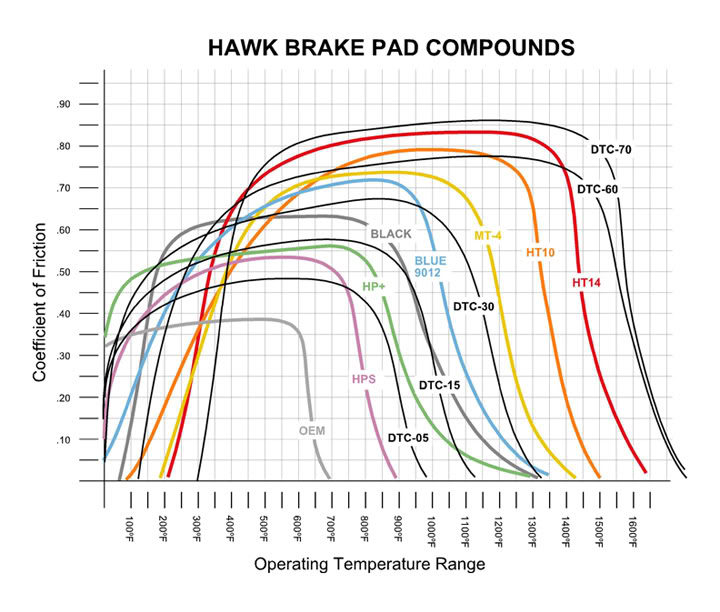
On a street car, we need the pads to full grab when bone cold, as well grab all the way up to the top of their working temp ranges.
So fade is when the pads are taken up higher than their working temp range to begin with, while the other side of the coin is pads not biting yet since they have not come up to heat yet with a race pad (where your going to glow the rotors pretty much every corner instead).
Since the pad you are using, and the pad you are looking at, are both Street pads, both will start to fade around the 600* mark. The oem HD pads on the other hand, don't start to fade until around the 750* mark instead.
So we first have the working temp of the pads (how hot you can get them before they start to fade but still grab bone cold). Then within these working temp range, you have the inital bite, and the pedal feed back that the pad will produce. We can take it one step farther, and include dusting, but since a pad that dust less, may give up either initial bite, pedal feed back, or higher working temp range, dusting is very low on my list of selecting a pad, and why I still run the OEM HD aggressive semi metallic pads.
So short of a lot of mountain pass driving where you can melt street pads from just normal street use from over heating them (or autocross use), still say go with the 1521's if you are looking for a low dusting street pad. Your going to give up a touch of higher working heat range over the OEM HD pads, but will not give up initial bite and pedal feed back that you will get with the OEM HD pads (neither of which you have now with the pads your running, or the other pads your looking at as well).
As for the OEM HD pad's (and all the dusting they will produce), the low down is your going to get about 30K out of the pads, will be able to turn the rotors once to reuse them again, then at the 60K mark on the second set of pads, will need to replace the rotors since they will be too thin to turn a second time.
Corvette Stories
The Best of Corvette for Corvette Enthusiasts

Top 10 Most Expensive Corvettes Ever Sold on Bring A Trailer
Brett Foote
10 Things Every Corvette Owner Needs (2026 Edition)
Michael S. Palmer
8 Most "Only Corvette Owners Understand" Quirks and Problems
Pouria Savadkouei
10 Reasons the C6 Z06 is Still A Performance Benchmark After 20 Years
Joe Kucinski
How Much Horsepower Every Corvette Engine "LOST" in 1972
Joe Kucinski
Top 10 DOs and DON'Ts for Protecting Your Convertible Top!
Michael S. Palmer
Top 10 Most Explosive Corvettes Ever Made: Power-to-Weight Ratio Ranked!
Joe Kucinski
150 hp to 1,250 hp: Every Corvette Generation Compared by the Specs That Matter
Joe Kucinski
8 Coolest Corvette Pace Cars (and Replicas) of All Time
Verdad Gallardo
Thread Starter
Le Mans Master
Joined: Jun 2011
Posts: 8,049
Likes: 330
From: Charlotte NC
St. Jude Donor '14-'15
OK so the answer to my question is...........
For my application on my DD the Carbon Fiber/Ceramic is a better pad than what I am currently using. The carbon fiber is a small step up.
Thanx for all of your help.
For my application on my DD the Carbon Fiber/Ceramic is a better pad than what I am currently using. The carbon fiber is a small step up.
Thanx for all of your help.

Race Director
Joined: Oct 2012
Posts: 17,383
Likes: 6,527
From: Melbourne, FL
OK so I am running Michelin PS4 tires, the Best tire made to date. I also replaced the fluid recently.
My question is.......... Will these Carbon Fiber/Ceramic pads have better stopping than my current just Ceramic Pads. Seems like an easy question.
From what I see on YouTube the answer is yes, however I am just checking in here to see what other Corvette owners have to say about them.
My question is.......... Will these Carbon Fiber/Ceramic pads have better stopping than my current just Ceramic Pads. Seems like an easy question.
From what I see on YouTube the answer is yes, however I am just checking in here to see what other Corvette owners have to say about them.