






Front rotors - cross drilled?

Thread Starter
Team Owner


Joined: Jan 2006
Posts: 29,085
Likes: 14
From: Cary IL and Parrish FL
St. Jude Donor '10-'11-'12-'13-'14-'15-'16-'17
 Front rotors - cross drilled?
I want to upgrade my rotors, but it seems everyone in my corvette club, and a lot of corvette mechanics are telling me to stay away from the cross drilled rotors - they say you get less surface area to brake and they are more prone to crack. So, what rotors do you guys suggest that are not cross drilled?
Melting Slicks

Joined: Jun 2005
Posts: 2,858
Likes: 1
From: Burlington County NJ
Although I have heard that theory - I have only heard of one person's rotors cracking and that was due to heavy track use. Unless you are going to track your car frequently - I would not worry about it.
Originally Posted by HyperX
I want to upgrade my rotors, but it seems everyone in my corvette club, and a lot of corvette mechanics are telling me to stay away from the cross drilled rotors - they say you get less surface area to brake and they are more prone to crack. So, what rotors do you guys suggest that are not cross drilled?

Le Mans Master

Joined: Dec 2002
Posts: 7,588
Likes: 6
From: Montreal Qc
Originally Posted by vette-oholic
Although I have heard that theory - I have only heard of one person's rotors cracking and that was due to heavy track use. Unless you are going to track your car frequently - I would not worry about it.
 ...if you do go with drilled rotors get a brand name type or at least from a respected forum vendor, not an E-bay special.
Thread Starter
Team Owner
Joined: Jan 2006
Posts: 29,085
Likes: 14
From: Cary IL and Parrish FL
St. Jude Donor '10-'11-'12-'13-'14-'15-'16-'17
Originally Posted by TommyV
Are you up grading for looks or performance? Are you tracking the car?
I will probably track very lightly. I have a base C6, so just upgrading for performance, but maybe a little for looks too.

Le Mans Master


Joined: Nov 2004
Posts: 6,566
Likes: 2
From: Goleta CA
Cruise-In VIII Veteran
Define "tracking lightly".
For hard use, don't get drilled. Otherwise they're fine. The whole "less surface area" thing is completely insignificant, especially on the street, where the brakes don't get anywhere near the temps they can reach on the racetrack.
edit: BTW, it's a waste of money if you're upgrading for performance. Many people with Z51 rotors are "downgrading" to the base rotors because those sizes are available much cheaper, and it doesn't hurt braking performance to any noticeable degree.
For hard use, don't get drilled. Otherwise they're fine. The whole "less surface area" thing is completely insignificant, especially on the street, where the brakes don't get anywhere near the temps they can reach on the racetrack.
edit: BTW, it's a waste of money if you're upgrading for performance. Many people with Z51 rotors are "downgrading" to the base rotors because those sizes are available much cheaper, and it doesn't hurt braking performance to any noticeable degree.
Last edited by mlongo99; Oct 11, 2006 at 05:17 PM.

Racer

Joined: May 2005
Posts: 415
Likes: 0
From: Cocoa Florida
Originally Posted by HyperX
I want to upgrade my rotors, but it seems everyone in my corvette club, and a lot of corvette mechanics are telling me to stay away from the cross drilled rotors - they say you get less surface area to brake and they are more prone to crack. So, what rotors do you guys suggest that are not cross drilled?
Corvette Stories
The Best of Corvette for Corvette Enthusiasts

Top 10 Most Expensive Corvettes Ever Sold on Bring A Trailer
Brett Foote
10 Things Every Corvette Owner Needs (2026 Edition)
Michael S. Palmer
8 Most "Only Corvette Owners Understand" Quirks and Problems
Pouria Savadkouei
10 Reasons the C6 Z06 is Still A Performance Benchmark After 20 Years
Joe Kucinski
How Much Horsepower Every Corvette Engine "LOST" in 1972
Joe Kucinski
Top 10 DOs and DON'Ts for Protecting Your Convertible Top!
Michael S. Palmer
Top 10 Most Explosive Corvettes Ever Made: Power-to-Weight Ratio Ranked!
Joe Kucinski
150 hp to 1,250 hp: Every Corvette Generation Compared by the Specs That Matter
Joe Kucinski
8 Coolest Corvette Pace Cars (and Replicas) of All Time
Verdad Gallardo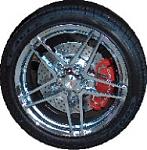
Burning Brakes


Joined: Dec 2004
Posts: 1,075
Likes: 3
From: Penn Valley California
I put Baer Eradispeed"+2", two piece slotted and drilled on my car for looks only(and they do look nice).I'm the kind of driver that gets 100k on a set of pads,so am not an aggressive brake user by any means.Baer offers slotted only on his website,though probably a special order( meaning more dollars).It would be nice if some of our Forum venders would offer that as an option,or no slots or holes in the two piece.I just hated the look of the tiny 12" rotors in 19" dia. rims.

Team Owner


Joined: Feb 2001
Posts: 27,254
Likes: 136
From: Short Hills, NJ
I would stick with the rotors you have now and just upgrade the pads for track use. 
Originally Posted by mlongo99
edit: BTW, it's a waste of money if you're upgrading for performance. Many people with Z51 rotors are "downgrading" to the base rotors because those sizes are available much cheaper, and it doesn't hurt braking performance to any noticeable degree.
Advanced
Joined: Mar 2006
Posts: 72
Likes: 1
From: Fairfield NJ
Originally Posted by HyperX
I want to upgrade my rotors, but it seems everyone in my corvette club, and a lot of corvette mechanics are telling me to stay away from the cross drilled rotors - they say you get less surface area to brake and they are more prone to crack. So, what rotors do you guys suggest that are not cross drilled?
What should you do? It depends on how you plan to use your Corvette. Are you taking it to high speed driving events? Then stick with plain or slotted rotors. Are you only driving it on the street? Then good quality drilled rotors are fine. Just don't think you're going to make your car look like a race car by installing drilled rotors, since the vast majority of racers use slotted rotors these days. I know of a few pro racers who use drilled rotors for qualifying sessions. (The 1/4 pound weight savings can make the difference between pole position and the 2nd row in some competetive series.) Then they switch back to slotted rotors for the race, since they are concerned that drilled rotors won't last for the entire event.
Thread Starter
Team Owner
Joined: Jan 2006
Posts: 29,085
Likes: 14
From: Cary IL and Parrish FL
St. Jude Donor '10-'11-'12-'13-'14-'15-'16-'17
Thanks to all that answered! Amazing amount of info! I will just keep the stock rotors and get better pads for now. Thanks again!!

Melting Slicks
Joined: Jun 2004
Posts: 3,439
Likes: 6
From: Newark, DE
St. Jude Donor '06
StopFORCE rotors might be a good compromise for your purposes. They give the "look" of cross-drilled rotors, but the holes are cast in, so the end result is much stronger. They are available for C5 and non-Z51 C6.

Instructor
Joined: Jun 2005
Posts: 162
Likes: 0
From: Levittown New York
Originally Posted by HyperX
Thanks to all that answered! Amazing amount of info! I will just keep the stock rotors and get better pads for now. Thanks again!!
Advanced
Joined: Mar 2006
Posts: 72
Likes: 1
From: Fairfield NJ
Originally Posted by bt944
Good idea. On the track you will notice a difference with pads, not with rotors.
Instructor
Joined: Jun 2005
Posts: 162
Likes: 0
From: Levittown New York
The main purpose of drilled or slotted rotors is to expel the build up of gases from under the pads and keep the rotors cooler. I have used drilled, slotted and cheap-o NAPA's and the difference is negligible on all but the heavy braking circuits such as Watkins Glen. My opinion is that unless your name is Ron Fellows, you won't notice the difference. You will get far more benefit from the proper pads.
Advanced
Joined: Mar 2006
Posts: 72
Likes: 1
From: Fairfield NJ
Originally Posted by bt944
The main purpose of drilled or slotted rotors is to expel the build up of gases from under the pads and keep the rotors cooler. I have used drilled, slotted and cheap-o NAPA's and the difference is negligible on all but the heavy braking circuits such as Watkins Glen. My opinion is that unless your name is Ron Fellows, you won't notice the difference. You will get far more benefit from the proper pads.
Radiation cooling is a function of rotor surface area and absolute temperature. Under race conditions (on a non-ducted system) it accounts for about 50% of total cooling. Neither drilling nor slotting affect the total surface area enough to make a measureable difference in cooling. You can do the math on a simplified rotor and convince yourself of this.
Convection is a function of the temperature difference between the rotors and the ambiant air, the size of the air gap between the two fricton plates, and the design of the internal cooling vanes. In other words, it depends on the amount of air flowing over and through the rotors. Again, drilling and slotting do not have a significant impact on this form of cooling. Drilling allows a very tiny increase in airflow through the internal chambers. Slotting does not. This mechanicsm accounts for about 25% of overall cooling.
Finally, conduction accounts for the remaining 25% and consists of heat being transferred directly into your hubs/wheel bearings, brake calipers, brake fluid, etc. Again, not affected by drilling or slotting.
None of this is an argument for picking slotted (or drilled) rotors instead of installing race pads for the track. Here we're in total agreement. A set of Performance Friction 01 race pads installed on stock (plain) rotors makes a huge difference in braking ability over running with street pads. If HyperX plans to take his C6 to the track, I strongly urge him to install a set of decent track pads, appropriate to his skill level and the track he's planning to run. Then swap back to street pads when he's done.
My point is that, all else being equal, slotted or drilled rotors do make a noticable improvement in bite. I was dealing with the expressed misconception that less swept area (from drilling) results in lower braking performance. This is false and, in fact, the opposite is true. And since HyperX expressed a desire for an aesthetic improvment to his brakes, I wanted to reassure him that he wasn't giving up any performance by installing drilled or slotted rotors. The only caveat is that I would suggest avoiding drilled rotors if he plans to track the car, due to the potential for accelerating the cracking process.
If you're comparing the relative difference between street pads vs track pads to the relative difference between plain rotors and slotted (or drilled) rotors, then you're absolutly right. The former is huge and the latter is relatively subtle. I wasn't making such a comparison. If we're looking at a limited pot of money, my first dollars would go to racing brake pads. Ultimately, we are making the same reccomendation to HyperX.

Instructor
Joined: Aug 2005
Posts: 196
Likes: 0
From: Bethesda MD
stock GM Z-51 rotors rust
I got the Baer drilled/slotted for my 05 Z-51. Yes the Baer look and work great. I also went with Hawk pads. No one said it, so I will. The stock GM Z-51 rotors rust. I have 2k miles on the car, which sits in a dry garage. So, yes go with just the pads, or if you want to change the rotors, go with the Baer drilled, slotted and new pads.
Just my 2 cents.
Just my 2 cents.


Melting Slicks

Joined: Nov 2003
Posts: 2,312
Likes: 82
From: Ridgeland MS
St. Jude Donor '06-'07-'08-'09-'10-'11
Originally Posted by DZeckhausen
The purpose of drilled or slotted rotors is to increase bite, sweep away debris from the pads, and provide a path for gasses to escape from under the pads. I can feel the difference in bite between plain and slotted and between slotted and drilled on the same car, simply driving on the street. Neither drilling nor slotting keep the rotors cooler. The rotors' job is to convert the kinetic energy of the car into heat and then shed that heat as fast as they can. They do it via three heat transfer mechanisms: Radiation, Convection, and Conduction.
My point is that, all else being equal, slotted or drilled rotors do make a noticable improvement in bite.
My point is that, all else being equal, slotted or drilled rotors do make a noticable improvement in bite.
I ran slotted and drilled rotors for some time on my '99 C5 and have them on my '05 C6 (Z51). I have never had a problem with cracking and I agree with the above post. As a pad bites on the rotor, dust and gas is emitted. The drilled holes allow the venting of these which maximizes the grip. Bill