





C6 brake fluid capacity
Advanced

Joined: Mar 2006
Posts: 72
Likes: 1
From: Fairfield NJ

If you're installing stainless steel braided brake lines or a big brake kit and/or you don't have much experience bleeding brakes, you may want to have a second can of fluid on hand. But you probably won't even open it. I've installed a 4-wheel big brake kit using only a single 1/2 liter bottle of Motul RBF600 racing brake fluid. It was close and, admittedly, I was going for a record. But I was able to complete the job and bleed to a rock hard pedal with only that one bottle.
Here's a link to some bleeding instructions I wrote that include some tips for getting an extra firm pedal. For example, I describe tapping on the caliper body with a rubber mallet to cause any trapped bubbles to break free and float to the top, where they will be expelled through the bleed screw. Instructions for Bleeding Brakes
Le Mans Master


Joined: Oct 2005
Posts: 6,635
Likes: 0
From: Fallston Maryland
It took about 2 1/2 bottles of Motul to do mine the first time. Actually closer to 3. The right rear brake line was full of air, yes from the factory.
It took a bit more to get the air out.
I like the small bottles. There is less waist. It is said it is not good to use an open bottle later. Moisture can get in the fluid.
It took a bit more to get the air out.
I like the small bottles. There is less waist. It is said it is not good to use an open bottle later. Moisture can get in the fluid.
Advanced
Joined: Mar 2006
Posts: 72
Likes: 1
From: Fairfield NJ
It took about 2 1/2 bottles of Motul to do mine the first time. Actually closer to 3. The right rear brake line was full of air, yes from the factory.
It took a bit more to get the air out.
I like the small bottles. There is less waist. It is said it is not good to use an open bottle later. Moisture can get in the fluid.
It took a bit more to get the air out.
I like the small bottles. There is less waist. It is said it is not good to use an open bottle later. Moisture can get in the fluid.
The bleeding technique has a lot to do with how much fluid it takes to get all the air out. If you use a pressure bleeder or a vacuum bleeder, it will take far more fluid. However, with the traditional 2-person bleed technique, you can use far less fluid. With an assistant pressing down HARD on the brake pedal, you should suddenly crack open the bleed screw, then close it as your assistant's foot reaches the floor. This sudden jolt to the brake fluid will knock loose bubbles and get them out fast. You should be able to do each corner in as few as 7 or 8 pumps of the pedal. If you hook up a pressure bleeder and crank it up to 20-25 psi (much more will blow the reservoir off the master cylinder and make a huge mess!), the brake fluid will slowly flow out the bleed screws and the bubbles will take their sweet time exiting the system. Similarly, a vacuum type system sucks (no pun intended) at getting air out quickly. Either method can easily use up two or more 1/2 liter bottles of Motul.
There's no harm in using extra brake fluid and, if your technique results in air bubbles still coming out after a liter or more of fluid has gone through the system, by all means keep going. I always make sure I do at least three more pumps of the pedal at each corner, after I've seen the last bubble come out.
outnumbered is absolutely correct. If there's any extra brake fluid left over in your bottle after bleeding, mark the date with a Sharpie pen and throw it out after a week or two. Brake fluid is hygroscopic and will quickly absorb moisture from the air.
Le Mans Master
Joined: Oct 2005
Posts: 6,635
Likes: 0
From: Fallston Maryland
I'm constantly amazed by how much air is left in the brake system by the factory. You can often transform the pedal feel by doing a good, competition bleed on your brand new Corvette, BMW, etc.
The bleeding technique has a lot to do with how much fluid it takes to get all the air out. If you use a pressure bleeder or a vacuum bleeder, it will take far more fluid. However, with the traditional 2-person bleed technique, you can use far less fluid. With an assistant pressing down HARD on the brake pedal, you should suddenly crack open the bleed screw, then close it as your assistant's foot reaches the floor. This sudden jolt to the brake fluid will knock loose bubbles and get them out fast. You should be able to do each corner in as few as 7 or 8 pumps of the pedal. If you hook up a pressure bleeder and crank it up to 20-25 psi (much more will blow the reservoir off the master cylinder and make a huge mess!), the brake fluid will slowly flow out the bleed screws and the bubbles will take their sweet time exiting the system. Similarly, a vacuum type system sucks (no pun intended) at getting air out quickly. Either method can easily use up two or more 1/2 liter bottles of Motul.
There's no harm in using extra brake fluid and, if your technique results in air bubbles still coming out after a liter or more of fluid has gone through the system, by all means keep going. I always make sure I do at least three more pumps of the pedal at each corner, after I've seen the last bubble come out.
outnumbered is absolutely correct. If there's any extra brake fluid left over in your bottle after bleeding, mark the date with a Sharpie pen and throw it out after a week or two. Brake fluid is hygroscopic and will quickly absorb moisture from the air.
The bleeding technique has a lot to do with how much fluid it takes to get all the air out. If you use a pressure bleeder or a vacuum bleeder, it will take far more fluid. However, with the traditional 2-person bleed technique, you can use far less fluid. With an assistant pressing down HARD on the brake pedal, you should suddenly crack open the bleed screw, then close it as your assistant's foot reaches the floor. This sudden jolt to the brake fluid will knock loose bubbles and get them out fast. You should be able to do each corner in as few as 7 or 8 pumps of the pedal. If you hook up a pressure bleeder and crank it up to 20-25 psi (much more will blow the reservoir off the master cylinder and make a huge mess!), the brake fluid will slowly flow out the bleed screws and the bubbles will take their sweet time exiting the system. Similarly, a vacuum type system sucks (no pun intended) at getting air out quickly. Either method can easily use up two or more 1/2 liter bottles of Motul.
There's no harm in using extra brake fluid and, if your technique results in air bubbles still coming out after a liter or more of fluid has gone through the system, by all means keep going. I always make sure I do at least three more pumps of the pedal at each corner, after I've seen the last bubble come out.
outnumbered is absolutely correct. If there's any extra brake fluid left over in your bottle after bleeding, mark the date with a Sharpie pen and throw it out after a week or two. Brake fluid is hygroscopic and will quickly absorb moisture from the air.
I am under the impression that you need the power bleeder to get the fluid through the ABS System module??....
Either way, the power bleeder worked well. Between HPDE's we do a two person bleed the old fashion way in order to freshen up the fluid in the calipers, which gets pretty dark from hard use.
By the way, AU N EGL was instrumental in giving me pointers of brakes and maintenance. Plus a bunch of Internet research.
Last edited by outnumbered; Mar 10, 2007 at 08:05 PM.
Advanced
Joined: Mar 2006
Posts: 72
Likes: 1
From: Fairfield NJ
It's interesting that you mentioned the power bleeder. I did in fact use the motive bleeder. It worked extremely well. However I only used 12 psi as the manufacture suggested.
I am under the impression that you need the power bleeder to get the fluid through the ABS System module??....
I am under the impression that you need the power bleeder to get the fluid through the ABS System module??....
The Motive pressure bleeder does nothing functionally different to the brake system than an assistant pushing on the brake pedal, other than producing far less pressure. The ABS control unit and the calipers are downstream of the master cylinder and reservoir. There are no alternative flow paths. Just two input lines (front & rear) leading from the master cylinder to the ABS control unit, and four output lines, one leading to each caliper from the ABS control unit. The ABS control unit can not tell the difference between pressurizing the system with 12psi using the Motive bleeder or a person very gently pressing on the brake pedal.
I attended two classes on ABS and stability control system design, taught by James Walker Jr. At the time, he was the head of Vehicle Performance Development at Delphi and the leader of the design team on the Corvette C6 ABS and stability control systems. Now he's moved on to a private company that does accident investigations and is like a CSI for cars. He still teaches classes for the SAE and I highly recommend this one: Introduction to Brake Control Systems: ABS, TCS, and ESC . Or, for much less of a personal investment, you can check out his excellent new book: High Performance Brake Systems
Le Mans Master
Joined: Oct 2005
Posts: 6,635
Likes: 0
From: Fallston Maryland
Great info.
So basically in time the fluid in the Abs will mix with the new fluid. After flush/bleeding multiple times, will the dot 3 be diluted with the dot4?
I guess this is another good reason to make sure you use fluids compatible with dot 3.
So basically in time the fluid in the Abs will mix with the new fluid. After flush/bleeding multiple times, will the dot 3 be diluted with the dot4?
I guess this is another good reason to make sure you use fluids compatible with dot 3.
Corvette Stories
The Best of Corvette for Corvette Enthusiasts

10 Reasons the C6 Z06 is Still A Performance Benchmark After 20 Years
Joe Kucinski
How Much Horsepower Every Corvette Engine "LOST" in 1972
Joe Kucinski
Top 10 DOs and DON'Ts for Protecting Your Convertible Top!
Michael S. Palmer
Top 10 Most Explosive Corvettes Ever Made: Power-to-Weight Ratio Ranked!
Joe Kucinski
150 hp to 1,250 hp: Every Corvette Generation Compared by the Specs That Matter
Joe Kucinski
8 Coolest Corvette Pace Cars (and Replicas) of All Time
Verdad Gallardo
Top 10 Corvette Engines RANKED by Peak Torque (70+ Years of Muscle!)
Joe Kucinski
Corvette ZR1X Will Be Pacing the Indy 500, And Could Probably Race, Too!
Verdad Gallardo
Top 10 Corvettes Coming to Mecum Indy 2026!
Brett Foote
Team Owner


Joined: Sep 2003
Posts: 43,084
Likes: 33
From: Raleigh / Rolesville NC
OR when the ATE fluids are used, One is Blue and the Other is Gold, but the fluids are identical. This way there is the color difference between the two fluids, and it is easy to tell when the old fluid is fully flushed.
Or just keep a close eye on the fluid color change, from dirty to clear.
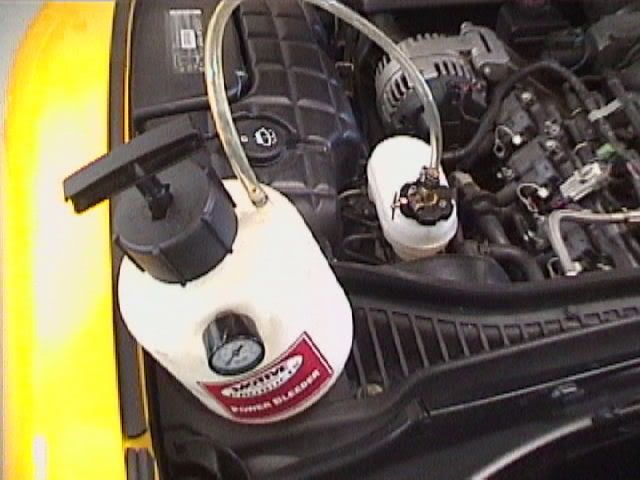
I prefer the power bleeder method and use the peddle pump only to set the brake pads and brake ride height.
Le Mans Master
Joined: Oct 2005
Posts: 6,635
Likes: 0
From: Fallston Maryland
That is why a full liter is suggested to flush the brake lines. To get all the old DOT 3 fluid or any old fluid out of the ABS moduals in the calipers and the brake lines. 1/2 liter just does not do this.
OR when the ATE fluids are used, One is Blue and the Other is Gold, but the fluids are identical. This way there is the color difference between the two fluids, and it is easy to tell when the old fluid is fully flushed.
Or just keep a close eye on the fluid color change, from dirty to clear.
I prefer the power bleeder method and use the peddle pump only to set the brake pads and brake ride height.
OR when the ATE fluids are used, One is Blue and the Other is Gold, but the fluids are identical. This way there is the color difference between the two fluids, and it is easy to tell when the old fluid is fully flushed.
Or just keep a close eye on the fluid color change, from dirty to clear.
I prefer the power bleeder method and use the peddle pump only to set the brake pads and brake ride height.
Hey Tom, Do you put fluid in the Motive tank or do you just use it for pressure and keep an eye on the reservoir. The tank and hose need to be cleaned afterwards.

Team Owner
Joined: Sep 2003
Posts: 43,084
Likes: 33
From: Raleigh / Rolesville NC
Rember for track events dont fill the reservoir much over the 1/2 point. HOT brake fluid expands. If the reservoir is filled up, where will that HOT brake fluid expand too??
Also not a bad Idea to Zip tie a rag over the MC Cap for just that overflow reason.
When I change or bleed my brake fluid, I can tell the color difference. Dark to black changed to Clear Golden colors. Easy to spot.
Advanced
Joined: Mar 2006
Posts: 72
Likes: 1
From: Fairfield NJ
If you're changing types of brake fluid from normal DOT 4 to something exotic like Castrol SRF, where there may be compatibility issues, then you probably want to use the scan tool to cycle the ABS while bleeding or else you want to bleed the car twice, with a short drive in between. But for your normal bi-annual maintenance flushes or your bleeding between track events, the normal method is perfectly fine. The amount of trapped fluid is insignificant.
OR when the ATE fluids are used, One is Blue and the Other is Gold, but the fluids are identical. This way there is the color difference between the two fluids, and it is easy to tell when the old fluid is fully flushed.
Also, Super Blue Racing is not a DOT 4 fluid. It has DOT 4 performance, but the dye violates the DOT 4 specification's color requirement of clear to amber. If you carefully compare the wording on the two cans, you'll see that TYP 200 says "This DOT 4 motor vehicle brake fluid conforms to ...", while the Super Blue Racing can has the weasel wording: "Better than specifications of FMVSS No 116 DOT 4/DOT 3 (differing blue coloration)...".
Finally, the blue dye will, after extended use, stain your reservoir blue to the point where you can't see through it any longer to determine brake fluid level.
Or just keep a close eye on the fluid color change, from dirty to clear.
I prefer the power bleeder method and use the peddle pump only to set the brake pads and brake ride height.
Team Owner
Joined: Sep 2003
Posts: 43,084
Likes: 33
From: Raleigh / Rolesville NC
The power bleeder does a great job and I believe better then the peddle pump method. But if you dont have one, the other works just as good.
If you only wish to push a few cc's though the ABS moduel be my guest. I prefer to make sure by flushing a fair amount though. There has been more then one time I have flushed someones brakes only to notice the fluid going from black, to clear, back to black or mix again. Then back to clear. Rember once a bottle is open it can not be saved, so use it up.
I use Castrol SRF at $72-75 / liter. My life depends on my brakes. and I beat the living chit out of them.
Never had to use a scan tool with the power bleeder method.
I dont like the so called speed bleeders nor the vacum pump method. Personally my speed bleeder is, the power bleeder with 12-15 psi, a 10 mm open ended wrentch, with clear tygon tube attached to the bleed head and draining into a clear 16 oz soda bottle with the top drilled to run the tygon tube though.
Advanced
Joined: Mar 2006
Posts: 72
Likes: 1
From: Fairfield NJ
Here's a quote from page 66 of James Walker's new book, "High Performance Brake Systems". Remember, James was in charge of the team that designed the ABS and stability control on the Corvette C6.
"There are a number of high-tech tools available to bleed brake systems, but nothing beats a good old manual bleed for bonding with your vehicle. Plus, while alternative techniques may save some time in the process, the quality of a manual bleed is second to none."
Last edited by DZeckhausen; Mar 11, 2007 at 12:48 PM.
Team Owner
Joined: Sep 2003
Posts: 43,084
Likes: 33
From: Raleigh / Rolesville NC
David I am. are you reading that last section in blue you posted??
Manual bleeding ?? Pressure Bleeding ?? one in the same. If some one needs to turn the KEY to accessor and let the "ABS Warm Up' light cycle so be it.
and Yes I have meet James and many many Corvette engineers. They come to MY ( NCM ) high performance Driving schools to learn how to drive the cars they have designed.
Have they discoverd things that need to addressed? YES. what are they? well I may be their teacher, but they dont share that info with me. I do know that many items will show up in the C7 as a direct result of the design engineers going to High Performacne Drivers Events.
I think we dont want to confuse the average C5 /C6 owner. Using the brake peddle pump, two person, bleeding method works great.
Manual bleeding ?? Pressure Bleeding ?? one in the same. If some one needs to turn the KEY to accessor and let the "ABS Warm Up' light cycle so be it.
and Yes I have meet James and many many Corvette engineers. They come to MY ( NCM ) high performance Driving schools to learn how to drive the cars they have designed.
Have they discoverd things that need to addressed? YES. what are they? well I may be their teacher, but they dont share that info with me. I do know that many items will show up in the C7 as a direct result of the design engineers going to High Performacne Drivers Events.
I think we dont want to confuse the average C5 /C6 owner. Using the brake peddle pump, two person, bleeding method works great.
Advanced
Joined: Mar 2006
Posts: 72
Likes: 1
From: Fairfield NJ

To get the ABS unit to cycle, you need to drive the car. Just turning the key (or in the case of the C6, pushing the ACC button) won't do it.
I think we dont want to confuse the average C5 /C6 owner. Using the brake peddle pump, two person, bleeding method works great.
Team Owner
Joined: Sep 2003
Posts: 43,084
Likes: 33
From: Raleigh / Rolesville NC
Agreed. The important thing is to change your fluid with some regularity and to use a sufficient amount for the job and the technique. If you're doing a track bleed, a single 1/2 liter of fluid is fine. If you're doing a service bleed (after changing a component), then you can easily use up to three times that amount.


Advanced
Joined: May 2002
Posts: 57
Likes: 0
From: Houston TX
Hello all - Dave asked me to take a peek at this thread to see if I had anything of value to offer. Seems like most of it got settled out before I was able to read through, but since I'm already here I'll toss in a few one-liners. Take them with a grain of salt.
1. No matter how hard you hit the brakes, or what type of pressurizing device you use, you can't bleed the fluid trapped in the ABS/TCS/AH module without cycling it with special software. That said, there is only about 3cc to 5cc of brake fluid trapped in there, so it's not such a big deal in the grander scheme of things.
2. There are two varieties of pressure bleeders: the ones you can get for $50 and the ones you can get for $500. The difference is that the $50 models pressurize the brake fluid directly, while the more expensive units use a flexible diaphragm to separate the air from the fluid (like this here: http://buy1.snapon.com/catalog/item....e&dir=catalog). There is a reason that vehicle assembly plants actually store their brake fluid under a vacuum - if you pressurize the air above the brake fluid, the air makes its way INTO the fluid. So, while those bargain-priced pressure bleeders may make the job appear easier, you are actually stuffing air into the fluid in the process. Not air bubbles large enough to see, mind you, but smaller quantities entrained in the brake fluid matrix which will require you to bleed again that much sooner. You get what you pay for.
3. AU N EGL - when have we met? Please refresh my memory. David is perhaps overstating my involvement in the C6 program a little bit, but when did I attend a school of yours?
All for now. And, just for the record, I really miss my Z06...
James Walker, Jr.
teamscr@flash.net
1. No matter how hard you hit the brakes, or what type of pressurizing device you use, you can't bleed the fluid trapped in the ABS/TCS/AH module without cycling it with special software. That said, there is only about 3cc to 5cc of brake fluid trapped in there, so it's not such a big deal in the grander scheme of things.
2. There are two varieties of pressure bleeders: the ones you can get for $50 and the ones you can get for $500. The difference is that the $50 models pressurize the brake fluid directly, while the more expensive units use a flexible diaphragm to separate the air from the fluid (like this here: http://buy1.snapon.com/catalog/item....e&dir=catalog). There is a reason that vehicle assembly plants actually store their brake fluid under a vacuum - if you pressurize the air above the brake fluid, the air makes its way INTO the fluid. So, while those bargain-priced pressure bleeders may make the job appear easier, you are actually stuffing air into the fluid in the process. Not air bubbles large enough to see, mind you, but smaller quantities entrained in the brake fluid matrix which will require you to bleed again that much sooner. You get what you pay for.
3. AU N EGL - when have we met? Please refresh my memory. David is perhaps overstating my involvement in the C6 program a little bit, but when did I attend a school of yours?
All for now. And, just for the record, I really miss my Z06...
James Walker, Jr.
teamscr@flash.net
Race Director


Joined: Dec 2005
Posts: 11,300
Likes: 957
From: Carlsbad Ca
I use a syringe to force the fluid through the bleeder screw up to the M/C. (You have to "pre-fill" the bleeder screw first or that little air bubble will enter the system.) Just make sure the M/C is empty! I've used vacuum systems only to have air enter the caliper via the bleeder screw threads...