


Ethanol in a Vette

Thread Starter
6th Gear

Joined: Dec 2007
Posts: 6
Likes: 0
From: Delta BC
 Ethanol in a Vette
The warning LOW FUEL had been on for a while and traffic was heavy when I spotted a Husky Gas station. When I pulled up to the pumps, the whole station was "Green" meaning they had only a mixed ethanol / gas at the pumps. Without much choice, I filled up with 94 octane green gas. I can't find anything in my 05 C6 owners manual mentioning ethanol one way or another, so without wanting to ignite the ethanol vs gas wars, can the LS2 handle it?

Team Owner


Joined: Apr 2005
Posts: 35,743
Likes: 148
From: Northern NYs Adirondack Mountains,http://www.visitsacandaga.com.

I'm "Apache" a psycho dog


Joined: Jan 2001
Posts: 3,085
Likes: 31
From: N.J.
Sounds like all that 'Green' may of been 85% ethanol station,
they don't do that for 10%, only small labels on the pumps saying
"contains up to 10% ethanol". where are you from? or where was the station?
they don't do that for 10%, only small labels on the pumps saying
"contains up to 10% ethanol". where are you from? or where was the station?

Le Mans Master


Joined: Oct 2007
Posts: 6,149
Likes: 11
From: Greater Detroit Metro MI, when I'm not travelling.
Corvettes, and any other car sold in this country, will run on any motor fuel that is sold for road use in this country aside from Diesel or Ethanol that is labelled as not for use in gasoline only engines. Your engine doesn't know or care if it has 10% Ethanol.

Safety Car

Joined: Dec 2004
Posts: 3,565
Likes: 5
From: stafford country, va. Avatar: Me on turn 3 @ Bristol (The World's Fastest Half-Mile)

Melting Slicks

Joined: Sep 2000
Posts: 3,040
Likes: 0
From: North Liberty IA
St. Jude Donor '07
Corvette Stories
The Best of Corvette for Corvette Enthusiasts

150 hp to 1,250 hp: Every Corvette Generation Compared by the Specs That Matter
Joe Kucinski
8 Coolest Corvette Pace Cars (and Replicas) of All Time
Verdad Gallardo
Top 10 Corvette Engines RANKED by Peak Torque (70+ Years of Muscle!)
Joe Kucinski
Corvette ZR1X Will Be Pacing the Indy 500, And Could Probably Race, Too!
Verdad Gallardo
Top 10 Corvettes Coming to Mecum Indy 2026!
Brett Foote
Top 10 C9 Corvette MUST-HAVES to Fix These C8 Generation Flaws!
Michael S. Palmer
10 Revolutionary 'Corvette Firsts' Most People Don't Know
Joe Kucinski
5 Reasons to Upgrade to an LS6-Powered Corvette; 5 Reasons to Stay LT2
Michael S. Palmer
2027 Corvette vs The World: Every C8 vs Its Closest Competitor
Joe Kucinski
Drifting

Joined: Jul 2007
Posts: 1,587
Likes: 90
Mine came with it in the tank from the dealer. I've used it for many many years, with no ill effects on the engine. Performance? Not sure, but I don't notice any. The manual says for agressive dirving use 91 octane. That's where you will find the real difference. Mileage slightly less, but again I don't notice that either. The 85% stuff you will notice these differences.


Team Owner

Joined: Jun 2007
Posts: 31,088
Likes: 23
St. Jude Donor '08 thru '13
We have no other choice here in Colorado, but to run the 10% ethanol blend in the winter.
It'll bump the octane a bit, your car will run great, and it's fully approved by GM and Chevrolet.
Full details here:
http://www.ncga.com/ethanol/main/your_car.htm
It'll bump the octane a bit, your car will run great, and it's fully approved by GM and Chevrolet.
Full details here:
http://www.ncga.com/ethanol/main/your_car.htm
Le Mans Master
Joined: Oct 2007
Posts: 6,149
Likes: 11
From: Greater Detroit Metro MI, when I'm not travelling.
Let me repeat what I just said:
EVERY VEHICLE
produced or sold in this country will run on
EVERY FUEL available for it at any gas station in this country. That is the whole principle behind certification. Gas stations aren't randomly experimenting with "miracle brews" that will work on some cars but not on others. 93 octane is 93 octane and will run every single car that is designed to run on 93 octane gasoline.
The only fuels you will EVER find in a gas station that will not run your Corvette, or any other gasoline only car for that matter, are diesel and ethanol. Not ethanol containing gasoline; ethanol. BIG difference.
10% will make zero perceptible difference. Ethanol has a higher octane rating than gasoline and as such it is used as an octane booster. It is also an oxygenated fuel that is used to reduce emissions; there is nothing wrong with using it, virtually all fuel sold in this country contains at least some small amount of it, and I would venture saying that we have all used oxygenated gasoline (I.E. Ethanol containing gas) at some point in time.

Safety Car
Joined: Jun 2004
Posts: 3,563
Likes: 2
From: Dallas Tx
You'll lose a little power because Ethanol has only 84,000 BTUs compared to gasoline at 115,000. At only 10% though it will be hardly noticeable. At 85% it will be noticeable, so will the fuel guage going down extremely fast.
The great myth of Ethanol is that it is so "green." It's made from corn, wow, what a great renewable environmentally friendly fuel... Only they neglect to tell you it takes 131,000 BTUs of energy to make one gallon of 84,000 BTU Ethanol. A net energy loss, subsidized by yours truly the tax payer.
The great myth of Ethanol is that it is so "green." It's made from corn, wow, what a great renewable environmentally friendly fuel... Only they neglect to tell you it takes 131,000 BTUs of energy to make one gallon of 84,000 BTU Ethanol. A net energy loss, subsidized by yours truly the tax payer.

Burning Brakes

Joined: Jul 2004
Posts: 932
Likes: 0
From: Las Cruces New Mexico
You'll lose a little power because Ethanol has only 84,000 BTUs compared to gasoline at 115,000. At only 10% though it will be hardly noticeable. At 85% it will be noticeable, so will the fuel guage going down extremely fast.
The great myth of Ethanol is that it is so "green." It's made from corn, wow, what a great renewable environmentally friendly fuel... Only they neglect to tell you it takes 131,000 BTUs of energy to make one gallon of 84,000 BTU Ethanol. A net energy loss, subsidized by yours truly the tax payer.
The great myth of Ethanol is that it is so "green." It's made from corn, wow, what a great renewable environmentally friendly fuel... Only they neglect to tell you it takes 131,000 BTUs of energy to make one gallon of 84,000 BTU Ethanol. A net energy loss, subsidized by yours truly the tax payer.
 Not only does it take more energy to make ethanol the amount of fertilizer used to grow the corn is amazing and then the run off into the river, lake and so on. We need to cut this out and just start drilling again and add some more nuclear facilities.
Safety Car
Joined: Dec 2004
Posts: 3,565
Likes: 5
From: stafford country, va. Avatar: Me on turn 3 @ Bristol (The World's Fastest Half-Mile)
What is Ethanol?
Ethanol works well in internal combustion engines. In fact, Henry Ford and other early automakers thought ethanol would be the world's primary fuel before gasoline became so readily available. A gallon of ethanol contains one-third less energy than a gallon of gasoline.
Ethanol is a high-octane fuel. Octane helps prevent engine knocking and is extremely important in engines designed to operate at a higher compression ratio, so they generate more power. These engines tend to be found in high-performance vehicles. Because ethanol has high octane, it is sometimes blended with gasoline in small amounts to boost octane rating. This mixture, in turn, can be used in high-performance engines.
Low-level blends of ethanol, such as E10 (10% ethanol, 90% gasoline), generally have a higher octane rating than unleaded gasoline. Low-octane gasoline can be blended with 10% ethanol to attain the standard 87 octane requirement.
http://www.eere.energy.gov/afdc/fuel...l_what_is.html
Ethanol Benefits
Ethanol is a renewable, largely domestic transportation fuel. Whether used in low-level blends, such as E10 (10% ethanol, 90% gasoline), or in E85 (85% ethanol, 15% gasoline), ethanol helps reduce imported oil and greenhouse gas emissions.
E85: An Alternative FuelE85 (85% ethanol, 15% gasoline) is considered an alternative fuel under the Energy Policy Act of 1992. It is used to fuel E85-capable flexible fuel vehicles (FFVs), which are available in a variety of models from U.S. and foreign automakers.
Other than lower gas mileage, motorists will see little difference when using E85 versus gasoline. E85 has about 27% less energy per gallon than gasoline. For more information on ethanol's energy content, see the E85 Fuel Properties section. Use the FFV Cost Calculator to quantify the effect of E85's lower energy content on FFV fuel economy and fuel costs.
http://www.eere.energy.gov/afdc/fuels/ethanol_e85.html
Ethanol has issues with water, it absorbs more and is therefore subject to condensation. unless the tanks are kept full it will suffer from water contamination.
much higher compression (14/15:1) is required to fully recognize the same performance level that is obtained from a comparable amount of gasoline.
ethanol is used to raise to octane level of the gasoline, however, even after the addition of the 10% (or more) i have yet to see higher than 93 octane offered for sale at any of the top-tier stations (recommended fuel).
that leads me to believe that ethanol is being blended with lower grade fuel to achieve the same octane rating that was obtained without the blend.
for example: if 10% ethanol raises the octane rating by 2-3 points, one can use 85 octane with a 10% ethanol blend and get 87 octane. 90 octane with 10% ethanol would become 93 octane. combine that with the lower power output of ethanol (at the same compression level) and you end up with less performance from the same amount of fuel. lower gas mileage (which is a result of less efficiency which in turn is a result of the lower power production).
Pro

Joined: Apr 2001
Posts: 672
Likes: 1
From: Scottsdale AZ
Yes. It. Is.
Let me repeat what I just said:
EVERY VEHICLE
produced or sold in this country will run on
EVERY FUEL available for it at any gas station in this country. That is the whole principle behind certification. Gas stations aren't randomly experimenting with "miracle brews" that will work on some cars but not on others. 93 octane is 93 octane and will run every single car that is designed to run on 93 octane gasoline.
The only fuels you will EVER find in a gas station that will not run your Corvette, or any other gasoline only car for that matter, are diesel and ethanol. Not ethanol containing gasoline; ethanol. BIG difference.
10% will make zero perceptible difference. Ethanol has a higher octane rating than gasoline and as such it is used as an octane booster. It is also an oxygenated fuel that is used to reduce emissions; there is nothing wrong with using it, virtually all fuel sold in this country contains at least some small amount of it, and I would venture saying that we have all used oxygenated gasoline (I.E. Ethanol containing gas) at some point in time.
Let me repeat what I just said:
EVERY VEHICLE
produced or sold in this country will run on
EVERY FUEL available for it at any gas station in this country. That is the whole principle behind certification. Gas stations aren't randomly experimenting with "miracle brews" that will work on some cars but not on others. 93 octane is 93 octane and will run every single car that is designed to run on 93 octane gasoline.
The only fuels you will EVER find in a gas station that will not run your Corvette, or any other gasoline only car for that matter, are diesel and ethanol. Not ethanol containing gasoline; ethanol. BIG difference.
10% will make zero perceptible difference. Ethanol has a higher octane rating than gasoline and as such it is used as an octane booster. It is also an oxygenated fuel that is used to reduce emissions; there is nothing wrong with using it, virtually all fuel sold in this country contains at least some small amount of it, and I would venture saying that we have all used oxygenated gasoline (I.E. Ethanol containing gas) at some point in time.
I don't think the Corvette is yet a "FlexFuel" automobile.
Better Check, and I will too.


Team Owner
Joined: Mar 2005
Posts: 20,933
Likes: 905
From: salem OR
Mine came with it in the tank from the dealer. I've used it for many many years, with no ill effects on the engine. Performance? Not sure, but I don't notice any. The manual says for agressive dirving use 91 octane. That's where you will find the real difference. Mileage slightly less, but again I don't notice that either. The 85% stuff you will notice these differences.


Le Mans Master

Joined: Jan 2005
Posts: 5,611
Likes: 5
From: Thousand Oaks California
10% ethanol, or less.
I prefer a Top Tier gasoline with 0% ethanol and 91 (R+M)/2 octane, minimum (93 preferred).
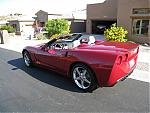
The C6 is not an E85 Flex Fuel vehicle, except for this one:

I prefer a Top Tier gasoline with 0% ethanol and 91 (R+M)/2 octane, minimum (93 preferred).
The C6 is not an E85 Flex Fuel vehicle, except for this one:
Last edited by calemasters; Dec 18, 2007 at 06:26 PM.