






Direct Port Nitrous

Thread Starter
Safety Car

Joined: Sep 2007
Posts: 3,902
Likes: 2
From: RIP Lotus
St. Jude Donor '09
 Direct Port Nitrous
I am considering a nitrous setup for my Cam/Fast 05 Z51
I was going to go with a plate kit but I've gone all out so far I figured I should look into a Direct Port setup, plus I think they look really cool!
I suppose I'll need forged internals? which ones?
Please explain direct port nitrous to me.
Pictures?
I was going to go with a plate kit but I've gone all out so far I figured I should look into a Direct Port setup, plus I think they look really cool!
I suppose I'll need forged internals? which ones?
Please explain direct port nitrous to me.
Pictures?
Melting Slicks


Joined: May 2005
Posts: 2,231
Likes: 0
From: Brownsville Tx
Well you dont need forged internals with direct port nitrous more than you do with any other nitrous system. Your need for forged internals really depends on the size of shot you're planning on. Forged internals will be needed for a BIG shot like maybe 250-300 or so.
Your basic wet system (like the plate system) sprays the nitrous and fuel in a fine mist through a pair of nozzles at the entrance to your intake manifold. From there it just gets sucked in with the rest of the air to each cylinder. These plates work well, but most people recommend that you go direct port if you are going for more than a 150 shot. The reason is that at, for example a 200 shot, you are spraying quite a bit of fuel into the intake manifold. That amount of fuel is hard to carry evenly into each cylinder just by carrying it along with the rest of the air. This opens the possiblity for one of the cylinders not getting enough additional fuel and causing a lean backfire, which will then also ignite all the rest of the fuel flying around in your manifold.
A direct port system addresses this distribution problem by putting a fuel nozzle and a nitrous nozzle in every single intake runner so that each cylinder gets an even dose of fuel and nitrous.
Direct port systems are more expensive and more labor intensive. Unless you plan on doing anything larger than a 150 shot then I'd say to stick with a good plate system. If you want something a little more flashy, check out the Power Ring system by Texas Nitrous Technology. I had it on my car for a good while and it works great. 150 shot on the TNT kit was unbelievable.
You should also consider a DRY nitrous system. These are much simpler to install and cheaper to buy. The only possible problem with those is you may not have someone near you who is experienced in tuning dry shots. A dry system is just like the wet system and the direct-port system, except for one part. Instead of having a fuel solenoid inject the fuel along with the nitrous into your engine, your computer will be tuned to command your injectors to supply the additional fuel when you spray the nitrous. A lot of people like dry systems better because there is no possibility of uneven fuel distribution. There is also no fuel solenoid to ever fail on you. This just adds an extra degree of safety to the system. Another plus to dry is that, regardless of your bottle pressure, the computer will only inject enough fuel according to the amount of nitrous coming in. This means you always get an optimal A/F ratio despit a low bottle pressure. On the wet kits, when your bottle pressure gets low, you're spraying less nitrous than you intend, but you're still spraying the same amount of fuel, so you end up very rich and lose some power there.
Your basic wet system (like the plate system) sprays the nitrous and fuel in a fine mist through a pair of nozzles at the entrance to your intake manifold. From there it just gets sucked in with the rest of the air to each cylinder. These plates work well, but most people recommend that you go direct port if you are going for more than a 150 shot. The reason is that at, for example a 200 shot, you are spraying quite a bit of fuel into the intake manifold. That amount of fuel is hard to carry evenly into each cylinder just by carrying it along with the rest of the air. This opens the possiblity for one of the cylinders not getting enough additional fuel and causing a lean backfire, which will then also ignite all the rest of the fuel flying around in your manifold.
A direct port system addresses this distribution problem by putting a fuel nozzle and a nitrous nozzle in every single intake runner so that each cylinder gets an even dose of fuel and nitrous.
Direct port systems are more expensive and more labor intensive. Unless you plan on doing anything larger than a 150 shot then I'd say to stick with a good plate system. If you want something a little more flashy, check out the Power Ring system by Texas Nitrous Technology. I had it on my car for a good while and it works great. 150 shot on the TNT kit was unbelievable.
You should also consider a DRY nitrous system. These are much simpler to install and cheaper to buy. The only possible problem with those is you may not have someone near you who is experienced in tuning dry shots. A dry system is just like the wet system and the direct-port system, except for one part. Instead of having a fuel solenoid inject the fuel along with the nitrous into your engine, your computer will be tuned to command your injectors to supply the additional fuel when you spray the nitrous. A lot of people like dry systems better because there is no possibility of uneven fuel distribution. There is also no fuel solenoid to ever fail on you. This just adds an extra degree of safety to the system. Another plus to dry is that, regardless of your bottle pressure, the computer will only inject enough fuel according to the amount of nitrous coming in. This means you always get an optimal A/F ratio despit a low bottle pressure. On the wet kits, when your bottle pressure gets low, you're spraying less nitrous than you intend, but you're still spraying the same amount of fuel, so you end up very rich and lose some power there.
Last edited by jogar80; Apr 11, 2008 at 06:40 PM.

Drifting


Joined: Jun 2007
Posts: 1,757
Likes: 2
From: Middletown DE
I'm definately getting that Procharger now!!!!!.............
Navy, due some research on the dry systems. I ran a dry 125 shot on my 99 Trans Am with all the bells and whistles and had great results.
On that car though, you sprayed before the MAF and the MAF made the required adjustments for fuel. No tuning was required.....I would think the dry systems for the C6 would be the same, but I'm not sure.
Navy, due some research on the dry systems. I ran a dry 125 shot on my 99 Trans Am with all the bells and whistles and had great results.
On that car though, you sprayed before the MAF and the MAF made the required adjustments for fuel. No tuning was required.....I would think the dry systems for the C6 would be the same, but I'm not sure.
Melting Slicks
Joined: May 2005
Posts: 2,231
Likes: 0
From: Brownsville Tx
It's the same in the C6. You spray before the MAF, and it senses it and adjusts the fuel accordingly. Tuning is still recommended to make sure your MAF is picking up the nitrous correctly, plus some other things. It just makes the system that much safer if you get it tuned.
Corvette Stories
The Best of Corvette for Corvette Enthusiasts

Top 10 Most Expensive Corvettes Ever Sold on Bring A Trailer
Brett Foote
10 Things Every Corvette Owner Needs (2026 Edition)
Michael S. Palmer
8 Most "Only Corvette Owners Understand" Quirks and Problems
Pouria Savadkouei
10 Reasons the C6 Z06 is Still A Performance Benchmark After 20 Years
Joe Kucinski
How Much Horsepower Every Corvette Engine "LOST" in 1972
Joe Kucinski
Top 10 DOs and DON'Ts for Protecting Your Convertible Top!
Michael S. Palmer
Top 10 Most Explosive Corvettes Ever Made: Power-to-Weight Ratio Ranked!
Joe Kucinski
150 hp to 1,250 hp: Every Corvette Generation Compared by the Specs That Matter
Joe Kucinski
8 Coolest Corvette Pace Cars (and Replicas) of All Time
Verdad Gallardo
Melting Slicks
Joined: May 2005
Posts: 2,231
Likes: 0
From: Brownsville Tx
Thread Starter
Safety Car
Joined: Sep 2007
Posts: 3,902
Likes: 2
From: RIP Lotus
St. Jude Donor '09
I'll have to ask my tuner some questions about Dry systems. Currently, my injectors couldn't handle it. I'd need new ones.
I'm not completely new to nitrous but it seems that in my area, most people in the LSX crowd that I know run wet kits.
Nitrous, atleast in my implementation would be a supercharger replacement. I don't want or need the power of a supercharger all the time. I want my car to run and sound just like it does, but with an extra 200hp on tap.
That is why I think I'd want a direct port/forged bottom end setup. Now with that in mind, what are your thoughts?
I'm not completely new to nitrous but it seems that in my area, most people in the LSX crowd that I know run wet kits.
Nitrous, atleast in my implementation would be a supercharger replacement. I don't want or need the power of a supercharger all the time. I want my car to run and sound just like it does, but with an extra 200hp on tap.
That is why I think I'd want a direct port/forged bottom end setup. Now with that in mind, what are your thoughts?
Melting Slicks
Joined: May 2005
Posts: 2,231
Likes: 0
From: Brownsville Tx
Yes its the same down here, most shops prefer wet kits and most say they are better/safer. My opinion is they all prefer wet kits because they are so easy to tune. I think both wet and dry can be safe if set-up and tuned correctly.
You can definitely do a 200 shot with a dry kit, many are doing this in the LSX world. You just need to be sure you have large enough injectors and perhaps a "Boost-a-Pump" for your fuel pump. If you decide on a wet kit, then you should DEFINITELY go with a direct-port setup, and you may still need a boost-a-pump, unless you have a dedicated fuel system. Whichever way you choose, get a progressive controller on it to ramp the delivery of the nitrous, a 200 hp shot hitting in an instant will be a handfull, for you AND your drivetrain. Forged bottom end is never going to be a bad idea, but I dont think you need it if you dont go above 200 hp and you ramp the nitrous delivery.
You can definitely do a 200 shot with a dry kit, many are doing this in the LSX world. You just need to be sure you have large enough injectors and perhaps a "Boost-a-Pump" for your fuel pump. If you decide on a wet kit, then you should DEFINITELY go with a direct-port setup, and you may still need a boost-a-pump, unless you have a dedicated fuel system. Whichever way you choose, get a progressive controller on it to ramp the delivery of the nitrous, a 200 hp shot hitting in an instant will be a handfull, for you AND your drivetrain. Forged bottom end is never going to be a bad idea, but I dont think you need it if you dont go above 200 hp and you ramp the nitrous delivery.

Race Director

Joined: Jan 2006
Posts: 18,396
Likes: 169
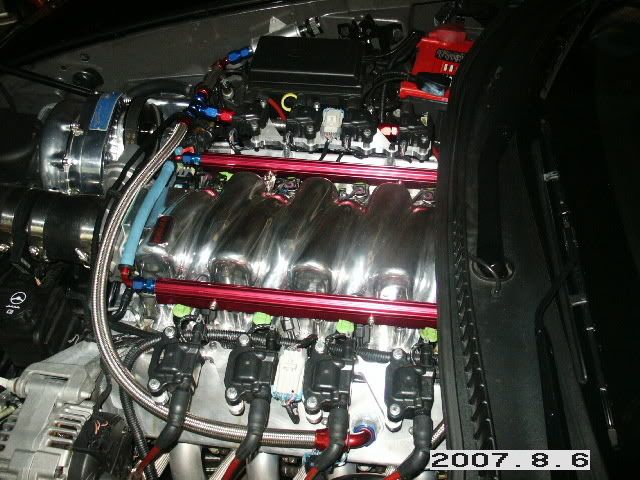
You really cannot see them in this photo, but the Typhoon aluminum intake manifold made by Professional Products has provisions made into the manifold design for direct port injection for NO2. All that is necessary is to drill and tap the additional bosses in the runners. And you need an aluminum intake if you're running NO2.
Thread Starter
Safety Car
Joined: Sep 2007
Posts: 3,902
Likes: 2
From: RIP Lotus
St. Jude Donor '09
Drifting
Joined: Dec 2002
Posts: 1,613
Likes: 0
The NO plate kit will flow 400 it has 6 nitrous and 6 fuel ports for great atomization.
That with a standalone and safe tune will be a fairly inexpensive and safe 200 rwhp and 250 rwtq
The more you spray the more octane you need or the more timing you need to pull, Octane is a good safety measure and with the stand alone you can run a beter NA tune and spray when you want.
That with a standalone and safe tune will be a fairly inexpensive and safe 200 rwhp and 250 rwtq
The more you spray the more octane you need or the more timing you need to pull, Octane is a good safety measure and with the stand alone you can run a beter NA tune and spray when you want.
Drifting
Joined: Dec 2002
Posts: 1,613
Likes: 0
Wet Nitrous Outlet Plate Kit.
Best ET / MPH so far: 11.1 / 125 at 3000 feet.
This is by no means the least expensive kit but I like the 6 fuel and 6 N20 ports for atomization and better distribution of fuel and N20 IMO.
650 Base Nitrous Outlet 90mm Plate kit
129 Window / WOT via tps switch
I also run 100 unleaded every time I spray, I run the tank 20 miles past the low fuel warning and add 5+ gallons of 100 octane unleaded.
IMO one should get a N20 tune and verify AFR at the very least.
I use HP tuners and a Inovative WB to monitor my AFR and Knock Retard.
Plate installed just like a TB spacer (Black lines are HSW).
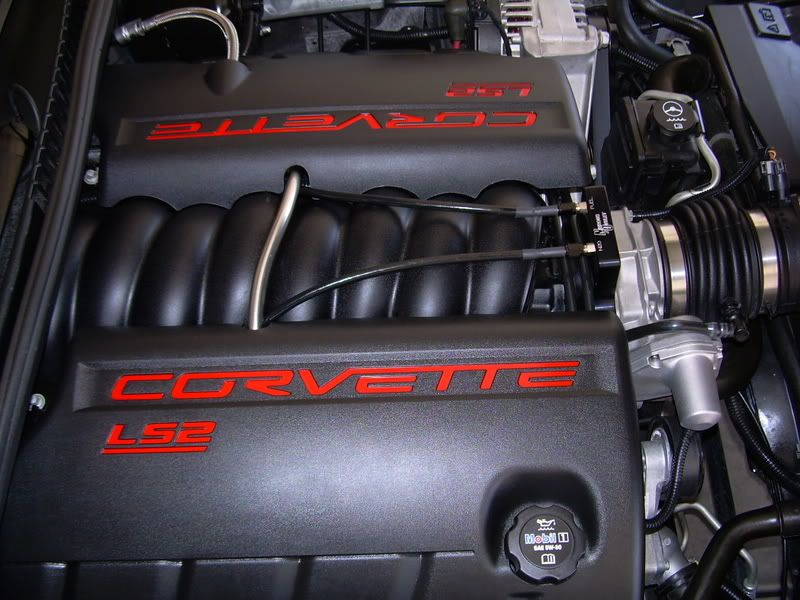
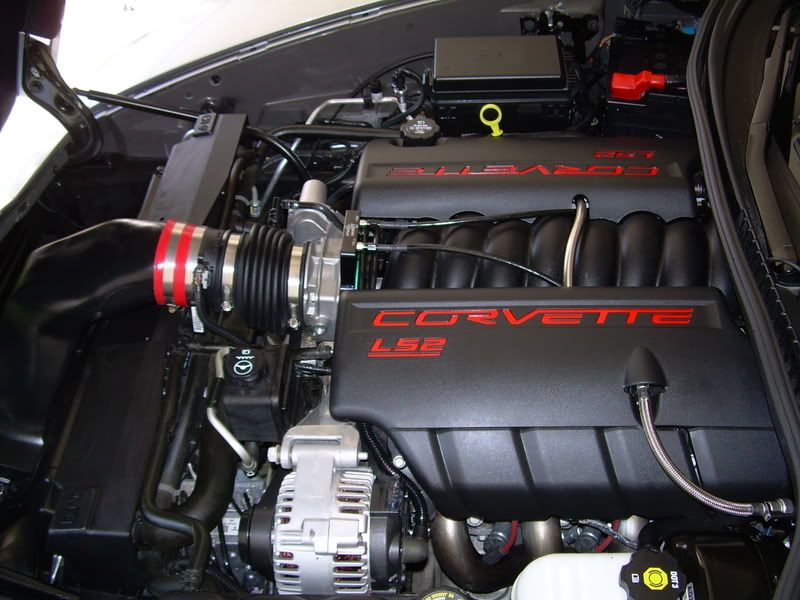
Close up of the plate (they come black but this pic shows the ports well).

Plate kit http://www.nitrousoutlet.com/catalog...del=37&dept=11
Window / WOT Switch http://www.nitrousoutlet.com/catalog...del=86&dept=11
Dave, Chis and Ray from Nitrous Outlet have been great.
http://www.nitrousoutlet.com/index.asp
Lots of good N20 info at LS1-LS2-LS6-LS7 PERFORMANCE Nitrous Oxide section
http://www.ls1tech.com/forums/forumd...aysprune=&f=10
Best ET / MPH so far: 11.1 / 125 at 3000 feet.
This is by no means the least expensive kit but I like the 6 fuel and 6 N20 ports for atomization and better distribution of fuel and N20 IMO.
650 Base Nitrous Outlet 90mm Plate kit
129 Window / WOT via tps switch
I also run 100 unleaded every time I spray, I run the tank 20 miles past the low fuel warning and add 5+ gallons of 100 octane unleaded.
IMO one should get a N20 tune and verify AFR at the very least.
I use HP tuners and a Inovative WB to monitor my AFR and Knock Retard.
Plate installed just like a TB spacer (Black lines are HSW).
Close up of the plate (they come black but this pic shows the ports well).
Plate kit http://www.nitrousoutlet.com/catalog...del=37&dept=11
Window / WOT Switch http://www.nitrousoutlet.com/catalog...del=86&dept=11
Dave, Chis and Ray from Nitrous Outlet have been great.
http://www.nitrousoutlet.com/index.asp
Lots of good N20 info at LS1-LS2-LS6-LS7 PERFORMANCE Nitrous Oxide section
http://www.ls1tech.com/forums/forumd...aysprune=&f=10
Safety Car
Joined: Jul 2006
Posts: 4,647
Likes: 1
From: Objects in your mirror are losing , Long Island, NY
St. Jude Donor '08
Well you dont need forged internals with direct port nitrous more than you do with any other nitrous system. Your need for forged internals really depends on the size of shot you're planning on. Forged internals will be needed for a BIG shot like maybe 250-300 or so.
Your basic wet system (like the plate system) sprays the nitrous and fuel in a fine mist through a pair of nozzles at the entrance to your intake manifold. From there it just gets sucked in with the rest of the air to each cylinder. These plates work well, but most people recommend that you go direct port if you are going for more than a 150 shot. The reason is that at, for example a 200 shot, you are spraying quite a bit of fuel into the intake manifold. That amount of fuel is hard to carry evenly into each cylinder just by carrying it along with the rest of the air. This opens the possiblity for one of the cylinders not getting enough additional fuel and causing a lean backfire, which will then also ignite all the rest of the fuel flying around in your manifold.
A direct port system addresses this distribution problem by putting a fuel nozzle and a nitrous nozzle in every single intake runner so that each cylinder gets an even dose of fuel and nitrous.
Direct port systems are more expensive and more labor intensive. Unless you plan on doing anything larger than a 150 shot then I'd say to stick with a good plate system. If you want something a little more flashy, check out the Power Ring system by Texas Nitrous Technology. I had it on my car for a good while and it works great. 150 shot on the TNT kit was unbelievable.
You should also consider a DRY nitrous system. These are much simpler to install and cheaper to buy. The only possible problem with those is you may not have someone near you who is experienced in tuning dry shots. A dry system is just like the wet system and the direct-port system, except for one part. Instead of having a fuel solenoid inject the fuel along with the nitrous into your engine, your computer will be tuned to command your injectors to supply the additional fuel when you spray the nitrous. A lot of people like dry systems better because there is no possibility of uneven fuel distribution. There is also no fuel solenoid to ever fail on you. This just adds an extra degree of safety to the system. Another plus to dry is that, regardless of your bottle pressure, the computer will only inject enough fuel according to the amount of nitrous coming in. This means you always get an optimal A/F ratio despit a low bottle pressure. On the wet kits, when your bottle pressure gets low, you're spraying less nitrous than you intend, but you're still spraying the same amount of fuel, so you end up very rich and lose some power there.
Your basic wet system (like the plate system) sprays the nitrous and fuel in a fine mist through a pair of nozzles at the entrance to your intake manifold. From there it just gets sucked in with the rest of the air to each cylinder. These plates work well, but most people recommend that you go direct port if you are going for more than a 150 shot. The reason is that at, for example a 200 shot, you are spraying quite a bit of fuel into the intake manifold. That amount of fuel is hard to carry evenly into each cylinder just by carrying it along with the rest of the air. This opens the possiblity for one of the cylinders not getting enough additional fuel and causing a lean backfire, which will then also ignite all the rest of the fuel flying around in your manifold.
A direct port system addresses this distribution problem by putting a fuel nozzle and a nitrous nozzle in every single intake runner so that each cylinder gets an even dose of fuel and nitrous.
Direct port systems are more expensive and more labor intensive. Unless you plan on doing anything larger than a 150 shot then I'd say to stick with a good plate system. If you want something a little more flashy, check out the Power Ring system by Texas Nitrous Technology. I had it on my car for a good while and it works great. 150 shot on the TNT kit was unbelievable.
You should also consider a DRY nitrous system. These are much simpler to install and cheaper to buy. The only possible problem with those is you may not have someone near you who is experienced in tuning dry shots. A dry system is just like the wet system and the direct-port system, except for one part. Instead of having a fuel solenoid inject the fuel along with the nitrous into your engine, your computer will be tuned to command your injectors to supply the additional fuel when you spray the nitrous. A lot of people like dry systems better because there is no possibility of uneven fuel distribution. There is also no fuel solenoid to ever fail on you. This just adds an extra degree of safety to the system. Another plus to dry is that, regardless of your bottle pressure, the computer will only inject enough fuel according to the amount of nitrous coming in. This means you always get an optimal A/F ratio despit a low bottle pressure. On the wet kits, when your bottle pressure gets low, you're spraying less nitrous than you intend, but you're still spraying the same amount of fuel, so you end up very rich and lose some power there.
 . Well, I guess the 150 dry shot system would be my next mod besides sticky tires.
Melting Slicks
Joined: May 2005
Posts: 2,231
Likes: 0
From: Brownsville Tx
Hello Jogar, I live not too far from SPINMONSTER, I was hangin out with him this past thursday, he mentioned your name and spoke highly of you, guess when spin speaks highly of someone he is being sincere . Well, I guess the 150 dry shot system would be my next mod besides sticky tires.
. Well, I guess the 150 dry shot system would be my next mod besides sticky tires. 