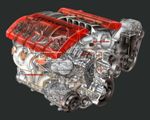







Hydrolocked LS3

Thread Starter
Le Mans Master


Joined: May 2003
Posts: 5,362
Likes: 3
From: Delray Beach FL

For now, we are going to keep the LS3 heads and intake, as they seem to flow really well.
Shop is guessing that I jammed a piston into the cylinder wall pretty good. Rod is definitely bent. Once they get the short block in, they will pull apart the old motor to see how many rods were bent.
Joe...good point. Going to start a new thread for the cam now.
Shop is guessing that I jammed a piston into the cylinder wall pretty good. Rod is definitely bent. Once they get the short block in, they will pull apart the old motor to see how many rods were bent.
Joe...good point. Going to start a new thread for the cam now.

Le Mans Master


Joined: Jul 2007
Posts: 5,511
Likes: 1,828
From: Arkansas
St. Jude Donor '09 thru '17,'22 thru '26
I was caught in a rainstorm in Fla. a few years ago in an area I was not familiar with. Luckily I was in an SUV and made it through an area of deep water that could not be identified by looking. Sometimes there are low areas in a street that just don't look low when dry but have very deep water after a downpour. Also all the talk about the depth of the water is BS. You must realize that the front of the Vette in fairly shallow water will act like a blade pushing up a wave of water that will get deeper and deeper at the front of the car even at a slow speed. Any intake open in the grill area is subject to inhaling this wave. You can't always say it's driver error or that is ok to drive in a certain depth of water-the front or bottom feeders put you at risk unless you never drive in the rain OR know the roads your driving very well.

Safety Car

Joined: Aug 2006
Posts: 4,206
Likes: 6
From: Makena, Maui & NM
Front/Bottom Feeder-Vararam
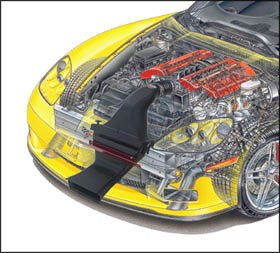
Back Feeder-Honker


Pro


Joined: Apr 2004
Posts: 559
Likes: 43
From: Bonita Springs FL
Thanks! Great diagrams!
I drove a 5.0 Mustang for 20 years and it had a Kenne Bell ram air kit where the "scoop" mounted under the front fascia.
It sat about 6" off the pavement. I never had an issue but was VERY careful where I drove it. I think what makes a difference is how it is ducted and the placement of the filter. For me to suck water it would have had to make a 90 degree turn up and then a couple of 45 turns through the fender and another 90 into the air box that housed the filter.
Obviously, a straight shot to the filter and you have more of a chance of sucking water.
Speaking of water, when I was a kid and was trying to make an old car that had been sitting run better was take some water in a bottle and dribble it down the throat of the carb. Clouds of steam out the back and eventually the idle would smooth out and the car would run pretty decently. Before you start flaming, no, I'd never do that to a Vette or any newer car. But it did work on those older cars and they never hydrolocked.
I drove a 5.0 Mustang for 20 years and it had a Kenne Bell ram air kit where the "scoop" mounted under the front fascia.
It sat about 6" off the pavement. I never had an issue but was VERY careful where I drove it. I think what makes a difference is how it is ducted and the placement of the filter. For me to suck water it would have had to make a 90 degree turn up and then a couple of 45 turns through the fender and another 90 into the air box that housed the filter.
Obviously, a straight shot to the filter and you have more of a chance of sucking water.
Speaking of water, when I was a kid and was trying to make an old car that had been sitting run better was take some water in a bottle and dribble it down the throat of the carb. Clouds of steam out the back and eventually the idle would smooth out and the car would run pretty decently. Before you start flaming, no, I'd never do that to a Vette or any newer car. But it did work on those older cars and they never hydrolocked.
Last edited by Whisky; May 4, 2009 at 10:09 PM.

Le Mans Master
Joined: Aug 2004
Posts: 5,259
Likes: 16
From: Monroe Township New Jersey
St. Jude Donor '05-'06-'07-'08-'09-'10-'11-'12-'13-'14-'15-'16
St. Jude donor in memory of jpee '14
Speaking of water, when I was a kid and was trying to make an old car that had been sitting run better was take some water in a bottle and dribble it down the throat of the carb. Clouds of steam out the back and eventually the idle would smooth out and the car would run pretty decently. Before you start flaming, no, I'd never do that to a Vette or any newer car. But it did work on those older cars and they never hydrolocked.
 …….We utilized an IV bag filled with water and attached it to a vacuum line just below the carb.
 Set the idle to 2000 and set the drip. The steam cleaned the intake, valves, piston tops and etc. We found it very useful with cams that had a lot of overlap and had exhaust revision. :thumbs
Corvette Stories
The Best of Corvette for Corvette Enthusiasts

Corvette & Porsche 911: How Two Icons Conquered the Last 25 Years
Joe Kucinski
2027 Chevrolet Silverado 1500 First Look: Everything You NEED to Know!
Michael S. Palmer
5 Best & 5 Worst Corvette Daily Drivers
Joe Kucinski
The Headlights of Every Corvette Generation Explained
Joe Kucinski
5 Best & 5 Most Overrated Corvette Track Packages of All Time!
Joe Kucinski
Every 2027 Corvette Engine Explained
Joe Kucinski
Designer Imagines A Corvette That Looks More Like a Corvette Than the Corvette
Verdad Gallardo
10 Ugly Corvettes That We Still Kinda Love
Joe Kucinski
Top 10 Most Expensive Corvettes Ever Sold on Bring A Trailer
Brett Foote
Racer

Joined: Dec 2008
Posts: 284
Likes: 0
From: Sugar Land TX
No one is going to flame you on that one. Old school …….We utilized an IV bag filled with water and attached it to a vacuum line just below the carb.
Set the idle to 2000 and set the drip. The steam cleaned the intake, valves, piston tops and etc. We found it very useful with cams that had a lot of overlap and had exhaust revision. :thumbs
…….We utilized an IV bag filled with water and attached it to a vacuum line just below the carb. Set the idle to 2000 and set the drip. The steam cleaned the intake, valves, piston tops and etc. We found it very useful with cams that had a lot of overlap and had exhaust revision. :thumbs


That is a good "old school" way to de-carbon the engine. The theory I subscribe to is that when the water contacts hot carbon the water instantly vaporizing and that "micro explosion" blows the carbon or coke off or alternatively the local vaporizing of the water causes the coke to contract suddenly because it is cooled by vaporizing water and cracks and breaks. Both mechanisms are possible and may work together. So it is the steam as stated above does the good but it is really is the conversion of water to steam that does the job.
No problem with an engine ingesting water drops or mist and it actually can improve the engine efficiency. A number of fighter aircraft in WWII used water injection for a short term boost in HP. The dangers are using too much, which is actually pretty hard to do at mid to high rpms and used continuously, the water gets in the oil and it causes the oil to loose its lubrication properties and the water causes internal corrosion.
The big problem is too much water where it becomes the dominate component in the intake and ultimately cause hydraulic lock where it breaks things.
Last edited by jrnorman; May 5, 2009 at 07:06 AM.

Team Owner

Joined: Jun 2005
Posts: 46,295
Likes: 2,596
From: Northern, VA
St. Jude Donor '15
"In honor of jpee"
Thanks! Great diagrams!
I drove a 5.0 Mustang for 20 years and it had a Kenne Bell ram air kit where the "scoop" mounted under the front fascia.
It sat about 6" off the pavement. I never had an issue but was VERY careful where I drove it. I think what makes a difference is how it is ducted and the placement of the filter. For me to suck water it would have had to make a 90 degree turn up and then a couple of 45 turns through the fender and another 90 into the air box that housed the filter.
Obviously, a straight shot to the filter and you have more of a chance of sucking water. ...
I drove a 5.0 Mustang for 20 years and it had a Kenne Bell ram air kit where the "scoop" mounted under the front fascia.
It sat about 6" off the pavement. I never had an issue but was VERY careful where I drove it. I think what makes a difference is how it is ducted and the placement of the filter. For me to suck water it would have had to make a 90 degree turn up and then a couple of 45 turns through the fender and another 90 into the air box that housed the filter.
Obviously, a straight shot to the filter and you have more of a chance of sucking water. ...
About six years ago, K&N designed a quik-release for a major portion of their intake for another car (G35 Infin) which required you get out and pop the hood, but at least it worked easily. AEM had already designed a valve that sensed water and diverted to an in-engine air source. The fact that there is nothing yet like those for Vettes is kind of amazing, esp. since the "cold air intakes" cost about double what those other intakes cost
Pro
Joined: Apr 2004
Posts: 559
Likes: 43
From: Bonita Springs FL

Burning Brakes

Joined: Feb 2008
Posts: 1,151
Likes: 7
I hydro-locked a new 1987 vette back in the day. Did absolutely no damage. Removed the plugs, cranking over the motor to get the water out, sprayed some oil back in the cylinders, blew it out again & changed the oil 3 times.