L92/L76 Conversion

Navigator


Joined: May 2007
Posts: 9
Likes: 0

No one is saying a single set of cam specs is best and again you seem to be latching onto that. As duration grows there are limited things to do to keep overlap down. The first to go should be the split size since LSA is more closely tied to the width of power band.
He was making fun of the 231/244 cam experts and not you.
I can think of no car that needs a 10-12 degree split with any set of mods.
The overwhelming PM topic I get is:
I got XYZ cam from tuner X and it bucks at 1600rpm, what can I do?
He was making fun of the 231/244 cam experts and not you.
I can think of no car that needs a 10-12 degree split with any set of mods.
The overwhelming PM topic I get is:
I got XYZ cam from tuner X and it bucks at 1600rpm, what can I do?

Drifting


Joined: Sep 2008
Posts: 1,722
Likes: 21
From: Roseburg Oregon
First off a 232/236 is not a big split.
Second, results from an LS3 are not comparable to a LS2 with LS3 heads. I got 463rwhp on an A6 with a 224 single pattern cam on a 115LSA on an LS3 engine.
The point being made is not that big split cams dont work for power but rather, the same power can be made with better driveability. The texas speed 228R is a zero overlap cam that has the awesome driveability of a zero overlap cam. If two cam makes the same power why not go with the one that has no bucking, surging, and works with a supercharger?
If a 230/234 made 501 rwhp, then why use a 232/238 that makes the same power? He posted his results for both track and dyno here:
http://forums.corvetteforum.com/c6-t...ivability.html
If the same power is made with a 230 intake duration why not take advantage of the lower overlap and better fitment?
The 501rwhp cam did a 127 trap speed at a 1400DA. Another guy got 486rwhp with it:
http://forums.corvetteforum.com/c6-t...right-now.html
Most people talk themselves into their bigger cam being ok to live with driveability wise but in a side by side comparison with a lower overlap cam, the smaller cam would be chosen by that owner.
Next up is a 232 intake duration on a 114 is not going to fit without flycutting with the compression needed for such a huge cam. It is near 11.7:1 for the same dynamic compression as the stock cam has. I saw a 234 intake duration on a 111LSA and it has .047" clearance which was well outside the safe margin of .080" minimum. These heads have a .140" valve drop from the valve seat to begin with. A 228 cam on a 114LSA with no advance is therefore .090" clearance at .050" off the seat. Now use a thinner gaskets or milling for compression and even a little 228 cam needs flycutting. So if someone told you they got a 232 111LSA with .030" milled and didnt flycut, they do not in any way in hell get a clearance of .080". Nor with a 232 111LSA drive as good as as 230 114LSA.
Use what you want but the results are track and dyno verified by others and not JUST ME. You wont get better power and you wont have better driveability.
Second, results from an LS3 are not comparable to a LS2 with LS3 heads. I got 463rwhp on an A6 with a 224 single pattern cam on a 115LSA on an LS3 engine.
The point being made is not that big split cams dont work for power but rather, the same power can be made with better driveability. The texas speed 228R is a zero overlap cam that has the awesome driveability of a zero overlap cam. If two cam makes the same power why not go with the one that has no bucking, surging, and works with a supercharger?
If a 230/234 made 501 rwhp, then why use a 232/238 that makes the same power? He posted his results for both track and dyno here:
http://forums.corvetteforum.com/c6-t...ivability.html
If the same power is made with a 230 intake duration why not take advantage of the lower overlap and better fitment?
The 501rwhp cam did a 127 trap speed at a 1400DA. Another guy got 486rwhp with it:
http://forums.corvetteforum.com/c6-t...right-now.html
Most people talk themselves into their bigger cam being ok to live with driveability wise but in a side by side comparison with a lower overlap cam, the smaller cam would be chosen by that owner.
Next up is a 232 intake duration on a 114 is not going to fit without flycutting with the compression needed for such a huge cam. It is near 11.7:1 for the same dynamic compression as the stock cam has. I saw a 234 intake duration on a 111LSA and it has .047" clearance which was well outside the safe margin of .080" minimum. These heads have a .140" valve drop from the valve seat to begin with. A 228 cam on a 114LSA with no advance is therefore .090" clearance at .050" off the seat. Now use a thinner gaskets or milling for compression and even a little 228 cam needs flycutting. So if someone told you they got a 232 111LSA with .030" milled and didnt flycut, they do not in any way in hell get a clearance of .080". Nor with a 232 111LSA drive as good as as 230 114LSA.
Use what you want but the results are track and dyno verified by others and not JUST ME. You wont get better power and you wont have better driveability.
Your 232/236 is the same split as mine. I suspect that a 116+3 would make the same power or slightly better but it isnt a XFI lobe for the intake and a 230 XFI will flow as well as a 232 XER so I never tried it. Can you post the results from it? If its better, I'll push it to others in the many PM's I get from members looking for advice. This isnt a pride thing for me. I'm just helping out.
I would say that the average guy would find the 228/232 work horse or its 230XFI counterpart to fit most applications. It seems to work great with a 243 or LS3 head too. The 230XFI/234 XER cam makes 432 on average with stock 243 heads and no FAST and has more power under the curve. It makes 460 with a FAST and stock 243 heads. On the LS3 we saw the results 486 to 501 from forum members. I think its a best bet. None of these cars used the FAST 102 yet with it
Didnt mean to offend you or to spark an argument.
I know a 232/236 is not a big split. I was agreeing with you that there are otheres out there that think a 230/234 or a smaller split cam is a good match.
8bygoat/PBANDPKGTO is running that 232/236 .600/.600 113 with the heads milled .030" It was a 113lsa though, not a 111 lsa. Dont know what lobes the flowtech tiger shark cam uses though. It fit without fly cutting with stock gaskets
So which do you recomend?
230xfi/234xer 114+2 (dont know the lift you had)
228/232 XER (dont know the lift or LSA on yours)
232/236 .600/.600 113
Im not arguing with you or disagreeing. Just trying to gain knowledge. You obviously know alot more on this then I do, or most others.
I just dont want to flycut. Looking for more of top end cam. Car isnt a DD and has 3:90 gears. Its a weekend toy. Supporting mods in sig. Can either go with a fast LSXR or a ported LS3 (havent bought an intake manifold yet) Shooting for 475whp.
Last edited by Spectre86; Nov 16, 2009 at 03:54 PM.

Melting Slicks

Joined: Sep 2007
Posts: 2,597
Likes: 3
From: READING PA
St. Jude Donor '08-'09-'10
228/232xer or 230xfi
Spin,
Didnt mean to offend you or to spark an argument.
I know a 232/236 is not a big split. I was agreeing with you that there are otheres out there that think a 230/234 or a smaller split cam is a good match.
8bygoat/PBANDPKGTO is running that 232/236 .600/.600 113 with the heads milled .030" It was a 113lsa though, not a 111 lsa. Dont know what lobes the flowtech tiger shark cam uses though. It fit without fly cutting with stock gaskets
So which do you recomend?
230xfi/234xer 114+2 (dont know the lift you had)
228/232 XER (dont know the lift or LSA on yours)
232/236 .600/.600 113
Im not arguing with you or disagreeing. Just trying to gain knowledge. You obviously know alot more on this then I do, or most others.
I just dont want to flycut. Looking for more of top end cam. Car isnt a DD and has 3:90 gears. Its a weekend toy. Supporting mods in sig. Can either go with a fast LSXR or a ported LS3 (havent bought an intake manifold yet) Shooting for 475whp.
Didnt mean to offend you or to spark an argument.
I know a 232/236 is not a big split. I was agreeing with you that there are otheres out there that think a 230/234 or a smaller split cam is a good match.
8bygoat/PBANDPKGTO is running that 232/236 .600/.600 113 with the heads milled .030" It was a 113lsa though, not a 111 lsa. Dont know what lobes the flowtech tiger shark cam uses though. It fit without fly cutting with stock gaskets
So which do you recomend?
230xfi/234xer 114+2 (dont know the lift you had)
228/232 XER (dont know the lift or LSA on yours)
232/236 .600/.600 113
Im not arguing with you or disagreeing. Just trying to gain knowledge. You obviously know alot more on this then I do, or most others.
I just dont want to flycut. Looking for more of top end cam. Car isnt a DD and has 3:90 gears. Its a weekend toy. Supporting mods in sig. Can either go with a fast LSXR or a ported LS3 (havent bought an intake manifold yet) Shooting for 475whp.
This cam is a zero issue cam and the torque curve is wicked. As far as the 230xfi not sure but I think the lifts are around 619 .

Tech Contributor

Joined: Mar 2003
Posts: 12,094
Likes: 197
From: Colorado Springs, CO
St. Jude Donor '08-'09-'10-'11
On your list above the 230xfi with even only 11.3:1 compression needs to be flycut. It has +4 overlap and I tell people planning on FI to use the 228/232 but on a 115+2 LS. The 228/232 114+0 is my blower cam and I wish it were a 115LSA for that last psi here at my elevation.
The 232/236 on a 113 has 8 degrees overlap and will not be anywhere near the nice driveability of a 228 on a 114 or 115. I dont know its power result on LS3 heads but if it isnt at least 15rwhp better (which I would bet it isnt) then it makes no sense to introduce more overlap and move the power band up for its use. On a 243 type head like the trick flow 225, use the 232 cam. On an LS3 it is a step in the wrong direction and there is no way with any thinner than stock gasket or milling it has .080" clearance on the intake valve. The stock LS3 head has .140" valve drop. If you mill it and use thinner gaskets, it isnt clearing without flycutting.
What has me worried are the number of cams that some people are using thinking that they fit. Just to keep things in perspecitve, LG motorsports says that their G5X3 234 112LSA cam wont fit with milled 243 heads. So how can people be thinking those size cams fit the L92's with a 2.16 intake valve will fit cams that size or bigger? They dont fit. You have to flycut. If you wont flycut then use a smaller cam that fits. Overcamming doesnt make more power with the heads especially when there is big overlap. I think 4 degrees is the limit before big reversion takes away from the gains had by the bigger intake duration. Such a big cam is also going to suffer with low end power.
The heads are very inefficient in the 3-4k rpm range hence why so many bigger cam installs show a depression in this rpm band. You throw timing at inefficiencies and this is evidenced by GM's stock timing curve for the LS3 has up to 8 more degrees timing in this narrow rpm range 3-4k. Overcamming exaggerates this issue.
Agreeing with Scoggins, you need to see your application before you get a cam. Saying you dont want to flycut limits your choice to a 224 cam with 11.4:1 compression.....so I would recomend you use a .040" gasket and a .030" mill to the heads with a 224XFI/230XER cam. If you want o use a 228/232 you need more compression than that and it needs a flycut.
Last edited by SpinMonster; Nov 17, 2009 at 05:14 AM.

Le Mans Master


Joined: Oct 2005
Posts: 5,054
Likes: 889
From: Tampa Florida
Okay, right now I have L92 stock heads, .020 milled heads and stock gaskets. So, what is my compression? I really want to be at stock compression or better but it doesn't seem that way after reading the posts. Thanks
Navigator
Joined: May 2007
Posts: 9
Likes: 0
The 232/236 on a 113 has 8 degrees overlap and will not be anywhere near the nice driveability of a 228 on a 114 or 115. I dont know its power result on LS3 heads but if it isnt at least 15rwhp better (which I would bet it isnt) then it makes no sense to introduce more overlap and move the power band up for its use.
I drive the car daily in Atlanta and I have 0 driveability issues (ie no bucking no surging at low rpms) but then again I have a properly matched stall converter, unported heads, and a good tune.
Drifting
Joined: Sep 2008
Posts: 1,722
Likes: 21
From: Roseburg Oregon
On my car (stalled A4 GTO) it makes 450/404. Through an M6 (GTO) it makes 480/430.
I drive the car daily in Atlanta and I have 0 driveability issues (ie no bucking no surging at low rpms) but then again I have a properly matched stall converter, unported heads, and a good tune.
I drive the car daily in Atlanta and I have 0 driveability issues (ie no bucking no surging at low rpms) but then again I have a properly matched stall converter, unported heads, and a good tune.
.030 milled heads and stock gaskets
and you didnt flycut right?
Corvette Stories
The Best of Corvette for Corvette Enthusiasts

5 Best & 5 Worst Corvette Daily Drivers
Joe Kucinski
The Headlights of Every Corvette Generation Explained
Joe Kucinski
5 Best & 5 Most Overrated Corvette Track Packages of All Time!
Joe Kucinski
Every 2027 Corvette Engine Explained
Joe Kucinski
Designer Imagines A Corvette That Looks More Like a Corvette Than the Corvette
Verdad Gallardo
10 Ugly Corvettes That We Still Kinda Love
Joe Kucinski
Top 10 Most Expensive Corvettes Ever Sold on Bring A Trailer
Brett Foote
10 Things Every Corvette Owner Needs (2026 Edition)
Michael S. Palmer
8 Most "Only Corvette Owners Understand" Quirks and Problems
Pouria Savadkouei
Racer
Joined: Feb 2007
Posts: 313
Likes: 0
fly cut
The cam I have is a Comp Cam XER273HR that is a special grind DTE used. The grind is 224 / 230 with .581/.592 lift with a 115. I have L92 heads being milled .030 for my 2007 C6 and plan to use cometic head gaskets that are .051 (stock thickness). I will also have Manley SS valves being used which I understand will decrease clearance with the piston.
I am just wondering if fly cutting is likely or not based on my spec’s. If you have this exact setup let me know if you had to fly cut or not.
I am just wondering if fly cutting is likely or not based on my spec’s. If you have this exact setup let me know if you had to fly cut or not.
Tech Contributor
Joined: Mar 2003
Posts: 12,094
Likes: 197
From: Colorado Springs, CO
St. Jude Donor '08-'09-'10-'11
Fitting doesnt mean the rotating assembly turns. It means you measured the distance and its greater than .080" on the intake valve. A 228/232 114 with heads milled .030" is .090". Thats still not over 11:1 and isnt optimum and there is no way 4 more degrees intake duration (about .006" each degree) and 1 less degree LSA comes to .010". My guess is he has about .060". A 234 111LSA I measrued was under .050".
Also, you should always exhaust using thinner gaskets before you mill. Thinner gaskets reduce quench distance and aid in avoiding detonation. Milling hurts head flow and maintains the same quench. The HP gaskets from using thinner gaskets allows more timing and thus more HP.
Flycutting takes an hour and I rent the cutter and flycut head for 150 plus shipping. There is a core charge. Do it right or plan on a new motor. You get the rental for 5 business days.
In addition if you want me to do this proceedure to your motor, spring for the plane ticket and 300 bucks and I will come there and do it for you.
The following is a reprint from my oldie but goodie FLYCUTMONSTER thread.....long since dead and buried in the boneyard of old threads:
OK, so in the midst of the header and gear wars, I figure its been long enough that we read the same non-sense so lets have another DIY tech thread involving real ways to make cars faster and an actual install with lots of music, grease, and torque wrenches clicking late into the night while the panzies dream about their gas mileage and low RPM’s on the hiway...a joke not a jab.
How to shove a big cam into a LS3 headed car that wont fit it with decent compression without having a piston hit a valve:
DISCLAIMER: This is not a begginer’s first project under the hood. It’s a look at what incredible tuners do to cars to make them run quick times and have awesome street manners with big cams and yet be safe running that big cam and not wreck an engine. When you go to a big name tuner, you should be aware that this type of mod takes experience, knowledge, and common sense too. If you don’t have all 3 of these things don’t try to duplicate what you see here. When you go for a 4x package at Cartek with a 3X cam, they build a high compression motor to smooth out the driveability with compression. That requires the heads to be milled, thinner gaskets and piston clearancing. Roy at Cartek does this for breakfast and its second nature and it takes time to learn to do it. Even the best of the best can mess up a measurement. Those companies back their work and what you get is a motor backed by a reputation. Louis at LG had spoken to me at length about this project and ones he is working on, and the thought and planning that goes into a package isn’t remedial nor is it based on your opinion of what he likes. Its based on absolutes and math. If you are an advanced mechanic and want to try such a project, do so with someone around that has done this before. I watched it done for years and messed up my share of practice pistons in dead engines before I was allowed to touch a good one.
PLEASE READ: I get frustrated when people ask me fitment questions about cams. This tech thread is about how you fly cut when a cam doesnt fit. It says nothing about how to check for a cam fitting. Without touching your engine and testing your actual car, no one is going to tell you what fits and what wont fit. The cam can be ground wrong, the heads could be milled if you werent the first owner....ect. Cam specs arent how you tell in a cam fits. You need to test it inperson. Please dont PM me with cam specs and ask if the cam fits with xyz milling. You need to dot hat yourself. As a guide in the quitessential world, a 230XER intake lobe on a 114+1 with 8.7 DCR is the limit of what fits with flycutting. You can fit a bigger cam with less compression. A 234 cam and 8.3 DCR can fit. Its all a trade off. I didnt test every cam out there nor will I vouch that your cam was ground right. There is no way I want that responsibility.
Enjoy the thread and if you want input from me, its free. The piston you mess up isn’t. I post this info here to at a minimum, give people a working respect for what is involved and like a science channel show, you don’t have to be the best at something to have an interest in it. You will be amazed at what you can accomplish when pride is set aside and you are willing to ask a question. If anyone sees an error in this thread, it was typed at 2am and I welcome any opinions (rare), corrections, or comments that contribute to the topic. I actually did the work on this car and it works fine so dont argue personal values here. If you have tech info and want to share, by all means do so.
PERSONAL VALUES:
Which camp do you fall into:
1-Leave it stock, I came here to look for a new cheap wax to make my car shine.
2-Get a tiny cam so it doesn’t appear that you changed it.
3-Put the biggest cam you can get in it for a big dyno number without more compression so you dont have to fly-cut.
4-Get a small cam so you don’t have to worry about it hitting with milled heads.
5-Get the cam you want and put the dress back in the closet! Make it fit with heads milled, thinner gaskets, and I want the thing to shake with lots of low end TQ! Fly-cut mah sheeet.
6-Get a Ford.
WARNING: those who yap about warranties and can’t handle seeing a CHERRY bone stock Corvette with an EXTENDED WARRANTY get violated in the most holy of ways, better close this thread.
Phil, the owner of the car is a Maryland married guy with an understanding wife that shares his values. She is happy with his hobbies and has a deep understanding of his need to tinker. He is a decent mechanic with the ability and comprehension level appropriate to this level of work. He was given a laundry list of disassembly for his car in preparation for me to install a head/cam package based on the LS3 head and a mid-sized cam which, with the static compression level needed for an 8.7 DCR requiring head milling and thinner gaskets. This made the cam not fit with the needed clearance on the intake valve side. He was in contact with me on the forum and wanted help with his project. Although I am listed as a forum tuner, I am not employed by anyone nor am I in the business of doing installs for money. I have to be a forum tuner in order to offer tuner services for auction to benefit St. Judes Hospital and save kids' lives. I was compensated for travel and expenses associated with prepping the LS3 cylinder heads with milling, port clean-up, and set-up. I traveled to his house for the install 230 miles away. I made a friend.
The H/C package will be another thread once more data is in one the finished project with the owner's input.
MAKING THE CAM FIT:
DEFINITION: FLYCUT / NOTCHING A PISTON- Cutting a space into a piston to allow for the intake valve which has a big cam lobe pushing it toward a piston to have more room without bumping into that piston.
Lets face it, the LS3 heads which are going to be on all GM creations are here to stay and they don’t have much clearance to start life out with. Getting a cam to raise the power is a dancing act between a decent compression w/small cam or a big over-cammed install lacking optimized compression. Valve drop using the stock gaskets is in the .170” territory and getting a big cam in there with both milling and thinner gaskets to get the compression up will not leave you with the required .080” intake and .100” exhaust clearance. The easy-fit line is in the 11.4:1cr range and a 224 cam. If you want a 228 to 238 intake duration cams for the 460 to 517rwhp we have seen from these heads, you will have to flycut if you want a real bootm end that these heads can extract if set-up right.
HOW TO FLYCUT
Flycutting is a simple operation when you know what you’re doing. For those that want to try this type of DIY project themselves, I will give it a 9 out of 10 for DIY difficulty. If you have worked on an engine before, this is doable but there are some do and donts and you best know which donts right up front. DON’T use a power tool for this project the first time you try it. The surface of the stock hypereutectic piston is at its thinnest section 220 thousandths. In most places its over .330” and some its .4”. The critical areas of the pistons are closest to the ring lands and it you cut through there, the piston would then (at least in my house growing up with overzealous boys with fly-cutters) become a Christams Tree ornament. Santa would then place and order for JE forged pistons to install, which come with huge monster sized reliefs that will allow the use of any cam.
OK, so you took out your sombrero on Saturday morning and went down to the kitchen and poured yourself a glass of milk waiting for your wife (the one who you begged for permission to buy the corvette you are about to rape) and when she wakes up and comes to the kitchen, with the straightest face possible and with a milk mustache (and the sombrero on) you say, “Honey, I’m going to cut reliefs in my pistons on my new car after I take it completely apart AND… I have a stranger coming to live with us for the weekend to help me do it!” At this point she is thinking insanity but the sombrero is your escape should she call you on it but she says ok. Wow, that was easy.
To do this we first need a donor car like this cherry. Behold the 14k mile 2005 C6 with no scratches and stored in a climate controlled envirnment:

OOOH YUH! A bone stock motor sporting some LG headers and a shiny Z06 exhaust. You head out to your 6 car garage you had built as a monument to your greatness and the neighbors’ jealousy and you begin to cannibalize the car until this is what you see in the engine bay:
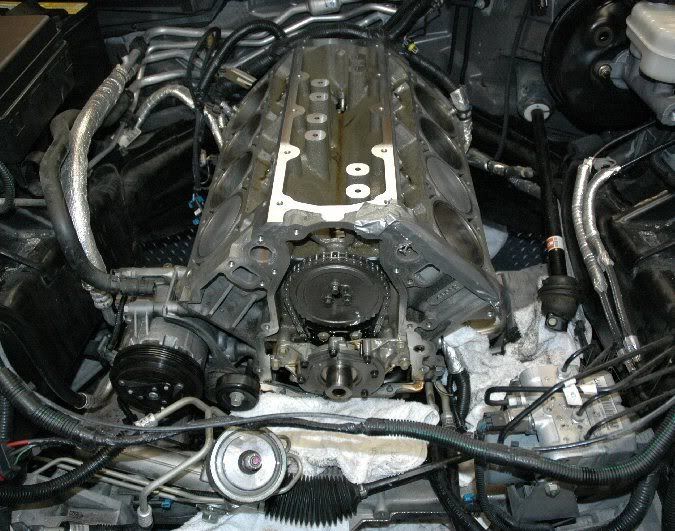
You think to your self that maybe you made a mistake until the Spinmonster comes to your home in much the same fashion as the Cat in the Hat brought Thing 1 and Thing 2. Out of the truck that did 2500 rpm on the hiway all the way from NY at 70mph while boomin' the bass which sets off car alarms comes a guy that shakes you hand and in 20 minutes swaps the cam out quick like so the real work can begin.
In this first 20 minutes, head mechanic/owner of cherry, was relieved and demoted to assistant fly cut man. Chain back on and cover on, it was on to the cool stuff.
The engine is then prepped for the flycutting. To do this operation, the ISKY fly-cut tool is used. Here is the head with the seat removed and the cutter is installed in one of the 4 positions:

The tool is basically a valve stem with a cutter head where a valve head would be and it goes in a cut up (destroyed) LS3 head which had the seats removed from it. I have different heads for different fly-cut operations. A LS3 head would put the cuts where a LS3 valve would touch the piston and a LS1/LS6 head would be used for a LS1,2,6 motor. The head is then clearanced for the size cutter you need to use. The ls3/l92 valves are 2.16” and you need the next bigger sized cutter which is 2.25”. You remove the seats in the head for the intake valves and using a aluminum cutter bit, you clearance the opening the valve seat was in for the bigger ISKY fly-cutter. For those that don’t want to destroy the 175 dollar head and buy the cutter you can rent one from SPINMONSTER for 150 plus shipping. It is my opinion that the cutter isn’t good for more than a few engines (more if you use a power tool) so be prepared for a long battle if you get a worn cutter. They are 125 bucks for a new cutter head and the stem/bearing can be used over and over as long as you didn’t strip out the guide bearing’s locking allen head screw.
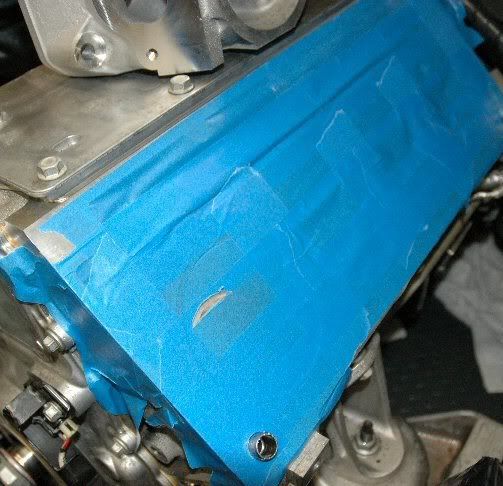
The engine is prepped for the cut by covering everything with garbage bags and using masking tape on the deck surfaces and anywhere else you can get the small amount of metal shavings like this:
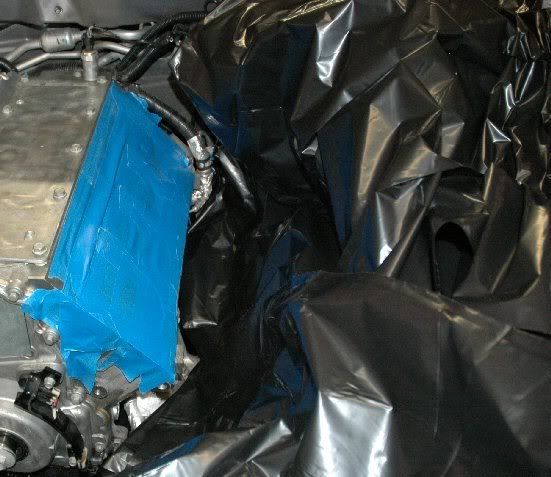
A note to the OCD guy that thinks the amount of metal shavings will be astronomical and cover your entire garage: The amount of metal that comes off is small and the shavings are contained in the combustion chamber until you remove the head after the cut. You vacume it up and NOTHING gets into the engine.
This is the cutter-head on the engine and the cutter will turned by hand with the same handle you use from a tap and dye set. DO NOT USE A POWER TOOL IF THIS IS THE FIRST OR ONE OF THE FIRST TIMES YOU ARE DOING THIS. YOU WILL GO TOO FAR IF YOU DON’T USE CAUTION.
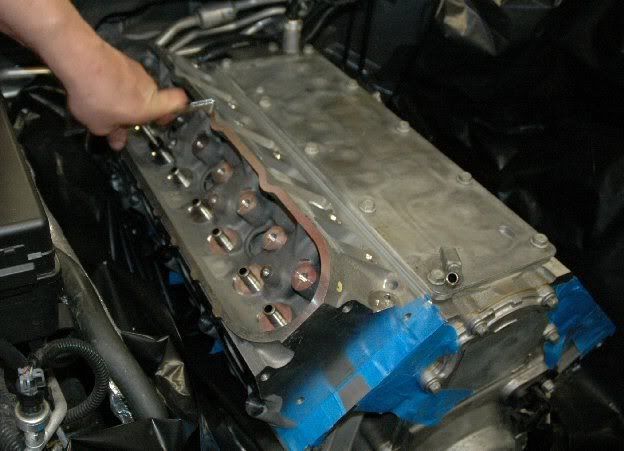
Once the head is actually on the engine there are some issues you need to be aware of as to where the cutter actually makes the cut.
CRITICAL!!!!
P/V interference is never when the piston is at top dead center. Why is this an issue? The piston is on its way down the cylinder when the intake valve is off the seat during the overlap period. The crank position for intake valve interference is after TDC until about 15 degrees past. The exhaust is in danger of hitting when the piston is approaching TDC from about 15 degrees before until TDC. Now, the fact that the piston isn’t at the top is the issue. The valve isn’t at a right angle to the top of the piston and therefore the place the valve would touch changes cam to cam depending on the height of the piston. This is a trangle formed by the valve, piston head, and an imaginary perpendicular that we drop from the valve stem to the piston. The further down the piston is the lower the valve contact would be. I made this picture to inllustrate:

The red line is if the piston was at TDC and the Blue line is where the valve may touch if the piston was some arbitrary amount of distance down the cylinder. As the piston is farther down the valve would touch further down in the direction of the black arrow. If you actually spin the crank +/- 15 degrees from TDC you will see that the distance is actually only a few thousandths of an inch different and of no concern if you use the size cutter we use here which is 2.25 minus 2.16 = .09/2 or .0045” wider than we need. There is also no gasket here so the cut will be high enough on the piston to not worry about missing the spot where the valve would touch. The wider cut does actually waste some of the precious cutter depth we need. For those that can picture it, the valve may actually touch at the spot where the cut is only .04 deep if you cut .06 at the edge.
In our case we need an added clearance of only 20 thousandths but we will cut 60 thousandths in case Phil wants to use a bigger more manly bumpstick in the future.
HOW DO YOU ADJUST THE DEPTH OF THE CUT?
The cutter stem has a bearing that is adjusted with the head on the car and the cutter is actually lowered to be in contact with the piston. The bearing is tightened down with an allen key. careful not to strip it but make it tight. If it comes loose the cut will go too deep especially for those not watching and using a power toll to spin it. It is best to bolt the head down lightly to compress the tape and get a good measurement. The bearing on the stem is loose and is moved onto the velve stem. The bearing will be spaced away from the valve stem guide using a feeler guage as in this next picture:
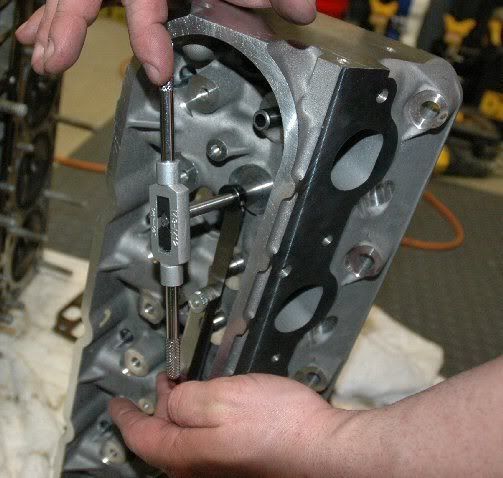
The feeler gauge is positioned here only to show you how it is placed for the measurement. This must be done with the head on the car and the cutter in contact with the piston. I used .06” and spaced the bearing that far from the valve stem. This bearing will not allow the cutter to go lower than that distance. Using a mirror and constantly checking that the bearing is tight and correctly placed, you turn the cutter by hand clockwise as in this picture:
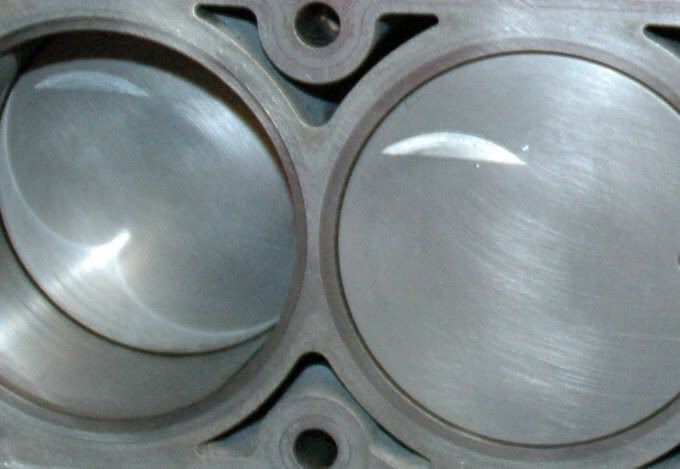
The cutter being sharp, makes the cut in about 40-50 turns by hand. Take your time and check a few times. The head cant get closer to the piston because the head deck surface touches the piston. The relief is oversized so it will fit the valve a various heights in case of interference. Check frequently on your first few turns to see the progress you are making. If it takes 2 hours for all 8, fine, if it takes 2 days, fine. Its not a race. The finished cut looks like this and the head gets a cleaning with a vacuumed as does the engine block deck surface every time the cutter head is lifted off. This is what you see (note there is no way the metal can get in the cylinders):
Once you complete the cut, you cover that relief and move to the next up position piston on the other side of the motor. There is no chance of metal shavings getting in the motor if you are meticulous about the clean up. Every opening is guarded as you can see in the picture.
Here is the finished product:
And this is a JE forged piston with 2cc reliefs cut in. Note the intake valve position:

The depth is verified with the feeler gauge in the relief at an angle of course. If its not deep enough put it back on and give it a few more turns.
A day later it looks like this (12 work hours):

And the monkey throws the switch….. it started right up with 42lbs oil pressure and the tune settled right into the idle. Phil was happy with the power and is awaiting 4.10’s on his Z51 to complete what is probably the fastest car he owns. He has a few.
Phil, thank you for the nice weekend vacation and the honor of your trust with this project.
How to shove a big cam into a LS3 headed car that wont fit it with decent compression without having a piston hit a valve:
DISCLAIMER: This is not a begginer’s first project under the hood. It’s a look at what incredible tuners do to cars to make them run quick times and have awesome street manners with big cams and yet be safe running that big cam and not wreck an engine. When you go to a big name tuner, you should be aware that this type of mod takes experience, knowledge, and common sense too. If you don’t have all 3 of these things don’t try to duplicate what you see here. When you go for a 4x package at Cartek with a 3X cam, they build a high compression motor to smooth out the driveability with compression. That requires the heads to be milled, thinner gaskets and piston clearancing. Roy at Cartek does this for breakfast and its second nature and it takes time to learn to do it. Even the best of the best can mess up a measurement. Those companies back their work and what you get is a motor backed by a reputation. Louis at LG had spoken to me at length about this project and ones he is working on, and the thought and planning that goes into a package isn’t remedial nor is it based on your opinion of what he likes. Its based on absolutes and math. If you are an advanced mechanic and want to try such a project, do so with someone around that has done this before. I watched it done for years and messed up my share of practice pistons in dead engines before I was allowed to touch a good one.
PLEASE READ: I get frustrated when people ask me fitment questions about cams. This tech thread is about how you fly cut when a cam doesnt fit. It says nothing about how to check for a cam fitting. Without touching your engine and testing your actual car, no one is going to tell you what fits and what wont fit. The cam can be ground wrong, the heads could be milled if you werent the first owner....ect. Cam specs arent how you tell in a cam fits. You need to test it inperson. Please dont PM me with cam specs and ask if the cam fits with xyz milling. You need to dot hat yourself. As a guide in the quitessential world, a 230XER intake lobe on a 114+1 with 8.7 DCR is the limit of what fits with flycutting. You can fit a bigger cam with less compression. A 234 cam and 8.3 DCR can fit. Its all a trade off. I didnt test every cam out there nor will I vouch that your cam was ground right. There is no way I want that responsibility.
Enjoy the thread and if you want input from me, its free. The piston you mess up isn’t. I post this info here to at a minimum, give people a working respect for what is involved and like a science channel show, you don’t have to be the best at something to have an interest in it. You will be amazed at what you can accomplish when pride is set aside and you are willing to ask a question. If anyone sees an error in this thread, it was typed at 2am and I welcome any opinions (rare), corrections, or comments that contribute to the topic. I actually did the work on this car and it works fine so dont argue personal values here. If you have tech info and want to share, by all means do so.
PERSONAL VALUES:
Which camp do you fall into:
1-Leave it stock, I came here to look for a new cheap wax to make my car shine.
2-Get a tiny cam so it doesn’t appear that you changed it.
3-Put the biggest cam you can get in it for a big dyno number without more compression so you dont have to fly-cut.
4-Get a small cam so you don’t have to worry about it hitting with milled heads.
5-Get the cam you want and put the dress back in the closet! Make it fit with heads milled, thinner gaskets, and I want the thing to shake with lots of low end TQ! Fly-cut mah sheeet.
6-Get a Ford.
WARNING: those who yap about warranties and can’t handle seeing a CHERRY bone stock Corvette with an EXTENDED WARRANTY get violated in the most holy of ways, better close this thread.
Phil, the owner of the car is a Maryland married guy with an understanding wife that shares his values. She is happy with his hobbies and has a deep understanding of his need to tinker. He is a decent mechanic with the ability and comprehension level appropriate to this level of work. He was given a laundry list of disassembly for his car in preparation for me to install a head/cam package based on the LS3 head and a mid-sized cam which, with the static compression level needed for an 8.7 DCR requiring head milling and thinner gaskets. This made the cam not fit with the needed clearance on the intake valve side. He was in contact with me on the forum and wanted help with his project. Although I am listed as a forum tuner, I am not employed by anyone nor am I in the business of doing installs for money. I have to be a forum tuner in order to offer tuner services for auction to benefit St. Judes Hospital and save kids' lives. I was compensated for travel and expenses associated with prepping the LS3 cylinder heads with milling, port clean-up, and set-up. I traveled to his house for the install 230 miles away. I made a friend.
The H/C package will be another thread once more data is in one the finished project with the owner's input.
MAKING THE CAM FIT:
DEFINITION: FLYCUT / NOTCHING A PISTON- Cutting a space into a piston to allow for the intake valve which has a big cam lobe pushing it toward a piston to have more room without bumping into that piston.
Lets face it, the LS3 heads which are going to be on all GM creations are here to stay and they don’t have much clearance to start life out with. Getting a cam to raise the power is a dancing act between a decent compression w/small cam or a big over-cammed install lacking optimized compression. Valve drop using the stock gaskets is in the .170” territory and getting a big cam in there with both milling and thinner gaskets to get the compression up will not leave you with the required .080” intake and .100” exhaust clearance. The easy-fit line is in the 11.4:1cr range and a 224 cam. If you want a 228 to 238 intake duration cams for the 460 to 517rwhp we have seen from these heads, you will have to flycut if you want a real bootm end that these heads can extract if set-up right.
HOW TO FLYCUT
Flycutting is a simple operation when you know what you’re doing. For those that want to try this type of DIY project themselves, I will give it a 9 out of 10 for DIY difficulty. If you have worked on an engine before, this is doable but there are some do and donts and you best know which donts right up front. DON’T use a power tool for this project the first time you try it. The surface of the stock hypereutectic piston is at its thinnest section 220 thousandths. In most places its over .330” and some its .4”. The critical areas of the pistons are closest to the ring lands and it you cut through there, the piston would then (at least in my house growing up with overzealous boys with fly-cutters) become a Christams Tree ornament. Santa would then place and order for JE forged pistons to install, which come with huge monster sized reliefs that will allow the use of any cam.
OK, so you took out your sombrero on Saturday morning and went down to the kitchen and poured yourself a glass of milk waiting for your wife (the one who you begged for permission to buy the corvette you are about to rape) and when she wakes up and comes to the kitchen, with the straightest face possible and with a milk mustache (and the sombrero on) you say, “Honey, I’m going to cut reliefs in my pistons on my new car after I take it completely apart AND… I have a stranger coming to live with us for the weekend to help me do it!” At this point she is thinking insanity but the sombrero is your escape should she call you on it but she says ok. Wow, that was easy.
To do this we first need a donor car like this cherry. Behold the 14k mile 2005 C6 with no scratches and stored in a climate controlled envirnment:
OOOH YUH! A bone stock motor sporting some LG headers and a shiny Z06 exhaust. You head out to your 6 car garage you had built as a monument to your greatness and the neighbors’ jealousy and you begin to cannibalize the car until this is what you see in the engine bay:
You think to your self that maybe you made a mistake until the Spinmonster comes to your home in much the same fashion as the Cat in the Hat brought Thing 1 and Thing 2. Out of the truck that did 2500 rpm on the hiway all the way from NY at 70mph while boomin' the bass which sets off car alarms comes a guy that shakes you hand and in 20 minutes swaps the cam out quick like so the real work can begin.
In this first 20 minutes, head mechanic/owner of cherry, was relieved and demoted to assistant fly cut man. Chain back on and cover on, it was on to the cool stuff.
The engine is then prepped for the flycutting. To do this operation, the ISKY fly-cut tool is used. Here is the head with the seat removed and the cutter is installed in one of the 4 positions:
The tool is basically a valve stem with a cutter head where a valve head would be and it goes in a cut up (destroyed) LS3 head which had the seats removed from it. I have different heads for different fly-cut operations. A LS3 head would put the cuts where a LS3 valve would touch the piston and a LS1/LS6 head would be used for a LS1,2,6 motor. The head is then clearanced for the size cutter you need to use. The ls3/l92 valves are 2.16” and you need the next bigger sized cutter which is 2.25”. You remove the seats in the head for the intake valves and using a aluminum cutter bit, you clearance the opening the valve seat was in for the bigger ISKY fly-cutter. For those that don’t want to destroy the 175 dollar head and buy the cutter you can rent one from SPINMONSTER for 150 plus shipping. It is my opinion that the cutter isn’t good for more than a few engines (more if you use a power tool) so be prepared for a long battle if you get a worn cutter. They are 125 bucks for a new cutter head and the stem/bearing can be used over and over as long as you didn’t strip out the guide bearing’s locking allen head screw.
The engine is prepped for the cut by covering everything with garbage bags and using masking tape on the deck surfaces and anywhere else you can get the small amount of metal shavings like this:
A note to the OCD guy that thinks the amount of metal shavings will be astronomical and cover your entire garage: The amount of metal that comes off is small and the shavings are contained in the combustion chamber until you remove the head after the cut. You vacume it up and NOTHING gets into the engine.
This is the cutter-head on the engine and the cutter will turned by hand with the same handle you use from a tap and dye set. DO NOT USE A POWER TOOL IF THIS IS THE FIRST OR ONE OF THE FIRST TIMES YOU ARE DOING THIS. YOU WILL GO TOO FAR IF YOU DON’T USE CAUTION.
Once the head is actually on the engine there are some issues you need to be aware of as to where the cutter actually makes the cut.
CRITICAL!!!!
P/V interference is never when the piston is at top dead center. Why is this an issue? The piston is on its way down the cylinder when the intake valve is off the seat during the overlap period. The crank position for intake valve interference is after TDC until about 15 degrees past. The exhaust is in danger of hitting when the piston is approaching TDC from about 15 degrees before until TDC. Now, the fact that the piston isn’t at the top is the issue. The valve isn’t at a right angle to the top of the piston and therefore the place the valve would touch changes cam to cam depending on the height of the piston. This is a trangle formed by the valve, piston head, and an imaginary perpendicular that we drop from the valve stem to the piston. The further down the piston is the lower the valve contact would be. I made this picture to inllustrate:
The red line is if the piston was at TDC and the Blue line is where the valve may touch if the piston was some arbitrary amount of distance down the cylinder. As the piston is farther down the valve would touch further down in the direction of the black arrow. If you actually spin the crank +/- 15 degrees from TDC you will see that the distance is actually only a few thousandths of an inch different and of no concern if you use the size cutter we use here which is 2.25 minus 2.16 = .09/2 or .0045” wider than we need. There is also no gasket here so the cut will be high enough on the piston to not worry about missing the spot where the valve would touch. The wider cut does actually waste some of the precious cutter depth we need. For those that can picture it, the valve may actually touch at the spot where the cut is only .04 deep if you cut .06 at the edge.
In our case we need an added clearance of only 20 thousandths but we will cut 60 thousandths in case Phil wants to use a bigger more manly bumpstick in the future.
HOW DO YOU ADJUST THE DEPTH OF THE CUT?
The cutter stem has a bearing that is adjusted with the head on the car and the cutter is actually lowered to be in contact with the piston. The bearing is tightened down with an allen key. careful not to strip it but make it tight. If it comes loose the cut will go too deep especially for those not watching and using a power toll to spin it. It is best to bolt the head down lightly to compress the tape and get a good measurement. The bearing on the stem is loose and is moved onto the velve stem. The bearing will be spaced away from the valve stem guide using a feeler guage as in this next picture:
The feeler gauge is positioned here only to show you how it is placed for the measurement. This must be done with the head on the car and the cutter in contact with the piston. I used .06” and spaced the bearing that far from the valve stem. This bearing will not allow the cutter to go lower than that distance. Using a mirror and constantly checking that the bearing is tight and correctly placed, you turn the cutter by hand clockwise as in this picture:
The cutter being sharp, makes the cut in about 40-50 turns by hand. Take your time and check a few times. The head cant get closer to the piston because the head deck surface touches the piston. The relief is oversized so it will fit the valve a various heights in case of interference. Check frequently on your first few turns to see the progress you are making. If it takes 2 hours for all 8, fine, if it takes 2 days, fine. Its not a race. The finished cut looks like this and the head gets a cleaning with a vacuumed as does the engine block deck surface every time the cutter head is lifted off. This is what you see (note there is no way the metal can get in the cylinders):
Once you complete the cut, you cover that relief and move to the next up position piston on the other side of the motor. There is no chance of metal shavings getting in the motor if you are meticulous about the clean up. Every opening is guarded as you can see in the picture.
Here is the finished product:
And this is a JE forged piston with 2cc reliefs cut in. Note the intake valve position:
The depth is verified with the feeler gauge in the relief at an angle of course. If its not deep enough put it back on and give it a few more turns.
A day later it looks like this (12 work hours):
And the monkey throws the switch….. it started right up with 42lbs oil pressure and the tune settled right into the idle. Phil was happy with the power and is awaiting 4.10’s on his Z51 to complete what is probably the fastest car he owns. He has a few.
Phil, thank you for the nice weekend vacation and the honor of your trust with this project.
Last edited by SpinMonster; Nov 18, 2009 at 06:20 AM.
Tech Contributor
Joined: Mar 2003
Posts: 12,094
Likes: 197
From: Colorado Springs, CO
St. Jude Donor '08-'09-'10-'11
The cam I have is a Comp Cam XER273HR that is a special grind DTE used. The grind is 224 / 230 with .581/.592 lift with a 115. I have L92 heads being milled .030 for my 2007 C6 and plan to use cometic head gaskets that are .051 (stock thickness). I will also have Manley SS valves being used which I understand will decrease clearance with the piston.
I am just wondering if fly cutting is likely or not based on my spec’s. If you have this exact setup let me know if you had to fly cut or not.
I am just wondering if fly cutting is likely or not based on my spec’s. If you have this exact setup let me know if you had to fly cut or not.
I do think you should get the gaskets reduced to .040 and mill to .025" off. Milling hurts flow.
Also, the valves are an issue too. The margins of an aftermarket valve are .030" more than a stock valve's are.
Margins of a valve:
The Manley race flow valve has a thicker margin than the stock valve by .030”. Yes I measured them. In the picture below the various parts of a valve are labeled.
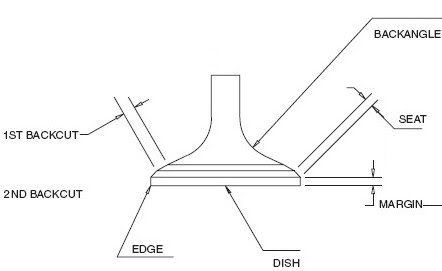
The margin takes away from P/V clearance therefore by about that amount. The heads being milled, and thinner gaskets are other factors.
Something that adds to clearance not mentioned so far is a competition valve job. When the valve seats are ground down, the valve then becomes more recessed into the head and thus away from the piston.
Another fly-cut thread:
http://forums.corvetteforum.com/c6-t...cam-specs.html
DO NOT PM ME TO ASK IF A CAM WILL FIT BY GIVING ME THE SPECS. I WONT ANSWER THE PM. I GOT 7 IN THE LAST 4 HOURS OF LAST NIGHT. NO ONE WILL TAKE THE RESPONSIBILITY OF SUCH A QUESTION. YOU HAVE TO MEASURE IT YOURSELF. CLAYING DOESNT GIVE YOU THE ACCURACY TO HEAR NUMBERS LIKE .080" VS .047" WHO EVER SAYS THEY CAN TELL .005" BY LOOKING AT CLAY IS ON CRACK. IF YOU WANT AN ABSOLUTE ANSWER NOW....FLYCUT AND BE SURE IT FITS. IF YOU STILL WANT TO DO IT THE HARD WAY, PUT IN A SOLID LIFTER AND A DEGREE WHEEL. WITH THE WHEEL 15 DEGREES PAST TDC CHECK THE #1 PISTON +/- 10 DEGREES OR SO WITH A FEELER GAUGE SET TO .080" AND IF IT DOESNT FIT BETWEEN THE TIP OF THE VALVE HELD IN BY A CHECKER SPRING AND THE ROCKER ARM OVER THIS RANGE, YOU NEED TO FLYCUT.
Last edited by SpinMonster; Nov 18, 2009 at 06:28 AM.
Tech Contributor
Joined: Mar 2003
Posts: 12,094
Likes: 197
From: Colorado Springs, CO
St. Jude Donor '08-'09-'10-'11
Navigator
Joined: May 2007
Posts: 9
Likes: 0
Tech Contributor
Joined: Mar 2003
Posts: 12,094
Likes: 197
From: Colorado Springs, CO
St. Jude Donor '08-'09-'10-'11
You needed a flycut before a thinner gasket. I would do a .030" mill and a .040" gasket with a .060" flycut. It would gain about 14rwhp.
Last edited by SpinMonster; Nov 20, 2009 at 01:32 PM.