



oil in the intake

Racer


Joined: Mar 2006
Posts: 265
Likes: 3
From: Metamora, IL

"I have a question about hose routing for the catch can. I have my catch can in about the same place as 1Corvette - next to the battery. The hoses are each about 30 inches long, and snake around the fuse block, but they stay fairly level from the catch can to the connections at the engine.
Is it a problem to have the hoses that long?"
The answer is no. The longer the hoses, the more chance the oil will coalesce and collect in the can instead of being carried with the airflow into the manifold to be burned. The catch can being farther away from the engine gives the oil vapor more time to mix with water vapor (a product of combustion) and drop out in the can. Remember, not all of the product laying in your manifold or catch can is oil. Some may be motor oil vapor, some is condensation, some is combustion gas vapor that has dropped out. Farther from the engine is better. Feel the hoses after you have driven the car. One will be much warmer than the other.
I agree with FrankTank, may not really need it, but I don't like the oil being burned and therefore the catch can is a nice simple way for me to slow it down.
MikeSVT04, good question, but virtually every engine burns the vapor from the PCV to meet EPA standards. You just don't see it in other engines. I do remember reading somewhere in a post that GM calls for special motor oil in these engines with the GM4718 spec. (I believe this is the correct number) The reason is, other oils without this spec number may contaminate the catalytic converter. Now you know where the oil is coming from that "may" attack the cat.
Is it a problem to have the hoses that long?"
The answer is no. The longer the hoses, the more chance the oil will coalesce and collect in the can instead of being carried with the airflow into the manifold to be burned. The catch can being farther away from the engine gives the oil vapor more time to mix with water vapor (a product of combustion) and drop out in the can. Remember, not all of the product laying in your manifold or catch can is oil. Some may be motor oil vapor, some is condensation, some is combustion gas vapor that has dropped out. Farther from the engine is better. Feel the hoses after you have driven the car. One will be much warmer than the other.
I agree with FrankTank, may not really need it, but I don't like the oil being burned and therefore the catch can is a nice simple way for me to slow it down.
MikeSVT04, good question, but virtually every engine burns the vapor from the PCV to meet EPA standards. You just don't see it in other engines. I do remember reading somewhere in a post that GM calls for special motor oil in these engines with the GM4718 spec. (I believe this is the correct number) The reason is, other oils without this spec number may contaminate the catalytic converter. Now you know where the oil is coming from that "may" attack the cat.
Last edited by 1Corvette; May 19, 2011 at 12:07 AM.

Drifting


Joined: Mar 2005
Posts: 1,424
Likes: 21
From: Placitas New Mexico
At Spins suggestion I put one on as my first mod. Later I did headers, 160* T-stat, and intake with a tune. I just did a ported IM and TB at 8,500 miles and didn't find a drop. Elite Engineering.

Former Vendor
Joined: Apr 2006
Posts: 2,470
Likes: 2
From: Portland OR
St. Jude Donor '10-'11-'12
we are introducing a catch can here shortly.. should be one of the most effective on the market
LS engine are infamous for this.. its blow by and should be controlled.. it will reduce the efficiency of the engine after a while
LS engine are infamous for this.. its blow by and should be controlled.. it will reduce the efficiency of the engine after a while
Last edited by 99blancoss; May 18, 2011 at 12:53 PM.

Le Mans Master


Joined: Feb 2006
Posts: 5,762
Likes: 4
From: Chandler Arizona
I have a question about hose routing for the catch can. I have my catch can in about the same place as 1Corvette - next to the battery. The hoses are each about 30 inches long, and snake around the fuse block, but they stay fairly level from the catch can to the connections at the engine.
Is it a problem to have the hoses that long?
The answer is no. The longer the hoses, the more chance the oil will coalesce and collect in the can instead of being carried with the airflow into the manifold to be burned. The catch can being farther away from the engine gives the oil vapor more time to mix with water vapor (a product of combustion) and drop out in the can. Remember, not all of the product laying in your manifold or catch can is oil. Some may be motor oil vapor, some is condensation, some is combustion gas vapor that has dropped out. Farther from the engine is better. Feel the hoses after you have driven the car. One will be much warmer than the other.
I agree with FrankTank, may not really need it, but I don't like the oil being burned and therefore the catch can is a nice simple way for me to slow it down.
MikeSVT04, good question, but virtually every engine burns the vapor from the PCV to meet EPA standards. You just don't see it in other engines. I do remember reading somewhere in a post that GM calls for special motor oil in these engines with the GM4718 spec. (I believe this is the correct number) The reason is, other oils without this spec number may contaminate the catalytic converter. Now you know where the oil is coming from that "may" attack the cat.
Is it a problem to have the hoses that long?
The answer is no. The longer the hoses, the more chance the oil will coalesce and collect in the can instead of being carried with the airflow into the manifold to be burned. The catch can being farther away from the engine gives the oil vapor more time to mix with water vapor (a product of combustion) and drop out in the can. Remember, not all of the product laying in your manifold or catch can is oil. Some may be motor oil vapor, some is condensation, some is combustion gas vapor that has dropped out. Farther from the engine is better. Feel the hoses after you have driven the car. One will be much warmer than the other.
I agree with FrankTank, may not really need it, but I don't like the oil being burned and therefore the catch can is a nice simple way for me to slow it down.
MikeSVT04, good question, but virtually every engine burns the vapor from the PCV to meet EPA standards. You just don't see it in other engines. I do remember reading somewhere in a post that GM calls for special motor oil in these engines with the GM4718 spec. (I believe this is the correct number) The reason is, other oils without this spec number may contaminate the catalytic converter. Now you know where the oil is coming from that "may" attack the cat.
Could you post a photo of how you mounted your separator?

Race Director


Joined: Sep 2007
Posts: 16,557
Likes: 2,108
From: Peoria/Phoenix AZ
C6 of Year Finalist (performance mods) 2019
The longer the hoses, the more chance the oil will coalesce and collect in the can instead of being carried with the airflow into the manifold to be burned.
MikeSVT04, good question, but virtually every engine burns the vapor from the PCV to meet EPA standards. You just don't see it in other engines. I do remember reading somewhere in a post that GM calls for special motor oil in these engines with the GM4718 spec. (I believe this is the correct number) The reason is, other oils without this spec number may contaminate the catalytic converter. Now you know where the oil is coming from that "may" attack the cat.
MikeSVT04, good question, but virtually every engine burns the vapor from the PCV to meet EPA standards. You just don't see it in other engines. I do remember reading somewhere in a post that GM calls for special motor oil in these engines with the GM4718 spec. (I believe this is the correct number) The reason is, other oils without this spec number may contaminate the catalytic converter. Now you know where the oil is coming from that "may" attack the cat.
Those "special" oil specs are industry wide. GM just issued their own to assure the EPA wouldn't single them out for not telling owners of the new requirements. You'll probably note that the latest GM spec is also in line with the latest oil industry and EPA requirements. You probably never noticed the change, as most things receive very little fanfare.
For more information about how the government regulations affect the oil industry and auto manufacturers and the specs you refer to, go here: http://www.nalube.com/news/gf4specs.htm
Just be aware the GF5 specs are the most current.

Drifting
Joined: Oct 2006
Posts: 1,340
Likes: 6
From: Redmond WA
I took a piece of 1/2 inch wide plate steel with the holes in it every inch and bent it to fit (this is the plate steel that I used to mount my garage door openers). I mounted one end to the battery hold down bolt, and the other end to the mount provided with my catch can. My can sits just behind the fuse block, and the hoses around the fuse block and then across towards where they connect to the engine. Overall length of the hoses is maybe 25-30 inches each.
It's not great looking as the plate steel is silver colored, and it wobbles just a little bit, but it's good enough for now. I'll probably remove it and spray paint it one day.
It's not great looking as the plate steel is silver colored, and it wobbles just a little bit, but it's good enough for now. I'll probably remove it and spray paint it one day.
Race Director
Joined: Sep 2007
Posts: 16,557
Likes: 2,108
From: Peoria/Phoenix AZ
C6 of Year Finalist (performance mods) 2019
No matter how effective a catch can is, it cannot control blow-by. That's what piston rings do.
Former Vendor
Joined: Apr 2006
Posts: 2,470
Likes: 2
From: Portland OR
St. Jude Donor '10-'11-'12
 Someone had asked where the oil comes from so I combined both answers
Last edited by 99blancoss; May 18, 2011 at 03:44 PM.
Corvette Stories
The Best of Corvette for Corvette Enthusiasts

Every 2027 Corvette Engine Explained
Joe Kucinski
Designer Imagines A Corvette That Looks More Like a Corvette Than the Corvette
Verdad Gallardo
10 Ugly Corvettes That We Still Kinda Love
Joe Kucinski
Top 10 Most Expensive Corvettes Ever Sold on Bring A Trailer
Brett Foote
10 Things Every Corvette Owner Needs (2026 Edition)
Michael S. Palmer
8 Most "Only Corvette Owners Understand" Quirks and Problems
Pouria Savadkouei
10 Reasons the C6 Z06 is Still A Performance Benchmark After 20 Years
Joe Kucinski
How Much Horsepower Every Corvette Engine "LOST" in 1972
Joe Kucinski
Top 10 DOs and DON'Ts for Protecting Your Convertible Top!
Michael S. Palmer
Former Vendor
Joined: Apr 2006
Posts: 2,470
Likes: 2
From: Portland OR
St. Jude Donor '10-'11-'12
I hope to put one in a test car this week.. options are OEM color of your car or polished
design is dual chamber single can with a filter element and no its not a scotch pad or steel wool, can be complete cleaned and of course the bottom drain. There is another aspect to it that is hush hush for now ...LOL but should make a difference.. cost should be in the 120-140 range shipped, trying to keep it as low as possible ...the prototype is always more expensive
design is dual chamber single can with a filter element and no its not a scotch pad or steel wool, can be complete cleaned and of course the bottom drain. There is another aspect to it that is hush hush for now ...LOL but should make a difference.. cost should be in the 120-140 range shipped, trying to keep it as low as possible ...the prototype is always more expensive

SUBVETTE

Joined: Jul 2006
Posts: 3,841
Likes: 93
From: San Diego CA
It's called PCV (positive crancase ventillation) and is required by emissions control regs. Crankcase receives fresh air from intake and discharges displaced crankcase vapors (with oil vapor) through the passenger side valve cover hose to the intake manifold for combustion burning. As a result, the intake manifold gets oil coated and the combustion chamber gets carbon buildup during combustion. Placing a catch can between the valve cover nipple and the intake manifold removes most oil while still maintaining the pcv. Leads to much less carbon buildup, minimum hot spots in combustion chamber, and therefore less possibility of pre-detonation knocking and pulled timng.

Safety Car

Joined: Jun 1999
Posts: 3,570
Likes: 3
From: Austin, Singapore, Kuala Lumpur, Houston, Dallas, Hong Kong, Elgin, etc.. Texas
Crankcase receives fresh air from intake and discharges displaced crankcase vapors (with oil vapor) through the passenger side valve cover hose to the intake manifold for combustion burning. As a result, the intake manifold gets oil coated and the combustion chamber gets carbon buildup during combustion. Placing a catch can between the valve cover nipple and the intake manifold removes most oil while still maintaining the pcv. Leads to much less carbon buildup, minimum hot spots in combustion chamber, and therefore less possibility of pre-detonation knocking and pulled timng.
The fresh air hose goes to the passenger's side valve cover and the crankcase vapor go out from the valley cover into the intake manifold after the throttle blade. The Oil Catch can is put between the valve cover and the intake manifold after the throttle blade. This is so dirty air never touches the throttle blade.
There are a number of routing diagrams posted on the forum.

Melting Slicks

Joined: May 2006
Posts: 2,303
Likes: 40
From: Edmonton Alberta
It's always interesting to me the amount of people on this forum who don't care about oil in the intake, and won't buy a catch-can. Their reasoning is that there are thousands of daily driver corvettes that don't have catch cans and they run fine, and there is no documented proof of engine failure due to oil in the intake manifold. 
While that may be true , oil in the intake is not supposed to be there regardless, a catch-can IMO is a cheap simple way to keept things clean. I would think if a lot of oil is in the intake the engine is not operating the best it can, and detonation is possible.
Oh well, I guess you can lead a horse to water, but you can't make it drink it
While that may be true , oil in the intake is not supposed to be there regardless, a catch-can IMO is a cheap simple way to keept things clean. I would think if a lot of oil is in the intake the engine is not operating the best it can, and detonation is possible.
Oh well, I guess you can lead a horse to water, but you can't make it drink it
 I had an Elite Engineering catch can put on my 2000 LS1 and it worked great. I'm planning on putting one on my 2007 LS2.


SUBVETTE
Joined: Jul 2006
Posts: 3,841
Likes: 93
From: San Diego CA
Excuse me, but your routing is incorrect.
The fresh air hose goes to the passenger's side valve cover and the crankcase vapor go out from the valley cover into the intake manifold after the throttle blade. The Oil Catch can is put between the valve cover and the intake manifold after the throttle blade. This is so dirty air never touches the throttle blade.
There are a number of routing diagrams posted on the forum.
The fresh air hose goes to the passenger's side valve cover and the crankcase vapor go out from the valley cover into the intake manifold after the throttle blade. The Oil Catch can is put between the valve cover and the intake manifold after the throttle blade. This is so dirty air never touches the throttle blade.
There are a number of routing diagrams posted on the forum.

Drifting
Joined: Oct 2006
Posts: 1,340
Likes: 6
From: Redmond WA
I redid the mounting for my catch can. It was a bit wobbly being mounted to the battery hold down bolt so I fabricated a new mount that uses the rear bolt for the hood latch.
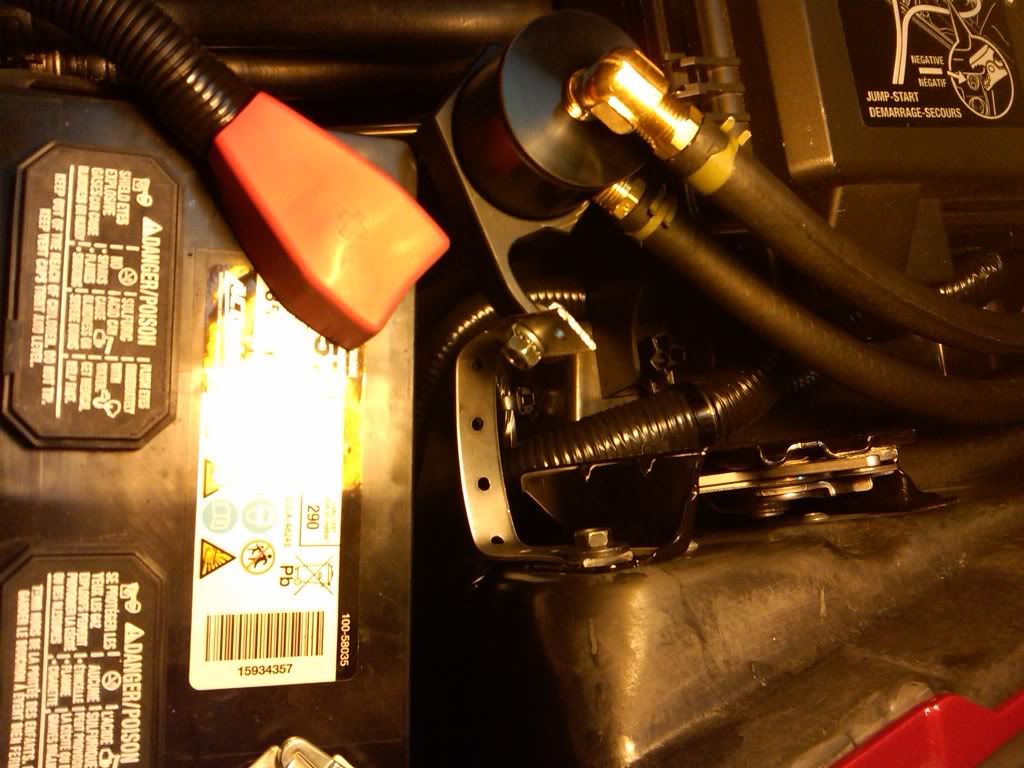
This shortens the mount significantly and makes it much more stable. It does get slightly in the way of the fuse block cover but all of the fuses are still fully accessible. Also, to get to the set screw to release the catch can, it's necessary to just twist the catch a bit so the allen wrench can access the screw.
The bolt holding the plate steel strip to the mount looks pretty ugly, but it has a split lock nut on either side and it was all I had at the moment. I still need to trim the plate strip a little bit as it's too long, and probably will also finish it up by painting it black at some point.
It clears the hood by a significant margin. I put three layers of bubble wrap on top of the catch can and closed the hood and it didn't pop the wrap so there's probably a good inch or more of clearance, and it only sits less than half an inch above the battery and fuse block.
This shortens the mount significantly and makes it much more stable. It does get slightly in the way of the fuse block cover but all of the fuses are still fully accessible. Also, to get to the set screw to release the catch can, it's necessary to just twist the catch a bit so the allen wrench can access the screw.
The bolt holding the plate steel strip to the mount looks pretty ugly, but it has a split lock nut on either side and it was all I had at the moment. I still need to trim the plate strip a little bit as it's too long, and probably will also finish it up by painting it black at some point.
It clears the hood by a significant margin. I put three layers of bubble wrap on top of the catch can and closed the hood and it didn't pop the wrap so there's probably a good inch or more of clearance, and it only sits less than half an inch above the battery and fuse block.
Last edited by MisterMidlifeCrisis; May 23, 2011 at 04:21 AM.

Team Owner

Joined: Oct 2004
Posts: 27,420
Likes: 64
From: San Clemente CA
I redid the mounting for my catch can. It was a bit wobbly being mounted to the battery hold down bolt so I fabricated a new mount that uses the rear bolt for the hood latch.
This shortens the mount significantly and makes it much more stable. It does get slightly in the way of the fuse block cover but all of the fuses are still fully accessible. Also, to get to the set screw to release the catch can, it's necessary to just twist the catch a bit so the allen wrench can access the screw.
The bolt holding the plate steel strip to the mount looks pretty ugly, but it has a split lock nut on either side and it was all I had at the moment. I still need to trim the plate strip a little bit as it's too long, and probably will also finish it up by painting it black at some point.
It clears the hood by a significant margin. I put three layers of bubble wrap on top of the catch can and closed the hood and it didn't pop the wrap so there's probably a good inch or more of clearance, and it only sits less than half an inch above the battery and fuse block.
This shortens the mount significantly and makes it much more stable. It does get slightly in the way of the fuse block cover but all of the fuses are still fully accessible. Also, to get to the set screw to release the catch can, it's necessary to just twist the catch a bit so the allen wrench can access the screw.
The bolt holding the plate steel strip to the mount looks pretty ugly, but it has a split lock nut on either side and it was all I had at the moment. I still need to trim the plate strip a little bit as it's too long, and probably will also finish it up by painting it black at some point.
It clears the hood by a significant margin. I put three layers of bubble wrap on top of the catch can and closed the hood and it didn't pop the wrap so there's probably a good inch or more of clearance, and it only sits less than half an inch above the battery and fuse block.
