







Halltech Super Bee MF103 Road Testing IAT

Thread Starter
Supporting Vendor


Joined: Mar 2002
Posts: 13,099
Likes: 672
From: Bristol, Tennessee
St. Jude Donor '09
 Halltech Super Bee MF103 Road Testing IAT
The Super Bee MF103 that got our first production unit came in for a checkup today to make sure everything is perfect.
I drove the 2010 LS3 for about 20 miles and the sound is fantastic. What a roar.
I video recorded the Intake Air Temps with our Beehive heat shield installed, but NO cutouts. The Beehive does not require the cutouts, but they obviously would bring down IATs faster.
79F today in sunny Wisconsin.
Video quality at 240 right now, but will improve over the next half hour:
I drove the 2010 LS3 for about 20 miles and the sound is fantastic. What a roar.
I video recorded the Intake Air Temps with our Beehive heat shield installed, but NO cutouts. The Beehive does not require the cutouts, but they obviously would bring down IATs faster.
79F today in sunny Wisconsin.
Video quality at 240 right now, but will improve over the next half hour:
__________________

"World Class Performance for your Corvette"
Intake Design and Engineering since 1999
Halltech Systems, LLC
423-915-6056
For service email:
orders@halltechsystems.com
www.halltechsystems.com
"World Class Performance for your Corvette"
Intake Design and Engineering since 1999
Halltech Systems, LLC
423-915-6056
For service email:
orders@halltechsystems.com
www.halltechsystems.com
Last edited by Halltech; Jun 20, 2011 at 11:48 PM.
Thread Starter
Supporting Vendor
Joined: Mar 2002
Posts: 13,099
Likes: 672
From: Bristol, Tennessee
St. Jude Donor '09
Thread Starter
Supporting Vendor
Joined: Mar 2002
Posts: 13,099
Likes: 672
From: Bristol, Tennessee
St. Jude Donor '09

Melting Slicks

Joined: Feb 2004
Posts: 3,131
Likes: 148
From: Sugar Land TX
Would be interesting to see what the temps read at idle for a period of time. My Airaid runs within a couple degrees of ambient moving at that speed. My problem comes in the staging lanes with hood closed. As an example, with engine fully warmed up I recorded with my HPT 118* IAT, 80* ambient idling just over 6 minutes in the staging lanes hood closed.
Thread Starter
Supporting Vendor
Joined: Mar 2002
Posts: 13,099
Likes: 672
From: Bristol, Tennessee
St. Jude Donor '09
Would be interesting to see what the temps read at idle for a period of time. My Airaid runs within a couple degrees of ambient moving at that speed. My problem comes in the staging lanes with hood closed. As an example, with engine fully warmed up I recorded with my HPT 118* IAT, 80* ambient idling just over 6 minutes in the staging lanes hood closed.
I can tell you that it rises 10 degrees from ambient in 60 seconds on our Z06, but that is with a NACA duct that has been hogged out.
If we sit facing a gentle breeze, temps stay around +4 for 5 minutes, but dead airflow is just that.
What you are going through is heat soak into the bottom of the airbridge which resides directly over the radiator hose. That is an additional benefit in relocation of the MAF/IAT sensor forward shielded under the Beehive from heat.
Without the Beehive, the stock motor will increase +50 degrees during hot staging with hot air systems.
Remember the ECMs is commanded to start pulling timing at 86F up to -12 degrees at around 135F
ECT timing (coolant temp) begins to pull timing at 212F.
Air density at 130 vs. 86 is 44 degrees lost to heat, and that is 4.4% power loss due to air density loss.
If you car pings under any of those conditions, there is a knock count that will relegate your timing from High Octane tables to Low Octane tables, where it REMAINs until you refill your gas tank. That triggers High Octane again, looking at knock, and if the count is ok, then it stays in HO.
Can you see why tuning is vital on cars with a mission? Anyone that dynos there car with stock tuning, can expect swings as much as 30 RWHP on the same motor, just from all the GM safety protocol. Even our 15 HP can get lost in that much protocol, which is why we have Katech do all dyno testing from the beginning to eliminate all correction and ECM intervention from the results. They dynoed our intake under strict clean room, and exactly duplicating all conditions, from water temp, oil temp, air temp, air density, and humidity. That way the dyno results reflect only the increase in airflow that their MEFI computer can dial in the best power by adding fuel or decreasing fuel until they get their best pull.
Interestingly, the stock LS7 intake gets best power from this system, which biases it since in the real world the factory ECM is so overcompensating toward saftey in the 120 deserts, that normal driving in normal areas suffer greatly from the overly rich 11.5:1 WOT air fuel ratio.
On the dyno, you have the additional nutty safety program called Cat Over Temp Protection fuel enrichment. This is based on O2 sensor temps. When they hit 1600+ degrees, more fuel is added to the already rich 11.8:1 factory ratio. There are three steps. Each adding more fuel until the cat temps decrease. As much as 20.5% more fuel can be added on the dyno. This protocol happens at the track and street, but not until around mid 3rd gear. So instead of 11.8:1, you are at 9.8:1 air fuel ratio. Just about right for E85, but not E10. E10 makes best power at around 12.3:1; E0 at around 12.5:1 on 93 Octane.

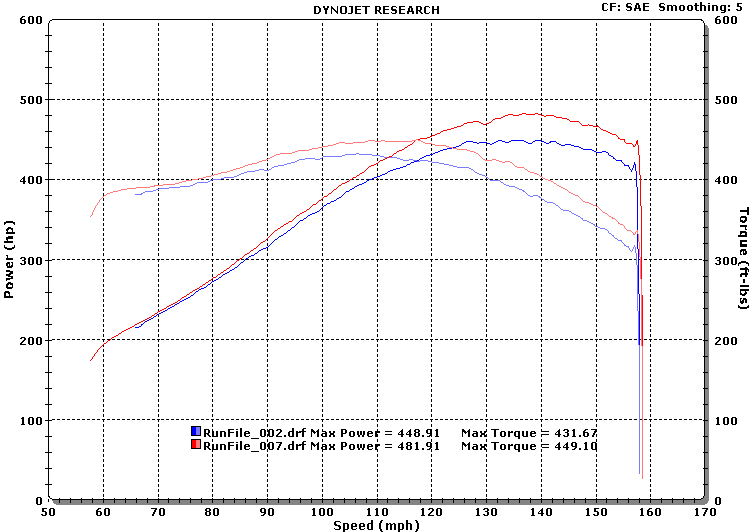
This is a dyno on a 2010 Z06 done in early 2010 by Excessive Autosports in SD. They do tuning and installs for Jerry's Chevrolet. 91 Octane. They tuned this Super Bee since the customer was doing headers later anyway.
The stock pull was done with 10 miles on the odometer, 2 more degrees timing (remember 91 Octane) and air fuel in OL at 12.3:1: +33 RWHP. This was not a freak. I have several other dynos by other shops that show the same results:
Last edited by Halltech; Jun 22, 2011 at 11:03 AM.
Corvette Stories
The Best of Corvette for Corvette Enthusiasts

Top 10 Most Expensive Corvettes Ever Sold on Bring A Trailer
Brett Foote
10 Things Every Corvette Owner Needs (2026 Edition)
Michael S. Palmer
8 Most "Only Corvette Owners Understand" Quirks and Problems
Pouria Savadkouei
10 Reasons the C6 Z06 is Still A Performance Benchmark After 20 Years
Joe Kucinski
How Much Horsepower Every Corvette Engine "LOST" in 1972
Joe Kucinski
Top 10 DOs and DON'Ts for Protecting Your Convertible Top!
Michael S. Palmer
Top 10 Most Explosive Corvettes Ever Made: Power-to-Weight Ratio Ranked!
Joe Kucinski
150 hp to 1,250 hp: Every Corvette Generation Compared by the Specs That Matter
Joe Kucinski
8 Coolest Corvette Pace Cars (and Replicas) of All Time
Verdad Gallardo
Melting Slicks
Joined: Feb 2004
Posts: 3,131
Likes: 148
From: Sugar Land TX
My suggestion to assimilate my test where I measured 118* is to bring engine up to operating temp, hood open, close hood and idle for 6 minutes, measure IAT.
Thread Starter
Supporting Vendor
Joined: Mar 2002
Posts: 13,099
Likes: 672
From: Bristol, Tennessee
St. Jude Donor '09
Halltech's Intakes are used on Katech's Engine dynos
Unless Katech is dyno testing another intake, their dyno baseline intake is the Halltech intake. See the dyno picture. We are sending them the new Super Bee MF103 for their baseline intake.
The CTS-V770 project is Halltech's CTS-V setup by Katech to run E85. This was a joint project between Halltech and Katech, and the results put the power/weight on par with the ZR1.
http://campaign.r20.constantcontact....l7gcG-nWUizVU4
The CTS-V770 project is Halltech's CTS-V setup by Katech to run E85. This was a joint project between Halltech and Katech, and the results put the power/weight on par with the ZR1.
http://campaign.r20.constantcontact....l7gcG-nWUizVU4
Last edited by Halltech; Jun 22, 2011 at 11:45 AM.