










EVAP Delete

Thread Starter
Le Mans Master


Joined: Aug 2002
Posts: 8,472
Likes: 38
From: Houston TX
St. Jude Donor '11
 EVAP Delete
What am I missing out on if I remove this junk from my engine bay and tune out the codes?
Follow up question: Is it possible to use the EVAP line as a return line for a return fuel system?
Follow up question: Is it possible to use the EVAP line as a return line for a return fuel system?

Melting Slicks


Joined: Aug 2004
Posts: 2,907
Likes: 229
From: Oakbank Manitoba
If you completely remove the EVAP system then you'll need to drill a small hole in your gas cap to vent the tanks. Then you run the risk of having a slight fuel smell in the garage.
The solenoid, plastic lines and canister are plastic. I just weighed the canister and solenoid at the tank, they're 4 lbs. The nylon vapor lines and solenoid at the manifold are maybe another 3 lbs.
It would be easier to just upgrade to the Z06 fuel module then to convert the EVAP vapor line to a return fuel line. You will have to drop the tanks anyways to accomplish this.
The solenoid, plastic lines and canister are plastic. I just weighed the canister and solenoid at the tank, they're 4 lbs. The nylon vapor lines and solenoid at the manifold are maybe another 3 lbs.
It would be easier to just upgrade to the Z06 fuel module then to convert the EVAP vapor line to a return fuel line. You will have to drop the tanks anyways to accomplish this.
Last edited by KENS80V; Jan 13, 2012 at 11:04 AM.

Le Mans Master

Joined: Dec 2004
Posts: 5,492
Likes: 808
From: West coast CA
Thread Starter
Le Mans Master
Joined: Aug 2002
Posts: 8,472
Likes: 38
From: Houston TX
St. Jude Donor '11
Wouldn't the evap hard line in the engine bay vent that, negating the need to drill a hole in the cap? I guess I'm not talking about the stuff in the tank, just the lines in the engine bay. I don't know why but it bugs me. Maybe it's not possible to remove that without removing the in tank stuff?
If I drop the tanks I'm putting in an aftermarket fuel system. Not ready to do that right now though.
I was kidding about the weight savings.
If I drop the tanks I'm putting in an aftermarket fuel system. Not ready to do that right now though.
I was kidding about the weight savings.
If you completely remove the EVAP system then you'll need to drill a small hole in your gas cap to vent the tanks. Then you run the risk of having a slight fuel smell in the garage.
The solenoid, plastic lines and canister are plastic. I just weighed the canister and solenoid at the tank, they're 4 lbs. The nylon vapor lines and solenoid at the manifold are maybe another 3 lbs.
It would be easier to just upgrade to the Z06 fuel module then to convert the EVAP vapor line to a return fuel line. You will have to drop the tanks anyways to accomplish this.
The solenoid, plastic lines and canister are plastic. I just weighed the canister and solenoid at the tank, they're 4 lbs. The nylon vapor lines and solenoid at the manifold are maybe another 3 lbs.
It would be easier to just upgrade to the Z06 fuel module then to convert the EVAP vapor line to a return fuel line. You will have to drop the tanks anyways to accomplish this.
Corvette Stories
The Best of Corvette for Corvette Enthusiasts

Top 10 Most Expensive Corvettes Ever Sold on Bring A Trailer
Brett Foote
10 Things Every Corvette Owner Needs (2026 Edition)
Michael S. Palmer
8 Most "Only Corvette Owners Understand" Quirks and Problems
Pouria Savadkouei
10 Reasons the C6 Z06 is Still A Performance Benchmark After 20 Years
Joe Kucinski
How Much Horsepower Every Corvette Engine "LOST" in 1972
Joe Kucinski
Top 10 DOs and DON'Ts for Protecting Your Convertible Top!
Michael S. Palmer
Top 10 Most Explosive Corvettes Ever Made: Power-to-Weight Ratio Ranked!
Joe Kucinski
150 hp to 1,250 hp: Every Corvette Generation Compared by the Specs That Matter
Joe Kucinski
8 Coolest Corvette Pace Cars (and Replicas) of All Time
Verdad Gallardo
Melting Slicks
Joined: Aug 2004
Posts: 2,907
Likes: 229
From: Oakbank Manitoba
If you just left the line open in the engine bay then fuel vapors could possibly accumulate.
The vapor line goes back to the canister. Then a separate vapor line joins the canister to the tank. A solenoid is also located at the canister. That closes off the fresh air allowed into the canister when the Evap system tests itself. The ECM opens the solenoid at the engine and then looks at the vacuum produced in the fuel tank with the tank solenoid sealed off.
The vapor line goes back to the canister. Then a separate vapor line joins the canister to the tank. A solenoid is also located at the canister. That closes off the fresh air allowed into the canister when the Evap system tests itself. The ECM opens the solenoid at the engine and then looks at the vacuum produced in the fuel tank with the tank solenoid sealed off.


Melting Slicks
Joined: Dec 2002
Posts: 2,897
Likes: 0
From: Lone Star State
I'm getting a lot of pressure in the fuel tank and once I cracked the cap, pressure comes out but continuously until it cools down. Where is the canister/soleniods/valves located?
I also witness that my service fuel system comes on and my gauge reads empty..
Anyone??
I also witness that my service fuel system comes on and my gauge reads empty..
Anyone??

Platinum Supporting Dealership


Joined: Sep 2007
Posts: 4,206
Likes: 28
From: Houston Tx
YOULL GET A CEL BUT THAT IS EASILY TURNED OFF. I GOT RID OF MINE NO FUEL SMELL AND THE CAR IS .0001 FASTER THROUGH THE 1/4 
__________________

YOUR CORVETTE SUPERSTORE SINCE 1988
CORVETTE WORLD HOUSTON
281-821-1222
http://corvetteworldhouston.com/
YOUR CORVETTE SUPERSTORE SINCE 1988
CORVETTE WORLD HOUSTON
281-821-1222
http://corvetteworldhouston.com/

Platinum Supporting Dealership
Joined: Sep 2007
Posts: 4,206
Likes: 28
From: Houston Tx

or if your around the store somethiem stop by id be glad to show you how i did it.
Race Director


Joined: Mar 2005
Posts: 10,399
Likes: 26
From: Austin Texas



Intermediate

Joined: Oct 2017
Posts: 41
Likes: 0
Would like to see what you did thanks
would like to see that diagram

Race Director


Joined: Dec 2013
Posts: 12,502
Likes: 3,631
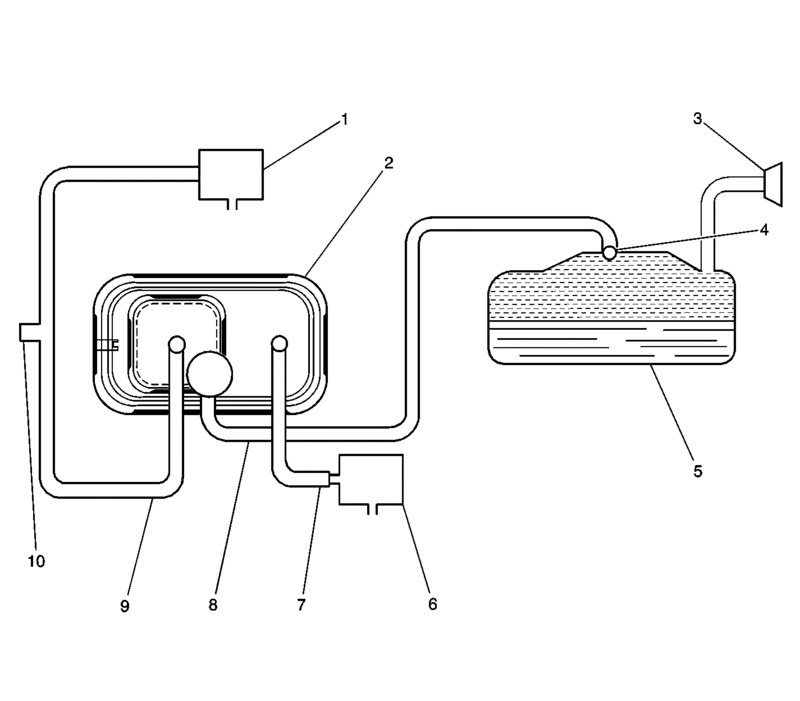
Down and dirty, with the car shut off, solenoid at the charcoal canistor is open, Forward evap solenoid closed, to allow the tank to vent pressure that way. Since the fumes are being pushed through the charcol canistor, no gas smell/no raw petrol fumes into the atmosphere.
With car on, charcoal canister solenoid is closed, and tank is venting through the evap solenoid into the intake isntead to still not vent raw gas fumes into the atmosphere.
At start up, both solenoids are help closed so the car can not only check the solenoids to makes sure they have the needed resistance to show they are connected/not burnt out, but the pressure in the system to make sure that the gas cap is not leaking as well.
As for the charcoal canister, it's above the tanks.
As for pulling the charcoal canister and evap lines, make sure to install one way check valves, so fuel is not allowed to pour out the top of tank in case of roll over.

Moderator, Tech Contributor


Joined: Sep 2013
Posts: 15,613
Likes: 4,061
From: Cape Coral, Florida
Down and dirty, with the car shut off, solenoid at the charcoal canistor is open, Forward evap solenoid closed, to allow the tank to vent pressure that way. Since the fumes are being pushed through the charcol canistor, no gas smell/no raw petrol fumes into the atmosphere.
With car on, charcoal canister solenoid is closed, and tank is venting through the evap solenoid into the intake isntead to still not vent raw gas fumes into the atmosphere.
At start up, both solenoids are help closed so the car can not only check the solenoids to makes sure they have the needed resistance to show they are connected/not burnt out, but the pressure in the system to make sure that the gas cap is not leaking as well.
As for the charcoal canister, it's above the tanks.
As for pulling the charcoal canister and evap lines, make sure to install one way check valves, so fuel is not allowed to pour out the top of tank in case of roll over.
Last edited by C5 Diag; Aug 8, 2021 at 07:52 PM.