







High battery voltage help....

Thread Starter
Intermediate

Joined: Aug 2010
Posts: 34
Likes: 0
 High battery voltage help....
My car is putting out 19.2 volts on initial start up then it will drop and maintain at 15.4-15.8. I checked my grounds and they are all good. I have tried two brand new alternators. And the car has a brand new optima red top battery ( new battery is moved to the hatch). I have taken the alternator back to oreillys and had it tested and it checked out fine I also had advance test It and it tested fine there also. The alternator clutch does make a clicking sound when you spin it by hand. Any ideas??

Team Owner

Joined: Mar 2008
Posts: 21,502
Likes: 462
From: Southern Utah
I'm not aware that the C6 has a clutch on the alternator. Mine certainly does not. That almost sounds to me like a voltage that would be produced by the system if the battery was not connected. Of course that couldn't be the case because it wouldn't turn over in that situation.

Race Director


Joined: Aug 2005
Posts: 13,592
Likes: 187
From: Hudson WI
NCM Sinkhole Donor
I'm not aware that the C6 has a clutch on the alternator. Mine certainly does not. That almost sounds to me like a voltage that would be produced by the system if the battery was not connected. Of course that couldn't be the case because it wouldn't turn over in that situation.
Corvette Stories
The Best of Corvette for Corvette Enthusiasts

Top 10 Most Expensive Corvettes Ever Sold on Bring A Trailer
Brett Foote
10 Things Every Corvette Owner Needs (2026 Edition)
Michael S. Palmer
8 Most "Only Corvette Owners Understand" Quirks and Problems
Pouria Savadkouei
10 Reasons the C6 Z06 is Still A Performance Benchmark After 20 Years
Joe Kucinski
How Much Horsepower Every Corvette Engine "LOST" in 1972
Joe Kucinski
Top 10 DOs and DON'Ts for Protecting Your Convertible Top!
Michael S. Palmer
Top 10 Most Explosive Corvettes Ever Made: Power-to-Weight Ratio Ranked!
Joe Kucinski
150 hp to 1,250 hp: Every Corvette Generation Compared by the Specs That Matter
Joe Kucinski
8 Coolest Corvette Pace Cars (and Replicas) of All Time
Verdad Gallardo
Burning Brakes

Joined: Dec 2007
Posts: 754
Likes: 2
From: Redondo Beach California
Old thread but, did you ever find a solution to this?
Im in the same boat...high voltage for about 30 seconds.
Jiggled the alternator harness, and connections are good. Still does it.
BCM?
Im in the same boat...high voltage for about 30 seconds.
Jiggled the alternator harness, and connections are good. Still does it.
BCM?


Race Director


Joined: Dec 2013
Posts: 12,502
Likes: 3,631
Bad voltage regulator or a short that is bypassing the voltage regulator to prevent the field from being clipped after the voltage exceeds around 14.6 volts.
The alternator puts out AC to begin with, then is converted to DC via diodes in a bridge rectifier type set up.
The voltage regulator is what keeps the alternator from putting out voltage past around 14.6 DC volts instead.
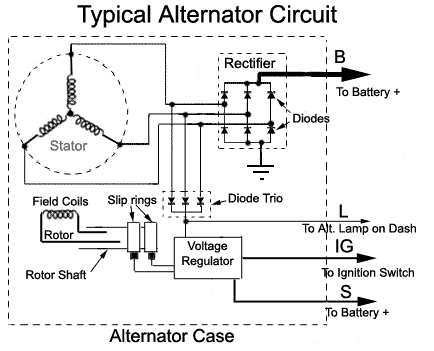
The alternator puts out AC to begin with, then is converted to DC via diodes in a bridge rectifier type set up.
The voltage regulator is what keeps the alternator from putting out voltage past around 14.6 DC volts instead.
The voltage regulator controls the field current applied to the spinning rotor inside the alternator. When there is no current applied to the field, there is no voltage produced from the alternator. When voltage drops below 13.5 volts, the regulator will apply current to the field and the alternator will start charging. When the voltage exceeds 14.5 volts, the regulator will stop supplying voltage to the field and the alternator will stop charging. This is how voltage output from the alternator is regulated. Amperage or current is regulated by the state of charge of the battery. When the battery is weak, the electromotive force (voltage) is not strong enough to hold back the current from the alternator trying to recharge the battery. As the battery reaches a state of full charge, the electromotive force becomes strong enough to oppose the current flow from the alternator, the amperage output from the alternator will drop to close to zero, while the voltage will remain at 13.5 to 14.5. When more electrical power is used, the electromotive force will reduce and alternator amperage will increase. It is extremely important that when alternator efficiency is checked, both voltage and amperage outputs are checked. Each alternator has a rated amperage output depending on the electrical requirements of the vehicle.
Last edited by Dano523; Jun 16, 2015 at 01:08 AM.

Melting Slicks


Joined: Jul 2010
Posts: 3,001
Likes: 243
From: Surprise, Az
AO, voltage regulators have been built into the alternators for a long time.
OP, whatever you do troubleshooting this problem, never remove a power lead from an alternator while the engine is running. To do so will certainly fry the diodes for the rectifier.
OP, whatever you do troubleshooting this problem, never remove a power lead from an alternator while the engine is running. To do so will certainly fry the diodes for the rectifier.

Burning Brakes
Joined: Dec 2005
Posts: 877
Likes: 102
From: TX Hill Country
I take it the power lead that you are referring to is the lead on the single post, correct? Does that mean if you remove the positive battery cable while the engine is running, the diodes will be fried?
Melting Slicks
Joined: Jul 2010
Posts: 3,001
Likes: 243
From: Surprise, Az
Yes and yes. I won't electrically disconnect any alternator connections while the engine is running. This is a mistake made more commonly in boats or RV's where you can switch between battery banks with the engine running.

Team Owner
Joined: Jun 2005
Posts: 46,295
Likes: 2,596
From: Northern, VA
St. Jude Donor '15
"In honor of jpee"
Thanks, mikeC. So, when the OP and others say, they have an issue with (possibly) the alternator and "had it checked out" does that mean the alternator AND voltage regulator were determined to be working properly? Or, just the alternator, or charging portion?