





Best Catch Can

Safety Car

Joined: Aug 2012
Posts: 4,706
Likes: 5
From: KY

One that looks like this:
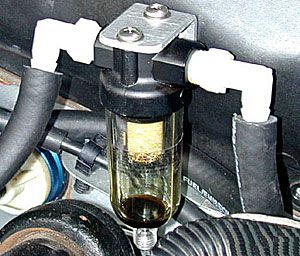 But since it doesn't look cool it's not too popular
If you Google Conceptual Polymer you will find something similar but a bit more professional. The key design issue is to swirl the air inside the catch can, this will separate the oil from the air better than a simple static filter (like a mesh used in practically all the others). Like a centrifuge but with no moving parts. It's the same concept as the air/oil separator on air compressors and other industrial equipment.
If you Google Conceptual Polymer you will find something similar but a bit more professional. The key design issue is to swirl the air inside the catch can, this will separate the oil from the air better than a simple static filter (like a mesh used in practically all the others). Like a centrifuge but with no moving parts. It's the same concept as the air/oil separator on air compressors and other industrial equipment.

Race Director


Joined: Feb 1999
Posts: 12,772
Likes: 17
From: Indianapolis IN
Its a drip catcher, I wouldn't over think this one, 
Mark2009, thats what they use in Manufacturing and it works great, plus you cna see the bowl. in my industry its called a filter regulator
Mark2009, thats what they use in Manufacturing and it works great, plus you cna see the bowl. in my industry its called a filter regulator
Race Director
Joined: Feb 1999
Posts: 12,772
Likes: 17
From: Indianapolis IN
Safety Car
Joined: Aug 2012
Posts: 4,706
Likes: 5
From: KY
What is generally marketed as a catch can is indeed a drip catcher. However, a true air/oil separator -- and the one pictured contains no regulator function -- is needed if you want to do the best job of keeping oil out of the intake manifold.
Even if it is cheaper
Even if it is cheaper
Corvette Stories
The Best of Corvette for Corvette Enthusiasts

Top 10 Most Expensive Corvettes Ever Sold on Bring A Trailer
Brett Foote
10 Things Every Corvette Owner Needs (2026 Edition)
Michael S. Palmer
8 Most "Only Corvette Owners Understand" Quirks and Problems
Pouria Savadkouei
10 Reasons the C6 Z06 is Still A Performance Benchmark After 20 Years
Joe Kucinski
How Much Horsepower Every Corvette Engine "LOST" in 1972
Joe Kucinski
Top 10 DOs and DON'Ts for Protecting Your Convertible Top!
Michael S. Palmer
Top 10 Most Explosive Corvettes Ever Made: Power-to-Weight Ratio Ranked!
Joe Kucinski
150 hp to 1,250 hp: Every Corvette Generation Compared by the Specs That Matter
Joe Kucinski
8 Coolest Corvette Pace Cars (and Replicas) of All Time
Verdad Gallardo
Race Director


Joined: Aug 2005
Posts: 13,592
Likes: 187
From: Hudson WI
NCM Sinkhole Donor


Drifting


Joined: Feb 2006
Posts: 1,339
Likes: 1
From: Lake Delton (WI Dells) WI
To make any catch can more effective, mount it someplace where it is cooler. This helps cool the vapor so the oil can condense and fall out of vapor. I mounted mine way up front and also used a copper line on the intake side. By doing these two things I virtually eliminated all oil vapor entering the intake tract. The can stays dramatically cooler as is the return line to the intake.
It's also amazing at how clean my exhaust tips stay now that I did this. I can drive 1,000 miles and my tips still look shiny. Before I moved the can and added the copper line they used to get black MUCH sooner than they do now.
It's also amazing at how clean my exhaust tips stay now that I did this. I can drive 1,000 miles and my tips still look shiny. Before I moved the can and added the copper line they used to get black MUCH sooner than they do now.
Race Director
Joined: Feb 1999
Posts: 12,772
Likes: 17
From: Indianapolis IN
I had this setup on my 406ci 85, it worked fine, I liked seeing the glass bowl oil level, with that said, "best" is a relative word, there is no way to measure the micron level of filtration, so this is why I say don't overthink it
Race Director
Joined: Aug 2005
Posts: 13,592
Likes: 187
From: Hudson WI
NCM Sinkhole Donor
Thanks!
Drifting
Joined: Feb 2006
Posts: 1,339
Likes: 1
From: Lake Delton (WI Dells) WI
The copper line adds to the heat dissipation of the vapor. Think of it has a heat sink. That copper line gets hot to the touch while the can and return rubber line are warm at best. Anything you can do to cool the vapor will help the oil fall out and condense.
Drifting

Joined: Feb 2010
Posts: 1,527
Likes: 34
Here we go again! Do a simple search and there are loads of good reads with discussions. As far as what is best, well........
These are a few of my attempts to improve with what I have at where it sits, not everything is shown in details but you might get the idea:


These are a few of my attempts to improve with what I have at where it sits, not everything is shown in details but you might get the idea:


Drifting
Joined: Feb 2010
Posts: 1,527
Likes: 34
There are two. The one at top for the incoming was something I made, then, mirror polished to resist corrosion.
The one on the reservoir, was modified from an commercially made, normally used by attaching to an existing oil filter housing, to aid, for the purpose of passive heat radiating.
The one on the reservoir, was modified from an commercially made, normally used by attaching to an existing oil filter housing, to aid, for the purpose of passive heat radiating.