







Minimum Rotor Thickness on 2011 GS

Thread Starter
Instructor


Joined: Jan 2013
Posts: 211
Likes: 72
From: Ellisville Missouri
 Minimum Rotor Thickness on 2011 GS
I am considering replacing the OEM brake pads because of the brake dust problem. I will re-machine the disc brake rotors when I replace the OEM pads.But, what is minimum thickness of the rotors?
Thanks
Thanks

Safety Car


Joined: Nov 2006
Posts: 3,667
Likes: 159
I did a search and found this...
https://www.corvetteforum.com/forums...on-the-c6.html
Looks like the service manual says the minimum serviceable thickness for rotors is:
Fronts - 30.3 mm 1.19 inches
Rears - 24.5 mm .965 inches
Thanks to BEZ06
https://www.corvetteforum.com/forums...on-the-c6.html
Looks like the service manual says the minimum serviceable thickness for rotors is:
Fronts - 30.3 mm 1.19 inches
Rears - 24.5 mm .965 inches
Thanks to BEZ06

Burning Brakes


Joined: Sep 2014
Posts: 912
Likes: 52
From: Mech. pa
I don't believe drilled and slotted rotors are able to be turned! Maybe it would be better to just wear that stuff out and then do pads and rotors? Water and soap are cheaper, plus you get to touch your car when you wash those wheels.

Race Director


Joined: Dec 2013
Posts: 12,502
Likes: 3,629
Very easy to turn drilled or slotted rotors.
You just can't take that deep of cuts that you would with a solid rotor, and since the cuts will be interrupted cuts over the slots/ drilled holes, you have to make sure that you have the damper belt around the out side of the rotor so you don't end up with a lot of chatter in the facing cut.
As for the problem with the Vet rotors, from brand new, there is just not that much extra metal on the rotor to allow for deeper turning and still be in the min thickness range. Gm did this to prevent extra spun weight with the rotor being too thick; and that they get to sell more rotors since they can not be turned as much/as deep.
So on that note, figure that you get turn the rotors once to clean them up if they are not too bad, but if you have deep gouging, your SOL thinking that you had a great deal of extra thickness of metal on the rotors to turn them down a few times. Really, if you can put a quarter up against the outer lip on the rotor, and the lip is higher that the quarter (or groove that deep that you are trying to clean up with turning), time for new rotors since they will end up way past the min allowed by the time the rotor is turned.
Last edited by Dano523; Dec 2, 2014 at 06:39 PM.

Team Owner


Joined: Sep 2000
Posts: 25,008
Likes: 2,707
From: Far NW 'burbs of Chicago
St. Jude Donor '13
Something I couldn't find in the Service Manual:
If your rotors are just above the minimum thickness, can you safely install new pads and go full life on the pads? As the brakes wear, the rotors will get below the minimum spec long before the new pads are worn out. Maybe GM accounts for that in the minimum spec, but somehow I doubt it.
If your rotors are just above the minimum thickness, can you safely install new pads and go full life on the pads? As the brakes wear, the rotors will get below the minimum spec long before the new pads are worn out. Maybe GM accounts for that in the minimum spec, but somehow I doubt it.
Corvette Stories
The Best of Corvette for Corvette Enthusiasts

Top 10 Most Explosive Corvettes Ever Made: Power-to-Weight Ratio Ranked!
Joe Kucinski
150 hp to 1,250 hp: Every Corvette Generation Compared by the Specs That Matter
Joe Kucinski
8 Coolest Corvette Pace Cars (and Replicas) of All Time
Verdad Gallardo
Top 10 Corvette Engines RANKED by Peak Torque (70+ Years of Muscle!)
Joe Kucinski
Corvette ZR1X Will Be Pacing the Indy 500, And Could Probably Race, Too!
Verdad Gallardo
Top 10 Corvettes Coming to Mecum Indy 2026!
Brett Foote
Top 10 C9 Corvette MUST-HAVES to Fix These C8 Generation Flaws!
Michael S. Palmer
10 Revolutionary 'Corvette Firsts' Most People Don't Know
Joe Kucinski
5 Reasons to Upgrade to an LS6-Powered Corvette; 5 Reasons to Stay LT2
Michael S. Palmer
Supporting Vendor

Joined: Oct 2002
Posts: 50,281
Likes: 518
From: Cleveland OH
St. Jude Donor '11,'13
Race Director
Joined: Dec 2013
Posts: 12,502
Likes: 3,629
From the other post,
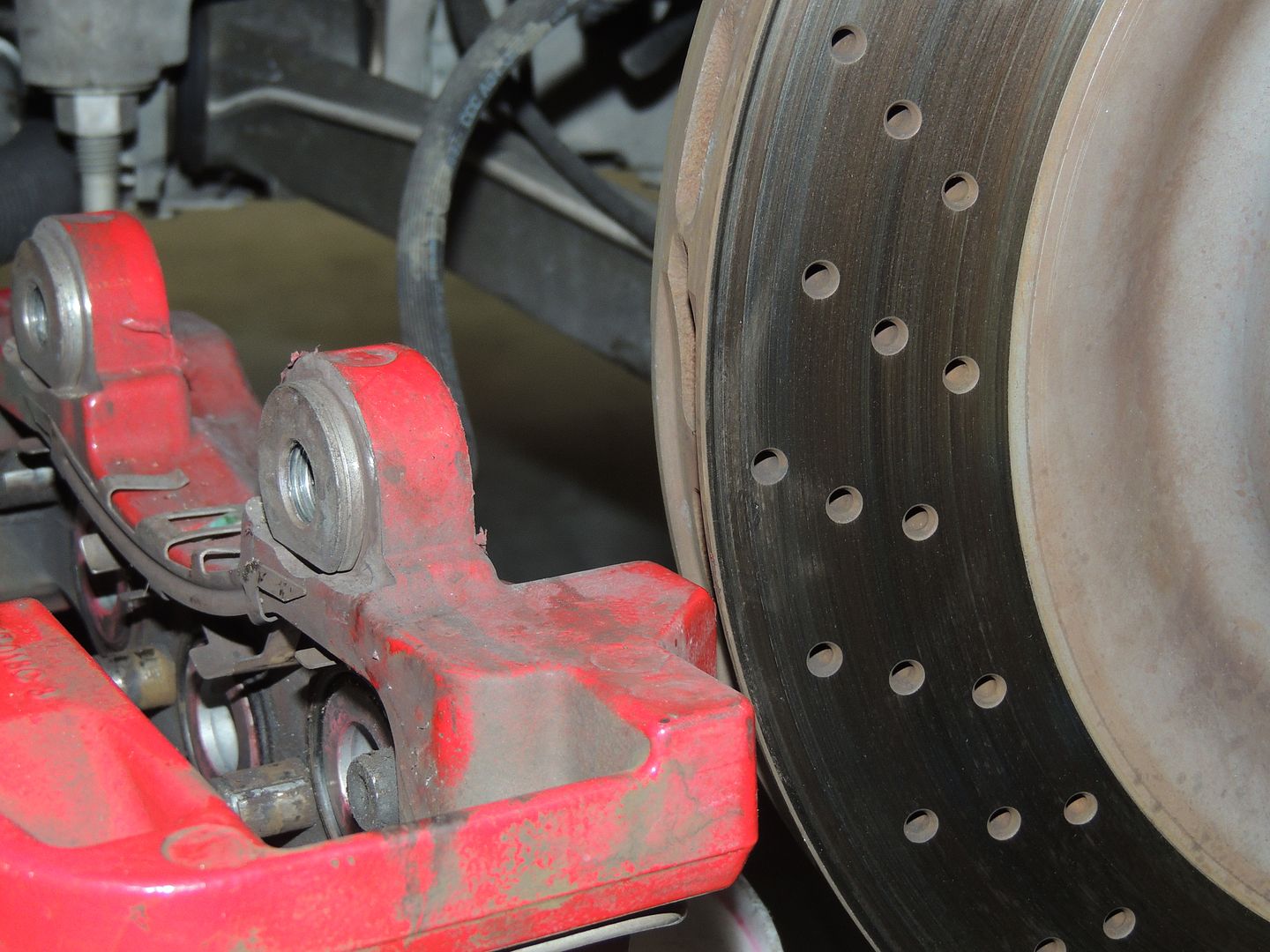
Two things you have to look at in regards if the rotors can be turned or not (had enough meat left on it).
Take a good look at the rotor, and notice that the outer edge of the rotor has worn more than the inner hub side surface. This is the reason that you have to mic across the entire area of the rotor to get the min thickness of any part of the rotor to determine if it machinable or not.
Take a look at the outer edge, and notice that the lip if you placed a quarter on the surface would not be proud of that lip.
This rotor still has enough meat in it (if it has not been turned before) to be turned to square the entire surface of the rotor flush and square to itself.
I bring this up, since if you just shove new pads on this rotor, pad break in is going to be a PITA/longer event, since the faces of the rotors are not square across the entire surfaces, and it will take a longer time for the pads to wear to this angle to correctly mate as well.
Also to add, when you do pull the rotors to have them turned (even if lightly surfaced to clean/entire surface square them up), you can get to the E brake shoe star nut to reset the E brake when doing the brake job.
Two things you have to look at in regards if the rotors can be turned or not (had enough meat left on it).
Take a good look at the rotor, and notice that the outer edge of the rotor has worn more than the inner hub side surface. This is the reason that you have to mic across the entire area of the rotor to get the min thickness of any part of the rotor to determine if it machinable or not.
Take a look at the outer edge, and notice that the lip if you placed a quarter on the surface would not be proud of that lip.
This rotor still has enough meat in it (if it has not been turned before) to be turned to square the entire surface of the rotor flush and square to itself.
I bring this up, since if you just shove new pads on this rotor, pad break in is going to be a PITA/longer event, since the faces of the rotors are not square across the entire surfaces, and it will take a longer time for the pads to wear to this angle to correctly mate as well.
Also to add, when you do pull the rotors to have them turned (even if lightly surfaced to clean/entire surface square them up), you can get to the E brake shoe star nut to reset the E brake when doing the brake job.

Le Mans Master

Joined: Feb 2014
Posts: 5,463
Likes: 1,138
From: Chino CA
I have read a lot of great reviews on CF about Brakemotive brake pad / rotor packages. They used to be a sponsor here and are now just on EBay. Crazy good prices and all good reviews if you are a street only driver. I have no experience with them (yet) but you guys may want to check them out. I saw the prices and assumed poor quality but a lot of forum members use them and I could not find a bad review.

Burning Brakes
Joined: Jun 2013
Posts: 867
Likes: 26
From: SW Ohio
Just out of curiosity, what is it that makes the e-brake go out of adjustment? Is it simply cable stretch? I can't imagine that the shoes or inner drums themselves undergo any appreciable wear by applying the hand brake when parked.
Team Owner
Joined: Mar 2008
Posts: 21,502
Likes: 461
From: Southern Utah
Most rotors have the min thickness cast into the rotor somewhere where it is easy to see. Most brake manufacturers no longer recommend turning rotors. If you have no issues with the brakes now, then you should not simply turn the rotors as a matter of course. The pads can just be replaced. Turning the rotors takes off material and makes the rotor less able to absorb heat, which is the purpose of brake rotors.
Team Owner
Joined: Sep 2000
Posts: 25,008
Likes: 2,707
From: Far NW 'burbs of Chicago
St. Jude Donor '13
Most rotors have the min thickness cast into the rotor somewhere where it is easy to see. Most brake manufacturers no longer recommend turning rotors. If you have no issues with the brakes now, then you should not simply turn the rotors as a matter of course. The pads can just be replaced. Turning the rotors takes off material and makes the rotor less able to absorb heat, which is the purpose of brake rotors.

Last time I looked in the Service Manual, it said not to turn the rotors unless they are seriously grooved or pitted.
Some people say you should do a very light cut when changing to a different type of pad, that might be true. Or not.
BTW, does anyone have an answer to the question I asked in post #6?
Race Director
Joined: Dec 2013
Posts: 12,502
Likes: 3,629
Seating and cable stretch.
As for seeing how bad this is on a car, just pull the E brake, and it should fully engage the brakes with the handle about half way up. If the handle is going all the way up and hitting the stop before the E brakes engage firmly, then time to adjust the E brake shoes via the star adjuster.
Short version, choke the front tires, loosen the lug nuts on the rear tires, get the back end up on either a lift or jack stands, pull the calipers off (the large bolts only if you have base/z51 and your leaving the brackets still on the caliper when you pull them) and zip tie them up so they are not hanging from the brake lines (throw a block of wood between the pads in case someone steps on the brakes), then starting on once side, turn the rotor by hand while listening for any E brake rub with the handle all the way down.
Now pull the rotor, and start adjusting the E brake out via the star adjuster until when you put the rotor back on and turn it, you hear just a slight rub in one spot of the rotor being turned. Now get in the car, pull the E brake to center the E brake shoe on the rotor disc area, put the handle back down, and go back and rotate the rotor again. If you still have a slight contact of the E brake pad to the rotor drum area, back off the star a click or two until the E brake shoe not longer makes contact to the drum part of the disc (may need to pull the E brake again to recenter the shoe on the drum).
One side completed, and now do the other side.
When you put the calipers back on, clean all the Blue loctite off the large Bolts, reapply Blue 242 loctite to them (heavy side), and torque the bolts to 125ftlbs.
Note, depending the amount of brake fluid in the tank, may need to pull some of it out (wall paper syringe from any hardware store will work). The reason for this, you will need to slightly compress the pads/pistons back into the calipers so the brake pads clear the rotor when you remove the calipers, and this will force fluid back into the tank (read so you don't end up with the fluid overflowing from the tank, since it will strip paint very, very quickly from any painted surface).
Race Director
Joined: Dec 2013
Posts: 12,502
Likes: 3,629
Something I couldn't find in the Service Manual:
If your rotors are just above the minimum thickness, can you safely install new pads and go full life on the pads? As the brakes wear, the rotors will get below the minimum spec long before the new pads are worn out. Maybe GM accounts for that in the minimum spec, but somehow I doubt it.
If your rotors are just above the minimum thickness, can you safely install new pads and go full life on the pads? As the brakes wear, the rotors will get below the minimum spec long before the new pads are worn out. Maybe GM accounts for that in the minimum spec, but somehow I doubt it.
Note, sure that GM included a safety margin of error in regards to min rotor thickness before replacement, but if you are going to be pushing the brakes hard, better to use GM min thickness safety error margins.
The rotors will have some embed on the them from the old pads, so if nothing else if switching to another type of pad, good to remove that before bedding in new brake pads.
As for turning or not, mic the rotor from the inside hub side to the outer edge side, and see how uneven the wear is to the over all rotor surfaces. There are times that the surface looks fine, but the rotors are no longer parallel/square across the surfaces to each other (outer edge has a lot more wear to the rotor than the inner hub side surface).
Again, take a look of the rotor from the other thread that I posted, and would dare to guess mic'g the rotor both sides, almost a hundred thousands difference from out edge contract area both sides, to inner hub contact both sides. Now translate this to new pads trying to mate up with the off square surfaces of the rotors to each sides (both, how the pads need to wear to mate up to the rotor canted surfaces, and the cocking of the pads in the caliper as they are trying to wear to match these canted surface planes as well.
Note, too bad the op did not show the old pads in his right up on the other post, since you would have been able to see the un-evern wear of the old pads to begin with; and the fact that the new pads will first have to wear to this canted edge to just mate up to the rotor, and since the brakes favor outer surface wear, by the time the new pads wear get half lifed, will be even a worse cant of brake pad wear.
Bluntly, the rotors can be turned, and if nothing else in regards to a light pass, to just parallel the both sides of the rotor contact surfaces to each other once again before you do mate in new pads to them. Plus on the back rotors, great time to knock off the edge lip of the drum section so you can reset the E brake without having to fight that lip to adjust the E brake shoe/pull-reinstall the rotor back on while adjusting them.
On the front, $15 each is about right since they only have to take slower passes on the rotors them selves, while on the backs, around $20 each, since not only rotor surfaces, but the you want them take a light pass on the E brake drum surface to remove the outer lip that forms as well.
E brake drum on the rear rotor, and although this one is rusted, the drum has min wear since there is no lip on the E drum.

Team Owner
Joined: Mar 2008
Posts: 21,502
Likes: 461
From: Southern Utah
Last time I looked in the Service Manual, it said not to turn the rotors unless they are seriously grooved or pitted.
Some people say you should do a very light cut when changing to a different type of pad, that might be true. Or not.
BTW, does anyone have an answer to the question I asked in post #6?

Melting Slicks


Joined: Jan 2004
Posts: 2,299
Likes: 387
From: Fort Worth TX
St. Jude Donor '14-'15
Good luck with your's; my '12 GS with 46K would still roll with the E-Brake totally on, so I took it into the dealer (still under warranty). They had to order parts (two weeks or so) before it could be fixed. Now it you use a lot of beef on the handle, the car will stay put.....but you have to pull up so hard I know my wife couldn't do it. Now you know why the C7's have gone to an electric activated (button) E-Brake

Team Owner
Joined: Mar 2008
Posts: 21,502
Likes: 461
From: Southern Utah
When I first owned the car, I pulled steadily up on the brake to engage it. It was the first car I have owned with a stick, so it was the first car where I used the e-brake all the time. At the hardware store one day, I parked and was fortunate that it grabbed enough attention that two people yelled at me as the car started gently rolling away after I exited. I have since learned that the way to pull on the handle is to yank it and not to pull it steadily. Never had a roll-away since and I have found that the e-brake works very well even on steep slopes.