




shifter upgrade

Thread Starter
Racer


Joined: Mar 2001
Posts: 326
Likes: 44
From: Newberg,Oregon,U.S.A.
 shifter upgrade
I'm looking to upgrade my stock 2008 M6 shifter to something better. I read that MGW has a nice one but wondering if anyone has comments on a hurst or B&M that ecklers offers?

Race Director


Joined: Dec 2013
Posts: 12,502
Likes: 3,631
MGW all the way!!!!
Its that simple, and head and shoulders above anything else.
As for when you install the shifter, the length that you set the shifter rod section/**** height above the housing will make a difference. The higher the ****, the more leverage you have to move the shifter through the gears, but the longer the throws will be instead.
So what most of us do, set the shaft/**** as low as possible for the shortest throws, and if you feel that the shifter is to too hard to get into the end positions/gear (feels too notchy) then we use a single M20 brass washer to shim the indexer on the side of the transmission outwards to allow the shifter to slip into it final position with less resistance from the transmission indexer (anti-venom mod).
http://www.toquez06.com/avm.html
Its that simple, and head and shoulders above anything else.
As for when you install the shifter, the length that you set the shifter rod section/**** height above the housing will make a difference. The higher the ****, the more leverage you have to move the shifter through the gears, but the longer the throws will be instead.
So what most of us do, set the shaft/**** as low as possible for the shortest throws, and if you feel that the shifter is to too hard to get into the end positions/gear (feels too notchy) then we use a single M20 brass washer to shim the indexer on the side of the transmission outwards to allow the shifter to slip into it final position with less resistance from the transmission indexer (anti-venom mod).
http://www.toquez06.com/avm.html
Last edited by Dano523; Mar 6, 2015 at 09:55 PM.

Tech Contributor


Joined: Sep 2008
Posts: 10,954
Likes: 261
From: Greensboro NC
2015 C6 of the Year Finalist

I had the older MGW version and recently switched the the newer model with the lower box. Shifting is smooth as butter now.

Melting Slicks


Joined: Jul 2004
Posts: 2,721
Likes: 149
From: North Carolina
I have a MGW w/ lower box and did the anti-venom mod. The combination yields an exponentially better shifting experience than stock. I'm changing over to AMSOIL fluid this week, which reportedly provides a noticeable improvement in shifting smoothness as well - especially when cold.
Race Director
Joined: Dec 2013
Posts: 12,502
Likes: 3,631

Burning Brakes


Joined: Dec 2009
Posts: 816
Likes: 40
From: Sacto Calif
That question came up last Saturday.
At his Corvette shop the B+M shifter is the only shifter that he recommends and installs also he didn't have anything good to say about the Hurst shifter either.
Corvette Stories
The Best of Corvette for Corvette Enthusiasts

Top 10 Most Expensive Corvettes Ever Sold on Bring A Trailer
Brett Foote
10 Things Every Corvette Owner Needs (2026 Edition)
Michael S. Palmer
8 Most "Only Corvette Owners Understand" Quirks and Problems
Pouria Savadkouei
10 Reasons the C6 Z06 is Still A Performance Benchmark After 20 Years
Joe Kucinski
How Much Horsepower Every Corvette Engine "LOST" in 1972
Joe Kucinski
Top 10 DOs and DON'Ts for Protecting Your Convertible Top!
Michael S. Palmer
Top 10 Most Explosive Corvettes Ever Made: Power-to-Weight Ratio Ranked!
Joe Kucinski
150 hp to 1,250 hp: Every Corvette Generation Compared by the Specs That Matter
Joe Kucinski
8 Coolest Corvette Pace Cars (and Replicas) of All Time
Verdad Gallardo
Racer
Joined: Nov 2014
Posts: 284
Likes: 1
From: DFW
I asked my Corvette mechanic that same question last Saturday and he acknowledged that the MGW shifter was a better made product but is it $100+ better than the B+M shifter? he said a resounding NO it's Not! Once installed you can't tell the difference between the MGW VS. B+M shifter.
At his Corvette shop the B+M shifter is the only shifter that he recommends and installs also he didn't have anything good to say about the Hurst shifter either.
At his Corvette shop the B+M shifter is the only shifter that he recommends and installs also he didn't have anything good to say about the Hurst shifter either.
MGW does not give the dealers much of a discount at all. When you cannot get a decent rate of return, why try and sell them.
The other side of that coin is the B&M shifter $$400 to $500 (installed price) better than stock.
I have the MGW and know that it is a better shifter than stock, but is it $500 to $600 (installed price) better than stock? I do race my car, so to me it is.
Are you willing to pay $100.00 extra to have the best...that is a decision we all have to make
Last edited by mysloride; Mar 9, 2015 at 08:16 AM.

Race Director
Joined: Aug 2005
Posts: 13,592
Likes: 187
From: Hudson WI
NCM Sinkhole Donor

Heel & Toe
Joined: Jun 2013
Posts: 21
Likes: 0
Actually answered my own question a few minutes after posting, clicked on the link a few posts above. Seems pretty simple, and given the fact I am doing a clutch replacement and installation of the shift kit, I will be in that neighborhood anyway.
Race Director
Joined: Aug 2005
Posts: 13,592
Likes: 187
From: Hudson WI
NCM Sinkhole Donor
I store my car on a lift in my garage, I all it took was the 24mm socket and 2 minutes. I took me more time to order the washers from Jegs.

Racer
Joined: Nov 2013
Posts: 438
Likes: 4
From: Fort Walton Beach Florida
I have the newest MGW shifter and it was worth every penny. I've driven a Z with the hurst and it doesn't stack up to the MGW.
I just decided to pony up the first time rather than wonder if the MGW was better after having bought one of the other shifters.
I just decided to pony up the first time rather than wonder if the MGW was better after having bought one of the other shifters.
Last edited by Ultrasport05; Mar 10, 2015 at 10:07 AM.
Race Director
Joined: Dec 2013
Posts: 12,502
Likes: 3,631
Lets start this from the top again.
Why does the stock shifter suck so bad. The cross axle linkage is just a couple of pin against a couple of slots, and the slop is huge between them.
On the MGW shifter, whole different ballgame to get is perfectly tight/smooth without any slop. And if such does become loose way, way down he road, fully adjustable to tighten it back up.
Next is the OEM lower housing, and when the through bar wears against the brass bushings, no OEM way to replace the bushings (can be done, but you better have a lathe handy to make new bushings)
On the MGW lower housing, the through bar runs through nylon bushings, and when the nylon bushing wear over many years, you can replace the bushings instead of having to replace the entire lower housing instead.
So if you want to know why the MGW shifter is that much better than anything else, just look up through the bottom of the shifter to see the linkage in it. The smoother/tighter movement lower housing over the OEM housing is just icing on the cake.
Why does the stock shifter suck so bad. The cross axle linkage is just a couple of pin against a couple of slots, and the slop is huge between them.
On the MGW shifter, whole different ballgame to get is perfectly tight/smooth without any slop. And if such does become loose way, way down he road, fully adjustable to tighten it back up.
Next is the OEM lower housing, and when the through bar wears against the brass bushings, no OEM way to replace the bushings (can be done, but you better have a lathe handy to make new bushings)
On the MGW lower housing, the through bar runs through nylon bushings, and when the nylon bushing wear over many years, you can replace the bushings instead of having to replace the entire lower housing instead.
So if you want to know why the MGW shifter is that much better than anything else, just look up through the bottom of the shifter to see the linkage in it. The smoother/tighter movement lower housing over the OEM housing is just icing on the cake.

Tech Contributor


Joined: Oct 1999
Posts: 41,058
Likes: 9,820
From: Charlotte, NC (formerly Endicott, NY)
Lets start this from the top again.
Why does the stock shifter suck so bad. The cross axle linkage is just a couple of pin against a couple of slots, and the slop is huge between them.
On the MGW shifter, whole different ballgame to get is perfectly tight/smooth without any slop. And if such does become loose way, way down he road, fully adjustable to tighten it back up.
Next is the OEM lower housing, and when the through bar wears against the brass bushings, no OEM way to replace the bushings (can be done, but you better have a lathe handy to make new bushings)
On the MGW lower housing, the through bar runs through nylon bushings, and when the nylon bushing wear over many years, you can replace the bushings instead of having to replace the entire lower housing instead.
So if you want to know why the MGW shifter is that much better than anything else, just look up through the bottom of the shifter to see the linkage in it. The smoother/tighter movement lower housing over the OEM housing is just icing on the cake.
Why does the stock shifter suck so bad. The cross axle linkage is just a couple of pin against a couple of slots, and the slop is huge between them.
On the MGW shifter, whole different ballgame to get is perfectly tight/smooth without any slop. And if such does become loose way, way down he road, fully adjustable to tighten it back up.
Next is the OEM lower housing, and when the through bar wears against the brass bushings, no OEM way to replace the bushings (can be done, but you better have a lathe handy to make new bushings)
On the MGW lower housing, the through bar runs through nylon bushings, and when the nylon bushing wear over many years, you can replace the bushings instead of having to replace the entire lower housing instead.
So if you want to know why the MGW shifter is that much better than anything else, just look up through the bottom of the shifter to see the linkage in it. The smoother/tighter movement lower housing over the OEM housing is just icing on the cake.
Bill
Race Director
Joined: Dec 2013
Posts: 12,502
Likes: 3,631
I have 38K miles on my stock 08 shifter with no issues. It works fine, slips into gear easily, shifts fast and only requires two fingers and the heel of the hand to operate it. There just isn't much you can do to improve on the design since none of them are more than a stick through a hole. The main part of the shifter linkage is the same no matter which shifter you use.
Bill
Bill
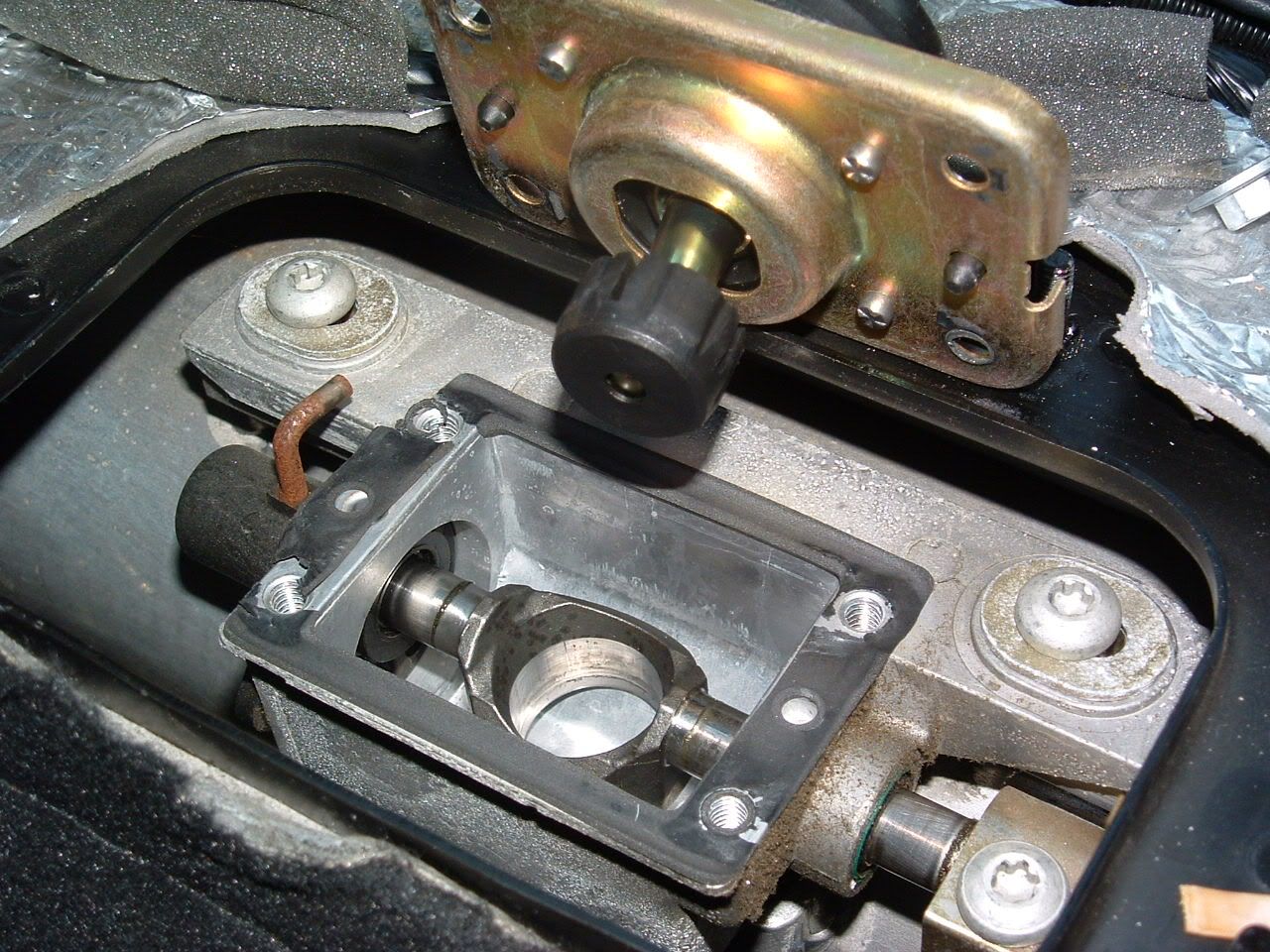
But lets start with the lower shifter housing, being the rod with the Hole in it for the shifter end ball bushing to fit into.
On the shaft to the housing, you can get wear to the bushing that it rides through on both side, and this increases slop of the rod in the housing.
Now lets move up to the shifter shaft to the top plate. Here on a stock shifter, grab the main shift and twist it. This slop also translates slop in the shifter as well.
But let's back it up,
On the lower housing, it's not the end of the world as a design, and all not that hard to polish the shaft, and even replace the worn bushings in the housing to tighten that up (none OEM methods, instead of just replacing the lower housing completely).
But on the **** shifter shaft to main top plate on the upper section, that one is a lost causes. Even if you remove the rivets to remove the holder plate from the main plate, your left with milled slots against metal posts, and short of reinventing the wheel, no way to correct that slop in any fashion that would even last a half a year of normal shifting.
Hence this is the weak link to the value engineered OEM shifter and why the OEM is so vague in it shifting gates/has so much slop side to side, and even up and down slop.
Bluntly, with the OEM shifter in any gate line, you have close to a 1/2" of movement from side to side and even up and back, with the majority of this is being created by the slop in the upper plate linkage to the shaft. To add, even if you just milled the stock shaft shorter to shorten the throws of the shifts, you still end with a lot of slop in the movement of the shifter paths.
So here, is where the MGW shifter excels, since it's upper plate to shaft pivot linkage is well though out to keep such tight to remove a the slop; hence linkage is adjustable if needed to be tightened up a decade down the line, and designed with contact parts to stay adjusted for year of use as well (even heavy use).
Last edited by Dano523; Mar 10, 2015 at 09:46 PM.