








Base C6 Vs Z51 Brakes

Thread Starter
Safety Car


Joined: Jan 2005
Posts: 3,675
Likes: 58
From: Hayward (Bay Area) CA
 Base C6 Vs Z51 Brakes
Hi Guys,
Can someone be specific of the differences, and what it takes to make the changes? And if ANY base parts can still be used while transforming to the Z51?
Thanks,
VF
Can someone be specific of the differences, and what it takes to make the changes? And if ANY base parts can still be used while transforming to the Z51?
Thanks,
VF

Popular Reply
Apr 30, 2018, 11:46 AM

Safety Car
Joined: Jun 2017
Posts: 4,786
Likes: 425
From: North Georgia, USA
Pet peeve here, there are no "Z51" brakes. Z51 is the RPO code for a suspension package. The brakes are "Heavy Duty Brakes" and RPO code J55 IIRC. I know that all cars that got Z51 suspension also got J55 heavy duty brakes, but that doesn't make the brakes "Z51 brakes."
Your question can be answered by looking in the parts catalog. Any parts that list different part numbers for "W/Heavy Duty Brakes" and "W/O Heavy Duty Brakes," You'll need the "W/Heavy duty brakes" parts.
IIRC, the hoses and calipers are the same, the pads may be the same. The rotors and the caliper brackets are different.
Oh and one more pet peeve. The rotors for "Heavy Duty Brakes" are drilled and have curved vanes. The only rotor that GM offers is a left rotor. They installed two left rotors on every car with the J55 heavy duty brakes. There are flat (undrilled) rotors with straight vanes available in the aftermarket, and there are curved vane rotors available that are sold in pairs. This is one of the few vehicles where I advise against using original equipment rotors.
Your question can be answered by looking in the parts catalog. Any parts that list different part numbers for "W/Heavy Duty Brakes" and "W/O Heavy Duty Brakes," You'll need the "W/Heavy duty brakes" parts.
IIRC, the hoses and calipers are the same, the pads may be the same. The rotors and the caliper brackets are different.
Oh and one more pet peeve. The rotors for "Heavy Duty Brakes" are drilled and have curved vanes. The only rotor that GM offers is a left rotor. They installed two left rotors on every car with the J55 heavy duty brakes. There are flat (undrilled) rotors with straight vanes available in the aftermarket, and there are curved vane rotors available that are sold in pairs. This is one of the few vehicles where I advise against using original equipment rotors.
Safety Car
Joined: Jun 2017
Posts: 4,786
Likes: 425
From: North Georgia, USA
Pet peeve here, there are no "Z51" brakes. Z51 is the RPO code for a suspension package. The brakes are "Heavy Duty Brakes" and RPO code J55 IIRC. I know that all cars that got Z51 suspension also got J55 heavy duty brakes, but that doesn't make the brakes "Z51 brakes."
Your question can be answered by looking in the parts catalog. Any parts that list different part numbers for "W/Heavy Duty Brakes" and "W/O Heavy Duty Brakes," You'll need the "W/Heavy duty brakes" parts.
IIRC, the hoses and calipers are the same, the pads may be the same. The rotors and the caliper brackets are different.
Oh and one more pet peeve. The rotors for "Heavy Duty Brakes" are drilled and have curved vanes. The only rotor that GM offers is a left rotor. They installed two left rotors on every car with the J55 heavy duty brakes. There are flat (undrilled) rotors with straight vanes available in the aftermarket, and there are curved vane rotors available that are sold in pairs. This is one of the few vehicles where I advise against using original equipment rotors.
Your question can be answered by looking in the parts catalog. Any parts that list different part numbers for "W/Heavy Duty Brakes" and "W/O Heavy Duty Brakes," You'll need the "W/Heavy duty brakes" parts.
IIRC, the hoses and calipers are the same, the pads may be the same. The rotors and the caliper brackets are different.
Oh and one more pet peeve. The rotors for "Heavy Duty Brakes" are drilled and have curved vanes. The only rotor that GM offers is a left rotor. They installed two left rotors on every car with the J55 heavy duty brakes. There are flat (undrilled) rotors with straight vanes available in the aftermarket, and there are curved vane rotors available that are sold in pairs. This is one of the few vehicles where I advise against using original equipment rotors.
Last edited by C6_Racer_X; Apr 30, 2018 at 11:56 AM.

Race Director


Joined: Sep 2007
Posts: 16,557
Likes: 2,108
From: Peoria/Phoenix AZ
C6 of Year Finalist (performance mods) 2019
Pet peeve here, there are no "Z51" brakes. Z51 is the RPO code for a suspension package. The brakes are "Heavy Duty Brakes" and RPO code J55 IIRC. I know that all cars that got Z51 suspension also got J55 heavy duty brakes, but that doesn't make the brakes "Z51 brakes."
Your question can be answered by looking in the parts catalog. Any parts that list different part numbers for "W/Heavy Duty Brakes" and "W/O Heavy Duty Brakes," You'll need the "W/Heavy duty brakes" parts.
IIRC, the hoses and calipers are the same, the pads may be the same. The rotors and the caliper brackets are different.
Oh and one more pet peeve. The rotors for "Heavy Duty Brakes" are drilled and have curved vanes. The only rotor that GM offers is a left rotor. They installed two left rotors on every car with the J55 heavy duty brakes. There are flat (undrilled) rotors with straight vanes available in the aftermarket, and there are curved vane rotors available that are sold in pairs. This is one of the few vehicles where I advise against using original equipment rotors.
Your question can be answered by looking in the parts catalog. Any parts that list different part numbers for "W/Heavy Duty Brakes" and "W/O Heavy Duty Brakes," You'll need the "W/Heavy duty brakes" parts.
IIRC, the hoses and calipers are the same, the pads may be the same. The rotors and the caliper brackets are different.
Oh and one more pet peeve. The rotors for "Heavy Duty Brakes" are drilled and have curved vanes. The only rotor that GM offers is a left rotor. They installed two left rotors on every car with the J55 heavy duty brakes. There are flat (undrilled) rotors with straight vanes available in the aftermarket, and there are curved vane rotors available that are sold in pairs. This is one of the few vehicles where I advise against using original equipment rotors.
 And with one minor addition that the rear calipers on the J55 brakes have a smaller piston. Although, it's not a concern for street use.
The unfortunate thing is that many suppliers started calling J55 brakes as Z51 brakes vs base brakes when the '05's were new and have never changed their nomenclature.
Last edited by HOXXOH; Apr 30, 2018 at 12:21 PM.

Race Director


Joined: Dec 2013
Posts: 12,505
Likes: 3,634
JL9 verses J55 brakes.
The calipers from a basic stand point, are the same.
So what happens,
is the J55 used different brake brackets that pushes the caliper out farther on the rotor, this allows for a larger rotors that will increase the surface bite per revolution area of the rotors, and HD semi metallic pads that have a greater bite to the rotors, higher heat range over stock pads as well. So what this boils down to it more initial bite, better brake pedal feed back, and slightly higher working temps of the brakes to resist brake fade for auto cross use.
To make the swap, just need the J55 brackets,the J55 rotors, the J55 HD pads, and since you are using the stock calipers, they work with the stock rims.
As for most for street us, the J55 brake system is waste, and all a base car for street use needs to do it just replace the base pads with something that does have a better bite (can use the J55 HD pads), and power flush the old water contaminated brake fluid out of the system.
Note, on the vet, the brake fluid should be power flushed every two years. Hence in the two years, the brake fluid wicks moisture out of the air into the fluid, and just fresh fluid makes a huge different in itself.
As for the J55 brake system with Duralast Ceramic pads, such a huge step in the wrong direction since your loosing pad bite, not to mention that the pads have a lower heat working temp, that it plan as day a wrong move instead. Hence the real deal in the J55 system is pads that have a better bite to begin with, and the rest of the system is really to just help keep the rotors cool under more demanding type use instead.
If you don't want to use the J55 hd pads, then there are other aftermarket ceramic autocross pads that still have the same bite, but will dust less isntead. Just don't use the base ceramic or autozone Duralast ceramic pads, since they lack the pad bite your looking for to start with.
To add, all this increase bite/feed back/heat range for the J55 system comes at a price. JL9 brakes, pads lasting 60K mile is pretty the norm. On the J55 system, pads will only last about 30K, and your going to be replacing the rotors as well at the 60K mark too with the next set of pads.
The calipers from a basic stand point, are the same.
So what happens,
is the J55 used different brake brackets that pushes the caliper out farther on the rotor, this allows for a larger rotors that will increase the surface bite per revolution area of the rotors, and HD semi metallic pads that have a greater bite to the rotors, higher heat range over stock pads as well. So what this boils down to it more initial bite, better brake pedal feed back, and slightly higher working temps of the brakes to resist brake fade for auto cross use.
To make the swap, just need the J55 brackets,the J55 rotors, the J55 HD pads, and since you are using the stock calipers, they work with the stock rims.
As for most for street us, the J55 brake system is waste, and all a base car for street use needs to do it just replace the base pads with something that does have a better bite (can use the J55 HD pads), and power flush the old water contaminated brake fluid out of the system.
Note, on the vet, the brake fluid should be power flushed every two years. Hence in the two years, the brake fluid wicks moisture out of the air into the fluid, and just fresh fluid makes a huge different in itself.
As for the J55 brake system with Duralast Ceramic pads, such a huge step in the wrong direction since your loosing pad bite, not to mention that the pads have a lower heat working temp, that it plan as day a wrong move instead. Hence the real deal in the J55 system is pads that have a better bite to begin with, and the rest of the system is really to just help keep the rotors cool under more demanding type use instead.
If you don't want to use the J55 hd pads, then there are other aftermarket ceramic autocross pads that still have the same bite, but will dust less isntead. Just don't use the base ceramic or autozone Duralast ceramic pads, since they lack the pad bite your looking for to start with.
To add, all this increase bite/feed back/heat range for the J55 system comes at a price. JL9 brakes, pads lasting 60K mile is pretty the norm. On the J55 system, pads will only last about 30K, and your going to be replacing the rotors as well at the 60K mark too with the next set of pads.
Last edited by Dano523; May 1, 2018 at 05:05 AM.
Thread Starter
Safety Car
Joined: Jan 2005
Posts: 3,675
Likes: 58
From: Hayward (Bay Area) CA
Thanks for the info guys.
Is it worth the upgrade to Z51 front brakes? All things equal, the front brackets alone are about $130.
Dano, thanks...
Say I stay with Base C6 setup, what pads you're recommending? Obviously, I'd want a strong bite, but also lesser dust & quiet would be nice as well - so finding the right balance is the key. Got ideas?
Is it worth the upgrade to Z51 front brakes? All things equal, the front brackets alone are about $130.
Dano, thanks...
Say I stay with Base C6 setup, what pads you're recommending? Obviously, I'd want a strong bite, but also lesser dust & quiet would be nice as well - so finding the right balance is the key. Got ideas?
Last edited by Vette_Fan; May 1, 2018 at 07:18 AM.

Supporting Vendor
Joined: Jul 2007
Posts: 31,191
Likes: 406
From: Raleigh NC
I think similarly in 2010+ it changes to the Magnetic Shock Suspension which calls out the same J55 heavy duty brakes RPO?
Oh and one more pet peeve. The rotors for "Heavy Duty Brakes" are drilled and have curved vanes. The only rotor that GM offers is a left rotor. They installed two left rotors on every car with the J55 heavy duty brakes. There are flat (undrilled) rotors with straight vanes available in the aftermarket, and there are curved vane rotors available that are sold in pairs. This is one of the few vehicles where I advise against using original equipment rotors.
I'd be very happy to see another aftermarket company make a straight or left/right set to correct GM's OEM error.

Supporting Vendor

Joined: Oct 2002
Posts: 50,281
Likes: 518
From: Cleveland OH
St. Jude Donor '11,'13
Thanks for the info guys.
Is it worth the upgrade to Z51 front brakes? All things equal, the front brackets alone are about $130.
Dano, thanks...
Say I stay with Base C6 setup, what pads you're recommending? Obviously, I'd want a strong bite, but also lesser dust & quiet would be nice as well - so finding the right balance is the key. Got ideas?
Is it worth the upgrade to Z51 front brakes? All things equal, the front brackets alone are about $130.
Dano, thanks...
Say I stay with Base C6 setup, what pads you're recommending? Obviously, I'd want a strong bite, but also lesser dust & quiet would be nice as well - so finding the right balance is the key. Got ideas?
Carbotech 1521 pad. A low dust pad that is rotor friendly and performs like OEM and last longer. 100% non-corrosive dust will not harm your paint or wheels. This pad also contains NRS technology. Carbotech uses NRS technology on all C4, C5, C6 & C7 front and rear brake pads.
Here is a link to explain further what NRS technology is exactly: http://www.nrsbrakes.com
If interested I will be happy to help you out or you can order online here http://ampdautosport.com/brake-pads/corvette/ Use promo code z28 at check out for your 5% discount.
Carbotech™ Bobcat 1521™ The Carbotech Bobcat 1521™ is our high performance street compound that is our most successful compound. The Bobcat compound is known for its awesome release and modulation, along with unmatched rotor friendliness. Like our AX™ & XP™ line of compounds, Bobcat 1521™ is a Ceramic based friction material offering minimal rotor damage and non-corrosive dust. Bobcat 1521™ offers outstanding performance, even when cold, low dusting and low noise with an excellent initial bite. This compound’s virtually perfect linear torque production provides incredible braking force without ABS intervention. Bobcat 1521™ operating range starts out at ambient and goes up to 900°F. Bobcat 1521™ is suitable for ALL street cars, perfect for your tow vehicle, police cruiser. The Bobcat 1521™ compound has been found to last two-three times longer than OE pads you can purchase at a dealership or national retailer. That’s one of the beauties of Carbotech Ceramic brake compounds. Bobcat 1521™ is NOT recommended for any track use.
Part numbers
F:CT731
R:CT732
Supporting Vendor
Joined: Jul 2007
Posts: 31,191
Likes: 406
From: Raleigh NC
The rear J55 calipers have a smaller piston than the base car. This compensates for the much larger rotor diameter to keep from adding too much rear bias.
As far as pads - ceramic pads are primarily designed for low dust and better NVH characteristics. This is at least to some extent at the detriment feel, heat range and ability to take hard repeated use. As suggested - your pad choice has a far greater impact on performance rather than getting bigger rotors.
Corvette Stories
The Best of Corvette for Corvette Enthusiasts

5 Best & 5 Worst Corvette Daily Drivers
Joe Kucinski
The Headlights of Every Corvette Generation Explained
Joe Kucinski
5 Best & 5 Most Overrated Corvette Track Packages of All Time!
Joe Kucinski
Every 2027 Corvette Engine Explained
Joe Kucinski
Designer Imagines A Corvette That Looks More Like a Corvette Than the Corvette
Verdad Gallardo
10 Ugly Corvettes That We Still Kinda Love
Joe Kucinski
Top 10 Most Expensive Corvettes Ever Sold on Bring A Trailer
Brett Foote
10 Things Every Corvette Owner Needs (2026 Edition)
Michael S. Palmer
8 Most "Only Corvette Owners Understand" Quirks and Problems
Pouria Savadkouei
Race Director
Joined: Sep 2007
Posts: 16,557
Likes: 2,108
From: Peoria/Phoenix AZ
C6 of Year Finalist (performance mods) 2019
Thanks for the info guys.
Is it worth the upgrade to Z51 front brakes? All things equal, the front brackets alone are about $130.
Dano, thanks...
Say I stay with Base C6 setup, what pads you're recommending? Obviously, I'd want a strong bite, but also lesser dust & quiet would be nice as well - so finding the right balance is the key. Got ideas?
Is it worth the upgrade to Z51 front brakes? All things equal, the front brackets alone are about $130.
Dano, thanks...
Say I stay with Base C6 setup, what pads you're recommending? Obviously, I'd want a strong bite, but also lesser dust & quiet would be nice as well - so finding the right balance is the key. Got ideas?
If it's appearance, then do whatever looks good to you, since they all work at least as well as what you already have.
If it's performance, specifically what do you need better brakes to do for you, because the reason will define the recommendation.
Any recommendation worth the time to read is worthless if it doesn't address your specific needs.
Thread Starter
Safety Car
Joined: Jan 2005
Posts: 3,675
Likes: 58
From: Hayward (Bay Area) CA
Noted and Thanks!
I think similarly in 2010+ it changes to the Magnetic Shock Suspension which calls out the same J55 heavy duty brakes RPO?
I understand the codes used for different options. My goal wasn't to get into the details of that debate. Typically, people say, "I have Z51 brakes or Z06 brakes" - that doesn't really mean anything if you're going to get into codes/options and such debate. However, We GET IT...
I know DBA and thus our KNS version are pillar vane (not directional). I believe all Centric/Stoptech rotors are curved vane 'left' rotors regardless of machining finish.
I'd be very happy to see another aftermarket company make a straight or left/right set to correct GM's OEM error.
I think similarly in 2010+ it changes to the Magnetic Shock Suspension which calls out the same J55 heavy duty brakes RPO?
I understand the codes used for different options. My goal wasn't to get into the details of that debate. Typically, people say, "I have Z51 brakes or Z06 brakes" - that doesn't really mean anything if you're going to get into codes/options and such debate. However, We GET IT...
I know DBA and thus our KNS version are pillar vane (not directional). I believe all Centric/Stoptech rotors are curved vane 'left' rotors regardless of machining finish.
I'd be very happy to see another aftermarket company make a straight or left/right set to correct GM's OEM error.
Thanks!

Race Director
Joined: Dec 2013
Posts: 12,505
Likes: 3,634


And not like this this with one vained for the left hand side, and one vained for the right hand side.
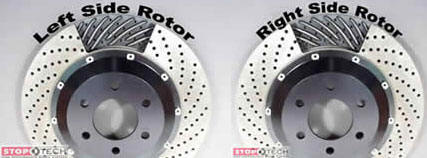
So in regards to curved internal vains, the concept is that you want the air to flow from the inside out with the vains directions, so the above oem J 55 rotors could be though of as being all for the left hand side of the car only
Now the glitch, and since both the left and right hand sides are both vained the same counter-clockwise directions on the OEM J55 rotors for both sides, when the OEM J55 rotors are mounted on the passenger side of the car (would be spinning clock wise as the car goes forward), they are thought to be vained backwards/incorrectly for the right hand side of the car isntead.
So although the OEM J55 rotor do work for their intended use of autocrossing and street use, ideally you want rotors set vained for a counter clockwise rotation front and back on the drivers side of the car (how they all come), and other side off the car set of rotors with the reverse vain direction-ed for clockwise rotation on the passanger side of the car instead (how the OEM Z06 rotors come, with one for the left hand side of the car, and the other for the right hand side).
Now so you don't have to play the left and right hand vain'g direction game per side game/have to produce two different directional vain rotors per front and back sets, you just vain the rotors with a straight, instead of curved vains, so they can be mounted on either side of the car instead.

Or in the case of the DBA 5000 series, unidirectional vain'g, which will turbine draw air better outwards than a straight vain design instead.

Last edited by Dano523; May 2, 2018 at 02:11 AM.

Race Director
Joined: Sep 2007
Posts: 16,557
Likes: 2,108
From: Peoria/Phoenix AZ
C6 of Year Finalist (performance mods) 2019
1. The rear rotors on the J55 brakes do not pull cooling air through the rotors like the fronts. Instead of drawing air from the interior side where the air duct provides fresh air, the rears draw air from the exterior side. The red painted rotors, clearly show the rears (the two at the top) have their air inlet on the wheel side. The rear air duct on the car is useless.
2. The base brakes (JL9) have no vanes, but are a round post style. The posts are placed in a pattern that centrifugally spins air outward, regardless of the direction the rotor is turning. They're similar to the photo of the DBA rotor in concept and the airflow inlet is on the interior side, both front and rear. The rear air duct provides cooling correctly.
3. Weight and diameter. The J55 rotors weigh 82# total, compared to 68# for the JL9's. That's primarily due to the diameters of each. The J55 front is 13.4" and rear at 13.0 vs the JL9 front at 12.8 and rear of 12.0. While a larger diameter has a longer lever from centerline to provide more force using the same pad size, the additional weight at the peripheral reduces both acceleration and deceleration abilities.
Unless you are planning to seriously track your car, all of the discussion about the differences in rotors won't affect you, since you'll never create enough heat to be a factor in performance, so you wont need the cooling ability either. If you want something a little better than stock for the street, just get better pads. The Carbotech 1521 will work as good as any street pad. Almost any pad, including the real low priced ones, will still stop your Vette quicker than 98% of the other cars on the street. I get more concerned in a panic stop situation about getting hit from behind, than hitting the car in front of me.
Check the diameter of your rear rotors. Most people who change to slotted rotors do it for appearance and retain the OEM size.
NOTE to Dano523:
VAIN means self admiring or futile, as in without success.
VANE is a stabilizing fin or blade, usually associated with air or fluid movement.
VEIN is a blood vessel or a distinctive style.

Race Director
Joined: Sep 2007
Posts: 16,557
Likes: 2,108
From: Peoria/Phoenix AZ
C6 of Year Finalist (performance mods) 2019
J55 brakes were part of the F55 option starting in 2007. They were also available as a stand-alone option on all years of C6 production base cars.
Thread Starter
Safety Car
Joined: Jan 2005
Posts: 3,675
Likes: 58
From: Hayward (Bay Area) CA
The front D55 calipers have the same size pistons as the base model. So the larger rotor/same caliper would increase front brake torque i.e move bias forward.
So you're saying the same caliper, same pads, but with the J55 (larger) rotor in the front would give better stopping?
The rear J55 calipers have a smaller piston than the base car. This compensates for the much larger rotor diameter to keep from adding too much rear bias.
Not sure how much difference that makes, but I would imagine that Base caliper having the bigger piston would have positive effects on the overall braking.
As far as pads - ceramic pads are primarily designed for low dust and better NVH characteristics. This is at least to some extent at the detriment feel, heat range and ability to take hard repeated use. As suggested - your pad choice has a far greater impact on performance rather than getting bigger rotors.
So you're saying the same caliper, same pads, but with the J55 (larger) rotor in the front would give better stopping?
The rear J55 calipers have a smaller piston than the base car. This compensates for the much larger rotor diameter to keep from adding too much rear bias.
Not sure how much difference that makes, but I would imagine that Base caliper having the bigger piston would have positive effects on the overall braking.
As far as pads - ceramic pads are primarily designed for low dust and better NVH characteristics. This is at least to some extent at the detriment feel, heat range and ability to take hard repeated use. As suggested - your pad choice has a far greater impact on performance rather than getting bigger rotors.
To answer some of the previously asked questions my goal is to improve the overall braking for street use & spirited driving in the hills. Although I may not take it to the track, it is worth having a much better braking than factory settings - this would be the 1st priority. As for the brake dust, I would like it also improved over the OEM pads, but it's 2nd priority. And finally, the price would be 3rd priority.
Burning Brakes

Joined: Jan 2017
Posts: 1,122
Likes: 199
From: TX
To answer some of the previously asked questions my goal is to improve the overall braking for street use & spirited driving in the hills. Although I may not take it to the track, it is worth having a much better braking than factory settings - this would be the 1st priority. As for the brake dust, I would like it also improved over the OEM pads, but it's 2nd priority. And finally, the price would be 3rd priority. Carbotech 1521 pads
Centric Stainless Steel Brake lines
ATE Typ 200 Brake fluid
Quite honestly this set-up will provide you with the goals you want. Spending the money on Z51 brake parts is just a waste IMHO. If you want to upgrade even more then go to a DBA 4000 series rotor or a 2-piece rotor. But the larger J55 brake size is going to provide a very marginal upgrade per dollar than going with some really nice rotors. Plus Z51 rotors cost more when they need to be replaced.
If you want to take it further then moving to a Wilwood 4 piston front brake caliper or the SSBC Tri-Power brake caliper are also options.
Safety Car
Joined: Jun 2017
Posts: 4,786
Likes: 425
From: North Georgia, USA
To answer some of the previously asked questions my goal is to improve the overall braking for street use & spirited driving in the hills. Although I may not take it to the track, it is worth having a much better braking than factory settings - this would be the 1st priority. As for the brake dust, I would like it also improved over the OEM pads, but it's 2nd priority. And finally, the price would be 3rd priority.  For fluid, look at the wet boiling point for street use as that's going to be more important than the dry boiling point unless you change the fluid often.
 If your rotors aren't worn, stock rotors plus better pads will work well. If you're rotors are worn, for street driving and spirited runs, "special rotors" mostly cost more. If you put money into the best pads you can get, the rotors won't matter.
As for stainless hoses, they look cool, and they are more rugged. Most of what people feel when they switch is the new brake fluid. If you religiously change the fluid every 2 or 3 years, you won't notice much difference with stainless lines. If you have 10+ year old brake fluid in it, put some fresh fluid in first and see if that firms everything up. Then, if you want, put the stainless lines on, but don't expect much improvement at the pedal from that.
Race Director
Joined: Sep 2007
Posts: 16,557
Likes: 2,108
From: Peoria/Phoenix AZ
C6 of Year Finalist (performance mods) 2019
To answer some of the previously asked questions my goal is to improve the overall braking for street use & spirited driving in the hills. Although I may not take it to the track, it is worth having a much better braking than factory settings - this would be the 1st priority. As for the brake dust, I would like it also improved over the OEM pads, but it's 2nd priority. And finally, the price would be 3rd priority. The front calipers are completely identical with J55 or JL9 brakes. The rear calipers are identical in physical size, but the J55 caliper has a smaller piston than the JL9 by 1/16" IIRC.
The reason for the smaller piston is that the rear rotor is larger percentage wise than is the front rotor when changing from JL9 to J55. (See my #3 comment on post #14 for sizes) It's a simple way to accomplish the same thing as changing a proportioning valve to get the correct front to rear bias. The importance of that is to have the rear braking power in correct relationship to the front braking power. It's not critical except in emergency maximum braking situations where the ABS system is engaged. Changing from JL9 to J55 rotors without changing rear calipers will result in having the rear brakes doing more work than previously. As a drag racer, I did the opposite and changed from J55 rotors to JL9 rotors for the lighter weight, but kept the J55 rear calipers. That meant the front brakes do a bigger percentage of the work and made it easier to do burnouts prior to staging.
Your biggest single improvement without a lot more dust is simply changing to the 1521 pads, so try that first.

Race Director
Joined: Nov 2003
Posts: 16,069
Likes: 4,152
From: Bergen county NJ
Are the brake pads with a 2008 z51 corvette the same size as the base model?
Are all rear brake pads the same size and fit?
If not what do I need to look for at the local advance auto part store..
They don't carry a lot of stock and I don't have time to ship etc..
Thanks
Are all rear brake pads the same size and fit?
If not what do I need to look for at the local advance auto part store..
They don't carry a lot of stock and I don't have time to ship etc..
Thanks