When you click on links to various merchants on this site and make a purchase, this can result in this site earning a commission. Affiliate programs and affiliations include, but are not limited to, the eBay Partner Network.
They do, and it’s called oil separators and baffles.
1. Its not a catch can if it doesn't catch and hold liquid. Obviously all engines have a baffle I mentioned keeping oil out of the baffle system many times. The key is to use those baffles how the factory intended. When the factory designed the baffle it was with a specific kinetic energy for separation of oil and gas. By installing catch cans, longer lines and larger volumes you ruin the kinetic energy supplied to the baffle and now the baffle cannot do its job and begins to fill with oil which eventually fills the catch devices you've added externally.
I have many posts on this and other forums where I detail exactly how baffle modifications are done and how to correctly incorporate additional baffle into vehicles which require one by connecting them to the oil pan for a oil return. Vehicles with excessive oil pooling in the head for example on some tracks require head modification for drainback or a baffle modification. But at the end of all these modifications is still the same thing: You must measure and re-set the crankcase pressure manually if its no good because of your mods, additional lines and crap which is extra friction. Assuming you actually installed the baffle on the correct side, that is, the wot side.
If I went to publish your data the review committee would laugh at me. It is useless unfortunately. There must be a control when performing some experiment to compare with. All tuners which add widebands to the vehicle must compare to the narrowband and gauge to the voltage offset during logging from an analog source to any ECU. Using a map sensor this way is no different. By neglected the sanity portion of data collection you have no control and therefore no credibility. I'm sorry but that is how data collecting works it must be verified. Even sensors are suspect, If you buy 3 different thermometers you will get 3 different temperatures. Useful data for publication would have 3x map sensors for a statistical sample group on the crankcase and 3x map sensors as a group for the control or atmosphere all on the same analog voltage and grounding for a level playing field. Groups are averaged and checked for normal distribution and then a statistical P-test may be applied and you can present quantitative data. Fortunately you don't need to publish the results in a journal you just need to convince a doctor/scientist on the internet by doing the experiment the way I showed which eliminates any analog offset contamination in the data collected.
1) Installed a rather cheap catch can in place of the U hose as we all know
2) Discovered a few drops on the floor (not sure ) since
3) Followed all the many theories and wondered if:
As shown in the pic, I built a very open air intake and went with a 1/4 inch fitting with solid hose to valve cover as shown...........
Is it possible that I am providing too much air to the crankcase??? Is the original air to valve cover metered in any way??
Too much air in with only a metered way out??
Simple add with a lot of opinions and all appreciated.........
1/4 inch is too small you may be pressurizing the crankcase causing oil to blow out. At least match the size of the valve cover fitting replace that 1/4". Whats the cover a 3/8"? You also need to rinse out the intake manifold with soap and water get all the oil you've blown in there out and replace the PCV valve. And if this is actually a performance vehicle it should get a compression test, and a intake pressure test as well, to see where the pressure goes and replace the parts that leak. For example your brand new pcv valve could be defective and you will never know unless you pressure test. And most of the GM versions of that pcv valve will leak especially aftermarket so it is critical if you don't want to blow oil out of the engine.
The LS engines do not have a 'PCV valve' .... just a metered orifice in the valley cover tube.
Some do Some do not. It is a general precaution and there is no harm in adding one provided you get the right one. I use two parallel twin turbo 1998 toyota supra PCV valve on my LS engine. But I am always forced inducted which absolutely requires a PCV valve whether there is an orifice or not. So you can preventative maintenance by adding a proper performance PCV valve to that line.
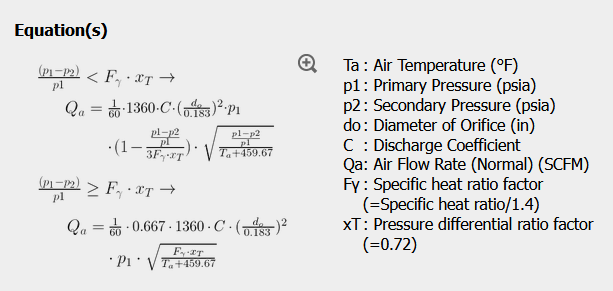
I calculated the flow rate of orifice in other threads. It is negligible flow rate for blow-by which means any oil in this line is due to other issues, not internal baffling of the valley cover for example. Flow rate is too low and gas density is too low.
Lets calculate the flow rate of a .100" diameter circular orifice with a pressure differential of 0psi crankcase to 18" Hg intake manifold pressure.
18" Hg is approx -8.8psi
If we assume a crankcase pressure near 0psi, 100*F air temp, .100" diameter orifice, -8.8psi intake pressure
and an online calculator, I get 1.65CFM @ .1" Diameter
6.6CFM @ .200" Diameter
At WOT when intake pressure is near -0.5PSI , I get .65CFM @ .1" Diameter
So, Negligible flow even with a .2" hole twice the size!
you do not realize that I know. I know whatever it is you think you are telling me, I already know. Ive done the math before you even considered there was any math. I've been doing this for 25 years and i have a doctorate. I am the top combustion gasoline engine tuner in the country. There is nobody not even the original engineers that can understand engines the way I do. Not as an individual.
You do not realize that I know. I know whatever it is you think you are telling me, I already know. Ive done the math before you even considered there was any math. I've been doing this for 25 years and i have a doctorate. I am the top combustion gasoline engine tuner in the country. There is nobody not even the original engineers that can understand engines the way I do. Not as an individual.
That's a real grandiose and braggart statement if I ever read one ...
Go continue to pat yourself on the back
______________________
Referring back to post #43 the hose from air intake to V/C is 3/8" my question is... was the original 1/4" metered in any way?
Since I believe all is installed correctly as shown I will perform the following tests (with motor running) !!
I will pull hose from valley to can & expect some pressure to can .. CORRECT?
Then re-attach and pull hose from can to intake manifold to assure air is flowing thru can....CORRECT?
While confirming suction @ intake to pull from can.................all this to make sure the flow of air & any crankcase oil is caught in can and fairly clean to intake...CORRECT?
I see this is a very controversial subject with lots of feedback and all is appreciated,
As a follow up I had 1'2 inch of oil in the catch can, then after checking all hoses & routing i was all good?? Then I added the vent filter to thecatch can and since that change I have had no measurable oil in can??? Did I cure this ?????? If not what's next????
Thanks to all in advance..........................
if the car originally came with an external pcv valve (made into the u-turn hose) that was not reused, that would explain the fast filling, as the pcv system was running unregulated (pretty bad)
adding the filter created a massive vacuum leak, and the pcv system no longer has that vacuum to power the system (even worse)
we have complete systems that are satisfaction guaranteed that take out the guesswork, frustration, and potential damage.
This vehicle did not have a PVC the driver side valve cover has a fixed plug at the rear with nothing connected in any way and the passenger side valve cover has a hose outlet with that hose running up to the air intake the u-shaped hose coming from the crankcase up to the throttle body was just a u-shaped hose I appreciate the response but I'm curious how the filter would create a vacuum leak? the car runs fine but since it did not have a PVC is there any other thoughts that might be applicable again I think everyone for their responses.
the hose from the valley goes to the intake manifold not the throttle body (goes behind the throttle blade to vacuum)
so if you hook an air filter up to that directly (on top of catch can, allowing air into the can), that would be a vacuum leak
if you have the regulated valley plate then you are good, i would double check that by taking off the oil cap, and this hose and blowing into it, should be very hard to blow into
Yes, I meant to say from the valley to the intake behind the throttle body. What I have is a hose from the valley to the inlet on the catch can and a hose from the outlet to the intake behind the throttle body as you mentioned, then the hose which sits between the math and the throttle body goes over to the passenger side valve cover as it was from the factory. I do believe all I simply did was interrupt what do you shaped hose did installing the catch can the flow is identical my surprise was how little to no oil was accumulated after I simply added the little vented filter on top of the catch can in place of the solid block. I'm only guessing that that vent allows for some escape but otherwise I'm not sure if I fixed it or if I still need more guidance?
Thanks again
If you added a breather to the catch can that is in-line between the valley and the intake manifold, air is going to be pulled into the intake manifold through that vent.
It would result in less oil in the can because the intake manifold used to be pulling air from the crankcase, through the hose and catch can and into the intake. Now the intake is pulling air from the engine bay, through the vent and into the intake manifold.
putting vacuum on the crankcase is a good thing - better sealing, more power…. But ingesting oil into the motor is not. So separating and catching the oil before it goes into the intake and then the cylinders is a very good thing.
putting a good catch can between the valley and the intake is wonderful but keep it a closed system
Thank you both for your input, this car does not come with a PCV and the vent sacrifice seems acceptable?? If I go back to no vent and see oil in the can and hopefully no oil drops on floor, is that best ? I realize a stock 150K motor may have some blow by. LOL but I was hoping the can could help as I play without killing the engine...?
Thank you both for your input, this car does not come with a PCV and the vent sacrifice seems acceptable?? If I go back to no vent and see oil in the can and hopefully no oil drops on floor, is that best ? I realize a stock 150K motor may have some blow by. LOL but I was hoping the can could help as I play without killing the engine...?
if you run no vent, have a closed system and no oil in the intake, that’s about as good as it gets before running a vacuum pump.
a vacuum on your crank case will help the rings seal and help mitigate blowby.
I’ve read that you can run as much vacuum as you can run before you start compromising seals so don’t worry about too much vacuum without a dedicated pump.
I believe the MM system with the vent will allow pressure to exit through the vent but not pull air into the can through it. So you wouldn’t have the problem of unmetered air entering the intake.