When you click on links to various merchants on this site and make a purchase, this can result in this site earning a commission. Affiliate programs and affiliations include, but are not limited to, the eBay Partner Network.
The purpose of your side mirrors is to be able to see the "blind spots" of the car. If you have it adjusted to see anything else, you're doing it wrong. You shouldn't be able to see the sides of your car without leaning your head all way out to the threshold of your window.
I understand what you are saying but I don't think that blind spots are entirely the only reason for side mirrors. They do assist with backing up. Yes, we now have cameras however IMO there is no substitute for a side mirror when backing into a garage. I may not want to stick my head way out of the window just to see the garage door jamb.
As I said it's hard to get a camera to match exactly what I see! I have been setting my mirrors per the 1995 SAE tech paper for many years. This is NOT something new as some have just discovered. My car is red, your looking at a bush and a plant branch IMO. Look in the small blind spot mirror and see what the left rear of a red corvette looks like! You'll also see the right rear of my '34 PoStreet Rod.
It seems to work quite well on the drivers side mirror. How much more of a view do the oval mirrors show on the passenger side mirror which already is convex?
To see the narrow area behind both rear fenders, called a “blind spot” the extra mirror is not needed on the passenger side when that mirror is set "properly!" It is convex so you also get a wider view. But staying out of trouble requires more than just setting your mirrors so you see these spots! In fact the suggested method some site with that graphic was outlined in an SAE (Society of Automotive Engineers) ~1995 tech paper. It covers more than seeing those two spots. Basically you need to see all the cars around you and check all mirrors continually. But as it notes, that requires a wide view from the rear center mirror. I’ve been using that method for many years and still think blind spot mirrors are useful on the C7. But some posters just don’t understand the issues or apparently even read or understand the text on the right side of the graphic posted!
Since the blind spot mirrors come in a package of two, I installed both. In 2 ½ years I now find them both useful. I’ll explain:
I find them most useful on the Interstate. I typically have the car set on cruise control at ~8 mph over the speed limit traveling in the center of 3 lanes. I also hate to travel next to an 18 wheeler as have had one throw a rock and put a pit in my windshield when I first got my C7. It was low near the wiper and a fix kit filled the pit. But now I accelerate past them for the shortest exposure to them and radar! We have lots of rolling troupers and speed traps where I travel going into town!
The other major 18 wheeler problem is tire treads in the road! When they come up there is little time to react and no time to turn my head! We have many folks barreling down the right lane trying to use other cars in attempt to avoid radar. If I have been looking at my right blind side mirror and nothing is visible I have the option of swerving to the right lane to avoid hitting tire treads when there is traffic blocking me from turning into the left lane.
In fact the wife has an 5X BMW SUV. On long trips and when it's raining I drive it! It has blind spot detection, lane change warning (which I like, it vibrates the steering wheel) as well as auto braking (which I have never had activate but have had the red vehicle warning light come on the center display when someone cut in front to close. In fact if your foot is on the brake it will not automatically brake the car.
However the BMW blind spot detection only gives you warning IF the cars on either side are close and truly in your blind spots. It doesn’t say there is a car barreling down at over 90 mph and it will be in your "blind spot" in 3 seconds so be careful! Watching all the mirrors gives you that perspective and you're prepared if it’s necessary to change lanes very quickly.
As I said in another post, I attribute never having an accident with another car in over 50 years of driving to luck and knowing where all cars are around me. The blind spot mirrors help with the latter, especially in the C7.
If you have macular degeneration you will definitely have a blind spot. No mirror or adjustment will help!
(And yes I'm acutely sensitive to the issue as my dad had macular degeneration for over 20 years).
Last edited by Crossed Flags Fan; May 29, 2016 at 08:38 PM.
An interesting thread. Perhaps my mirrors are not adjusted properly as I've had instances when a vehicle was nearly next to me and I could not see it.
Personally, I think the vert has terrible visibility around it. It's important to be highly vigilant of cars behind you, and to always look twice. Or maybe three times, especially at night when there is much fast traffic, as on a crowded interstate.
Like I said about 50 times, I don't think I need them, I say they make me more accurately ascertain that there's nothing in the blind spot. Which exists.
From: In a parallel universe. Currently own 2014 Stingray Coupe.
C7 of the Year - Modified Finalist 2021
MO Events Coordinator
St. Jude Co-Organizer
St. Jude Donor '03 thru '26
NCM Sinkhole Donor
CI 5, 8 & 11 Veteran
Originally Posted by AlexRD
Like I said about 50 times, I don't think I need them, I say they make me more accurately ascertain that there's nothing in the blind spot. Which exists.
For those that say there is no need for them, that's your preference and nothing wrong with that. But after having them now for a year on my DD, they do provide an extra layer of safety and are very nice to have. It would not bother me at all if the blind spot warnings were made available as an option on the Vette.
EU mirrors are bigger (glass size 120mm x 180mm) and is partly convex like on the Acura so it should be an easy fix to replace if they are available in the US.
This guy has the Euro convex glass to replace the existing mirror. Here's his email: TrygveS@aol.com
I think in many cars/suv's even with the "correct" adjustment to both sideview mirrors, there may still be some blindspot. Maybe not for everyone, but I've had it. And I've driven up next to very small parked cars to test where it is. For that reason, and as JerryU states, there are some instances when you just don't have time to turn your head to the right--you need a quick side glance to see what's there, or else stuff will happen.
And JerryU highlights some of the means to at least partially alleviate or eliminate that condition of no time to look and a possible blindspot. Of course, the old "Wink" mirrors (originally used in road racing) attached to the windshield and the more recent Autobahn attached at a corner work, too, and quite well.
Just had the windshield replaced on my C7. I got a Chevy cruze, one of the dealerships courtesy cars. It had blindspot warning indicators in the outside mirrors. If Chevy can put them in the cruze why not corvettes?
When adjusted properly, I have no problem in my C7 see along the driver's side. Interesting that was the same for my 2011 Ford Taurus also with a single flat mirror. But then for my 2014 Ford Taurus that changed to what you see below, and it's not a stick on. I guess Ford felt the need was there. I do like the added view provided.
Interesting topic. I typically turn my head to validate theres nothing in my blind spot which works well but can see how this could be helpful especially on the passenger side where the problem seems to be increased. I never had any close calls but I do remember sating to myself "Im glad I turned my head" or that could have been bad.
The problem is that many other drivers just sit in the blind spot watching the car as we roll down the highways and often times we don't even realize they are there. Most of the new cars have the electronic versions of the blind spot warnings which I think is very cool. (Wife has on her 2015 Durango RT.) Just my 2 cents...
Here is what I found..Adjust both side mirrors to your satisfaction, then when looking to merge or change lanes I lean forward and can see a veh in my blind spot..Just try doing this while driving,,you see the car catching up in say the left lane and wait until you lose sight of the car, then lean forward and look in the mirror and you will see it again..
Roll-up left window, place the left side of your head up against the side glass and adjust the driver side mirror inward until you can just see the side of your car.
Now move your head over your center console (right eye centered with rear view mirror) and adjust right mirror in just enough to see the side of the car.
Adjust the center rear view mirror to see squarely out the center of the rear glass.
Now drive out on a multi-lane road a little slower than the surrounding traffic and follow the cars in your mirrors as they go by on each side. You will find that you can follow the car in the rear view mirror, then to the side mirror and the just as the car starts to move out of the side mirror it will become visible in your side vision.
The mirrors will feel awkward for a while until you get use to having them adjusted this way. Once you get use to it, you will be amazed at the coverage.
All my cars are adjusted this way for some time now. It takes some serious getting used to but works if you do exactly as you explained.
Here is what I found..Adjust both side mirrors to your satisfaction, then when looking to merge or change lanes I lean forward and can see a veh in my blind spot..Just try doing this while driving,,you see the car catching up in say the left lane and wait until you lose sight of the car, then lean forward and look in the mirror and you will see it again..
Jerry in Minnesota.
Jerry, I think with the stock mirrors, this should be SOP. I took some time, after reading this thread to adjust my mirrors, and it made a huge difference. And all the time, I thought I had them adjusted correctly, LOL
Still, leaning forward a bit, and giving a quick look is pretty critical, especially on the passenger side, in heavy, fast traffic (Read motorcycles splitting lanes) before initiating the lane change.
I adjust my mirrors in a way that works best for me, and it is slightly different for my different vehicles. I shoot for what makes me safest, not what others think I need.
In the state of Oregon, a driver will not pass his driving exam if he does not physically turn his head to check what the DMV considers a blind spot before changing lanes. That is not simply a subjective call by the examiner; it is specifically stated in the Oregon DMV Rules of the Road that "Side mirrors do not eliminate 'blind' spots so drivers should look over their shoulder before changing lanes."
Even with the little spot mirrors or electronic blind spot monitors, the requirement still exists to physically check. It is the driver relying blindly on his insistence that his knowledge of driving makes him perfect who presents the greatest danger on the road.
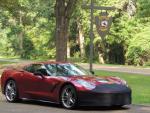
Designer Imagines A Corvette That Looks More Like a Corvette Than the Corvette
Slideshow: A Jaguar designer's personal project imagines what a modern front-engined Corvette might look like if Chevrolet revisited the golden age of the Stingray.



























 For those that say there is no need for them, that's your preference and nothing wrong with that. But after having them now for a year on my DD, they do provide an extra layer of safety and are very nice to have. It would not bother me at all if the blind spot warnings were made available as an option on the Vette.