




Orange Peel Paint
Racer

Joined: Oct 2015
Posts: 434
Likes: 121
From: Allen Tx

It's completely normal.......so is wheel click.......don't set your seat to it furthest back position......these things gm has conditioned us to accept as "normal" lol.....but we still wouldn't trade them

Drifting


Joined: Jan 2005
Posts: 1,556
Likes: 276
From: Marshall Texas
As I just posted on Z forum, I'll repeat my guesses/observation. Orange peel occurs when the paint doesn't have enough time to "flow" & level out before it hardens. Much on the net speculates this has alot to do with U.S. EPA restricting the solid (paint) to solvent (liquid) ratio. Overseas not as much strict control (yet) on the solvent pollution problem. A new standard is gaining traction here using waterborne paint (many collision repair shops have switched). I wonder if the new paint dept for Vettes will be of the waterborne process.


Burning Brakes


Joined: Apr 2014
Posts: 854
Likes: 302
If the "EPA" was to blame, ALL cars would exhibit OP this bad. They don't. If I look at the Crystal red on a GM SUV and compare it to my Vette, the SUV's paint is much smoother.....hell, OP even varies Vette to Vette in the same color...

Thread Starter
Advanced
Joined: Nov 2012
Posts: 59
Likes: 31
OK I now understand the popcorn thing. The orange peel thing bugs me, to the point that I was willing to pay for buffing or another way to have a better finish. Seems I'd just be asking for more trouble, without much chance for improvement.
It's nice to have access to so many experienced opinions here, thanks. The C-7 is so nice in so many ways, I'll accept the orange peel and won't risk making things worse trying to make the finish better.
Funny thing, my neighbor has a Mercedes AMG GT, in the matte finish. He paid lots and intentially choose matte paint that to me isn't as nice as my orange peel.
Still wish that buffing thing would have worked.
It's nice to have access to so many experienced opinions here, thanks. The C-7 is so nice in so many ways, I'll accept the orange peel and won't risk making things worse trying to make the finish better.
Funny thing, my neighbor has a Mercedes AMG GT, in the matte finish. He paid lots and intentially choose matte paint that to me isn't as nice as my orange peel.
Still wish that buffing thing would have worked.
Melting Slicks


Joined: Aug 2016
Posts: 2,762
Likes: 1,017
From: MOUNTAIN HOME Arkansas
 The precise mix of paint (solid) to liquid (solvent) allowing consistent flow rate to even out paint highs/lows is paramount, which is what peel is.
Instructor

Joined: Sep 2016
Posts: 131
Likes: 53
Solution?
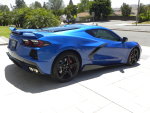
I noticed a little orange peel in my Laguna Blue Z51 when I took it home. I called Dave at Innovative Detailing in Tustin. He offers a solution to the paint issue. It is paint correction. I took it to him and he performed the service and my car looks like it should. Not cheap but awesome. 
Last edited by lagunabluez51; Aug 5, 2017 at 10:44 AM.
Melting Slicks
Joined: Aug 2016
Posts: 2,762
Likes: 1,017
From: MOUNTAIN HOME Arkansas
OK I now understand the popcorn thing. The orange peel thing bugs me, to the point that I was willing to pay for buffing or another way to have a better finish. Seems I'd just be asking for more trouble, without much chance for improvement.
It's nice to have access to so many experienced opinions here, thanks. The C-7 is so nice in so many ways, I'll accept the orange peel and won't risk making things worse trying to make the finish better.
Funny thing, my neighbor has a Mercedes AMG GT, in the matte finish. He paid lots and intentially choose matte paint that to me isn't as nice as my orange peel.
Still wish that buffing thing would have worked.
It's nice to have access to so many experienced opinions here, thanks. The C-7 is so nice in so many ways, I'll accept the orange peel and won't risk making things worse trying to make the finish better.
Funny thing, my neighbor has a Mercedes AMG GT, in the matte finish. He paid lots and intentially choose matte paint that to me isn't as nice as my orange peel.
Still wish that buffing thing would have worked.
Corvette Stories
The Best of Corvette for Corvette Enthusiasts

Top 10 Most Expensive Corvettes Ever Sold on Bring A Trailer
Brett Foote
10 Things Every Corvette Owner Needs (2026 Edition)
Michael S. Palmer
8 Most "Only Corvette Owners Understand" Quirks and Problems
Pouria Savadkouei
10 Reasons the C6 Z06 is Still A Performance Benchmark After 20 Years
Joe Kucinski
How Much Horsepower Every Corvette Engine "LOST" in 1972
Joe Kucinski
Top 10 DOs and DON'Ts for Protecting Your Convertible Top!
Michael S. Palmer
Top 10 Most Explosive Corvettes Ever Made: Power-to-Weight Ratio Ranked!
Joe Kucinski
150 hp to 1,250 hp: Every Corvette Generation Compared by the Specs That Matter
Joe Kucinski
8 Coolest Corvette Pace Cars (and Replicas) of All Time
Verdad Gallardo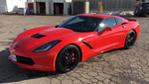
Race Director


Joined: May 2001
Posts: 15,324
Likes: 2,077
From: Guelph, Ontario
When I had my black C5 I literally spent dozens and dozens of hours going over the finish with my buffer trying to get the paint as perfect as can be and in the end I came to the realization that it's a never ending battle that you just can't win. When you see your car from 10-15 feet away you can't even see the flaws! So I've just learned to accept it. When I got my C6 it did have quite a few scratches and swirls but I have only spent maybe 10 hours in total with the buffer and have just left it at that. When I order my Torch Red 2018 next year there is a good chance it could be painted in the new shop, but if it isn't, I'm not going to lose any sleep over it. The new Torch Red cars I've seen on the lots so far look pretty good to me already, with an acceptable amount of orange peel.

Pro

Joined: Dec 2000
Posts: 722
Likes: 342
From: Vancouver British Columbia
A Solution is in the Works....
Went to a local high end detailing shop as I wanted to know what could be done. They did a test panel (the carbon flash metallic section by the rear license plate). I did a few photos:

Here is the panel before the repair:

Here is a side by side comparing the left side repaired with the right side unchanged:

The detailing shop does not use wet sanding to remove orange peel as they do not believe they have enough control over the amount of clear coat removed.
These were presented to dealer who contacted GM regional rep and quickly authorized paint correction to car and issued a PO to my detailing shop. Car is booked for repair mid August.
I am pleased with the quick response from my dealer. I will post a detailed update after the repair is done.
Jacob
Here is the panel before the repair:
Here is a side by side comparing the left side repaired with the right side unchanged:
The detailing shop does not use wet sanding to remove orange peel as they do not believe they have enough control over the amount of clear coat removed.
These were presented to dealer who contacted GM regional rep and quickly authorized paint correction to car and issued a PO to my detailing shop. Car is booked for repair mid August.
I am pleased with the quick response from my dealer. I will post a detailed update after the repair is done.
Jacob
Last edited by Jacob; Aug 5, 2017 at 11:44 AM.


Team Owner


Joined: Oct 2004
Posts: 25,583
Likes: 16,942
As I just posted on Z forum, I'll repeat my guesses/observation. Orange peel occurs when the paint doesn't have enough time to "flow" & level out before it hardens. Much on the net speculates this has alot to do with U.S. EPA restricting the solid (paint) to solvent (liquid) ratio. Overseas not as much strict control (yet) on the solvent pollution problem. A new standard is gaining traction here using waterborne paint (many collision repair shops have switched). I wonder if the new paint dept for Vettes will be of the waterborne process.
Virtually everyone, including body shops, have been using waterborne paints almost exclusively for many years now. That's about the only automotive paint available these days. Since all vehicles have been painted with waterborne solvents for many years, the only way the body shop is going to match it is with the same waterborne product.
Last edited by Foosh; Aug 5, 2017 at 12:10 PM.
Burning Brakes

Joined: May 2017
Posts: 802
Likes: 248
From: Vero Beach Florida
As I just posted on Z forum, I'll repeat my guesses/observation. Orange peel occurs when the paint doesn't have enough time to "flow" & level out before it hardens. Much on the net speculates this has alot to do with U.S. EPA restricting the solid (paint) to solvent (liquid) ratio. Overseas not as much strict control (yet) on the solvent pollution problem. A new standard is gaining traction here using waterborne paint (many collision repair shops have switched). I wonder if the new paint dept for Vettes will be of the waterborne process.

Le Mans Master

Joined: Sep 2013
Posts: 7,137
Likes: 3,176
From: Kannapolis MA.
Staying Tuned

Pro
Joined: Dec 2000
Posts: 722
Likes: 342
From: Vancouver British Columbia
Melting Slicks
Joined: Aug 2016
Posts: 2,762
Likes: 1,017
From: MOUNTAIN HOME Arkansas
Jacob, just curious but why did they use that panel instead of inconspicuous spot of your blue paint to show difference? I would imagine the "real" car paint would show an even more dramatic improvement. Also, are they saying its the clear coat that has highs/lows that need to be leveled by polishing/not actual base coat (paint)?
Last edited by madrob2020; Aug 5, 2017 at 12:21 PM.
Pro
Joined: Dec 2000
Posts: 722
Likes: 342
From: Vancouver British Columbia
Jacob, just curious but why did they use that panel instead of inconspicuous spot of your blue paint to show difference? I would imagine the "real" car paint would show an even more dramatic improvement. Also, are they saying its the clear coat that has highs/lows that need to be leveled by polishing/not actual base coat (paint)?
1. That is the worst section of orange peel on the car, and I figured if they could fix that, they could fix the body coloured panels with less serious peel.
2. Since this detailing shop was new to me and untested, I wanted to limit my exposure to an inconspicuous section in case they screwed up.
The paint correction is to the clear coat, not the base. The proprietor explained that with the rotary pad, the idea is to remove to the tops of the peel without removing any clear in the valleys. I do not anticipate they will remove all of the peel, but enough to render a decent looking outcome. They do measure the paint thickness prior to starting the correction process. My Ford RS (Germany) averaged about 200 microns, with about 50 microns of base coat and 150 microns of clear coat. It has peel but not excessive peel.
I first learned of this shop from a Porsche 996 owner who had good experience with them on 3 of his cars.
Last edited by Jacob; Aug 5, 2017 at 01:08 PM.
Instructor
Joined: Sep 2007
Posts: 188
Likes: 14
From: San Diego CA
For what it's worth, I had a BMW and a C6 which were both used as daily drivers to work. Over 15k miles a year.
Same route, both cars. After 8 years the BMW looked like it had been sandblasted. After almost 10 years, the C6 paint looked perfect.
Got a C7 now, and no more work.
Same route, both cars. After 8 years the BMW looked like it had been sandblasted. After almost 10 years, the C6 paint looked perfect.
Got a C7 now, and no more work.
Le Mans Master
Joined: Sep 2013
Posts: 7,137
Likes: 3,176
From: Kannapolis MA.
Pro
Joined: Dec 2000
Posts: 722
Likes: 342
From: Vancouver British Columbia