



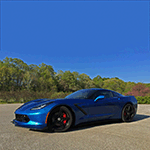

Halltech C7 Stingray

Thread Starter
Supporting Vendor


Joined: Mar 2002
Posts: 13,099
Likes: 672
From: Bristol, Tennessee
St. Jude Donor '09

Supposedly today. Banks closed, so I expect it in a day or so.
__________________

"World Class Performance for your Corvette"
Intake Design and Engineering since 1999
Halltech Systems, LLC
423-915-6056
For service email:
orders@halltechsystems.com
www.halltechsystems.com
"World Class Performance for your Corvette"
Intake Design and Engineering since 1999
Halltech Systems, LLC
423-915-6056
For service email:
orders@halltechsystems.com
www.halltechsystems.com
Thread Starter
Supporting Vendor
Joined: Mar 2002
Posts: 13,099
Likes: 672
From: Bristol, Tennessee
St. Jude Donor '09
Thread Starter
Supporting Vendor
Joined: Mar 2002
Posts: 13,099
Likes: 672
From: Bristol, Tennessee
St. Jude Donor '09
I can't bring myself to sell it. 5 years of work produced a car like no other. The right offer will come someday without my advertising it.
Imagine bolts and nuts that cannot be seen made of titanium, lightening parts where no one would expect. Molds that were made just for this car to sport carbon fiber in areas no one else would ever go. Aluminum honeycomb torque plates, with titanium bolts, covering a carbon fiber driveshaft, feeding behind a 28lb. triple clutch, feathering the power of 700+ Katech e85 horses.
Carbon fiber wheels with Carbon Ceramic brakes, titanium caliper bolts, with featherlight coil overs, and even titanium brake bleeders and lug nuts. Cost per wheel/brake/shock $7500
Even the latest Porsche 918 lugs (King of Nurburgring) around more weight/hp than our ULZ700.
Now our new C7 comes 260 lbs heavier, and less horsepower than were we started in 2008. 7.53lbs/hp vs. 3.98lbs/hp.
Imagine bolts and nuts that cannot be seen made of titanium, lightening parts where no one would expect. Molds that were made just for this car to sport carbon fiber in areas no one else would ever go. Aluminum honeycomb torque plates, with titanium bolts, covering a carbon fiber driveshaft, feeding behind a 28lb. triple clutch, feathering the power of 700+ Katech e85 horses.
Carbon fiber wheels with Carbon Ceramic brakes, titanium caliper bolts, with featherlight coil overs, and even titanium brake bleeders and lug nuts. Cost per wheel/brake/shock $7500
Even the latest Porsche 918 lugs (King of Nurburgring) around more weight/hp than our ULZ700.
Now our new C7 comes 260 lbs heavier, and less horsepower than were we started in 2008.
7.53lbs/hp vs. 3.98lbs/hp.
Last edited by Halltech; Oct 14, 2013 at 11:31 PM.

Safety Car


Joined: Oct 2007
Posts: 3,987
Likes: 20
From: Miami Fl.
St. Jude Donor '09
Right, I'm still disappoint (not a whole lot but some) about the weight of the car BUT... all the extra niceties add weight so its somewhat acceptable.
HOWEVER, I've been looking at areas as to where weight can be taken out without going "halltech-krazy" .. know what I mean?!
HOWEVER, I've been looking at areas as to where weight can be taken out without going "halltech-krazy" .. know what I mean?!
Thread Starter
Supporting Vendor
Joined: Mar 2002
Posts: 13,099
Likes: 672
From: Bristol, Tennessee
St. Jude Donor '09
Right, I'm still disappoint (not a whole lot but some) about the weight of the car BUT... all the extra niceties add weight so its somewhat acceptable.
HOWEVER, I've been looking at areas as to where weight can be taken out without going "halltech-krazy" .. know what I mean?!
HOWEVER, I've been looking at areas as to where weight can be taken out without going "halltech-krazy" .. know what I mean?!
Picked up our Laguna Blue Z51 today. My opinion of the car has changed. The rear end will look much better when we are finished with our carbon fiber touch.
Now forward with the intake.
Thread Starter
Supporting Vendor
Joined: Mar 2002
Posts: 13,099
Likes: 672
From: Bristol, Tennessee
St. Jude Donor '09
Oil Capacity
I noticed in the Owners manual that the oil capacity has changed on the Z51 from 10.3 quarts to 9.8 quarts.
We have ordered 24 quarts of OIL EXTREME 5W30, which we want to get into our crankcase asap. Amazing Oil.
We have ordered 24 quarts of OIL EXTREME 5W30, which we want to get into our crankcase asap. Amazing Oil.
Corvette Stories
The Best of Corvette for Corvette Enthusiasts

Top 10 Most Expensive Corvettes Ever Sold on Bring A Trailer
Brett Foote
10 Things Every Corvette Owner Needs (2026 Edition)
Michael S. Palmer
8 Most "Only Corvette Owners Understand" Quirks and Problems
Pouria Savadkouei
10 Reasons the C6 Z06 is Still A Performance Benchmark After 20 Years
Joe Kucinski
How Much Horsepower Every Corvette Engine "LOST" in 1972
Joe Kucinski
Top 10 DOs and DON'Ts for Protecting Your Convertible Top!
Michael S. Palmer
Top 10 Most Explosive Corvettes Ever Made: Power-to-Weight Ratio Ranked!
Joe Kucinski
150 hp to 1,250 hp: Every Corvette Generation Compared by the Specs That Matter
Joe Kucinski
8 Coolest Corvette Pace Cars (and Replicas) of All Time
Verdad Gallardo
Thread Starter
Supporting Vendor
Joined: Mar 2002
Posts: 13,099
Likes: 672
From: Bristol, Tennessee
St. Jude Donor '09
Drove it like a grannie at first today, and when I got tired of the V4 to V8 mode switching, (I can definitely feel the car stumbling during transition between modes), I decided to put it into Track mode, double tap the TC button and let her rip! Crap, what a ride!! I am impressed. Feels like our old CTS-V when we first bought it, prior to the 770 HP mods.
In fact, the automatic hits like the crack of a bat in a home run shifting through the gears. BAMM!
We have the intake off, and our prototype getting ready for prime time. We are going to have it ready sooner than anticipated. The prototype will be done tomorrow. A copy of what Katech is putting on the engine dyno.
Once we get full testing done, our molds can go forward. Bolt on power, with perfect long term fuel trims and power throughout all the gears. We should see a baseline around 395 to 400 RWHP, since we are running an A-6.
We plan to drive to Michigan for our dyno testing, since that is where all the engine and chassis dynos will be validated.

Headers will not be part of the diet at first, we may be making our own next year. Hard to believe much time and effort was put into the headers already out there, but they certainly have the numbers so far. Can't wait to see someone dyno them without a homemade intake in the mix.
The next step will be the rear end project with our molds cooking next month.
Last edited by Halltech; Oct 17, 2013 at 10:01 PM.


Safety Car
Joined: Oct 2007
Posts: 3,987
Likes: 20
From: Miami Fl.
St. Jude Donor '09
Here's an idea... Why not also try painting the lower bumper area the same as the body as well as the surround around the tail lights.
I think that'll be enough to smooth out the rear.
I think that'll be enough to smooth out the rear.
Thread Starter
Supporting Vendor
Joined: Mar 2002
Posts: 13,099
Likes: 672
From: Bristol, Tennessee
St. Jude Donor '09
Initial Engine Dyno testing by Katech
Red is the stock airbox on the engine dyno (Katech Cell 2) and Black is the Halltech Stinger Alpha Prototype.
+13HP/8lbs-ft STP Correction. 500 HP/486lbs/ft torque on the Katech dyno vs. stock.
I am sure we will see 15 HP once our Beta Prototype is done. The velocity stack will be longer for high rpm performance, and we will have our CKN (Carbon, Kevlar, Nomex) technology at work.
Why this will make a difference? The stock airbox is in the direct path of the bottom of the radiator, which will super-heat the intake, especially sitting at a stop light for 45 seconds to a minute. We noted that even on the road at 65 mph the IATs we +10 degrees hotter than ambient. Our Super Bee on the C6 sees IAT and OAT parity, which means that 10 degrees of IAT subtracts 1% power from air density loss, and if the IAT go over 86F timing is pulled by the ECM. Those two events could spell up to 5% loss of power from heat alone.

+13HP/8lbs-ft STP Correction. 500 HP/486lbs/ft torque on the Katech dyno vs. stock.
I am sure we will see 15 HP once our Beta Prototype is done. The velocity stack will be longer for high rpm performance, and we will have our CKN (Carbon, Kevlar, Nomex) technology at work.
Why this will make a difference? The stock airbox is in the direct path of the bottom of the radiator, which will super-heat the intake, especially sitting at a stop light for 45 seconds to a minute. We noted that even on the road at 65 mph the IATs we +10 degrees hotter than ambient. Our Super Bee on the C6 sees IAT and OAT parity, which means that 10 degrees of IAT subtracts 1% power from air density loss, and if the IAT go over 86F timing is pulled by the ECM. Those two events could spell up to 5% loss of power from heat alone.

Le Mans Master


Joined: Sep 2004
Posts: 7,978
Likes: 1,854
From: North/Central NJ - a.k.a. Gotti in the CFNE section
St. Jude Donor '05
is 13 hp / 8 tq untuned? If so are you going to tune for the intake? I am curious on the numbers for an intake + tune package.
Thread Starter
Supporting Vendor
Joined: Mar 2002
Posts: 13,099
Likes: 672
From: Bristol, Tennessee
St. Jude Donor '09
GM is running 13.1:1 air fuel ratio in OL, which is already super lean, so leaning the mix out would be counterproductive. We want to first get the intake perfected before we look at tuning.
I suspect a complete package, with headers, and tuning will be coming very soon from Halltech and Katech. Katech will handle the cam, springs, and heads.

Team Owner

Joined: Sep 1999
Posts: 41,732
Likes: 1,718
From: Springfield MO
I'm having a problem with the graph. The LT1 is SAE certified at 460 HP at the flywheel, yet the graph shows ~487 HP.
Sounds like a very happy dyno. I realize that you are speaking about the delta between the stock air breather and yours, but unfortunately some people will look at that dyno sheet an run like crazy with it proclaiming they were right all along and GM was sandbagging with it's horsepower, which isn't true.
Sounds like a very happy dyno. I realize that you are speaking about the delta between the stock air breather and yours, but unfortunately some people will look at that dyno sheet an run like crazy with it proclaiming they were right all along and GM was sandbagging with it's horsepower, which isn't true.

Le Mans Master

Joined: Jul 2000
Posts: 6,559
Likes: 4,501
From: North Dallas 40 TX
I'm having a problem with the graph. The LT1 is SAE certified at 460 HP at the flywheel, yet the graph shows ~487 HP.
Sounds like a very happy dyno. I realize that you are speaking about the delta between the stock air breather and yours, but unfortunately some people will look at that dyno sheet an run like crazy with it proclaiming they were right all along and GM was sandbagging with it's horsepower, which isn't true.
Sounds like a very happy dyno. I realize that you are speaking about the delta between the stock air breather and yours, but unfortunately some people will look at that dyno sheet an run like crazy with it proclaiming they were right all along and GM was sandbagging with it's horsepower, which isn't true.
The 460 HP is based on different air temperature and pressure.
Thread Starter
Supporting Vendor
Joined: Mar 2002
Posts: 13,099
Likes: 672
From: Bristol, Tennessee
St. Jude Donor '09
SAE correction is what was used by The SAE folks
The Katech dyno cell #2 is the same dyno used to validate GMs LSX motors from the past. I think it is pretty accurate.
Different correction factors based on different standards.
SAE J1349 correction:
29.23 in/hg.
77 degree temp
0 percent humidity
Standard STP correction:
29.92 in/hg.
68 degree temp
0 percent humidity
C2-10133
SAE 464/457 (Stock)
STP 487/478 (Stock)
C2-10138
SAE 476/464 (Halltech prototype)
STP 500/486 (Halltech prototype)
The STP correction has been used by most engine builders for many years.
Different correction factors based on different standards.
SAE J1349 correction:
29.23 in/hg.
77 degree temp
0 percent humidity
Standard STP correction:
29.92 in/hg.
68 degree temp
0 percent humidity
C2-10133
SAE 464/457 (Stock)
STP 487/478 (Stock)
C2-10138
SAE 476/464 (Halltech prototype)
STP 500/486 (Halltech prototype)
The STP correction has been used by most engine builders for many years.


Thread Starter
Supporting Vendor
Joined: Mar 2002
Posts: 13,099
Likes: 672
From: Bristol, Tennessee
St. Jude Donor '09
For those that need everything, here are the actual SAE Certified Numbers done by SAE in May, 13, 2013
Measured Output with performance exhaust: 459.06 HP @ 5999 (GM Rated at 460 HP @ 6,000 rpm)
462.44 lb-ft @4600 rpm (GM rated at 465 HP)
Katech dyno stock SAE J1347: 464 HP/457 lb-ft
Halltech prototype SAE J1347: 476 HP/ 464 lb-ft
Measured Output with performance exhaust: 459.06 HP @ 5999 (GM Rated at 460 HP @ 6,000 rpm)
462.44 lb-ft @4600 rpm (GM rated at 465 HP)
Katech dyno stock SAE J1347: 464 HP/457 lb-ft
Halltech prototype SAE J1347: 476 HP/ 464 lb-ft
Last edited by Halltech; Oct 18, 2013 at 07:31 AM.