When you click on links to various merchants on this site and make a purchase, this can result in this site earning a commission. Affiliate programs and affiliations include, but are not limited to, the eBay Partner Network.
I've looked around some, but really haven't seen many post about a centrifugal supercharger catch can. I have a base (non z51) with an A&A. I really don't want to spend $600 on the LMR. Are there other options that people have used and seen good results?
I have 3,000 miles with no oil in the catch can or intake. No fuel smells. It works. There are threads indicating the LMR unit may the way to go.
Update....my catch can had 5 ounces after 3,000 miles.
Last edited by Little Red Corvette1; Sep 15, 2015 at 07:52 PM.
Reason: Updated with operating data
I've looked around some, but really haven't seen many post about a centrifugal supercharger catch can. I have a base (non z51) with an A&A. I really don't want to spend $600 on the LMR. Are there other options that people have used and seen good results?
I have a base with an A&A going on in a couple weeks. Unfortunately, the LMR is the best and I haven't seen anything else close..
I went with the LMR after looking at the other options I wanted to ensure that I get no oil smell in the cabin and they are the only ones that have the relocation kit which fixes that problem.
And yes they have raised the price CONSIDERABLY, as well as they are no longer going to offer the base can/breather only the one with the relocation setup.
I went with the LMR after looking at the other options I wanted to ensure that I get no oil smell in the cabin and they are the only ones that have the relocation kit which fixes that problem.
And yes they have raised the price CONSIDERABLY, as well as they are no longer going to offer the base can/breather only the one with the relocation setup.
I think thats starting to push the envelope on value. I'm making some assumptions here that the cost of the kit is driven by custom length hoses with proper end, all cut to proper length and high quality, low volume manufacturing, etc...not much off the shelf.
I'm not questioning the cost of the kit, just its value in relation to its price.
But when your talking nearly 1K, over 1K if your having it installed thats getting up there.
Especially for a problem that according to the SC kit producers does not exist.
I'm surprised that none of the kit products have come out with one, cut the price a bit, build it into their package and just say you have to have one.
You figure to do cooling and venting right thats a $300 T-stat, and BTW they raised the price on that too, its not $349 instead of $299, $750 for a radiator and $900 for a breather.
That's a little more than 1/3 the price of a kit. Do you NEED all those things, maybe not, but what do most people end up buying, some of those parts or a version of them.
I JUST spoke to LMR last week and placed my order for the catch-can/breather and I was informed that they are NOT going to sell The original version any longer and now they are only doing The relo style (which makes perfect sense).
Also be aware that the price has jumped up CONSIDERABLY for these pieces. I'm lucky I received a quote for the lower price. The new price with the relo kit (filter under the bumper) I was told is 1000.00 no powder coating or shipping. Thank goodness I got a quote before the price hike.
LMR with a z51 car non F/I for the moment but will add a something over the winter. I do know the RX monster can don't work that good on the c5 with a big blower on it.
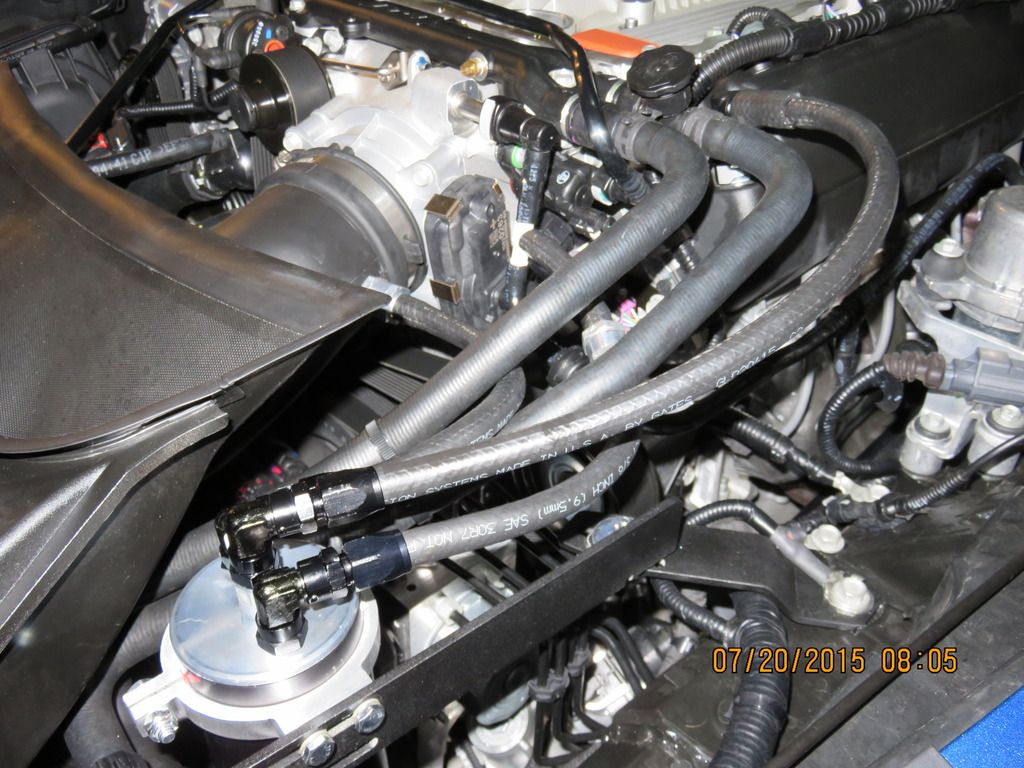
We have both the C7 LT1 AND the proper closed system EPA compliant LT4 C7Z06 systems ready to go for those that want! C7Z06 system is only $299 and both dry sump and wet sump LT1 for $389! Here is the LT4 system installed:
Guaranteed to retain a completely closed 100% MAF metered PCV as well as stop the oil AND eliminate crankcase pressure.
The system for the A&A and other centrifugal SC or turbo builds is also $389 and maintains a closed system.
My car is at LMR this week getting a few new parts including their catch can with a relocation setup. I like the idea of having the fumes routed out of the under hood area too because it does smell bad inside the car sitting at a red light. I'll let you know how well it works when I get the car back.
My car is at LMR this week getting a few new parts including their catch can with a relocation setup. I like the idea of having the fumes routed out of the under hood area too because it does smell bad inside the car sitting at a red light. I'll let you know how well it works when I get the car back.
Be aware, if you are using a system that is only venting pressure, all of the damaging compounds that MUST be removed as soon as they enter the crankcase as blow-by are then left to accumulate and contaminate the engine oil. No reason to defeat the evacuation function and open the PCV system when it can all be accomplished with a properly designed closed system that retains all of the PCV functions. A simple oil analysis from an engine that uses a vented, or breathered system will show the elevated harmful compounds.
Think of the engines pre mid 60's that only vented pressure with a draft tube. You dont want to throw away all these years of technology that went into proper evacuation to go back to the "dark ages"
Here is a great training video on what a PCV system does (it is far more important than as an emissions device) to prolong engine life.
You do not want to leave the water, unburnt fuel, sulfuric acid, abrasive soot and carbon particles and other hydrocarbon related compound in the crankcase as a system that only release pressure does. That is why using a system that constantly pulls vacuum/suction on the crankcase is ideal and then no smell or shortened engine life:
Also, anyone that has torn down a LS6/2/3 that only evacuates from the valley cover and not any from the driverside valve cover, look at the underside and see the discoloration of the aluminum form the condensed sulfuric acid VS the passenger side that will be still shiny. This is only a small view of what happens when you defeat all those critical functions. Of course the best solution would be a belt driven vacuum pump with a adjustable vacuum relief valve on the opposite bank your drawing/evacuating from but getting one to last on the street is not an option.
Anyone with questions on this, please ask in detail here for a good discussion. This is not to slam anyone's product, just to educate how critical removing these compounds is, and what happens when you leave them to accumulate in the crankcase (and no, the pressure being relieved only brings a small amount of these out with it...most stays in the crankcase). So this can be a good technical discussion into this.
Of course if you change your oil every few hundred miles you won't see any damage/premature wear, bit that is very costly when this can be done properly. And as this is gradual and accumulative, you won't notice increased oil burning and rod/cam/main bearing wear until the damage is already done.
LMR catch can is $1000+shipping in silver. $1100+shipping in black powered coated. They were $600 in silver and $650 in black. Redesigned okay, but almost double in price. They can not even throw in the shipping. Thanks but not for me at that price.
Be aware, if you are using a system that is only venting pressure, all of the damaging compounds that MUST be removed as soon as they enter the crankcase as blow-by are then left to accumulate and contaminate the engine oil. No reason to defeat the evacuation function and open the PCV system when it can all be accomplished with a properly designed closed system that retains all of the PCV functions. A simple oil analysis from an engine that uses a vented, or breathered system will show the elevated harmful compounds.
Think of the engines pre mid 60's that only vented pressure with a draft tube. You dont want to throw away all these years of technology that went into proper evacuation to go back to the "dark ages"
Here is a great training video on what a PCV system does (it is far more important than as an emissions device) to prolong engine life.
You do not want to leave the water, unburnt fuel, sulfuric acid, abrasive soot and carbon particles and other hydrocarbon related compound in the crankcase as a system that only release pressure does. That is why using a system that constantly pulls vacuum/suction on the crankcase is ideal and then no smell or shortened engine life:
Also, anyone that has torn down a LS6/2/3 that only evacuates from the valley cover and not any from the driverside valve cover, look at the underside and see the discoloration of the aluminum form the condensed sulfuric acid VS the passenger side that will be still shiny. This is only a small view of what happens when you defeat all those critical functions. Of course the best solution would be a belt driven vacuum pump with a adjustable vacuum relief valve on the opposite bank your drawing/evacuating from but getting one to last on the street is not an option.
Anyone with questions on this, please ask in detail here for a good discussion. This is not to slam anyone's product, just to educate how critical removing these compounds is, and what happens when you leave them to accumulate in the crankcase (and no, the pressure being relieved only brings a small amount of these out with it...most stays in the crankcase). So this can be a good technical discussion into this.
Of course if you change your oil every few hundred miles you won't see any damage/premature wear, bit that is very costly when this can be done properly. And as this is gradual and accumulative, you won't notice increased oil burning and rod/cam/main bearing wear until the damage is already done.
Just wondering, what is that little ball in the quick disconnect fittings do on both driver and passenger valve cover?
is it suppose to block air passage when it trying to exit out of valve cover?
Just wondering, what is that little ball in the quick disconnect fittings do on both driver and passenger valve cover?
is it suppose to block air passage when it trying to exit out of valve cover?
Its a check ball. When there is positive pressure in engine the ball moves to open the way for the gas to escape. When there is a vacuum, the ball closes to prevent unmetered air from entering the engine.
Its a check ball. When there is positive pressure in engine the ball moves to open the way for the gas to escape. When there is a vacuum, the ball closes to prevent unmetered air from entering the engine.
100% correct! All GM V8 DI engines now come with checkvave(ball) from the factory now to prevent back-flow as much as possible. GM has done a TON of new changes to help this issue (that they and all other auto makers claim don't acknowledge exists). The valve covers alone on the LT1/LT4 are by far the best I have seen period as far as baffling, but be aware, at app 20-30% effectiveness anything else that returns what is trapped to the crankcase, allows the damaging compounds to stay and accumulate int he crankcase, so they are about at the limit that can be done w/out an external device that needs to be emptied. There is one Company that has a Patent pending device/solution for the OEM market that never needs to be emptied for 100k plus miles. It self empties and meets all EPA guidelines so expect in the next few years to see these come stock like most SuperCars do now.
100% correct! All GM V8 DI engines now come with checkvave(ball) from the factory now to prevent back-flow as much as possible. GM has done a TON of new changes to help this issue (that they and all other auto makers claim don't acknowledge exists). The valve covers alone on the LT1/LT4 are by far the best I have seen period as far as baffling, but be aware, at app 20-30% effectiveness anything else that returns what is trapped to the crankcase, allows the damaging compounds to stay and accumulate int he crankcase, so they are about at the limit that can be done w/out an external device that needs to be emptied. There is one Company that has a Patent pending device/solution for the OEM market that never needs to be emptied for 100k plus miles. It self empties and meets all EPA guidelines so expect in the next few years to see these come stock like most SuperCars do now.
The RX and the EliteEngineering E2 can be configured this way with the checkvalves. It is one of those companies doing the OEM solution as I understand.
The RX and the EliteEngineering E2 can be configured this way with the checkvalves. It is one of those companies doing the OEM solution as I understand.
I hate the way some people walk around to say stuff in here plus in life also. Let cut thur the crap and just say what a person means here are you saying the RX can is the only one that will work due to the way it works. Plus the LMR can is going to let all the stuff go back into the motor & it not worth buying.
I dont mean to be what ever here but just got a LMR can & sure not going to work with it on the car if it is all talk & will not work like those guys have said it will. Robert







 Best Catch Can for Supercharged Base