




LT1 GDI owners

Safety Car

Joined: Jan 2015
Posts: 3,941
Likes: 499
From: Northern Virginia

The more oil on the valve stems the faster and thicker the carbon build-up is going to be, and the greater the wear on the valve seals in the same amount of time.
TBH, I can't say whether coking is going to be a significant problem with the LT1. Nor can I state that a decent catch can will or will not make a difference long term, although I get about an ounce of oil mixture every 1100 miles or so in my Elite E2 can (wet sump motor). Best case, I'm minimizing a problem. Worst case, I've spent less than $200 and an hour of my time for no reason. Heck, many of us spend more than that on a grill that adds no functional value at all.
I keep insurance on my car even though I haven't had an at fault accident in more than 30 years. I figure a catch can is cheap insurance.
Last edited by meyerweb; Nov 18, 2015 at 09:05 PM.

Safety Car


Joined: Jan 2006
Posts: 3,940
Likes: 43
From: shavertown Pa.
I think the can is worth the time money, if it saves me valve cleaning in the time that I own this car it was worth it.
2 years from now I might still be driving my car while others without a can are in for cleaning and spending a good buck for the service.
2 years from now I might still be driving my car while others without a can are in for cleaning and spending a good buck for the service.

Melting Slicks


Joined: Jun 2012
Posts: 2,226
Likes: 1,029
From: Thomas Texas
Oh, and look at the picture of the oily valve closely. It is closed all the way and has a puddle of oil behind it. Study that picture closely. There is a reason I would like the person who took the picture to chime in with more and more info to determine why there is so much oil and why it is so wet instead of the dry baked on deposits we generally see.

Race Director


Joined: Jul 2007
Posts: 10,961
Likes: 2,643
From: Texas Hill Country
Not sure I follow this logic. Is a little bit of bleeding as bad as massive bleeding? A little bit of cancer as bad as cancer that's spread throughout your body?
The more oil on the valve stems the faster and thicker the carbon build-up is going to be, and the greater the wear on the valve seals in the same amount of time.
TBH, I can't say whether coking is going to be a significant problem with the LT1. Nor can I state that a decent catch can will or will not make a difference long term, although I get about an ounce of oil mixture every 1100 miles or so in my Elite E2 can (wet sump motor). Best case, I'm minimizing a problem. Worst case, I've spent less than $200 and an hour of my time for no reason. Heck, many of us spend more than that on a grill that adds no functional value at all.
I keep insurance on my car even though I haven't had an at fault accident in more than 30 years. I figure a catch can is cheap insurance.
The more oil on the valve stems the faster and thicker the carbon build-up is going to be, and the greater the wear on the valve seals in the same amount of time.
TBH, I can't say whether coking is going to be a significant problem with the LT1. Nor can I state that a decent catch can will or will not make a difference long term, although I get about an ounce of oil mixture every 1100 miles or so in my Elite E2 can (wet sump motor). Best case, I'm minimizing a problem. Worst case, I've spent less than $200 and an hour of my time for no reason. Heck, many of us spend more than that on a grill that adds no functional value at all.
I keep insurance on my car even though I haven't had an at fault accident in more than 30 years. I figure a catch can is cheap insurance.
Either way, if you are ok with oil on your valves, that's up to you. My valves don't have one molecule of oil on them, which was my goal. 10K mile oil changes and 200K mile service life is not. I have 20K+ dollars in my engine setup, my oil change situation is not even on the radar. I haven't even opened the garage it is in in over a month.
BTW, has it been measured how much oil the can reduces? We know how much is/could be in the can when you open it but how much is that in proportion to the total amount of oil that flows through? If it is 90%, ok I agree, install the can. But how do we know it isn't 3%?
Last edited by Higgs Boson; Nov 18, 2015 at 10:45 PM.

Drifting

Joined: Dec 2012
Posts: 1,630
Likes: 203
From: MI
Bleeding is a bad example but cancer could be ok. I'd rather have certain types of cancers than say, a little bit of brain cancer.
Either way, if you are ok with oil on your valves, that's up to you. My valves don't have one molecule of oil on them, which was my goal. 10K mile oil changes and 200K mile service life is not. I have 20K+ dollars in my engine setup, my oil change situation is not even on the radar. I haven't even opened the garage it is in in over a month.
BTW, has it been measured how much oil the can reduces? We know how much is/could be in the can when you open it but how much is that in proportion to the total amount of oil that flows through? If it is 90%, ok I agree, install the can. But how do we know it isn't 3%?
Either way, if you are ok with oil on your valves, that's up to you. My valves don't have one molecule of oil on them, which was my goal. 10K mile oil changes and 200K mile service life is not. I have 20K+ dollars in my engine setup, my oil change situation is not even on the radar. I haven't even opened the garage it is in in over a month.
BTW, has it been measured how much oil the can reduces? We know how much is/could be in the can when you open it but how much is that in proportion to the total amount of oil that flows through? If it is 90%, ok I agree, install the can. But how do we know it isn't 3%?
I put 10k miles on my corvette a year. I plan to keep my car for around 4 years. i plan on doing 30k-45k miles. poor design of a engine to have problems at those miles.
If i plan on keeping it long term which i might (never know) i am hoping for data by then. Which in that case i will do a manual valve cleaning and add a catch can.
Last edited by MikeLsx; Nov 18, 2015 at 11:14 PM.

Burning Brakes

Joined: Sep 2015
Posts: 861
Likes: 156
From: California
2017 C7 of Year Finalist
if the oil in the intake doesn't cause any harm or take any from performance under a certain amount of miles. I could careless.
I put 10k miles on my corvette a year. I plan to keep my car for around 4 years. i plan on doing 30k-45k miles. poor design of a engine to have problems at those miles.
If i plan on keeping it long term which i might (never know) i am hoping for data by then. Which in that case i will do a manual valve cleaning and add a catch can.
I put 10k miles on my corvette a year. I plan to keep my car for around 4 years. i plan on doing 30k-45k miles. poor design of a engine to have problems at those miles.
If i plan on keeping it long term which i might (never know) i am hoping for data by then. Which in that case i will do a manual valve cleaning and add a catch can.

Drifting
Joined: Dec 2012
Posts: 1,630
Likes: 203
From: MI

Race Director
Joined: Jul 2007
Posts: 10,961
Likes: 2,643
From: Texas Hill Country
if the oil in the intake doesn't cause any harm or take any from performance under a certain amount of miles. I could careless.
I put 10k miles on my corvette a year. I plan to keep my car for around 4 years. i plan on doing 30k-45k miles. poor design of a engine to have problems at those miles.
If i plan on keeping it long term which i might (never know) i am hoping for data by then. Which in that case i will do a manual valve cleaning and add a catch can.
I put 10k miles on my corvette a year. I plan to keep my car for around 4 years. i plan on doing 30k-45k miles. poor design of a engine to have problems at those miles.
If i plan on keeping it long term which i might (never know) i am hoping for data by then. Which in that case i will do a manual valve cleaning and add a catch can.
(and I say that with all the upmost respect for all involved in this thread, i love everyone here and mean no harm to anyone)
Corvette Stories
The Best of Corvette for Corvette Enthusiasts

Top 10 Most Expensive Corvettes Ever Sold on Bring A Trailer
Brett Foote
10 Things Every Corvette Owner Needs (2026 Edition)
Michael S. Palmer
8 Most "Only Corvette Owners Understand" Quirks and Problems
Pouria Savadkouei
10 Reasons the C6 Z06 is Still A Performance Benchmark After 20 Years
Joe Kucinski
How Much Horsepower Every Corvette Engine "LOST" in 1972
Joe Kucinski
Top 10 DOs and DON'Ts for Protecting Your Convertible Top!
Michael S. Palmer
Top 10 Most Explosive Corvettes Ever Made: Power-to-Weight Ratio Ranked!
Joe Kucinski
150 hp to 1,250 hp: Every Corvette Generation Compared by the Specs That Matter
Joe Kucinski
8 Coolest Corvette Pace Cars (and Replicas) of All Time
Verdad Gallardo
Race Director


Joined: Dec 1999
Posts: 10,230
Likes: 885
From: Alexandria, Virginia, USA VA
GM did quite a bit of research on this and seems to have a better oil control setup than some of the foreign cars. we don't have a bunch of high mileage folks stepping in here showing badly deposited valves which is what I'm looking to see
Toyota on the little subbee BRZ used a combo of DI and Port injectors to keep things nice and tidy on the valves so for sure we're not the only ones
sooooo...... leads me to my favorite topic of late (boost junkie) direct port meth injection. even on a NA car at peak torq a bit of the old corn might help this situation if applied on a regular basis. but clearly alchy injection has some down sides too.
I'd love to see some pics of the "high milers"
the 12k valves really didn't look that bad to me but clearly they have more deposits that the port injection engines I'm more familiar with
so maybe guys have old ecotec di engines can chime in. I'm sure GM did some improvements based on lessons learned with that engine.
I sure like the look of the c7 cyl heads!!
Toyota on the little subbee BRZ used a combo of DI and Port injectors to keep things nice and tidy on the valves so for sure we're not the only ones
sooooo...... leads me to my favorite topic of late (boost junkie) direct port meth injection. even on a NA car at peak torq a bit of the old corn might help this situation if applied on a regular basis. but clearly alchy injection has some down sides too.
I'd love to see some pics of the "high milers"
the 12k valves really didn't look that bad to me but clearly they have more deposits that the port injection engines I'm more familiar with
so maybe guys have old ecotec di engines can chime in. I'm sure GM did some improvements based on lessons learned with that engine.
I sure like the look of the c7 cyl heads!!
Last edited by Rkreigh; Nov 19, 2015 at 08:10 AM.

Thread Starter
Melting Slicks
Joined: Dec 2004
Posts: 3,120
Likes: 119
St. Jude Donor '10
Thanks for the clarification!!!

Thread Starter
Melting Slicks
Joined: Dec 2004
Posts: 3,120
Likes: 119
St. Jude Donor '10
Bleeding is a bad example but cancer could be ok. I'd rather have certain types of cancers than say, a little bit of brain cancer.
Either way, if you are ok with oil on your valves, that's up to you. My valves don't have one molecule of oil on them, which was my goal. 10K mile oil changes and 200K mile service life is not. I have 20K+ dollars in my engine setup, my oil change situation is not even on the radar. I haven't even opened the garage it is in in over a month.
BTW, has it been measured how much oil the can reduces? We know how much is/could be in the can when you open it but how much is that in proportion to the total amount of oil that flows through? If it is 90%, ok I agree, install the can. But how do we know it isn't 3%?
Either way, if you are ok with oil on your valves, that's up to you. My valves don't have one molecule of oil on them, which was my goal. 10K mile oil changes and 200K mile service life is not. I have 20K+ dollars in my engine setup, my oil change situation is not even on the radar. I haven't even opened the garage it is in in over a month.
BTW, has it been measured how much oil the can reduces? We know how much is/could be in the can when you open it but how much is that in proportion to the total amount of oil that flows through? If it is 90%, ok I agree, install the can. But how do we know it isn't 3%?
On how much is stopped, 99% of the cans on the market only stop 15-40% of the oil, but the 2 systems I endorse here are 95-98% effective as anyone can test and verify. That is why all the education on this. Where most cans on port injection were a benefit by stopping some of the oil as valve coking is not an issue with port injection, it is GDI can tolerate little at all. So the long term testing, and the immediate results on eliminating most KR (logging with HPT or EFI Live will show) is easy to document.
if the oil in the intake doesn't cause any harm or take any from performance under a certain amount of miles. I could careless.
I put 10k miles on my corvette a year. I plan to keep my car for around 4 years. i plan on doing 30k-45k miles. poor design of a engine to have problems at those miles.
If i plan on keeping it long term which i might (never know) i am hoping for data by then. Which in that case i will do a manual valve cleaning and add a catch can.
I put 10k miles on my corvette a year. I plan to keep my car for around 4 years. i plan on doing 30k-45k miles. poor design of a engine to have problems at those miles.
If i plan on keeping it long term which i might (never know) i am hoping for data by then. Which in that case i will do a manual valve cleaning and add a catch can.
GM did quite a bit of research on this and seems to have a better oil control setup than some of the foreign cars. we don't have a bunch of high mileage folks stepping in here showing badly deposited valves which is what I'm looking to see
Toyota on the little subbee BRZ used a combo of DI and Port injectors to keep things nice and tidy on the valves so for sure we're not the only ones
sooooo...... leads me to my favorite topic of late (boost junkie) direct port meth injection. even on a NA car at peak torq a bit of the old corn might help this situation if applied on a regular basis. but clearly alchy injection has some down sides too.
I'd love to see some pics of the "high milers"
the 12k valves really didn't look that bad to me but clearly they have more deposits that the port injection engines I'm more familiar with
so maybe guys have old ecotec di engines can chime in. I'm sure GM did some improvements based on lessons learned with that engine.
I sure like the look of the c7 cyl heads!!
Toyota on the little subbee BRZ used a combo of DI and Port injectors to keep things nice and tidy on the valves so for sure we're not the only ones
sooooo...... leads me to my favorite topic of late (boost junkie) direct port meth injection. even on a NA car at peak torq a bit of the old corn might help this situation if applied on a regular basis. but clearly alchy injection has some down sides too.
I'd love to see some pics of the "high milers"
the 12k valves really didn't look that bad to me but clearly they have more deposits that the port injection engines I'm more familiar with
so maybe guys have old ecotec di engines can chime in. I'm sure GM did some improvements based on lessons learned with that engine.
I sure like the look of the c7 cyl heads!!
Water/Meth injection DOES help without a doubt. This we have seen in testing and studying the different conditions and the end results, but most are only spraying with FI applications and then it is not constant or on a regular basis. To use this full time is costly and requires filling the tank quite often.
And finally, ANY tank/breather/VTA will result in definite shorter engine life and increased internal wear. That is unavoidable as you are defeating the critical flushing and evacuating of the damaging combustion by product removal leaving most of these damaging compounds in the crankcase to mix with the oil, and THAT is going to bite many down the road that do not fully understand this.
You must retain flushing and evacuation or your going back to the "dark ages" of pre early 1960's and engines only lasting 40-50k miles before needing a rebuild (I have covered this in great detail earlier for those wanting to understand this, just go back a few pages or to my other threads).
So, yes, every single auto maker is working on these issues around the clock as the mandates of CAFE and emission standards (especially EURO emissions) have forced them into GDI before these issue have been properly addressed, and until an exterenal solution is implemented (it has already been perfected and is in the Patent Pending stage) that does not require end user draining, the internal oil controls have reached a "wall" that will also retain the damaging combustion byproducts that cause premature wear and must be flushed and evacuated before settling and mixing with the oil.
Anyone that does their own oil changes, or checks oil levels on a regular basis can attest to how quickly after a change it gets dark. This is the abrasive soot and carbon particles too small for the oil filter to trap that used to be evacuated mostly in the past. And the internal separation advancements are already trapping more of these damaging compounds than the systems in the past with LS series engines.
Hope this helps!


Racer

Joined: Feb 2015
Posts: 331
Likes: 38
From: Florham Park NJ
@ CoSpeed
I know this is a topic that gets tossed around alot and there are believers and non believers. I am more or less on the fence. My feeling is that a catch can can't hurt you in anyway and an ounce of prevention is worth a pound of cure. My question is which catch can do you recommend ? Which one will give us the most benefit. I also spray meth but thats only at 7 lbs. of boost.
Thanbks
Thanbks
Thread Starter
Melting Slicks
Joined: Dec 2004
Posts: 3,120
Likes: 119
St. Jude Donor '10
I know this is a topic that gets tossed around alot and there are believers and non believers. I am more or less on the fence. My feeling is that a catch can can't hurt you in anyway and an ounce of prevention is worth a pound of cure. My question is which catch can do you recommend ? Which one will give us the most benefit. I also spray meth but thats only at 7 lbs. of boost.
Thanbks
Thanbks
Turbo and Centri blower are the same basically in that they both pressurize the intake manifold with boost, and the primary suction source for evacuation is provided usually by the intake manifold vacuum. So, you need a dual outlet system like the ColoradoSpeed Dual valve or dual valve "monster", or the Elite Engineering E-2X series. Their largest for big boost is the E2-X "Ultra".
The larger model is just for added capacity that big power builds sometimes need, and big boost especially.
The primary outlet from the main air/oil separator of either brand will use the intake manifold vacuum for evacuation when your in non-boost operation, and the secondary outlet will connect to the inlet side of the turbo or centri head unit, as close to the impeller as possible w/no chance of contacting it such as this:

So when boost is detected, the primary checkvalve closes, and the secondary opens so at all times the evacuation is using the strongest suction source available. And no boost can back flow into the crankcase. The cleanside (opposite valve cover that this older diagram shows) then replaces the oil fill cap and you run a hose from it to the end or base of your main airfilter so the one bank has clean filtered fresh air entering to flush and replace the foul oil laden vapors the opposite bank is exiting to the can. This is for a turbo or centri blower as they will generally be a speed density tune and the incoming air is not MAF metered. On a PD (top mount) type blower you do use 100% MAF metered air as the intake tube is not pressurized when in boost. The secondary outlet on that will attache to a barb you install just upstream of the TB and it provides an added evacuation capacity when at WOT. The cleanside hose attaches between the MAF and the TB for 100% MAF metered incoming air.
This will provide evacuation and pull suction on the crankcase at all times avoiding allowing pressure to first build and vent as a tank/breather system does helping to maintain ring stability, removes the damaging compounds that shorten engine life, and meets emission compliance and retains a closed system for any concerned with warranty. A better solution of course is a belt driven vacuum pump with vac relief valve in opposite bank. But those pumps do not last long on the street, and the outlet side is routed to a vented can for off road use only.
Thread Starter
Melting Slicks
Joined: Dec 2004
Posts: 3,120
Likes: 119
St. Jude Donor '10
GDI is in practice great as far as allowing such high compression, initially lower emissions, and all around higher output in smaller displacement engines. As the fuel is only introduced milliseconds before ignition, detonation is in theory eliminated as there should be no explosive gasses present during the compression stroke, but in practice oil mist will still ignite and "detonate" causing KR, and the latest multiple fuelijg events also introduce some fuel early as well as the Audi/Toyota and others that started putting in small port injectors. So, yes, lots of work to do before these are perfected, but the theory is sound. Audi in their R&D division has engines running as high as 17 and 19:1 CR!!!!!! But in the lab with controlled environment. We would never have thought GM would have a small block V8 at 11.5:1 CR that would run on 91 octaine a few years back either.
I foresee factory external separators in the next 4-5 years that do not need to be serviced for 100k plus miles. Until then the owners must deal with this or ignore it and as most trade in 3-4 years it will be the next owners issue.
Racer
Joined: Feb 2015
Posts: 331
Likes: 38
From: Florham Park NJ
Are you running a turbo, centrifugal SC, or a PD type blower?
Turbo and Centri blower are the same basically in that they both pressurize the intake manifold with boost, and the primary suction source for evacuation is provided usually by the intake manifold vacuum. So, you need a dual outlet system like the ColoradoSpeed Dual valve or dual valve "monster", or the Elite Engineering E-2X series. Their largest for big boost is the E2-X "Ultra".
The larger model is just for added capacity that big power builds sometimes need, and big boost especially.
The primary outlet from the main air/oil separator of either brand will use the intake manifold vacuum for evacuation when your in non-boost operation, and the secondary outlet will connect to the inlet side of the turbo or centri head unit, as close to the impeller as possible w/no chance of contacting it such as this:
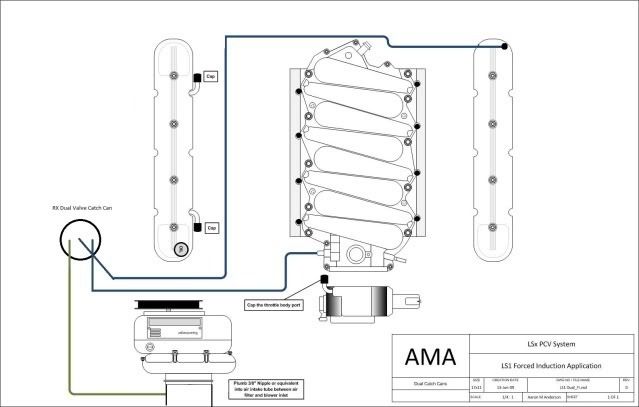
So when boost is detected, the primary checkvalve closes, and the secondary opens so at all times the evacuation is using the strongest suction source available. And no boost can back flow into the crankcase. The cleanside (opposite valve cover that this older diagram shows) then replaces the oil fill cap and you run a hose from it to the end or base of your main airfilter so the one bank has clean filtered fresh air entering to flush and replace the foul oil laden vapors the opposite bank is exiting to the can. This is for a turbo or centri blower as they will generally be a speed density tune and the incoming air is not MAF metered. On a PD (top mount) type blower you do use 100% MAF metered air as the intake tube is not pressurized when in boost. The secondary outlet on that will attache to a barb you install just upstream of the TB and it provides an added evacuation capacity when at WOT. The cleanside hose attaches between the MAF and the TB for 100% MAF metered incoming air.
This will provide evacuation and pull suction on the crankcase at all times avoiding allowing pressure to first build and vent as a tank/breather system does helping to maintain ring stability, removes the damaging compounds that shorten engine life, and meets emission compliance and retains a closed system for any concerned with warranty. A better solution of course is a belt driven vacuum pump with vac relief valve in opposite bank. But those pumps do not last long on the street, and the outlet side is routed to a vented can for off road use only.
Turbo and Centri blower are the same basically in that they both pressurize the intake manifold with boost, and the primary suction source for evacuation is provided usually by the intake manifold vacuum. So, you need a dual outlet system like the ColoradoSpeed Dual valve or dual valve "monster", or the Elite Engineering E-2X series. Their largest for big boost is the E2-X "Ultra".
The larger model is just for added capacity that big power builds sometimes need, and big boost especially.
The primary outlet from the main air/oil separator of either brand will use the intake manifold vacuum for evacuation when your in non-boost operation, and the secondary outlet will connect to the inlet side of the turbo or centri head unit, as close to the impeller as possible w/no chance of contacting it such as this:
So when boost is detected, the primary checkvalve closes, and the secondary opens so at all times the evacuation is using the strongest suction source available. And no boost can back flow into the crankcase. The cleanside (opposite valve cover that this older diagram shows) then replaces the oil fill cap and you run a hose from it to the end or base of your main airfilter so the one bank has clean filtered fresh air entering to flush and replace the foul oil laden vapors the opposite bank is exiting to the can. This is for a turbo or centri blower as they will generally be a speed density tune and the incoming air is not MAF metered. On a PD (top mount) type blower you do use 100% MAF metered air as the intake tube is not pressurized when in boost. The secondary outlet on that will attache to a barb you install just upstream of the TB and it provides an added evacuation capacity when at WOT. The cleanside hose attaches between the MAF and the TB for 100% MAF metered incoming air.
This will provide evacuation and pull suction on the crankcase at all times avoiding allowing pressure to first build and vent as a tank/breather system does helping to maintain ring stability, removes the damaging compounds that shorten engine life, and meets emission compliance and retains a closed system for any concerned with warranty. A better solution of course is a belt driven vacuum pump with vac relief valve in opposite bank. But those pumps do not last long on the street, and the outlet side is routed to a vented can for off road use only.
Thread Starter
Melting Slicks
Joined: Dec 2004
Posts: 3,120
Likes: 119
St. Jude Donor '10
Then you need the largest of the 2 brands/series I mentioned and installation and routing as shown. Currently your probably not evacuating at all and only are venting into the unfiltered portion of the airbox, correct? That leaves almost all the damaging compounds to remain in the crankcase and mix with the engine oil.
The January issue of Vette Magazine has a great article by James Berry in the "Technically speaking" section on just most of what I have been sharing in most of my threads. He is one of the few that has printed very accurate info on all of this, and Feb issue is to have an article on installing a catchcan. Not sure what they will show as that is such a mix of very ineffective and/or incorrect solutions, that may be more confusing. But he sure understands what is happening, and why!
The January issue of Vette Magazine has a great article by James Berry in the "Technically speaking" section on just most of what I have been sharing in most of my threads. He is one of the few that has printed very accurate info on all of this, and Feb issue is to have an article on installing a catchcan. Not sure what they will show as that is such a mix of very ineffective and/or incorrect solutions, that may be more confusing. But he sure understands what is happening, and why!
Drifting
Joined: Dec 2012
Posts: 1,630
Likes: 203
From: MI
Were in agreement!! Yes, they were forced into it before all issues were sorted out, but the LS1 released in 1997 was far from ready either as the oil consumption, piston slap, poor head/port design (and not enough meat for us to port them properly), the lack of windage windows in the block, etc. it was not until the LS6 and further the LS3 that GM perfected that engine.
GDI is in practice great as far as allowing such high compression, initially lower emissions, and all around higher output in smaller displacement engines. As the fuel is only introduced milliseconds before ignition, detonation is in theory eliminated as there should be no explosive gasses present during the compression stroke, but in practice oil mist will still ignite and "detonate" causing KR, and the latest multiple fuelijg events also introduce some fuel early as well as the Audi/Toyota and others that started putting in small port injectors. So, yes, lots of work to do before these are perfected, but the theory is sound. Audi in their R&D division has engines running as high as 17 and 19:1 CR!!!!!! But in the lab with controlled environment. We would never have thought GM would have a small block V8 at 11.5:1 CR that would run on 91 octaine a few years back either.
I foresee factory external separators in the next 4-5 years that do not need to be serviced for 100k plus miles. Until then the owners must deal with this or ignore it and as most trade in 3-4 years it will be the next owners issue.
GDI is in practice great as far as allowing such high compression, initially lower emissions, and all around higher output in smaller displacement engines. As the fuel is only introduced milliseconds before ignition, detonation is in theory eliminated as there should be no explosive gasses present during the compression stroke, but in practice oil mist will still ignite and "detonate" causing KR, and the latest multiple fuelijg events also introduce some fuel early as well as the Audi/Toyota and others that started putting in small port injectors. So, yes, lots of work to do before these are perfected, but the theory is sound. Audi in their R&D division has engines running as high as 17 and 19:1 CR!!!!!! But in the lab with controlled environment. We would never have thought GM would have a small block V8 at 11.5:1 CR that would run on 91 octaine a few years back either.
I foresee factory external separators in the next 4-5 years that do not need to be serviced for 100k plus miles. Until then the owners must deal with this or ignore it and as most trade in 3-4 years it will be the next owners issue.

Pro

Joined: Nov 2013
Posts: 693
Likes: 158
From: Milwaukee WI
Are you running a turbo, centrifugal SC, or a PD type blower?
Turbo and Centri blower are the same basically in that they both pressurize the intake manifold with boost, and the primary suction source for evacuation is provided usually by the intake manifold vacuum. So, you need a dual outlet system like the ColoradoSpeed Dual valve or dual valve "monster", or the Elite Engineering E-2X series. Their largest for big boost is the E2-X "Ultra".
The larger model is just for added capacity that big power builds sometimes need, and big boost especially.
The primary outlet from the main air/oil separator of either brand will use the intake manifold vacuum for evacuation when your in non-boost operation, and the secondary outlet will connect to the inlet side of the turbo or centri head unit, as close to the impeller as possible w/no chance of contacting it such as this:
So when boost is detected, the primary checkvalve closes, and the secondary opens so at all times the evacuation is using the strongest suction source available. And no boost can back flow into the crankcase. The cleanside (opposite valve cover that this older diagram shows) then replaces the oil fill cap and you run a hose from it to the end or base of your main airfilter so the one bank has clean filtered fresh air entering to flush and replace the foul oil laden vapors the opposite bank is exiting to the can. This is for a turbo or centri blower as they will generally be a speed density tune and the incoming air is not MAF metered. On a PD (top mount) type blower you do use 100% MAF metered air as the intake tube is not pressurized when in boost. The secondary outlet on that will attache to a barb you install just upstream of the TB and it provides an added evacuation capacity when at WOT. The cleanside hose attaches between the MAF and the TB for 100% MAF metered incoming air.
This will provide evacuation and pull suction on the crankcase at all times avoiding allowing pressure to first build and vent as a tank/breather system does helping to maintain ring stability, removes the damaging compounds that shorten engine life, and meets emission compliance and retains a closed system for any concerned with warranty. A better solution of course is a belt driven vacuum pump with vac relief valve in opposite bank. But those pumps do not last long on the street, and the outlet side is routed to a vented can for off road use only.
Turbo and Centri blower are the same basically in that they both pressurize the intake manifold with boost, and the primary suction source for evacuation is provided usually by the intake manifold vacuum. So, you need a dual outlet system like the ColoradoSpeed Dual valve or dual valve "monster", or the Elite Engineering E-2X series. Their largest for big boost is the E2-X "Ultra".
The larger model is just for added capacity that big power builds sometimes need, and big boost especially.
The primary outlet from the main air/oil separator of either brand will use the intake manifold vacuum for evacuation when your in non-boost operation, and the secondary outlet will connect to the inlet side of the turbo or centri head unit, as close to the impeller as possible w/no chance of contacting it such as this:
So when boost is detected, the primary checkvalve closes, and the secondary opens so at all times the evacuation is using the strongest suction source available. And no boost can back flow into the crankcase. The cleanside (opposite valve cover that this older diagram shows) then replaces the oil fill cap and you run a hose from it to the end or base of your main airfilter so the one bank has clean filtered fresh air entering to flush and replace the foul oil laden vapors the opposite bank is exiting to the can. This is for a turbo or centri blower as they will generally be a speed density tune and the incoming air is not MAF metered. On a PD (top mount) type blower you do use 100% MAF metered air as the intake tube is not pressurized when in boost. The secondary outlet on that will attache to a barb you install just upstream of the TB and it provides an added evacuation capacity when at WOT. The cleanside hose attaches between the MAF and the TB for 100% MAF metered incoming air.
This will provide evacuation and pull suction on the crankcase at all times avoiding allowing pressure to first build and vent as a tank/breather system does helping to maintain ring stability, removes the damaging compounds that shorten engine life, and meets emission compliance and retains a closed system for any concerned with warranty. A better solution of course is a belt driven vacuum pump with vac relief valve in opposite bank. But those pumps do not last long on the street, and the outlet side is routed to a vented can for off road use only.

Le Mans Master

Joined: Aug 2015
Posts: 8,243
Likes: 4,618
From: Southwest Florida
And finally, ANY tank/breather/VTA will result in definite shorter engine life and increased internal wear. That is unavoidable as you are defeating the critical flushing and evacuating of the damaging combustion by product removal leaving most of these damaging compounds in the crankcase to mix with the oil, and THAT is going to bite many down the road that do not fully understand this.
You must retain flushing and evacuation or your going back to the "dark ages" of pre early 1960's and engines only lasting 40-50k miles before needing a rebuild (I have covered this in great detail earlier for those wanting to understand this, just go back a few pages or to my other threads).