When you click on links to various merchants on this site and make a purchase, this can result in this site earning a commission. Affiliate programs and affiliations include, but are not limited to, the eBay Partner Network.
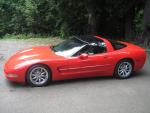
The objective of this project is to create an inexpensive 3D-printed cold-air intake tube for my 16 Z06. This design will utilize the stock airbox and the stock ported throttle body. I used an Artillery Sidewinder X1 3D Printer for the prototypes and finished pieces. This printer has a 12" cube print capacity so I split the intake tube into 3 main parts. The piece that attaches to the airbox is one print (plus the MAF mount), and the elbow is 2 separate prints epoxied together. I made all the tubes ~4.65" diameter, since the stock tube is roughly 4.3" diameter and I've read the ECM / tune needs to be re-calibrated for a 5" intake (I split the difference). Even with the larger tube diameter I tried to make the airflow path as smooth as possible. Areas I focused on specifically were the airbox flange opening and smoothing the transition between the filter mount and the round tube.
Process – For those not familiar with 3D printing the process is as follows: Design the parts using 3D solid modeling software like SolidWorks or FreeCAD, the output being a XXX.STL file. Import the .STL file into “slicer” software, I use Ultimaker Cura which is available for free. The slicer output is a XXX.gcode file that you send to the 3D printer either direct connected or with a thumbdrive. The slicer preps the .gcode file with specifics for the print like print speed, temperature, and supports.
Filament - I used PLA 1.75mm filament for the prototype tubes and TPU 1.75mm flexible filament for the couplers. For the finished parts I might use ABS filament since its more durable and can handle higher temps.
Filter - I plan to use a Burger Motorsports Performance Drop-In Filter to further improve the capacity of the intake system.
Cost - The total cost of the 3D-printed parts (filament for the 3 tube parts and the 2 couplers) is about $20. A newer version of my printer – Sidewinder X2 – is available for under $200.
I'm still looking to improve the joint between the 2 elbows but these parts are basically complete.
The stock filter fits the printed flange quite well. I assume the Burger filter will fit the same. These parts will eventually be printed as one complete unit.
I don't know a lot about the materials, but from what I've read, ABS seems like the way to go, especially to handle underhood temps.
I'm still printing my parts in PLA on a Kobra Max, which has really surprised me with how well it works for such a big volume. I tried Cura for a while but went back to Prusa slicer; it seems to work a bit better for what I'm doing.
Last edited by Torque Obsessed; Feb 13, 2024 at 01:48 AM.
Thanks! The Kobra Max looks like a nice unit and can print a lot bigger parts than my Sidewinder. I see it's made by Anycubic. I've been using a lot of their filament lately; it works well and is inexpensive.
I'll have to try the Prusa slicer, assuming it will work with my printer.
I've been amazed by the TPU filament I used for the couplers. It's a bit finicky to print (temps and extruder arm pressure) but the end product is super tough and flexible. Yes, I'll definitely go with ABS for the final pieces.
Thanks. I can print all the main parts with a single 1kg spool of filament and a spool can be bought for less than $20. I burned another spool or 2 making prototype pieces LOL. I don't have a 3D scanner so I did my best to measure the position of the throttle body relative to the airbox for the model. It took a couple of trials to get it right. I'm sure the GS & Stingray will be different, since the aftermarket CAI's for them are different from the Z06.
I already had the 3D printer but even if you bought a printer you'd have less invested than an aftermarket CAI.
Amazing work and attention to detail! Keep us updated please!
I prototype a bunch of track enhancements on my 3D printer too. I can tell you from experience that 1000% PLA will deform like crazy in the engine bay. ABS lasts longer, but once your car is idling at temp in a traffic jam during the summer, it will deform too; specifically, where it couples to the throttle body. Any near-engine prints (in my experience) "must" be done in PC.
Lastly, ABS, PLA, PC, etc.. will outgas VOCs; make sure they aren't going to react with your MAF and cause pre-mature sensor failure or lead to gunk on your throttle body and intake manifold. OEM engine bay plastic is made of nylon (PA). You might want to check out those filaments and see if your printer is capable of printing them. That'll give you the closest to OEM compatibility and performance.
Forgive me if I'm preaching to the choir. I'm excited to see someone else printing parts. Best of luck!
Amazing work and attention to detail! Keep us updated please!
I prototype a bunch of track enhancements on my 3D printer too. I can tell you from experience that 1000% PLA will deform like crazy in the engine bay. ABS lasts longer, but once your car is idling at temp in a traffic jam during the summer, it will deform too; specifically, where it couples to the throttle body. Any near-engine prints (in my experience) "must" be done in PC.
Lastly, ABS, PLA, PC, etc.. will outgas VOCs; make sure they aren't going to react with your MAF and cause pre-mature sensor failure or lead to gunk on your throttle body and intake manifold. OEM engine bay plastic is made of nylon (PA). You might want to check out those filaments and see if your printer is capable of printing them. That'll give you the closest to OEM compatibility and performance.
Forgive me if I'm preaching to the choir. I'm excited to see someone else printing parts. Best of luck!
Awesome - thanks so much for the advice! You're definitely NOT preaching to the choir, I'm learning as I go. I'm going to give ABS a shot for the main pieces and see how it performs. It seems like having ambient air flowing thru the tube should help keep it cool when the car is moving. Sitting in traffic with 100 deg. F ambient air, well that might be a different story. The specs for the TPU I'm using for the throttle body coupler show it's good for ~250 deg. F so I'm fairly confident it will be ok. We'll see.
Now that I have component geometry figured out it will be fun playing with materials. I'll definitely do some more research on PA / nylon. The extruder on my Sidewinder can get up to 260 deg. C, but that's where PA needs to print so I might need an extruder upgrade.
Awesome - thanks so much for the advice! You're definitely NOT preaching to the choir, I'm learning as I go. I'm going to give ABS a shot for the main pieces and see how it performs. It seems like having ambient air flowing thru the tube should help keep it cool when the car is moving. Sitting in traffic with 100 deg. F ambient air, well that might be a different story. The specs for the TPU I'm using for the throttle body coupler show it's good for ~250 deg. F so I'm fairly confident it will be ok. We'll see.
Now that I have component geometry figured out it will be fun playing with materials. I'll definitely do some more research on PA / nylon. The extruder on my Sidewinder can get up to 260 deg. C, but that's where PA needs to print so I might need an extruder upgrade.
Thanks again - cheers!!!
No worries! Glad I could help. I'm generally a little conservative with my design specs so maybe you can get away with ABS, but my gut feeling is that at temperature, it will warp where the clamp puts stress on it. Who knows though, maybe it will warp in a way that creates a better seal haha. As long as you get good layer adhesion with TPU, it should be just fine.
Do you have an enclosure? Both ABS and PA need an elevated controlled environment during printing to perform per spec.
One thing you can consider doing is prototyping everything at home and then sending the part to a 3D print house. Some of them (generally the international ones), are comparable in price to printing at home. I do this when I need something printed larger than my bed can handle. you can even get small things like shift ***** and brackets printed in metal for under $50.
Regarding TPU - I printed with the extruder at 220 and the couplers are very tough & flexible, no hint of separating layers. Of course that's at room temp so we'll see LOL.
Originally Posted by shaladdin
.....Both ABS and PA need an elevated controlled environment during printing to perform per spec...
Interesting fact about the enclosure. I don't have one, I thought printing with ABS in an enclosure was just to capture the fumes. I told you I'm learning as I go! I'm sure I could build something but I see there are some inexpensive ones on Amazon.
If I don't have any luck with ABS I may look into outsourcing in PA. I found PA / nylon filament is relatively expensive so it might not make sense for me to experiment with it for this one-shot project.
Regarding TPU - I printed with the extruder at 220 and the couplers are very tough & flexible, no hint of separating layers. Of course that's at room temp so we'll see LOL.
Interesting fact about the enclosure. I don't have one, I thought printing with ABS in an enclosure was just to capture the fumes. I told you I'm learning as I go! I'm sure I could build something but I see there are some inexpensive ones on Amazon.
If I don't have any luck with ABS I may look into outsourcing in PA. I found PA / nylon filament is relatively expensive so it might not make sense for me to experiment with it for this one-shot project.
Thanks again for all the info.
Definitely for fumes, but also to get uniform cooling throughout the print- a big factor in poor layer adhesion and mid-print warping. PA is one of the more exotic filaments. If you do decide to go PA, you might only need it on the section closes to the engine.
My print volume isn't as large as yours (10" cube), but I can print PA and have a couple spools lying around. Lmk if you need any help with a one-off. My printer is collecting dust most of the time.
Definitely for fumes, but also to get uniform cooling throughout the print- a big factor in poor layer adhesion and mid-print warping. PA is one of the more exotic filaments. If you do decide to go PA, you might only need it on the section closes to the engine.
My print volume isn't as large as yours (10" cube), but I can print PA and have a couple spools lying around. Lmk if you need any help with a one-off. My printer is collecting dust most of the time.
Wow, that's a serious piece! Evidently you have a scanner or access to one? That surely makes things easier in the design process.
Thanks for the offer for a one-off with PA. My car is put away for winter so it will be several weeks before I can start testing with ABS.
Believe it or not, that was scanned on an iPhone 12 with an app called PolyCam. It can use either the phone's lidar sensor or a set of overlapping images for reconstruction; I think that particular scan was done through images. It's surprisingly accurate, with only a couple millimeters of error over the whole scan.
Thanks mittens. Taking advice from shaladdin and others I built a printer enclosure to help with these high-temp filaments (I used some materials I had laying around the shop). I'm printing my 1st part in ABS right now, and - knock-on-wood - it looks good so far. Bed-Weld seems to do the trick. I have a plated extruder nozzle and polycarbonate (PC) / PETG hybrid filament on the way. This stuff is 'advertised' to take 210 deg. F temps and be easy to print. We'll see.
Last edited by hiltsy855; Feb 28, 2024 at 08:39 PM.
Good luck, when I print PETG, I close off all HVAC Vents and close the door to the room so its like its own box. helps alot. before my cold AC was warping my prints.
I got all the parts printed with ABS filament, it is more of a challenge than PLA. I painted the inner surfaces with acetone to strengthen and smooth them. I installed the ABS intake along with a new BMS filter. It's 70 degrees out today (in Iowa!!!) so I went for a drive. The car was a bit louder but I also installed an X-Pipe over the winter so I doubt the intake made any difference. When I got back I popped the hood and quickly checked temps of the intake with an infrared gun. Most everything was between 150 and 155 deg. F. ABS has a heat deflection rating of 192 deg so I have some overhead for driving on cooler days but clearly I need to try printing the parts with PC (polycarbonate). On to the next phase LOL.
Designer Imagines A Corvette That Looks More Like a Corvette Than the Corvette
Slideshow: A Jaguar designer's personal project imagines what a modern front-engined Corvette might look like if Chevrolet revisited the golden age of the Stingray.











 3D Printed Cold Air Intake