



Alignment Machine Readouts

Thread Starter
Melting Slicks


Joined: Nov 2005
Posts: 2,074
Likes: 309
 Alignment Machine Readouts
Does anybody know what a negative sign preceding a degree reading for toe usually means? I have a readout but the machine is unknown. I'm trying to help a friend sort out some handling issues.
The readout that I'm interested in says " -0.04 degrees" Does the negative sign mean toe in or toe out?
Thanks.
The readout that I'm interested in says " -0.04 degrees" Does the negative sign mean toe in or toe out?
Thanks.

Race Director


Joined: Jan 2005
Posts: 10,924
Likes: 854
From: Daytona Beach FL
Virtually all alignment machines use the same conventions for describing the specifications of an alignment.
Most all machines are like this:
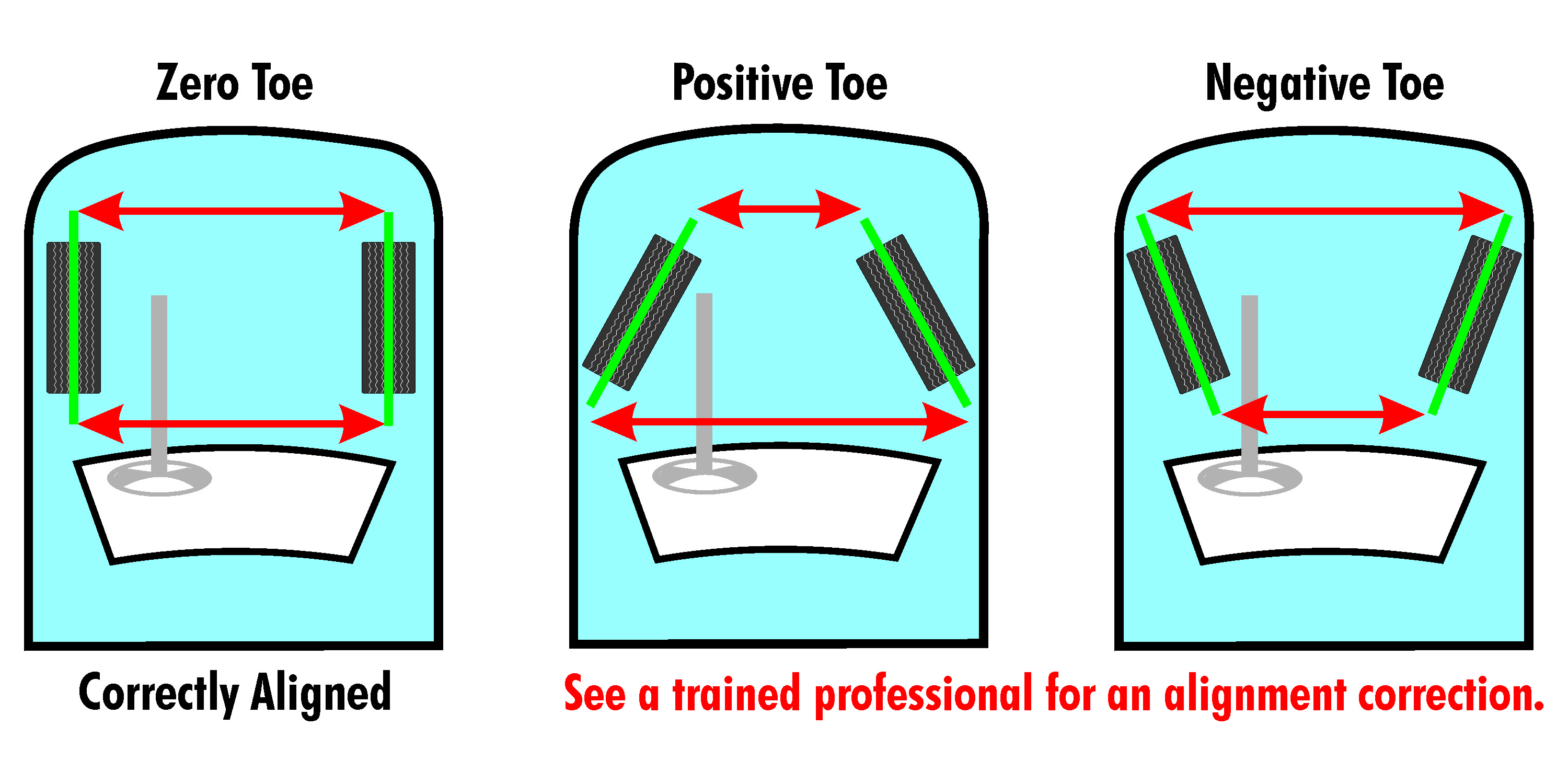
Take a look at this thread in the C7 Tech section. In the first post you can see the screens that show all the alignment specs. The top screen is the "rear" of the car, and the bottom (fuzzy screen) is the "front". Notice on the screen for the rear wheels that toe is shown to be 0.09 degrees for both sides - and there's no +/- symbol, so it's a + number. Also look at the arrows - they are both "inward" from the center, indicating toe-IN.
Look at the fuzzy screen for the front wheels of the car. You'll see that the toe specs are -0.04 degrees, and the arrows are both "outward" from the center of the scale, indicating toe-OUT.
Here's a link to that thread:
https://www.corvetteforum.com/forums...-right-in.html
.
https://www.corvetteforum.com/forums...-right-in.html
Most all machines are like this:
Take a look at this thread in the C7 Tech section. In the first post you can see the screens that show all the alignment specs. The top screen is the "rear" of the car, and the bottom (fuzzy screen) is the "front". Notice on the screen for the rear wheels that toe is shown to be 0.09 degrees for both sides - and there's no +/- symbol, so it's a + number. Also look at the arrows - they are both "inward" from the center, indicating toe-IN.
Look at the fuzzy screen for the front wheels of the car. You'll see that the toe specs are -0.04 degrees, and the arrows are both "outward" from the center of the scale, indicating toe-OUT.
Here's a link to that thread:
https://www.corvetteforum.com/forums...-right-in.html
.
https://www.corvetteforum.com/forums...-right-in.html

Tech Contributor


Joined: Oct 1999
Posts: 41,058
Likes: 9,820
From: Charlotte, NC (formerly Endicott, NY)
A minus sign generally means toe out. However, there is no specific standard so some people reference it as toe in. When I had my car aligned today I specified toe in with no tolerance for toe out. All of the toe readings are positive. Which is what I wanted but when I made out the sheet I showed plus signs in front of the toe and wrote in parentheses Toe In. Then I put a note on the sheet that no toe reading should be toe out.
Bill
Bill
Last edited by Bill Dearborn; Mar 29, 2016 at 06:35 PM.

Melting Slicks


Joined: Feb 2015
Posts: 2,122
Likes: 452
From: Syracuse-Central Square New York Winer of the all Corvette race WGI 8/23!
A minus sign generally means toe out. However, there is no specific standard so some people reference it as toe in. When I had my car aligned today I specified toe in with no tolerance for toe out. All of the toe readings are positive. Which is what I wanted but when I made out the sheet I showed plus signs in front of the toe and wrote in parentheses Toe In. Then I put a note on the sheet that no toe reading should be toe out.
Bill
Bill
Race Director
Joined: Jan 2005
Posts: 10,924
Likes: 854
From: Daytona Beach FL
https://www.corvetteforum.com/forums...alignment.html
-
Tech Contributor
Joined: Oct 1999
Posts: 41,058
Likes: 9,820
From: Charlotte, NC (formerly Endicott, NY)
Bill
Melting Slicks
Joined: Feb 2015
Posts: 2,122
Likes: 452
From: Syracuse-Central Square New York Winer of the all Corvette race WGI 8/23!
No rear caster adjustment. Since 5 different dealers in the area couldn't measure or set the caster I just chose the one that charged the least for 4 wheel alignment. The technician that did it today didn't know that caster could be adjusted and didn't know about any GM bulletins on the track alignment. When I got home I did some checking. It looks like the caster hasn't changed since before the alignment. The problem I have is when laying on the ground holding the plastic edge of my gauge against the bosses in the upright I can't tell which way the upright is leaning since I can't see the indicator arrows on the gauge. What was funny about the alignment is all but one eccentric was moved only a small amount from the street position that I marked. Maybe a 1/4 of a turn. However, the left rear lower control arm eccentric was moved at least a 1/2 turn.
Bill
Bill
Just order 2 nice red Schroth harnesses, thanks.
Sorry to the original OP for high jacking but when Bill talks people listen!
Tech Contributor
Joined: Oct 1999
Posts: 41,058
Likes: 9,820
From: Charlotte, NC (formerly Endicott, NY)
Surprises me our Z07 major adjustments needed for Track settings. They must of removed washers if only minor eccentric movement. As you know its easy to check neg. camber even with your phone app. I bet you will to confirm before tracking. What camber did you run at WG with the C6?
Just order 2 nice red Schroth harnesses, thanks.
Sorry to the original OP for high jacking but when Bill talks people listen!
Just order 2 nice red Schroth harnesses, thanks.
Sorry to the original OP for high jacking but when Bill talks people listen!
The sheet shows the after settings as -1.9 left front with 6.9 caster, -1.9 right front with 7.1 caster; -2.2 left rear and -2.0 right rear. Total toe in front is .05 which is what I requested and .02 in the rear which is less than the .05 I asked for there.
The camber on the C6Z varied depending on what tires I was running. The first season I ran EMTs and the second season I ran Nitto NT05s seasons so front camber was at -1.5 and rear camber was at -1.0. The rest of the time I was running R888s or Conti Slicks so I varied the camber. Initially with the R888s I had it set at -3 front and -1.5 rear but the last year when I was using the slicks exclusively I took it back to -2.2 to -2.5 in front. Now that I look back on things I think I had the best time running the EMTs. They gripped very well for a street tire, would maintain consistency over a 20 minute session and were pretty much low maintenance. I was running just as fast or faster on them as I did with my C5Z with 315/17 Kumho's all the way around. The Nittos were crap tires that worked well in an autocross but couldn't stand up to the heat of the track.
Bill
Corvette Stories
The Best of Corvette for Corvette Enthusiasts

Top 10 Most Expensive Corvettes Ever Sold on Bring A Trailer
Brett Foote
10 Things Every Corvette Owner Needs (2026 Edition)
Michael S. Palmer
8 Most "Only Corvette Owners Understand" Quirks and Problems
Pouria Savadkouei
10 Reasons the C6 Z06 is Still A Performance Benchmark After 20 Years
Joe Kucinski
How Much Horsepower Every Corvette Engine "LOST" in 1972
Joe Kucinski
Top 10 DOs and DON'Ts for Protecting Your Convertible Top!
Michael S. Palmer
Top 10 Most Explosive Corvettes Ever Made: Power-to-Weight Ratio Ranked!
Joe Kucinski
150 hp to 1,250 hp: Every Corvette Generation Compared by the Specs That Matter
Joe Kucinski
8 Coolest Corvette Pace Cars (and Replicas) of All Time
Verdad Gallardo
Thread Starter
Melting Slicks
Joined: Nov 2005
Posts: 2,074
Likes: 309
A minus sign generally means toe out. However, there is no specific standard so some people reference it as toe in. When I had my car aligned today I specified toe in with no tolerance for toe out. All of the toe readings are positive. Which is what I wanted but when I made out the sheet I showed plus signs in front of the toe and wrote in parentheses Toe In. Then I put a note on the sheet that no toe reading should be toe out.
Bill
Bill