When you click on links to various merchants on this site and make a purchase, this can result in this site earning a commission. Affiliate programs and affiliations include, but are not limited to, the eBay Partner Network.
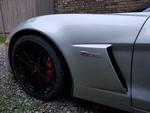
Earlier the week, I saw a vacuum pump degasser kit on Amazon that I thought would work for purging the intercooler system on my 2016Z06. When I bought the pump it was $123. Now it is 153. Anyway, I used a 1" hose that I had bought from OSH when they were still open. I used some pvc that I had in the garage along with some assorted hoses to hook up to the pump and container. I drilled a hole near the bottom of the container and used a 3/8" bulkhead fitting which connected to the purge port on the car. It only took a few minutes to get the assembly ready for action and was actually a fun project. I went from a huge bubble to zero bubble. The pump was able to hit 29" of vacuum. I raised the front of the car off the ground because it was easy for me to do in the garage with an assortment of jacks. At most, I spent $150-160. I had hardwired a switch from the fusebox a few years to activate the cooler pump which helped with the project. Sort of a permanent G Speed switch. Enjoy.
Top notch on everything! but between you and me I would be thinking that I should leave a little air in the system (fluid tank) to take care of "hot" fluid expansion which could cause a leak.
Last edited by C7/Z06 Man; Apr 10, 2021 at 04:57 PM.
the pressure in the ic system doesn't get anywhere near the levels of the main coolant system. All the lines can accomdate the pressure increase and actually helps improve its ability to move more heat out.
the pressure in the ic system doesn't get anywhere near the levels of the main coolant system. All the lines can accomdate the pressure increase and actually helps improve its ability to move more heat out.
You are most likely 100% correct.
But GM had a reason to design the coolant tank the way they did to "contain" an air pocket for expansion. So if it were me that tank would have a small air pocket just to be safe.
Last edited by C7/Z06 Man; Apr 10, 2021 at 05:41 PM.
LOL. No drama. Imitation is the sincerest form of flattery. What's posted here is more or less what I've posted several times over the last several years if you haven't seen it you haven't been looking.
Can a system like this get the air out? Yes.
Is there a massive list of differences and improvements Ive made between this and what I've finally developed and made available? Also yes, but this isn't the time or place.
LOL. No drama. Imitation is the sincerest form of flattery. What's posted here is more or less what I've posted several times over the last several years if you haven't seen it you haven't been looking.
Can a system like this get the air out? Yes.
Is there a massive list of differences and improvements Ive made between this and what I've finally developed and made available? Also yes, but this isn't the time or place.
Well done 383vette
Thanks. I know you had developed a bleeder system but I don't recall a picture of the product. If this resembles yours, it was truly by coincidence. Didn't mean to step on any toes. Anyway, this thing is simple, cheap and worked for me. Well done to you too Atljar.
To those who are saying there should be a bubble, no there shouldnt be one. The Supercharger cooling system isnt pressurized like the engine cooling system is, so there is minimal to no fluid expansion. No air bubble means no air going thru the IC pump causing it to cavitate.
*The engine coolant system has no pressure when cold. Example that will be clear to anyone. You change your engine coolant for whatever reason, than you reinstall the pressure cap on the 'cold' engine.Than you go for a drive and the car engine coolant heats up & "WHOOP THERE IT IS" the engine coolant system has pressure which will go away if you let the car sit long enough to completely cool down (shrink) the liquid. The C7/Z06 pressure cap is rated at 20 psi which will open at that point to prevent the coolant system from going any higher causing leaks.
* The Supercharger coolant system has 'no' pressure cap: so that is why GM has an air pocket/bubble built into the system to take care of the 'expected coolant expansion' from heat. You can compress air easier (liquid not so much) so the air bubble works like a pressure cap, that is why the air bubble is smaller when the system is hot. My theory is that GM did this to prevent having to replace leaking bricks, etc., which could also include a hydro locked engine. A small air pocket in the scheme of things will not affect the cars preformance.
PS: GM designed that tank so the air bubble will stay in that tank and not get into the system.
Last edited by C7/Z06 Man; Apr 11, 2021 at 02:14 PM.
But GM had a reason to design the coolant tank the way they did to "contain" an air pocket for expansion. So if it were me that tank would have a small air pocket just to be safe.
I'd really like to know more about why GM put a CAC reservoir in the C7 Z06 but not the LT4 powered ZL1 or CTS-V. The really interesting and I think telling evidence is when GM took to the C7 ZR1. GM had free reign with the LT5 ZR1 to make it everything that they maybe would have liked to have but were compromised with on the Z06. Not terribly surprising, GM choose not to emulate the C7 Z06's CAC reservoir.
I think that the main reason that there is air in the CAC reservoir on C7 Z06's is because GM quite frankly didn't/doesn't really have a good way of getting the CAC circuit properly bleed. I recently drained and renewed all my coolant on my 2016 Z06 (new radiator and heat exchanger, and I even completely drained the CAC reservoir as I had the front bumper off,) and when I went to fill the CAC circuit back up with my coolant evac tool, it was really cool how it took just seconds to fill the entire circuit back up. It went exactly to where it was prior to my draining the previous fluid, (which was assuredly the original fill as it came from GM), however, and unfortunately, that same place was just not anywhere near the top of the reservoir. Works great to fill, it just doesn't bleed the air out of the system.
I saved this post from another thread a while back, and mind you this was one of the earliest comments from GM on the whole thing (2015.)
Originally Posted by atljar
LOL. No drama. Imitation is the sincerest form of flattery. What's posted here is more or less what I've posted several times over the last several years if you haven't seen it you haven't been looking.
Can a system like this get the air out? Yes.
Is there a massive list of differences and improvements I've made between this and what I've finally developed and made available? Also yes, but this isn't the time or place.
Well done 383vette
I used Jared's Cooler Bleeder this weekend and it was top notch. Jared put a lot of time into carefully selecting all of the parts that comprise of his kit, and the connectors that he offers that fit a variety of applications are the best that you can get. But the best thing about Jared's product, IMO, is the automated cycling of extreme vacuum with the simultaneous modulation of the CAC pump; the little grey box with the blue and amber lights on it. Once you have it set up, you turn it all on and just watch it go. The results were not only excellent but they were also achieved in minutes. No GM dealer or GM tool can come close to Jared's tool.
Last edited by BigVette427; Apr 11, 2021 at 05:44 PM.
I was going to bring up the zr1, cts v and zl1 but it was already mentioned. The cac of the z06 and the whole system design in general is poorly designed.
Don't read into gm infinite wisdom in the cac reservoir and air bubbles as a good design.
The mqin coolqnt system is exposed to an incredible amount of heat generated by the combustion of the cylinders. It is then cycled very quickly by the water pump which is linked to rpm.
Compare this to air compression in the intake which takes out heat energy from the air being compressed. This energy extraction pales in comparison to the combustion heat generated. The pump is pretty low flow too and a fixed rate. No pressure cap, just a simple metal clip holding the fill plug. Add it up and you'll realize what gm discovered for the later car designs. the cac reservoir is pointless and the best cooling setup is to ensure no air in the ic system.
A good vacuum pump qnd large reservoir as posted here is an invaluable tool to any z06 owner.
So without quoting anyone specifically, but just my takes on all of this:
Air in the reservoir doesn't directly matter to performance. It is however a visual indicator / gauge of how well the system is bled. Air in the tank means there is air in the heat exchangers, pump, and the intercoolers etc. Air in these components is a LARGE detrimental issue. If you unbolt the tank, turn it on its side and rid it 100% of its air pocket. Then go drive the car again, the tank slowly but surely will have air pockets start to return to it. I believe the tank was designed to be an air trapping point to help prevent large pockets from going through the system during operation. It can only hold so much air though, and even then still doesn't catch all the air within the system because it cant trap what is above it in the intercooler bricks.
I dont think the system needs any pressure relief or air pocket in the system for cushioning reasons. First, its a relatively low temperature circuit, compared to engine coolant. Therefore the pressure build up is going to be very small. Secondly, there are several rubber hoses in the system. These hoses are going to expand under pressure more so than what a quarter sized air pocket can compress under pressure. Finally, many other intercooler circuits don't have a pressure cap on them and also don't have an designed air pocket cushion
How much air is the right amount in the reservoir? Based on all the testing I have done, I agree with GM that the system is fully bled if you get the reservoir down to little quarter sized pockets (or less) THROUGH vacuum bleeding. If you are unbolting the tank like I mention above, you've introduced another variable into the equation and changes everything. But I assure you that if you are able to vacuum bleed the system with the car at ride height, and get that pocket in the tank to quarter sized or less, that there is NO air anywhere else in the system. The reservoir is a nasty little air trap, and designed this way purposefully. If you can draw the air out of it, again through vacuum and not other artificial means, you have gotten air out of everywhere else in the system and can safely call the system fully bled. If a quarter sized spot remains, it will have absolutely no adverse affect on efficiency or performance of the system. It will also remain trapped there baring a "shiny side down" accident (ie roll over of the car)
One thing of note for air trapped in the ic bricks; you will have a hard time pulling 28 in/hg of vacuum if there is air trapped in the system. What is required is a cycling of vacuum/release to forcefully displace the air out. The IC pump alone CANNOT get the air trapped in the top bricks out. You can pull vacuum on it for hours and run the pump on and off till your battery drains but it will not be enough to displace the air trapped in the top.
I figured this out as I was doing this by hand, but a vacuum pump system doing this will be a lot quicker. You need a good reservoir (I used an oversized 2 inch diameter almost 2 ft long reinforced tube + a 1 qt brake reservoir kit to help keep a reserve in the vacuum system for my efforts. I ensured it stayed topped up so that every time I released the vacuum more fluid would get pulled back in while I ensured the air was forced out to the highest point in my hand pump system. This is the key part; if the air is still in bubble form in the fluid pulled back in, you end up not removing it.
I have Jared's cooler bleeder. I had the ground clamp in the wrong spot and the automatic box wasn't functioning. I figured I could replicate what it was doing with the valves and bleed the system. Which I did and it seemed to work fine. I talked to Jared and he recommended a better ground spot and to try it again. That ended up being my problem and the unit worked fine. I asked why not make a cheaper manual version so private guys with one car doesn't have to spend as much money to bleed there systems. He told me there was no way to easily manipulate the valves to replicate what his system automatically did. I tried it and he was right. The system on automatic mode removed a shitload of trapped air that I didn't think existed. When I say a shitload I mean that. As in hose violently shaking and coolant splashing around in the resivour so much I thought my vacuum pump was going to injest some. I don't actually know how the sequence is timed in his bleeder but there is no way your getting the same results with the $150 ripoff bleeder above. Since the vacuum pump is roughly half the cost if you buy a nice one your not really saving much with the diy setup. And you really can just walk away and let it run for half hour instead of monkeying around. If anyone doubts this bleed your car with whatever method you think is the same or better and bring it by I'll get more air out of it while standing there drinking a beer laughing at you.
Btw his system works perfect with the g speed dry brake fitting.
+1 for the Cooler Bleeder setup. Works like a charm and well worth the cost of the automation in my opinion. But kudos to the OP for making his own setup that met his needs.
I wanted to add. I used g speeds drybreak resivour and pump switch to bleed my intercooler system the first time. Never got any real air out of the system. I adapted my snapon vacuum radiator filler to the dry break adapter and got some air out of the system. Never got to the two quarter sized bubbles until I used Jareds system in manual mode. With cooler bleeder operated with just the valves I got a lot of air out and got down to two very small air bubbles. I bled it a few more times until I didn't see any more air coming out of the hose. After I got his system running correctly in automatic mode I got a lot more air out. So if you have two small bubbles in your resivour that doesn't mean there's no more air up top in the bricks.
I have Jared's cooler bleeder. I had the ground clamp in the wrong spot and the automatic box wasn't functioning. I figured I could replicate what it was doing with the valves and bleed the system. Which I did and it seemed to work fine. I talked to Jared and he recommended a better ground spot and to try it again. That ended up being my problem and the unit worked fine. I asked why not make a cheaper manual version so private guys with one car doesn't have to spend as much money to bleed there systems. He told me there was no way to easily manipulate the valves to replicate what his system automatically did. I tried it and he was right. The system on automatic mode removed a shitload of trapped air that I didn't think existed. When I say a shitload I mean that. As in hose violently shaking and coolant splashing around in the resivour so much I thought my vacuum pump was going to injest some. I don't actually know how the sequence is timed in his bleeder but there is no way your getting the same results with the $150 ripoff bleeder above. Since the vacuum pump is roughly half the cost if you buy a nice one your not really saving much with the diy setup. And you really can just walk away and let it run for half hour instead of monkeying around. If anyone doubts this bleed your car with whatever method you think is the same or better and bring it by I'll get more air out of it while standing there drinking a beer laughing at you.
Btw his system works perfect with the g speed dry brake fitting.
I have communicated with Jared a number of times last year. He has a wonderful product and what he offers can't be matched. He has hours and hours of R&D and has developed the Cadillac of bleeders. I am a true diy guy. I saw the bubble problem with the intercooler and set out to develop my method for bleeding the system. I started with a 2 quart catch can and soon learned that my vacuum pump didn't like ingesting coolant. I experimented with this Amazon dryer tank and by trial and error used hoses and fittings to adapt it to my C7. This is not a "ripoff bleeder". I created it without seeing any pictures or reading any threads about Jared's bleeder. I have included a picture of my reservoir taken today after bleeding the system 6 months ago with zero bubble. So drink you beer and laugh while I have the satisfaction that I created a bleeder with my own hands that works as well as the best. Oh, and you couldn't figure out how to ground a pump? Good thing you bought a bleeder because you certainly don't have the aptitude to develop one.
A lot of people bled their cars here the old fashion tilt your car back way along with vacuum pumps and shorting the ic pump. That method while a bit time consuming works too, you just have to determine how much your time is worth. It's not impossible to bleed it of air, its just annoying.
Designer Imagines A Corvette That Looks More Like a Corvette Than the Corvette
Slideshow: A Jaguar designer's personal project imagines what a modern front-engined Corvette might look like if Chevrolet revisited the golden age of the Stingray.












 $150 intercooler purge setup