



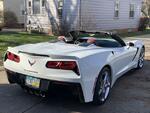


New C8 Corvette Wing Released

Drifting


Joined: Mar 2005
Posts: 1,316
Likes: 646
From: manalapan new jersey
Drifting
Joined: Mar 2005
Posts: 1,316
Likes: 646
From: manalapan new jersey

Thread Starter
Platinum Supporting Vendor
Joined: Sep 2023
Posts: 144
Likes: 50
From: Florida

Melting Slicks


Joined: Oct 2006
Posts: 2,076
Likes: 1,069
From: TX

That is the first thing I was thinking. Putting that spoiler on the trunk lid....seems like it could lead to all kinds of issues. The first one is your question. No matter what its going to provide down force and what does that do to the integrity of the hatch and locking system (soft close)? Is the hatch designed for point or spread load that this provides? Does the hatch even lift/close properly after installation and how long wiill that last?

Administrator


Joined: Mar 2001
Posts: 368,536
Likes: 24,826
From: In a parallel universe. Currently own 2014 Stingray Coupe.
C7 of the Year - Modified Finalist 2021
MO Events Coordinator
St. Jude Co-Organizer
St. Jude Donor '03 thru '26
NCM Sinkhole Donor
CI 5, 8 & 11 Veteran
I like the look of that new wing. 
Thread Starter
Platinum Supporting Vendor
Joined: Sep 2023
Posts: 144
Likes: 50
From: Florida
Great question. Thank you!
Corvette Stories
The Best of Corvette for Corvette Enthusiasts

Every 2027 Corvette Engine Explained
Joe Kucinski
Designer Imagines A Corvette That Looks More Like a Corvette Than the Corvette
Verdad Gallardo
10 Ugly Corvettes That We Still Kinda Love
Joe Kucinski
Top 10 Most Expensive Corvettes Ever Sold on Bring A Trailer
Brett Foote
10 Things Every Corvette Owner Needs (2026 Edition)
Michael S. Palmer
8 Most "Only Corvette Owners Understand" Quirks and Problems
Pouria Savadkouei
10 Reasons the C6 Z06 is Still A Performance Benchmark After 20 Years
Joe Kucinski
How Much Horsepower Every Corvette Engine "LOST" in 1972
Joe Kucinski
Top 10 DOs and DON'Ts for Protecting Your Convertible Top!
Michael S. Palmer
Banned Scam/Spammer
Joined: Oct 2023
Posts: 6,913
Likes: 2,629
From: The E-Ray prophet
I'm not sure I agree with this. If it's area-rule consideration, then I could buy that. But if it's just the additional area under the aerofoil...I'm not sure that matters. If the Jaguar could be an effective jet with stores ON TOP OF the wing, I don't think pillars under a car's wing should matter...

Melting Slicks

Joined: Dec 2019
Posts: 2,617
Likes: 1,805
From: Mandalore
I'm not sure I agree with this. If it's area-rule consideration, then I could buy that. But if it's just the additional area under the aerofoil...I'm not sure that matters. If the Jaguar could be an effective jet with stores ON TOP OF the wing, I don't think pillars under a car's wing should matter...
"It has to do with how wings work. These pieces are shaped to force the air traveling past them to take different paths, which creates different forces on the wing surfaces. Air moving over the top of a car's wing creates a high-pressure zone that pushes the wing, and thus the car, down. Air traveling underneath the wing creates a low-pressure zone that pulls the wing down. Counterintuitively, the air passing under the wing creates far more force than air going over the top. The combined result we call downforce.
The Swan Neck wing design is all about airflow separation. The underside of a wing is the most susceptible to separation, which means no downforce. Traditional underwing stands can be slimmed and streamlined to produce as little turbulence as possible, but only in one direction - straight ahead. As soon as the car turns, the air is coming at them from an angle instead of dead on, which creates turbulence and thus separation at the exact time you don't want it.
The swan neck wing supports eliminate the problem—or at least shift them topside—by attaching to the top of the wing, which has positive pressure pushing down on it and is far more aerodynamically stable (i.e. where a little turbulence from the wing stands won't matter). This makes the wing not only more aerodynamically efficient, but more efficient in more situations."

Melting Slicks
Joined: Jul 2010
Posts: 2,763
Likes: 820
From: SUFFIELD CT USA 2023 C8 CORVETTE UN-MODIFIED FINALIST
2023 C8 of the Year Finalist - Unmodified
I like it but it does raise the question say this provides 900lbs of downforce at 150 mph,, can the hatch , latch etc. take it repeatedly ? The good news is you won't have to reach over it when loading the trunk especially for coupe owners !
Banned Scam/Spammer
Joined: Oct 2023
Posts: 6,913
Likes: 2,629
From: The E-Ray prophet
Mando, I am not buying that explanation. Wing fences and their effects suggest that airflow is actually better when you prevent it from lateral movement across an aerofoil. The "high-pressure" zone on top of a spoiler isn't really high pressure, it's just higher pressure in relation to the lower pressure area created by the camber of the aerofoil being on the underside (downforce) instead of topside (lift).
And just like angle of attack increases lift until you stall--the same thing applies with canting a spoiler to increase downforce. Wing fences delay the onset of aerofoil stall.
In any event, the chord and camber of a spoiler are designed for maximum effectiveness in only one direction of airflow--head on. The implication that airflow could come sideways onto a spoiler and contribute productively to downforce--is laughable. That is why most spoilers have winglets or at the very least endcaps. It is why F1 and indycars are designed so that the airflow arriving at the rear spoiler is shaped by the car's bodywork/aerofoils so that it will impact the spoiler at the ideal angle for maximum effectiveness.
Off the top of my head, the only way to design a stationary spoiler so that it provided maximum grip directional to a car turning would be to vary the aerofoil dimensions along the span so that the ideal airflow angle on the port edge would be several degrees left of the car's heading; and airflow on the starboard side would be several degrees right of the car's heading. That is a very complex aerofoil to design even with a straight span. It becomes even more complex to design if the span isn't linear.
And just like angle of attack increases lift until you stall--the same thing applies with canting a spoiler to increase downforce. Wing fences delay the onset of aerofoil stall.
In any event, the chord and camber of a spoiler are designed for maximum effectiveness in only one direction of airflow--head on. The implication that airflow could come sideways onto a spoiler and contribute productively to downforce--is laughable. That is why most spoilers have winglets or at the very least endcaps. It is why F1 and indycars are designed so that the airflow arriving at the rear spoiler is shaped by the car's bodywork/aerofoils so that it will impact the spoiler at the ideal angle for maximum effectiveness.
Off the top of my head, the only way to design a stationary spoiler so that it provided maximum grip directional to a car turning would be to vary the aerofoil dimensions along the span so that the ideal airflow angle on the port edge would be several degrees left of the car's heading; and airflow on the starboard side would be several degrees right of the car's heading. That is a very complex aerofoil to design even with a straight span. It becomes even more complex to design if the span isn't linear.



Instructor


Joined: Nov 2023
Posts: 209
Likes: 150
How much downforce does each wing generate? What front splitter / aero do you have to balance the aero on the car? If you are generating more aero what spring rate do you recommend to run? How are you balancing the aero?
Else of this is to just look interesting or "cool" then party on.
Else of this is to just look interesting or "cool" then party on.
So I guess it's just a look and does nothing functionally?
Melting Slicks
Joined: Dec 2019
Posts: 2,617
Likes: 1,805
From: Mandalore
Mando, I am not buying that explanation. Wing fences and their effects suggest that airflow is actually better when you prevent it from lateral movement across an aerofoil. The "high-pressure" zone on top of a spoiler isn't really high pressure, it's just higher pressure in relation to the lower pressure area created by the camber of the aerofoil being on the underside (downforce) instead of topside (lift).
And just like angle of attack increases lift until you stall--the same thing applies with canting a spoiler to increase downforce. Wing fences delay the onset of aerofoil stall.
In any event, the chord and camber of a spoiler are designed for maximum effectiveness in only one direction of airflow--head on. The implication that airflow could come sideways onto a spoiler and contribute productively to downforce--is laughable. That is why most spoilers have winglets or at the very least endcaps. It is why F1 and indycars are designed so that the airflow arriving at the rear spoiler is shaped by the car's bodywork/aerofoils so that it will impact the spoiler at the ideal angle for maximum effectiveness.
Off the top of my head, the only way to design a stationary spoiler so that it provided maximum grip directional to a car turning would be to vary the aerofoil dimensions along the span so that the ideal airflow angle on the port edge would be several degrees left of the car's heading; and airflow on the starboard side would be several degrees right of the car's heading. That is a very complex aerofoil to design even with a straight span. It becomes even more complex to design if the span isn't linear.
And just like angle of attack increases lift until you stall--the same thing applies with canting a spoiler to increase downforce. Wing fences delay the onset of aerofoil stall.
In any event, the chord and camber of a spoiler are designed for maximum effectiveness in only one direction of airflow--head on. The implication that airflow could come sideways onto a spoiler and contribute productively to downforce--is laughable. That is why most spoilers have winglets or at the very least endcaps. It is why F1 and indycars are designed so that the airflow arriving at the rear spoiler is shaped by the car's bodywork/aerofoils so that it will impact the spoiler at the ideal angle for maximum effectiveness.
Off the top of my head, the only way to design a stationary spoiler so that it provided maximum grip directional to a car turning would be to vary the aerofoil dimensions along the span so that the ideal airflow angle on the port edge would be several degrees left of the car's heading; and airflow on the starboard side would be several degrees right of the car's heading. That is a very complex aerofoil to design even with a straight span. It becomes even more complex to design if the span isn't linear.
"Negatives:
i. For ease of install, the wing would be mounted on the bottom and not swan neck.
ii. This reduces efficiency of the wing but isn’t a massive performance hit"
Then they pivoted to a swan neck:


They use cutting edge CFD modeling and analysis technology on designs which they'd then validate with wind tunnel testing:
"ANSYS Adjoint Solver:
This is something not many people in our market know about, let alone heard before. This is the same technology that F1 companies utilize to optimize their aero packages. Aerodynamics are not very intuitive, you think A will happen and B, C, or Z happens. ANSYS Adjoint Solver is a large reason why the latest generations of F1 cars look so odd; it’s due to this software’s ability to optimize the geometry in ways us designers would never think about without thousands upon thousands of hours of work."


Their C8 wing has a trad mount for which I'm sure pros/cons were considered (weight, packaging, complexity, cost). The simulated fluid dynamics shows where flow gets broken at the pedestals compared to the BRZ's swan neck:


Verus offers the most comprehensive suite of full functional track aero that I know of for the C8.
Last edited by switchlanez; Aug 15, 2024 at 09:20 PM.