When you click on links to various merchants on this site and make a purchase, this can result in this site earning a commission. Affiliate programs and affiliations include, but are not limited to, the eBay Partner Network.
For those interested in performance numbers for a high speed driving event, this is a summary of a recent race.
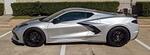
The car is a stock 2022 Z51 with a four wheel street alignment driving in a slightly modified Sport mode. The race is the north bound leg of the Big Bend Open Road Race, a 59 mile course in west Texas. There are 61 turns of varying intensity and a 1500 foot elevation change. The target is to average 140 mph with a maximum allowed speed of 168 mph.
This data summary was in part extracted from the PDR mp4 file using Cosworth’s PI Toolbox 12.3. There are 15K + data points in the raw data so some data smoothing was used for presentation purposes. A 23rd order polynomial function was used for smoothing. The ambient air temperature varies along the course and with altitude changes with an average of 86 F. The average elevation is about 3400 feet. The transmission was in auto for the entire course.
The temperature graphs show the oil, coolant and transmission temperature. Oil got the hottest at about 225 F. Coolant hit 210 and the transmission hit 205. This was a welcome surprise. My C7 on the same course was always much hotter. I saw oil temperatures and transmission temperatures above 260 F. This is a big improvement.
The tire pressure graphs show the left rear as typical of all the tires. There is an 80 degree temperature rise with the tie pressure varying from 31 to 37 psi. The tire pressure rose at 1 psi for each 13 degrees temperature rise. The C8 manual recommends setting your tire pressure to 38 psi cold for spirited driving. Although this recommendation comes straight from a tire institute’s book, it does not match the reality I see. With the expected tire pressure rise you will quickly trip the tire pressure warnings and your driver information center will show only tire warnings for the rest of the drive.
The speed and acceleration graphs illustrate the driving profile for the course. The first 19 miles have a lot of complex turns with target speeds from 100 to 150 mph. The next 20 mile have several multi-mile straights. The last miles show I was on my target time and only needed to average 125 mph to finish on time.
In the C7, I usually held the lateral G force to .5-.6 in most of the 100-150 mph turns for comfort and ease of driving. The C8 felt much better. I raised my target speed through most of the turns by 4 to 12 mph. I was pushing .8-.95 lateral G’s at 130-140 mph and it felt great. The C7 was great to drive in a high speed event like this, but this C8 is that much better.
I use cruise control in the straights set to 166 mph to avoid going over 168 mph and DQing. You can’t set the cruise to 166 mph. It will only set to 159 mph. Then using resume, you can walk it up to 166 mph. But if you brake, it doesn’t seem to resume to 166 mph. You have to step it up again to 166 mph. That is a real pain while driving at 165 mph. And yes, the air conditioner and all other accessories seem to work as intended at 166 mph.
The car averaged 6.5 mpg using 91 octane with ethanol gas.
This is great car at 165 mph. It is stable, as quiet as can be expected and the handling is great. The weakest link still seems to be the driver.
Wow! Awesome real world track results for a rather well engineered vehicle in stock form. Do you happen to have inlet air temps to indicate how much heat is picked up by the air ducting and/or the air cleaner?
This is what I can extract using Pi Toolbox. The car was moving up slowly in queue for several minutes before hard acceleration.
This appears rather impressive based on the feedback from some of the track guys! I'll call IAT approximately 10-13° above ambient. A little additional heatshielding could likely drop that to a <10° rise.
Great information. I'm just now learning (tonight) to use Cosworth after this past track weekend. Haven't found where this particular data is.
There's no doubt I was having IAT issues from heat soak and maybe just higher temps period. Saturday was around 87 and I was running hard with great times. My car oil temp was up to 237, water 223, and Trans 217 with no issues that day. The next day temps got up to 91 but shorter runs of 15 minutes instead of the normal 30 minutes I had lower oil temps 230, water 218, trans 210 but we had a black flag for an incident and I sat there for 10 minutes and as soon as we went back out I had hard power cuts. I'm sure a lot of timing pulled and holding revs at 4500 only in fourth gear for about two/ three laps which obviously after it had cooled down some it was back on par majority of the time but still would appear here and there. I'm going to start logging data from now on to see what's going on and try to learn this Cosworth program along with another system.
As Kracka mentioned I know there could be some more heat protection added here and there along with finding some ways to get more/ cleaner air to the intake and engine. The OEM air box I feel is not up to the task more or less other intakes systems. Needs a total heat shielding away from the motor like the K&N system but I want to wrap my head around what will be the best solution as I'm discussing with another to get where this car can be happy. Even with better isolation of the air filter the IAT is still in a vulnerable spot.
Anyone know exactly where the IAT is? I haven't looked but I know it should be near the throttle body. Just never looked that good yet and haven't had time. But I will tomorrow. I know there's an air temp sensor at the bottom of air intake. I've now seen where the C7 & and 6 had an issue with the IAT sensor this but most of them where supercharged. They had relocated them but tuning is required to offset the difference but there was a lot debating of this practice.
Anyone know exactly where the IAT is? I haven't looked but I know it should be near the throttle body. Just never looked that good yet and haven't had time. But I will tomorrow. I know there's an air temp sensor at the bottom of air intake. I've now seen where the C7 & and 6 had an issue with the IAT sensor this but most of them where supercharged. They had relocated them but tuning is required to offset the difference but there was a lot debating of this practice.
The sensor at the bottom of the stock airbox is an ambient temp sensor that controls the engine bay ventilation fan. The IAT sensor is likely contained within the MAF; I do not remember unplugging one from the intake manifold while swapping the ported unit on (there's a MAP sensor).
The sensor at the bottom of the stock airbox is an ambient temp sensor that controls the engine bay ventilation fan. The IAT sensor is likely contained within the MAF; I do not remember unplugging one from the intake manifold while swapping the ported unit on (there's a MAP sensor).
Thats correct, IAT is in the MAF.
I am still wrapping my head around the ambient temp sensor in the engine bay, i am trying to determine if it has more influence than just the engine bay ventilation.
I am still wrapping my head around the ambient temp sensor in the engine bay, i am trying to determine if it has more influence than just the engine bay ventilation.
Highly likely is my guess. I would imagine it has the ability to put the engine into limp mode in order to protect itself if it senses temps/heatsoak becoming excessive. One member here posted an issue where his failed and forced the fan to run 100% of the time the engine was running. I should go back to see if he commented on experiencing any engine errors/warnings to go along with it because I do not remember...
godzilladude Paragon harness bar, 6 Point harness, arm restraints, HANS, fire extinguisher, flame suit, shoes, gloves, under wear, etc. Meets or exceed BBORR Grand Sport and SORC tech requirements. Car has two rear view mirror mounted Go Pro 4's and extensive computer navigation equipment for racing. Then the next day it turns back into a plain vanilla street car.
godzilladude Paragon harness bar, 6 Point harness, arm restraints, HANS, fire extinguisher, flame suit, shoes, gloves, under wear, etc. Meets or exceed BBORR Grand Sport and SORC tech requirements. Car has two rear view mirror mounted Go Pro 4's and extensive computer navigation equipment for racing. Then the next day it turns back into a plain vanilla street car.
Excellent! I was out at BBORR back in 2008, it is fun. Getting my then GTO up to GS spec would have been a challenge. The C8 works MUCH easier.
And thanks for all the details on performance.
Here's another data point for anyone concerned with extreme accuracy.
The PDR mph number seems to match the displayed speedometer mph.
I have two GPS-19X precision GPS units recording at 10 readings per second and they are very accurate.
At 125 mph the average GPS velocity from the two units is 1.15 mph higher that the PDR velocity.
At 163 mph the GPS velocity is 1.43 mph higher than the PDR velocity.
I take the GPS velocity to be the true number.
Albeit slight, for my car, I am actually going faster than the speedometer shows.
In this event that can result in a disqualification.
















 High Speed Driving Performance Summary