



How does RT improvement affect ET?
Thread Starter
Melting Slicks


Joined: Jul 2007
Posts: 2,116
Likes: 6
From: Waynesville NC
 How does RT improvement affect ET?
Did a search to no avail...
What kind of gains does one get with better RT's?
My RT's were (at best) disdainful and I was just wondering, with my driver improvement mods, how will a better RT affect my final ET and speed?
92 degrees - 1500 fool elevation - 2 year old GY Supercars with 15,000 miles - RT .686 - 60ft 2.359
1/4 13.022 @ 112.87
I couldn't hookup well and the rear was a little squirrely all the way through first gear.
Thanks
What kind of gains does one get with better RT's?
My RT's were (at best) disdainful and I was just wondering, with my driver improvement mods, how will a better RT affect my final ET and speed?
92 degrees - 1500 fool elevation - 2 year old GY Supercars with 15,000 miles - RT .686 - 60ft 2.359
1/4 13.022 @ 112.87
I couldn't hookup well and the rear was a little squirrely all the way through first gear.
Thanks

Le Mans Master


Joined: Mar 1999
Posts: 6,029
Likes: 85
From: Palm Coast, FL
simple answer - If you are just going for ET ... reaction times do not matter.
If you are racing, and dialing a time, it will effect what you dial (ET).
Your staging will also effect ET
If you are racing, and dialing a time, it will effect what you dial (ET).
Your staging will also effect ET

Race Director


Joined: Jan 2003
Posts: 15,177
Likes: 90
From: State of Confusion
RT - the time it takes the rear edge of the front tire clears the beam after the Green light glows (if-before, it's a foul-start / Red-light)
ET - this clock starts when the rear-edge of the tire clears the beam, and stops whenever the front edge of that tire, or bumper, or chin-spoiler, trips the finish-line beam down-track
ET is how-long it takes your car to travel the measured distance, while RT shows when it leaves the line , in relation to the tree blinking Green
this explains how a slower-car can beat a quicker car to the finish-line in a heads-up, no break-out race, like you see on ESPN2 ~ slower-but-sooner beats quicker-but-later

ET - this clock starts when the rear-edge of the tire clears the beam, and stops whenever the front edge of that tire, or bumper, or chin-spoiler, trips the finish-line beam down-track
ET is how-long it takes your car to travel the measured distance, while RT shows when it leaves the line , in relation to the tree blinking Green
this explains how a slower-car can beat a quicker car to the finish-line in a heads-up, no break-out race, like you see on ESPN2 ~ slower-but-sooner beats quicker-but-later

Race Director

Joined: Oct 1999
Posts: 13,298
Likes: 14
From: Somers NY
RT - the time it takes the rear edge of the front tire clears the beam after the Green light glows (if-before, it's a foul-start / Red-light)
ET - this clock starts when the rear-edge of the tire clears the beam, and stops whenever the front edge of that tire, or bumper, or chin-spoiler, trips the finish-line beam down-track
ET is how-long it takes your car to travel the measured distance, while RT shows when it leaves the line , in relation to the tree blinking Green
this explains how a slower-car can beat a quicker car to the finish-line in a heads-up, no break-out race, like you see on ESPN2 ~ slower-but-sooner beats quicker-but-later
ET - this clock starts when the rear-edge of the tire clears the beam, and stops whenever the front edge of that tire, or bumper, or chin-spoiler, trips the finish-line beam down-track
ET is how-long it takes your car to travel the measured distance, while RT shows when it leaves the line , in relation to the tree blinking Green
this explains how a slower-car can beat a quicker car to the finish-line in a heads-up, no break-out race, like you see on ESPN2 ~ slower-but-sooner beats quicker-but-later
Glen RT and how it equates to your ET is one of the hardest things to do..! People can't understand how a slower car (ET) can beat a (FASTER ET) and that is only in "Heads Up" racing..
Try explaining it in a "Bracket race" where I have a .010 light & you have an .005 light but I run my # with a .009 and you run it with a .010
You win by .004 (I think) you take the stripe by .001
Now do this scenario with a 14.50 car racing a 11.40 car

Race Director
Joined: Jan 2003
Posts: 15,177
Likes: 90
From: State of Confusion

one racer has a .019 package (.010 + .009), other has .015 package (.005 + .010)
that's why it is easiest to discuss each respective racer's 'package', or how they ran against their-own dial-in, and ignore the handicap-start
Thread Starter
Melting Slicks
Joined: Jul 2007
Posts: 2,116
Likes: 6
From: Waynesville NC
...so if I want to get into the 12's I need to improve my 60 foot times, right? My Goodyears (based on past wear) have about 5g left on them and I'm sure a different
street tire will help. I tried using the TC on 1 of my 6 runs but felt it was too intrusive, and as a result I hit the rev-limiter at the top of 1st and 2nd gear. Anyone using a street tire they recommend?
Also, which type of helmet seems to work well...the one I used had a large pop up shield with speakers and a mic. It was extremely bulky and no doubt affected my concentration as well.
street tire will help. I tried using the TC on 1 of my 6 runs but felt it was too intrusive, and as a result I hit the rev-limiter at the top of 1st and 2nd gear. Anyone using a street tire they recommend?
Also, which type of helmet seems to work well...the one I used had a large pop up shield with speakers and a mic. It was extremely bulky and no doubt affected my concentration as well.
Race Director
Joined: Oct 1999
Posts: 13,298
Likes: 14
From: Somers NY
...so if I want to get into the 12's I need to improve my 60 foot times, right? My Goodyears (based on past wear) have about 5g left on them and I'm sure a different
street tire will help. I tried using the TC on 1 of my 6 runs but felt it was too intrusive, and as a result I hit the rev-limiter at the top of 1st and 2nd gear. Anyone using a street tire they recommend?
Also, which type of helmet seems to work well...the one I used had a large pop up shield with speakers and a mic. It was extremely bulky and no doubt affected my concentration as well.
street tire will help. I tried using the TC on 1 of my 6 runs but felt it was too intrusive, and as a result I hit the rev-limiter at the top of 1st and 2nd gear. Anyone using a street tire they recommend?
Also, which type of helmet seems to work well...the one I used had a large pop up shield with speakers and a mic. It was extremely bulky and no doubt affected my concentration as well.
IMO An open face is fine for any car that runs 11.00 or slower... much better visibility etc...
As for tires I use Nitto 555 Drag radial size 305/35x18" and they are a perfect fit on my 05... I'm using 2004 rear thin spoke wheels, I'm automatic , & don't have any traction problems... my BEST so far is 11.98 @ 117 MPH.. I also leave the Nitto's on all the racing season March through Nov.
Corvette Stories
The Best of Corvette for Corvette Enthusiasts

5 Best & 5 Worst Corvette Daily Drivers
Joe Kucinski
The Headlights of Every Corvette Generation Explained
Joe Kucinski
5 Best & 5 Most Overrated Corvette Track Packages of All Time!
Joe Kucinski
Every 2027 Corvette Engine Explained
Joe Kucinski
Designer Imagines A Corvette That Looks More Like a Corvette Than the Corvette
Verdad Gallardo
10 Ugly Corvettes That We Still Kinda Love
Joe Kucinski
Top 10 Most Expensive Corvettes Ever Sold on Bring A Trailer
Brett Foote
10 Things Every Corvette Owner Needs (2026 Edition)
Michael S. Palmer
8 Most "Only Corvette Owners Understand" Quirks and Problems
Pouria Savadkouei
Team Owner

Joined: Feb 2000
Posts: 32,545
Likes: 2
From: Lithia FL
Cruise-In II & IV Veteran
CI VI Drag Champ!
for the most part, you guys are right but for us index racers....I can show how RT impacts ET though not technically. Shall I go on? Think shallow/deep stage and that impacts both RT and ET provide all other things equal. That's a 201 class, not a 101 

Team Owner

Joined: Feb 2001
Posts: 27,264
Likes: 141
From: Short Hills, NJ

Race Director
Joined: Jan 2003
Posts: 15,177
Likes: 90
From: State of Confusion
the RT is what would've been different.
Typically, in a sorted-out car, you will find that an improvement of .01-seconds in 60' will equate to about .02-quicker ET
for the quickest possible ET for any combination, you need to apply the available power as quickly and efficiently as-possible
I haven't raced a standard-shift car (as they are very-difficult to make consistent for bracket-racing), but I would think that making smooth, crisp 1-2 and 2-3 shifts would be the 1st thing to concentrate-on as a driver
get the car 'rolling' quickly to 330' & beyond, and it's tough to not run a good ET
I am not-familiar with the ET tendencies of the C5 & C6-cars, but if you post your incremental times (splits), it's possible that others here will offer their thoughts on what they see
there are many smart racers on this site that we can learn from, but I think your 112 MPH trap-speed shows that car is capable of running low-12's (maybe quicker?) if traction, gearing & driving is optimized
welcome to the insanity


Drifting


Joined: Jan 2006
Posts: 1,457
Likes: 22
For 90% here RT has no effect on ET.
For the rest (index and bracket racers) I see a 1 to 1 ratio of ET, 60' and RT in my firebird and mustang. As my 60' and ET increase my RT decreases. BR201 and BR301 deal with the rollout that's not shown on time slips. Crazy when you get to a point where the numbers get so small.
Thread Starter
Melting Slicks
Joined: Jul 2007
Posts: 2,116
Likes: 6
From: Waynesville NC
[QUOTE=Glensgages;1580953357][B][FONT="Arial"]Correct... you could have launched when the first Amber bulb blinked, or wait 3 hours after the Green bulb shown, but regardless, under those atmospheric-conditions, the power you were making, and with your (then) present driving-style, your car would've still run 13.022
the RT is what would've been different.
Typically, in a sorted-out car, you will find that an improvement of .01-seconds in 60' will equate to about .02-quicker ET
for the quickest possible ET for any combination, you need to apply the available power as quickly and efficiently as-possible
I haven't raced a standard-shift car (as they are very-difficult to make consistent for bracket-racing), but I would think that making smooth, crisp 1-2 and 2-3 shifts would be the 1st thing to concentrate-on as a driver
get the car 'rolling' quickly to 330' & beyond, and it's tough to not run a good ET
I am not-familiar with the ET tendencies of the C5 & C6-cars, but if you post your incremental times (splits), it's possible that others here will offer their thoughts on what they see
there are many smart racers on this site that we can learn from, but I think your 112 MPH trap-speed shows that car is capable of running low-12's (maybe quicker?) if traction, gearing & driving is optimized
welcome to the insanity
I can see where the insanity issue comes from - my adrenaline was racing and the 2 other couples I "dragged" to the strip ended up not wanting to leave for our dinner reservations. My buddy's wife talked him into running his '05 'Vert at the last minute (his car hooked so well that he was about 3 car lengths ahead of me by the 330') and his reaction times were consistently around .200. He came up anywhere from .5 to .7 slower than my car as I trapped about 3 car lengths ahead of him in 5 runs.
I can't read all the incremental times of my 13.022 second run but I ran a 13.386 @ 110.50 with legible incremental numbers as follows:
RT .341
60' 2.318
330' 5.932
1/8 8.886 @84.21
1000 11.340
It was 92 degrees and it wasn't busy so we were able to get back in line after each race; running 5 runs in about 30 minutes. It was a mistake not letting the car cool down between runs - as my times became higher with each race. Yep, I've lots to learn! ;-)
Ain't this forum great?!?
the RT is what would've been different.
Typically, in a sorted-out car, you will find that an improvement of .01-seconds in 60' will equate to about .02-quicker ET
for the quickest possible ET for any combination, you need to apply the available power as quickly and efficiently as-possible
I haven't raced a standard-shift car (as they are very-difficult to make consistent for bracket-racing), but I would think that making smooth, crisp 1-2 and 2-3 shifts would be the 1st thing to concentrate-on as a driver
get the car 'rolling' quickly to 330' & beyond, and it's tough to not run a good ET
I am not-familiar with the ET tendencies of the C5 & C6-cars, but if you post your incremental times (splits), it's possible that others here will offer their thoughts on what they see
there are many smart racers on this site that we can learn from, but I think your 112 MPH trap-speed shows that car is capable of running low-12's (maybe quicker?) if traction, gearing & driving is optimized
welcome to the insanity
I can see where the insanity issue comes from - my adrenaline was racing and the 2 other couples I "dragged" to the strip ended up not wanting to leave for our dinner reservations. My buddy's wife talked him into running his '05 'Vert at the last minute (his car hooked so well that he was about 3 car lengths ahead of me by the 330') and his reaction times were consistently around .200. He came up anywhere from .5 to .7 slower than my car as I trapped about 3 car lengths ahead of him in 5 runs.
I can't read all the incremental times of my 13.022 second run but I ran a 13.386 @ 110.50 with legible incremental numbers as follows:
RT .341
60' 2.318
330' 5.932
1/8 8.886 @84.21
1000 11.340
It was 92 degrees and it wasn't busy so we were able to get back in line after each race; running 5 runs in about 30 minutes. It was a mistake not letting the car cool down between runs - as my times became higher with each race. Yep, I've lots to learn! ;-)
Ain't this forum great?!?
Thread Starter
Melting Slicks
Joined: Jul 2007
Posts: 2,116
Likes: 6
From: Waynesville NC
Is there a quick reference chart for figuring Density Altitude on this forum? I guess I could always check my old Felsenthal E6B flight computer I have sitting around the house somewhere. I believe the field elevation at Bristol is about 14-1500 feet.
Race Director
Joined: Oct 2001
Posts: 19,655
Likes: 430
From: Melbourne Florida
Cruise-In IV Veteran
Now I am confused...R/T cannot affect ET in any way...Staging position can but that is not what he asked...
If one cuts a better light it will have no effect on the ET just as a worse light has no effect...a better R/T does have an effect on certain aspects of drag racing but not ET...
As noted, ET improvement lies in better 60' times...
A general rule of thumb is: you will pick up twice as much in ET for whatever you pick up in your 60'...if you ran 13.02 with a 2.36 60' and then you dropped your 60' 30 numbers to a 2.06 you would run about 12.42...I hope my math is correct...
Anyway, the key to a better ET is your short time (60') not your R/T...cutting a better light is another topic as is staging position, heads up racing, bracket racing, index racing and helmets...
So you answered your own question without knowing it...slipping and sliding through first gear is your culprit...whether it be with new tires or driving technique, if you stop most of the sliding your ET will be better...
Good luck and have fun out there...
If one cuts a better light it will have no effect on the ET just as a worse light has no effect...a better R/T does have an effect on certain aspects of drag racing but not ET...
As noted, ET improvement lies in better 60' times...
A general rule of thumb is: you will pick up twice as much in ET for whatever you pick up in your 60'...if you ran 13.02 with a 2.36 60' and then you dropped your 60' 30 numbers to a 2.06 you would run about 12.42...I hope my math is correct...
Anyway, the key to a better ET is your short time (60') not your R/T...cutting a better light is another topic as is staging position, heads up racing, bracket racing, index racing and helmets...
So you answered your own question without knowing it...slipping and sliding through first gear is your culprit...whether it be with new tires or driving technique, if you stop most of the sliding your ET will be better...
Good luck and have fun out there...
Race Director
Joined: Oct 2001
Posts: 19,655
Likes: 430
From: Melbourne Florida
Cruise-In IV Veteran
http://www.csgnetwork.com/densaltcalc.html
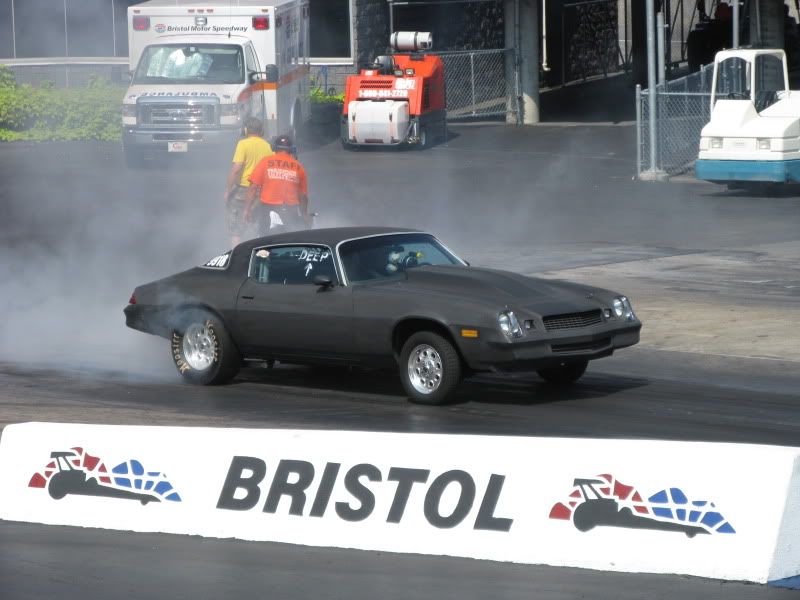
I raced at Bristol and it is a very tricky track...I ran 7.50 staging deep versus 7.22 staged deep here in Florida...it was Africa hot up there...95 to 100* every day...prettiest track I have run at though...they have a shower facility that puts most home bath rooms to shame and it is sponsored by Old Spice (not kidding)....my junk at Bristol...
Last edited by Fuzzy Dice; May 31, 2012 at 09:01 PM.
Thread Starter
Melting Slicks
Joined: Jul 2007
Posts: 2,116
Likes: 6
From: Waynesville NC
Thanks for all the information...Yes, Bristol was a great place to run the car and the folks there were very friendly and "understanding" of our junior drag racing status. And yes, the bathrooms were spotless!
Team Owner
Joined: Feb 2001
Posts: 27,264
Likes: 141
From: Short Hills, NJ
How does one calculate the physical elevation/altitude into that conversion to get the actual DA for a particular location.
I came up with a DA of like 83000 feet
 using only the parameters given there.

Safety Car

Joined: Sep 2010
Posts: 3,752
Likes: 190
From: Indiana PA
These guys are getting pretty advanced for a beginner like yourself.
If you goal is to go bracket racing, pay more attention to RT, ET, staging,etc...
However, like you, I am mainly focused on getting my best ET's and running consistently. Once THIS is done, then you can worry about RT and so forth.
The first 60' is the most critical next to that the 330' mark is critical in a street car. After that it is all hitting your shift marks and keeping the car straight.
You have to get good 60's to get good ET's not way around it. Same with shifting. Good launches, with little or no wheel spin, smooth yet forceful. Shifts not bouncing off the rev limiter, crisp, smooth, fast. Your left foot should be hitting the floor at the exact time your right hand is hitting the next gear. Right foot should be synchronized to lift off with the left foot being full in. DO NOT POWER SHIFT IF YOU LIKE YOUR TRANSMISSION, IE, KEEPING THE GAS FLOORED WHEN YOU SHIFT. At least in stock-ish street car. Modified race boxes are another story.
If you going after good ET's you WANT to shallow stage, long story short. Get your pre-stage bulb lit and you just want to bump the car into the stage light. It should just barely flicker on if you do it right.
The timer does not start until you break the beam which is about foot ahead of your shallow stage position. For best ET you want to be moving as fast as possible when you break that beam.
Deep staging is more advanced and used more for bracket type racing. When consistent ET's with a dial, and good RT are everything if you want to win.
I agree with Glengauges.... Indeed.
I'm still learning things, like this newbie but aren't we all? Just at different stages.
If you goal is to go bracket racing, pay more attention to RT, ET, staging,etc...
However, like you, I am mainly focused on getting my best ET's and running consistently. Once THIS is done, then you can worry about RT and so forth.
The first 60' is the most critical next to that the 330' mark is critical in a street car. After that it is all hitting your shift marks and keeping the car straight.
You have to get good 60's to get good ET's not way around it. Same with shifting. Good launches, with little or no wheel spin, smooth yet forceful. Shifts not bouncing off the rev limiter, crisp, smooth, fast. Your left foot should be hitting the floor at the exact time your right hand is hitting the next gear. Right foot should be synchronized to lift off with the left foot being full in. DO NOT POWER SHIFT IF YOU LIKE YOUR TRANSMISSION, IE, KEEPING THE GAS FLOORED WHEN YOU SHIFT. At least in stock-ish street car. Modified race boxes are another story.
If you going after good ET's you WANT to shallow stage, long story short. Get your pre-stage bulb lit and you just want to bump the car into the stage light. It should just barely flicker on if you do it right.
The timer does not start until you break the beam which is about foot ahead of your shallow stage position. For best ET you want to be moving as fast as possible when you break that beam.
Deep staging is more advanced and used more for bracket type racing. When consistent ET's with a dial, and good RT are everything if you want to win.
I agree with Glengauges....
Indeed. I'm still learning things, like this newbie but aren't we all? Just at different stages.
Last edited by 93Rubie; May 31, 2012 at 11:19 PM.