



Safe maximum piston speed?

Thread Starter
Melting Slicks

Joined: Mar 2003
Posts: 2,472
Likes: 0
From: Toronto ONTARIO
 Safe maximum piston speed?
Not the most familiar with this stuff. have a 388 ci . 3.75 stroke. using a 5.85 rod. is there a formula for maxium piston speed etc? i remember reading an article about airflow velocity and theres a certain fps they want to maintain in f-1 engnes. that got me curious.
thanks !
thanks !
Thread Starter
Melting Slicks
Joined: Mar 2003
Posts: 2,472
Likes: 0
From: Toronto ONTARIO
ive been readin up on this all night 
came across some good readings.. one short one sums it up quick
http://www.mustangsandmore.com/ubb/S...stonspeed.html
based on his formula of maximum engine speed for a race engine is 30,000/ stroke . using his equation i get 8000 rpm (3.75 stroke).
wondering what you guys go by etc or is this a general rule of thumb that builders follow?
came across some good readings.. one short one sums it up quick
http://www.mustangsandmore.com/ubb/S...stonspeed.html
based on his formula of maximum engine speed for a race engine is 30,000/ stroke . using his equation i get 8000 rpm (3.75 stroke).
wondering what you guys go by etc or is this a general rule of thumb that builders follow?

Le Mans Master


Joined: Feb 1999
Posts: 5,877
Likes: 1
From: Park Ridge IL
Several of us discussed this to great length a couple of years ago here. I've always calculated it in terms of feet per minute, but used variation of the foruma listed in the link above (the result is the same, it's just easier to explain to people sometimes):
Piston Speed in Feet per Minute = (stroke x 2 x rpm)/12
Based on my personal experience, I'd say around 4500 feet per minute for a well built (internally balanced, 4340NT crank, 4340 rods with cap bolts, steel pins, forged pistons, and a suitable valvetrain) street/strip engine is around the limit for reliability. Production engine's are generally good up to around 3800-4000 feet per minute. Racing engines such Nextel Cup, F1, Indy, and even sportbikes have piston speeds exceeding 4800 feet per minute and maybe exceeding 5000.
Piston Speed in Feet per Minute = (stroke x 2 x rpm)/12
Piston Speed in Feet per Minute = (stroke x 2 x rpm)/12
Based on my personal experience, I'd say around 4500 feet per minute for a well built (internally balanced, 4340NT crank, 4340 rods with cap bolts, steel pins, forged pistons, and a suitable valvetrain) street/strip engine is around the limit for reliability. Production engine's are generally good up to around 3800-4000 feet per minute. Racing engines such Nextel Cup, F1, Indy, and even sportbikes have piston speeds exceeding 4800 feet per minute and maybe exceeding 5000.
Piston Speed in Feet per Minute = (stroke x 2 x rpm)/12
Thread Starter
Melting Slicks
Joined: Mar 2003
Posts: 2,472
Likes: 0
From: Toronto ONTARIO
I did the formula .. 3.75 x 2 x 7800 rpm / 12 = 4875. sounds like its on the high side? of course we dont know where and how much power it will make beyond 7000 so i guess its tough to say if 7800 rpm will even be needed. but im hoping so
Last edited by DieL; Mar 3, 2006 at 08:40 PM.
Le Mans Master
Joined: Feb 1999
Posts: 5,877
Likes: 1
From: Park Ridge IL
Why? Why "hope" to build a 3.75" stroke 7800rpm engine? What's your hp/tq goals? Unless it's a race only application, there's probably a better combo to achieve you goals without requiring excessive rpm's. That's alot of stroke for a 7800rpm engine.

Race Director

Joined: May 2000
Posts: 12,712
Likes: 2,270
The chances of building a remotely streetable 3.75" stroke engine that will rev useably to 7800 and last more that two minutes is about as likely as finding the Holy Grail!
It's always a good idea to look at mean piston speed and consider the following:
1. Internal inertia stress on the bottom end components increases with the SQUARE of mean piston speed.
2. Sonic velocity places a limit on aspiration efficiency at high mean piston speeds - the airflow just can't keep up with piston motion, no matter how short and efficient the inlet tract is.
The first issue has been dealt with over the years with better design and materials technology.
The second limit is basic physics and there is no solution other than to eek out incremental improvements with better detail design.
The current "limit" is about 5200 FPM, which is the regime of F1 and NASCAR engines.
The new LS7 is running 4733 FPM at the 7100 rev fuel cutoff, which is VERY Impressive for a production engine, even DOHC, but if you have enough budget for titanium rods, inlet valves, dry sump, etc. it can be done with Gen IV architecture components.
If you want to approach this level using vintage SB architecture components you better have at least a $20,000 budget, but it still won't be reasonably streetable.
About 3800-4000 FPM is a reasonable goal for an enthusiast using vintage architecture SB components with a few thousand dollars to spend on a good street or dual purpose high performance engine.
Duke
It's always a good idea to look at mean piston speed and consider the following:
1. Internal inertia stress on the bottom end components increases with the SQUARE of mean piston speed.
2. Sonic velocity places a limit on aspiration efficiency at high mean piston speeds - the airflow just can't keep up with piston motion, no matter how short and efficient the inlet tract is.
The first issue has been dealt with over the years with better design and materials technology.
The second limit is basic physics and there is no solution other than to eek out incremental improvements with better detail design.
The current "limit" is about 5200 FPM, which is the regime of F1 and NASCAR engines.
The new LS7 is running 4733 FPM at the 7100 rev fuel cutoff, which is VERY Impressive for a production engine, even DOHC, but if you have enough budget for titanium rods, inlet valves, dry sump, etc. it can be done with Gen IV architecture components.
If you want to approach this level using vintage SB architecture components you better have at least a $20,000 budget, but it still won't be reasonably streetable.
About 3800-4000 FPM is a reasonable goal for an enthusiast using vintage architecture SB components with a few thousand dollars to spend on a good street or dual purpose high performance engine.
Duke
Last edited by SWCDuke; Mar 4, 2006 at 12:51 AM.

Le Mans Master

Joined: Apr 2000
Posts: 7,562
Likes: 9
From: B'Ville NY
Cruise-In III Veteran
St. Jude Donor '05
Originally Posted by DieL
I did the formula .. 3.75 x 2 x 7800 rpm / 12 = 4875. sounds like its on the high side? of course we dont know where and how much power it will make beyond 7000 so i guess its tough to say if 7800 rpm will even be needed. but im hoping so
Hmm, I'd consider my bottom end to be pretty tough on my 388 sbc, and hope it would survive 7500 rpms if I took it that high.
For my combo I came up with 3.625 x 2 x 7500rpms/ 12 = 4531.25
WIth your 7800rpm goal, I came up with 4712.5 so you could lessen piston speed by going to a shorter stroke and bigger bore for the same ci

Corvette Stories
The Best of Corvette for Corvette Enthusiasts

Top 10 Most Expensive Corvettes Ever Sold on Bring A Trailer
Brett Foote
10 Things Every Corvette Owner Needs (2026 Edition)
Michael S. Palmer
8 Most "Only Corvette Owners Understand" Quirks and Problems
Pouria Savadkouei
10 Reasons the C6 Z06 is Still A Performance Benchmark After 20 Years
Joe Kucinski
How Much Horsepower Every Corvette Engine "LOST" in 1972
Joe Kucinski
Top 10 DOs and DON'Ts for Protecting Your Convertible Top!
Michael S. Palmer
Top 10 Most Explosive Corvettes Ever Made: Power-to-Weight Ratio Ranked!
Joe Kucinski
150 hp to 1,250 hp: Every Corvette Generation Compared by the Specs That Matter
Joe Kucinski
8 Coolest Corvette Pace Cars (and Replicas) of All Time
Verdad Gallardo
Burning Brakes

Joined: Feb 2005
Posts: 894
Likes: 91
Originally Posted by DieL
Not the most familiar with this stuff. have a 388 ci . 3.75 stroke. using a 5.85 rod. is there a formula for maxium piston speed etc? i remember reading an article about airflow velocity and theres a certain fps they want to maintain in f-1 engnes. that got me curious.
thanks !
thanks !
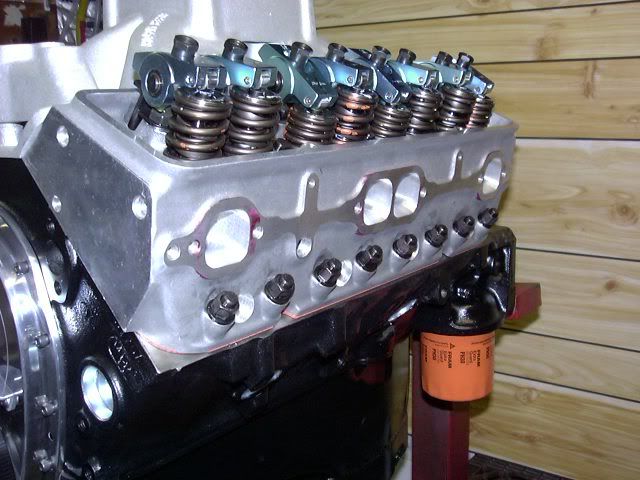
Block=Dart SB (Steel-Caps), 9.025" decks, block-plated +.030" (4.155"), Dart supplied main bolts.
Crankshaft=Eagle #435037505700 (4340 Internal-Balance)
Pistons=Ross #95465, Flat-tops, 1.268" C.H.
Rods=Eagle #CRS5850B3D
Rings=Speed-Pro #R9346+35 (Gapped @ .018" Tops, .014" Second, and Low-Tension Oils)
Cam=Blue-Racer #WG5008MR (Mechanical Roller 256/264 @ .050 106ILC-Lash .022"/.024")
Lifters=Comp Cams 818-16
Damper=BHJ #CH-IBS-7
Oil Pan=Customer Supplied #N.A. No windage trays installed. (Kick-out pan with 1 baffle with trap door).
Timing Chain=Wolverine #TC499S (Nylon timing set machined for roller button)
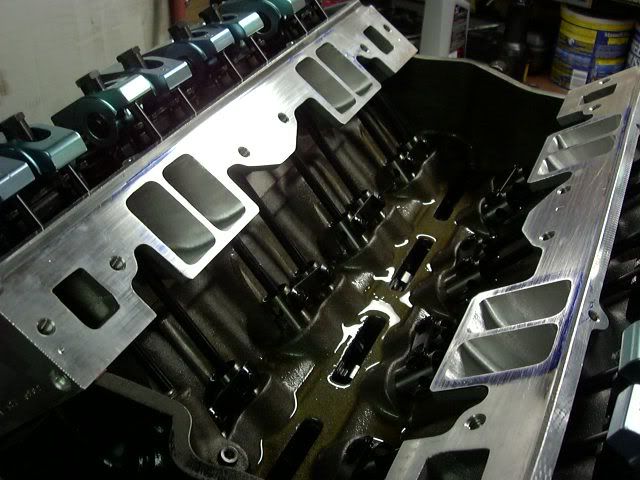
Cylinder Heads=Pro-Topline 23 Degree, 2.080's, 1.600's, 235 CC runners, fully ported in house.
Valves=Ferrea’s #N.A. (Intake and Exhaust)
Springs/Retainers= Comp Cams #N.A. (Titanium Retainers).
Head Gaskets=Corteco (Detroit Gasket) #55431HG (.038" composition).
Fasteners=ARP # 134-4001 (Stud Kit)
Rocker Arms=Blue-Racer (8)#WG6004 (1.6-Intakes) - (8)#WG6002 (1.5-Exhausts).
Pushrods=Comp Cams #7993-16 (5/16”)
Stud Girdle=Comp Cams #4009
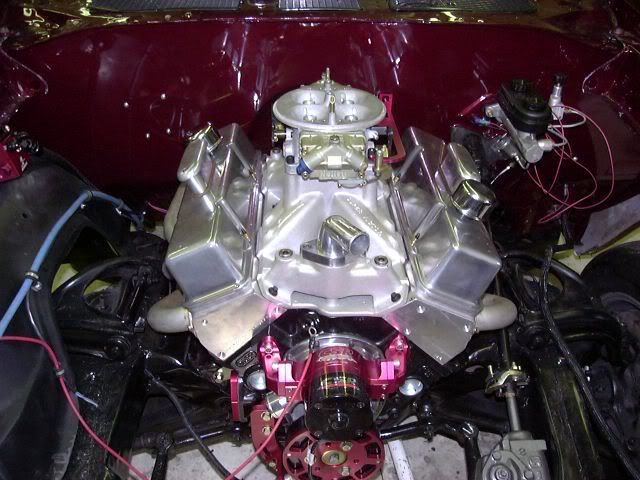
Intake/Carb=Edelbrock #2970 (Super-Victor) / Holley 8896-1(4500 CFM)
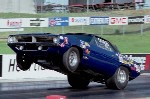
Tested with 2.000" primaries. (Pictured below in '72 El Camino with 1.750" pipes, customer was waiting for new headers to be built.
Compression ratio is approx. 11:1 and runs with no problems on 93 Octane @ 34 Degrees total timing. I will add here however, we did the initial test using 110 because it was in the fuel cell. We ran it out and tested on 93. Customer uses 93 for street and 100 unleaded for track.
He's presently waiting for season to begin!
Final numbers=580 HP @ 6600 RPM and 523 Ft.Lbs. @ 5500 RPM.
Thanks, Gary in N.Y.
Last edited by GOSFAST; Mar 5, 2006 at 01:23 PM.

Burning Brakes

Joined: Sep 2005
Posts: 993
Likes: 3
From: Iowa
I see most of my guys with 360 sprint cars are pushing to way over 8000 RPM this year and the 410 unlimited guys have always been hitting that or higher. Most of the big inch Hemi drag cars leave the line at over 5000 and take it up to 10K with over 4 inches of stroke. I don't see much of an issue with turning a good forged piston and bottom end that hard. Sure you won't go 100,000 miles; but that’s not the idea in the first place!

Team Owner


Joined: Feb 2005
Posts: 32,519
Likes: 1
From: central America
St. Jude Donor '08-'09
Here's a good article from road and track.
http://www.roadandtrack.com/article....rticle_id=2398
Interesting topic.
trw
http://www.roadandtrack.com/article....rticle_id=2398
Interesting topic.
trw
Race Director
Joined: May 2000
Posts: 12,712
Likes: 2,270
Good article, but with one notable mistake. A couple of years ago Chryler came out with a "big bore" engine that ran a shorter stroke than the 4" bore engines. This allows higher revs at the same mean piston speed, which means more power, so everyone else had to follow suit.
In order to nip this new form of escalation in the bud, NASCAR limited stroke to either 3.27" or 3.25", which dictates about a 4 1/8" bore to meet the displacement limit, and 9500 is about as high as the unrestricted engines rev (and live) with properly selected gearing, which is close to 5200 FPM.
Also F1 peak revs are at least 19,000, which gets them into the same 5200 FPM ballpark.
Top Fuel and Funny Car engines might be a little higher through the lights, but the median WOT life expectancy of those engines is not much more than their quarter mile time, and they get new rods and pistons after every run.
Duke
In order to nip this new form of escalation in the bud, NASCAR limited stroke to either 3.27" or 3.25", which dictates about a 4 1/8" bore to meet the displacement limit, and 9500 is about as high as the unrestricted engines rev (and live) with properly selected gearing, which is close to 5200 FPM.
Also F1 peak revs are at least 19,000, which gets them into the same 5200 FPM ballpark.
Top Fuel and Funny Car engines might be a little higher through the lights, but the median WOT life expectancy of those engines is not much more than their quarter mile time, and they get new rods and pistons after every run.
Duke

Drifting

Joined: Dec 1999
Posts: 1,462
Likes: 1
From: Reno nevada
Originally Posted by DieL
of course we dont know where and how much power it will make beyond 7000 so i guess its tough to say if 7800 rpm will even be needed. but im hoping so
Your smarter to build bigger ci and lower rpm.

Thread Starter
Melting Slicks
Joined: Mar 2003
Posts: 2,472
Likes: 0
From: Toronto ONTARIO
it all depends on the power curves when we dyno it and get it tuned. if the hp and torque are diving after 7k then there wont be much need to rev that high. thats one reason why i went with a solid roller though  its wait and see i guess!
its wait and see i guess!
