




Quench

Thread Starter
Burning Brakes

Joined: May 2006
Posts: 855
Likes: 0
From: Location Location

I only pulled 2 cylinders. The engine was roughly 215-ish.
Cylinder 5: 215 PSI
Cylinder 2: 211 PSI
I think I'm going to find a junkyard LT1 and swap. I'll leave this thing for next Spring.
Cylinder 5: 215 PSI
Cylinder 2: 211 PSI
I think I'm going to find a junkyard LT1 and swap. I'll leave this thing for next Spring.
Last edited by DarkMatter; Sep 12, 2006 at 09:44 AM.
Thread Starter
Burning Brakes
Joined: May 2006
Posts: 855
Likes: 0
From: Location Location
Originally Posted by gkull
Just look at your specs! You have a very low compression motor
You have a timing problem and or fuel delivery. hot cam, dished pistons and lots of quench space should make your car run fine on 87 octane. You have a very low D.C.R. a thin head gasket is not going to fix your problems
You have a timing problem and or fuel delivery. hot cam, dished pistons and lots of quench space should make your car run fine on 87 octane. You have a very low D.C.R. a thin head gasket is not going to fix your problems
How do I have a low compression motor?
54cc combustion chambers
4.030 bore
3.75 stroke
-12cc d-cup
4.125 gasket bore
.039 comp. thickness
.017 deck (with 1.433 compressed hieght)
This all equals out to 11:1 SCR. DCR should be right around 8.5:1. It has a higher than optimal quench, at .056 but still within KB's spec of .060.
Even with 58cc chambers, the SCR is still the 10.5 the motor left the factory with, with a DCR of 8.3:1.
-DM

Team Owner


Joined: Apr 1999
Posts: 21,953
Likes: 1,445
From: Reno Nevada
2024 C3 of the Year Finalist- Modified
I wasn't thinking of the small cc heads - Sorry!
My 383 has 11.24 with .041 quench. The pistons are .020 down and I used a .021 gasket. My original cam was a solid roller from Crane with 232/240 112lc. It was very close to detonation on our California 91 octane. Just a small change to timing and or motor heat like out track lapping and it required octane booster. To solve the problem i eventually installed a Comp cams custom grind of 236/244 112lc with 1.65 /1.6 RR
to this day it runs ping free
My 383 has 11.24 with .041 quench. The pistons are .020 down and I used a .021 gasket. My original cam was a solid roller from Crane with 232/240 112lc. It was very close to detonation on our California 91 octane. Just a small change to timing and or motor heat like out track lapping and it required octane booster. To solve the problem i eventually installed a Comp cams custom grind of 236/244 112lc with 1.65 /1.6 RR
to this day it runs ping free

Le Mans Master

Joined: Sep 2001
Posts: 7,739
Likes: 630
From: Unreconstructed, South Carolina
Originally Posted by LD85
Cometic makes a .027" and SCE makes an .021"
Cometic is a Silcone covered steel gasket
SCE is a Copper gasket.
I have used both and either will be an easy fix for your quench issue.
Cometic is a Silcone covered steel gasket
SCE is a Copper gasket.
I have used both and either will be an easy fix for your quench issue.
Victor Reinz P/N 5746 ... is a coated composition gasket w/ flattened SS fire ring ... 4.100" bore, 0.026" compressed ... about 5.4cc ... relatively inexpensive & readily available at local parts house. Nice piece.
I can't recall the P/N but GM did have a similar gasket but 0.028" compressed.
Thread Starter
Burning Brakes
Joined: May 2006
Posts: 855
Likes: 0
From: Location Location
Originally Posted by gkull
I wasn't thinking of the small cc heads - Sorry!
My 383 has 11.24 with .041 quench. The pistons are .020 down and I used a .021 gasket. My original cam was a solid roller from Crane with 232/240 112lc. It was very close to detonation on our California 91 octane. Just a small change to timing and or motor heat like out track lapping and it required octane booster. To solve the problem i eventually installed a Comp cams custom grind of 236/244 112lc with 1.65 /1.6 RR
to this day it runs ping free
My 383 has 11.24 with .041 quench. The pistons are .020 down and I used a .021 gasket. My original cam was a solid roller from Crane with 232/240 112lc. It was very close to detonation on our California 91 octane. Just a small change to timing and or motor heat like out track lapping and it required octane booster. To solve the problem i eventually installed a Comp cams custom grind of 236/244 112lc with 1.65 /1.6 RR
to this day it runs ping free

I'm thinking that the problem is mechanical. There're guys here running 383s, 385s, and 388s with the hot cam with just as high compression with no problems. I even swapped out to the original PCM this morning. It helped some, but didn't quell it entirely.
I most sincerely hope I don't have a bent rod.
-DM

Race Director


Joined: Sep 2000
Posts: 17,298
Likes: 33
From: The Top of Utah
Originally Posted by DarkMatter
54cc combustion chambers
4.030 bore
3.75 stroke
-12cc d-cup
4.125 gasket bore
.039 comp. thickness
.017 deck (with 1.433 compressed hieght)
This all equals out to 11:1 SCR. DCR should be right around 8.5:1. It has a higher than optimal quench, at .056 but still within KB's spec of .060.
4.030 bore
3.75 stroke
-12cc d-cup
4.125 gasket bore
.039 comp. thickness
.017 deck (with 1.433 compressed hieght)
This all equals out to 11:1 SCR. DCR should be right around 8.5:1. It has a higher than optimal quench, at .056 but still within KB's spec of .060.
Originally Posted by DarkMatter
My quench with a .025 deck and a .039 compressed gastket thickness is .064.
At 215 pounds of cranking compression, I'd say you have other problems. The compression ratio doesn't affect the cylinder pressures as quickly or radically as the cam timing. Did you degree the cam when you installed it? I think that either you have made a major miss application or calculation of something that drastically makes the compression ratio other than you believe, or the cam has been mis-installed. I think the 215 pounds of cranking pressure explains the persistent pinging.
RACE ON!!!
Corvette Stories
The Best of Corvette for Corvette Enthusiasts

Top 10 Most Expensive Corvettes Ever Sold on Bring A Trailer
Brett Foote
10 Things Every Corvette Owner Needs (2026 Edition)
Michael S. Palmer
8 Most "Only Corvette Owners Understand" Quirks and Problems
Pouria Savadkouei
10 Reasons the C6 Z06 is Still A Performance Benchmark After 20 Years
Joe Kucinski
How Much Horsepower Every Corvette Engine "LOST" in 1972
Joe Kucinski
Top 10 DOs and DON'Ts for Protecting Your Convertible Top!
Michael S. Palmer
Top 10 Most Explosive Corvettes Ever Made: Power-to-Weight Ratio Ranked!
Joe Kucinski
150 hp to 1,250 hp: Every Corvette Generation Compared by the Specs That Matter
Joe Kucinski
8 Coolest Corvette Pace Cars (and Replicas) of All Time
Verdad Gallardo
Thread Starter
Burning Brakes
Joined: May 2006
Posts: 855
Likes: 0
From: Location Location
Originally Posted by CFI-EFI
How many engines are you working on? In the opening post the piston was .025" down the hole and the piston to head clearance was .064".
The point, however is, as you quoted KB Pistons, "A running quench height in excess of .060" will forfeit most of the benefits of the quench head design". As I said in my first post there is nothing magic about the .060" number. I also said that reducing the quench by .004", to obtain .060" quench, would make no noticeable difference. The same is true of the .056" quench. Being within the ragged limit by .004" doesn't make .056" a good quench distance. As previously stated, .004" wouldn't make much of a noticeable difference. The .060" distance isn't, as said before, a "magic" number. The benefits of quench gradually fade as the .060" number is approached. Nothing close to .060" is very good. When you get to .045" and below, you are in the game. Remember, too until the piston hits the head, you are not TOO close.
At 215 pounds of cranking compression, I'd say you have other problems. The compression ratio doesn't affect the cylinder pressures as quickly or radically as the cam timing. Did you degree the cam when you installed it? I think that either you have made a major miss application or calculation of something that drastically makes the compression ratio other than you believe, or the cam has been mis-installed. I think the 215 pounds of cranking pressure explains the persistent pinging.
RACE ON!!!
The point, however is, as you quoted KB Pistons, "A running quench height in excess of .060" will forfeit most of the benefits of the quench head design". As I said in my first post there is nothing magic about the .060" number. I also said that reducing the quench by .004", to obtain .060" quench, would make no noticeable difference. The same is true of the .056" quench. Being within the ragged limit by .004" doesn't make .056" a good quench distance. As previously stated, .004" wouldn't make much of a noticeable difference. The .060" distance isn't, as said before, a "magic" number. The benefits of quench gradually fade as the .060" number is approached. Nothing close to .060" is very good. When you get to .045" and below, you are in the game. Remember, too until the piston hits the head, you are not TOO close.
At 215 pounds of cranking compression, I'd say you have other problems. The compression ratio doesn't affect the cylinder pressures as quickly or radically as the cam timing. Did you degree the cam when you installed it? I think that either you have made a major miss application or calculation of something that drastically makes the compression ratio other than you believe, or the cam has been mis-installed. I think the 215 pounds of cranking pressure explains the persistent pinging.
RACE ON!!!
Post #6 explains it better. Through a mathematical error on my part (not taking correctly into account piston compressed height) my deck is closer to the .017". Thus I end up with the 11:1 CR instead of my originally planned 10.8:1.
Now, I agree about the cam. I did not install it. I spec'ed out the motor, but had a "professional" shop do the build. They came as a reputable establishment. In my other thread over in C4 tech/Perf I make mention that the shop appears instead to be a butcher shop.

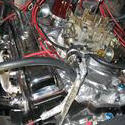
And yes, once I put the compression gauge on and cranked her over, my heart sank. I can only imagine that my piston crowns are irrevocably damaged and/or I have bent rods. In any case, as for right now the car is idle, and most likely will be for the immediate future.
I suppose it makes me a jerk. This was my first attempt at spec'ing an SBC. I recently moved over to the RWD/V8 genre from the I-4 FWD world. My initial foray has been an expensive learning process. Live and learn.
Thanks for checking in CFI-EFI.
-DM


Le Mans Master

Joined: Oct 2002
Posts: 7,098
Likes: 378
From: Las Vegas - Just stop perpetuating myths please.
Wow, look at that pressure.
Sorry to read the bad news BlackMatter. We see that .054" quench does no "majic" for your engine. But maybe if we tell you that several more times it well help you feel better.
Thx for your efforts and posting your test results. Now we see that 215psi crank press is high and we can all post this several more times to help you now even if we didn't have a clue to question or post this before - it just makes us feel smarter. And how 'bout maybe higher press yet if measured at normal running temp or maybe this is majic too and stays the same measured at any temp. What the heck, i'll jump on in where i can anyways and just act like i'm an expert now on compression tests.
But now it's easy to get you chasing a fix for a radically timed cam rather than replacing a goofed, maybe bent, motor. BTW are the letters AR found on that engine anywhere (inside humor).
BTW folks, that GM head gasket p/n 10105117 is a GEN I part and would not work very well on GEN II reverse flow engine. Didn't check the Victor-Hienz but maybe some-one should.
Good night.
cardo0
Thx for your efforts and posting your test results. Now we see that 215psi crank press is high and we can all post this several more times to help you now even if we didn't have a clue to question or post this before - it just makes us feel smarter. And how 'bout maybe higher press yet if measured at normal running temp or maybe this is majic too and stays the same measured at any temp. What the heck, i'll jump on in where i can anyways and just act like i'm an expert now on compression tests.
But now it's easy to get you chasing a fix for a radically timed cam rather than replacing a goofed, maybe bent, motor.
BTW are the letters AR found on that engine anywhere (inside humor). BTW folks, that GM head gasket p/n 10105117 is a GEN I part and would not work very well on GEN II reverse flow engine.
Didn't check the Victor-Hienz but maybe some-one should.Good night.
cardo0
Race Director
Joined: Sep 2000
Posts: 17,298
Likes: 33
From: The Top of Utah
[QUOTE=DarkMatter]http://forums.corvetteforum.com/show...09&postcount=6
Calculating the piston deck clearance is an iffy proposition, unless you have some accurate measurements. Apparently you have the compression height of the piston. Do you have the main bearing centerline to deck measurement for YOUR block? That can vary considerably. The best method to determine the piston to deck clearance, is to measure it.
Why do you fear engine damage? Does it run any worse or make any noises it didn't when you first fired it up?
One lesson I see here is universal, regardless of where it was built or the number of cylinders, if you want it done right, do it yourself. My best advice is to get your hands on a degree wheel and see if you can see if there is anything wrong with the cam installation. My guess is that there is.
RACE ON!!!
Originally Posted by DarkMatter
Post #6 explains it better. Through a mathematical error on my part (not taking correctly into account piston compressed height) my deck is closer to the .017".
Originally Posted by DarkMatter
And yes, once I put the compression gauge on and cranked her over, my heart sank. I can only imagine that my piston crowns are irrevocably damaged and/or I have bent rods.
Originally Posted by DarkMatter
I suppose it makes me a jerk. This was my first attempt at spec'ing an SBC. I recently moved over to the RWD/V8 genre from the I-4 FWD world. My initial foray has been an expensive learning process. Live and learn.
RACE ON!!!
Race Director
Joined: Sep 2000
Posts: 17,298
Likes: 33
From: The Top of Utah
Take a break cardo0. As soon as you started posting to this thread I backed off, allowing you to have you way. Nothing I read was so glaring that I felt I had to step in and correct you false statements. In one case that was done for me.
Your pointless sarcasm is misdirected. DarkMatter had expressed some relief in the belief that he really was under the .060" mark, that further explanation seemed necessary. If it bothers you that I prefer to be sure I convey the facts clearly, don't read them. Just because YOU understand what I'm saying (maybe) doesn't necessarily mean that the person I am addressing does.
What a bunch of garbage. I tried to let you run with this, but I felt I had something worthwhile, that hadn't been said, to contribute. Most of what you had to say was valid and that is why I didn't jump in with corrections. At least you didn't post much PURE fiction, like how solid lifters have pumps in them. Write back if, or when, you have something to contribute.
RACE ON!!!
Originally Posted by cardo0
We see that .054" quench does no "majic" for your engine. But maybe if we tell you that several more times it well help you feel better.
Originally Posted by cardo0
Now we see that 215psi crank press is high and we can all post this several more times to help you now even if we didn't have a clue to question or post this before - it just makes us feel smarter. And how 'bout maybe higher press yet if measured at normal running temp or maybe this is majic too and stays the same measured at any temp. What the heck, i'll jump on in where i can anyways and just act like i'm an expert now on compression tests.
RACE ON!!!
Le Mans Master
Joined: Oct 2002
Posts: 7,098
Likes: 378
From: Las Vegas - Just stop perpetuating myths please.
Awwwh, someones feeling got hurt.
Woooow! I was using some self-critisim and it must'a surprized someone. Man, i quess the truth really does hurt. But gee, at least i get qouted more than anyone else. And that pretty good for someone that miss-labed "tiny metering vlvs" as "tiny pumps". That's a big mistake that might cost someone else like 2cents maybe someday. Not quite as much as the poor guy that hacks up a good 400" block to install V6 roller lifters on lame adivce from someone that ain't even built one or others that can't make'm run. Didn't want to dig up the mud on someone elses thread even if i feel my rants are more important so now i kin'a feel bad too. I just wish those that don't like my self-criticism would place me on thier Ignore list rather than make threats of reprisials or direct me when to speak/post or not.
No, i don't want to reconsider the dynamics of quench here anymore as it's clear it won't fix the problem as is. The majic or magic or .060" are just easy to use thumbrule terms that are adequate of most of us to use. True dynamics of a 454" engine compressing 50% more air through a .060" gap compared than a 305" engine are not fully addressed by the Chevy Power Manual, Vizard, or even Smokey. Nor is the differences in quench area of the cyl head over piston for changes in combustion chamber shape. But for most of us .060" does have some magic to observe. Though i have posted this in other threads i see it is not doing any good.
I can't really add anything to help DarkMatter now other than as i already posted - reduce compression and thinner hd gaket if possible.
The only imbarrassing item here is i waste the time to reply to direct accusations that are totally unproductive for everyone.
cardo0
I was using some self-critisim and it must'a surprized someone. Man, i quess the truth really does hurt. But gee, at least i get qouted more than anyone else. And that pretty good for someone that miss-labed "tiny metering vlvs" as "tiny pumps". That's a big mistake that might cost someone else like 2cents maybe someday. Not quite as much as the poor guy that hacks up a good 400" block to install V6 roller lifters on lame adivce from someone that ain't even built one or others that can't make'm run. Didn't want to dig up the mud on someone elses thread even if i feel my rants are more important so now i kin'a feel bad too. I just wish those that don't like my self-criticism would place me on thier Ignore list rather than make threats of reprisials or direct me when to speak/post or not.No, i don't want to reconsider the dynamics of quench here anymore as it's clear it won't fix the problem as is. The majic or magic or .060" are just easy to use thumbrule terms that are adequate of most of us to use. True dynamics of a 454" engine compressing 50% more air through a .060" gap compared than a 305" engine are not fully addressed by the Chevy Power Manual, Vizard, or even Smokey. Nor is the differences in quench area of the cyl head over piston for changes in combustion chamber shape. But for most of us .060" does have some magic to observe. Though i have posted this in other threads i see it is not doing any good.
I can't really add anything to help DarkMatter now other than as i already posted - reduce compression and thinner hd gaket if possible.
The only imbarrassing item here is i waste the time to reply to direct accusations that are totally unproductive for everyone.
cardo0
Race Director
Joined: Sep 2000
Posts: 17,298
Likes: 33
From: The Top of Utah
Four days later? There is plenty I could say, but rereading YOUR last post makes my point for me better than I can do it myself.
Show me a threat I have made. I try not to namecall, but you stretch ones self control.
RACE ON!!!
Originally Posted by cardo0
rather than make threats of reprisials
RACE ON!!!

Advanced


Joined: Aug 2006
Posts: 65
Likes: 0
It's interesting that a lot of motors came from the factory with .025"-.030" piston-to-deck clearance and .038"-.041" gaskets. That's .063"-.071" quench.
John Lingenfelter used to say that a .005" deck and .038" gasket was optimal, but that anything under .050" total was OK. I always shoot for around .040"-.045" and try to stay away from dished pistons and 4 valve reliefs.
John Lingenfelter used to say that a .005" deck and .038" gasket was optimal, but that anything under .050" total was OK. I always shoot for around .040"-.045" and try to stay away from dished pistons and 4 valve reliefs.
