



502 on the dyno

Thread Starter
Racer


Joined: Jan 2002
Posts: 274
Likes: 2
From: Prescott,Az
 502 on the dyno
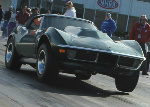
I recently had my 502 restomod show car on a rear wheel dyno.The engine has an upgraded Crane cam (598/610 lift hydraulic roller with duration of 230/236 & lobe separation of 110.I still use the std 1.70 ratio rockers. I have SS headers w/ 2" primaries into a 3" collector which feeds 3 1/2" side pipes into spiral turbo flow mufflers. The std alum.heads have a pocket port on them. Other than those mods its a std ZZ502 crate motor which runs thru a TKO600 Tremec 5 speed transmission with a 3:36 rear gear. Jets in the std,850 Holley single pumper carb are 74/78.Timing is set at 39 degrees total.
On the dyno it made 361 RWHP & 419TQ with the air cleaner on & w/o any air cleaner it made 367 RWHP & 434TQ.MaxHP came in at 5,400 rpm and max TQ was at 4,000rpm.Fuel/air ratio was 12.9 with air cleaner on & 13.7 w/o the air cleaner in place.
From what I have read on the forum these figures are at or a little more than most guys are getting out of this combination
The question I have is is there anyone out there that knows how to figure out gross HP & TQ or what these numbers would be based on a regular engine dyno?? I guess that would be gross HP & TQ??
On the dyno it made 361 RWHP & 419TQ with the air cleaner on & w/o any air cleaner it made 367 RWHP & 434TQ.MaxHP came in at 5,400 rpm and max TQ was at 4,000rpm.Fuel/air ratio was 12.9 with air cleaner on & 13.7 w/o the air cleaner in place.
From what I have read on the forum these figures are at or a little more than most guys are getting out of this combination
The question I have is is there anyone out there that knows how to figure out gross HP & TQ or what these numbers would be based on a regular engine dyno?? I guess that would be gross HP & TQ??
Le Mans Master


Joined: May 2006
Posts: 9,993
Likes: 1,136
From: League City Tx
Assuming the usual 20% parasitic loss for a stick trans and IRS, that would put you around 440 crank hp. Ofcourse there is a ton of variables with this due to different types of dynos, dyno calibration/correction factors etc etc.. Can't accurate guess true crank HP from a chasis dyno.
I will say the side pipe baffles are probably killing 50 rwhp easy... Then whatever accessories/fan etc etc your crank is having to turn also hurts HP..
Lastly Mustang dynos read about 8% lower then DynoJets so depending on what kind of dyno you were on will effect the numbers.
With the air cleaner lid off, the afr at 13.7 was a touch lean..you probably would have gained another 8-10hp from rejetting it with the air cleaner off.
Either way you have enough power to dip into the high 11s if you can hook it and shift good...fun street car.
I will say the side pipe baffles are probably killing 50 rwhp easy... Then whatever accessories/fan etc etc your crank is having to turn also hurts HP..
Lastly Mustang dynos read about 8% lower then DynoJets so depending on what kind of dyno you were on will effect the numbers.
With the air cleaner lid off, the afr at 13.7 was a touch lean..you probably would have gained another 8-10hp from rejetting it with the air cleaner off.
Either way you have enough power to dip into the high 11s if you can hook it and shift good...fun street car.
Le Mans Master
Joined: May 2006
Posts: 9,993
Likes: 1,136
From: League City Tx
For comparison I once saw a 67' coupe with a stock zz502 make right at 400rwhp on a dynojet dyno with a TKO500 5 spd, electric fan and no PS. That was with headers and a 2.5" under car exhaust with magnaflow muffs..air cleaner on, hood open.
That would be real close to the 502hp rating....(like 480 ish).. About as good as youre gonna get to the 502hp crank rating having to go thru exhaust and spin an alternator.
Even wheel weight and tire type will affect HP...hell tire psi even has a small effect.
That would be real close to the 502hp rating....(like 480 ish).. About as good as youre gonna get to the 502hp crank rating having to go thru exhaust and spin an alternator.
Even wheel weight and tire type will affect HP...hell tire psi even has a small effect.

Burning Brakes


Joined: Jan 2003
Posts: 755
Likes: 32
From: Roswell Georgia
Here are some observations on your setup based upon the info you provided:
1. Your air cleaner assembly seems to be choking down the airflow to your Holley 850 given that your HP/TQ is higher w/o the air cleaner than with it installed. Back in the 70's, Holley recommended that we install the tall truck element in place of the stock air filter to obtain max air flow through our 780/850 carbs. Now we have Air Hog and K&N air filters to do the same thing w/o requiring a hood bump to accommodate the taller air filter assembly. I recommend that you try maximizing the airflow through your air filter assembly to achieve best HP/TQ.
2. Crane Cam #168761 best matches the timing/lift data you provided. This cam works best with a static compression ratio between 10.0-11.5:1. The stock ZZ502 has an 8.75:1 static compression ratio. Did you bump up the compression to boost low end torque as recommended by Crane Cams? If not, you're giving away HP/TQ on the bottom end up to your mid-range.
3. Your total timing seems a little high to me. I believe that Chevy Performance recommended a total timing of 36 degrees BTDC for their original ZZ502 engines. If you set total timing based upon rear wheel dyno pulls, you may want to back it off a little especially if you didn't check for detonation under full load acceleration in each gear (1st through 4th) from 1,200 RPM up to redline.
4. I'm thinking that you may have the Holley 80531 850 cfm carb. Although Holley advertises this carb as calibrated for the 502 out of the box, I've found that the best way to calibrate my BBC Holleys was to do full power runs in 4th gear and then cut the engine off/shift into neutral at the end of the pull. Then I'd read the spark plugs to see which cylinders were running lean/too rich and use stagger jetting to compensate. (Modern manifolds are head and shoulders above what we used in the 70's; still, I trust my spark plugs more than someone's advertised claims.) You may not need to do this, but reading spark plugs is the best insurance against burning valves/fouling spark plugs.
5. Your air-fuel ratios were interesting. With the air filter off, you started to lean out as more air passed through the carb. That by itself would point to more carb tuning to achieve best HP/TQ. Locally, we capture the air-fuel mixture during a WOT acceleration between say 2,000-6,000 rpm in 4th gear under dyno load. Is that where the data came from? Just asking as I would have expected an air-fuel ratio of 12.1-12.3 during that type of pull.
Hope this info helps. Have fun with your C2 ZZ502.

Thread Starter
Racer
Joined: Jan 2002
Posts: 274
Likes: 2
From: Prescott,Az
502 on the dyno
Assuming the usual 20% parasitic loss for a stick trans and IRS, that would put you around 440 crank hp. Ofcourse there is a ton of variables with this due to different types of dynos, dyno calibration/correction factors etc etc.. Can't accurate guess true crank HP from a chasis dyno.
I will say the side pipe baffles are probably killing 50 rwhp easy... Then whatever accessories/fan etc etc your crank is having to turn also hurts HP..
Lastly Mustang dynos read about 8% lower then DynoJets so depending on what kind of dyno you were on will effect the numbers.
With the air cleaner lid off, the afr at 13.7 was a touch lean..you probably would have gained another 8-10hp from rejetting it with the air cleaner off.
Either way you have enough power to dip into the high 11s if you can hook it and shift good...fun street car.
I will say the side pipe baffles are probably killing 50 rwhp easy... Then whatever accessories/fan etc etc your crank is having to turn also hurts HP..
Lastly Mustang dynos read about 8% lower then DynoJets so depending on what kind of dyno you were on will effect the numbers.
With the air cleaner lid off, the afr at 13.7 was a touch lean..you probably would have gained another 8-10hp from rejetting it with the air cleaner off.
Either way you have enough power to dip into the high 11s if you can hook it and shift good...fun street car.
I don't know what kind of dyno was used but I will find out.
Regarding the AFR I thought that 13.7 was a little lean & will be rejetting the carb up. Are you recommending rejetting the secondaries up from 78 to 80 & leaving the primaries at 74 for around town? (The plugs were slightly light tan on the outside of the plug & slightly dark grey/black on the electrode).
I have purchased an Edlebrock air cleaner with the blue filter in the lid top so that should bring in the added air needed.
Thread Starter
Racer
Joined: Jan 2002
Posts: 274
Likes: 2
From: Prescott,Az
502 on the dyno
To answer your question, there is no magic formula to figure out gross HP/TQ using rear wheel dyno data. The gross HP/TQ figures are derived by testing on an engine dyno with minimum accessories, free flowing exhaust, and optimal timing. (I would imagine that Chevy came up with the 502 HP figure on an engine dyno with only the water pump creating parasitic drag on the engine.) The advertised HP figure at the crank was derived under these conditions. As for the as installed HP/TQ figures measured at the rear wheels, there is plenty of contention on exactly how to convert rear wheel HP/TQ to flywheel HP/TQ. (Click this link to read just such a discussion on this web site.) Although every engine installation differs somewhat (see this article to understand why this affects driveline losses), based upon my experience, I would say that a 15-18% loss between the flywheel and rear wheels would work in your case since you only installed a Tremec 5-spd in place of the Muncie 4-spd. These figures would give you a SWAG at your as-installed flywheel HP/TQ.
Here are some observations on your setup based upon the info you provided:
1. Your air cleaner assembly seems to be choking down the airflow to your Holley 850 given that your HP/TQ is higher w/o the air cleaner than with it installed. Back in the 70's, Holley recommended that we install the tall truck element in place of the stock air filter to obtain max air flow through our 780/850 carbs. Now we have Air Hog and K&N air filters to do the same thing w/o requiring a hood bump to accommodate the taller air filter assembly. I recommend that you try maximizing the airflow through your air filter assembly to achieve best HP/TQ.
2. Crane Cam #168761 best matches the timing/lift data you provided. This cam works best with a static compression ratio between 10.0-11.5:1. The stock ZZ502 has an 8.75:1 static compression ratio. Did you bump up the compression to boost low end torque as recommended by Crane Cams? If not, you're giving away HP/TQ on the bottom end up to your mid-range.
3. Your total timing seems a little high to me. I believe that Chevy Performance recommended a total timing of 36 degrees BTDC for their original ZZ502 engines. If you set total timing based upon rear wheel dyno pulls, you may want to back it off a little especially if you didn't check for detonation under full load acceleration in each gear (1st through 4th) from 1,200 RPM up to redline.
4. I'm thinking that you may have the Holley 80531 850 cfm carb. Although Holley advertises this carb as calibrated for the 502 out of the box, I've found that the best way to calibrate my BBC Holleys was to do full power runs in 4th gear and then cut the engine off/shift into neutral at the end of the pull. Then I'd read the spark plugs to see which cylinders were running lean/too rich and use stagger jetting to compensate. (Modern manifolds are head and shoulders above what we used in the 70's; still, I trust my spark plugs more than someone's advertised claims.) You may not need to do this, but reading spark plugs is the best insurance against burning valves/fouling spark plugs.
5. Your air-fuel ratios were interesting. With the air filter off, you started to lean out as more air passed through the carb. That by itself would point to more carb tuning to achieve best HP/TQ. Locally, we capture the air-fuel mixture during a WOT acceleration between say 2,000-6,000 rpm in 4th gear under dyno load. Is that where the data came from? Just asking as I would have expected an air-fuel ratio of 12.1-12.3 during that type of pull.
Hope this info helps. Have fun with your C2 ZZ502.
Here are some observations on your setup based upon the info you provided:
1. Your air cleaner assembly seems to be choking down the airflow to your Holley 850 given that your HP/TQ is higher w/o the air cleaner than with it installed. Back in the 70's, Holley recommended that we install the tall truck element in place of the stock air filter to obtain max air flow through our 780/850 carbs. Now we have Air Hog and K&N air filters to do the same thing w/o requiring a hood bump to accommodate the taller air filter assembly. I recommend that you try maximizing the airflow through your air filter assembly to achieve best HP/TQ.
2. Crane Cam #168761 best matches the timing/lift data you provided. This cam works best with a static compression ratio between 10.0-11.5:1. The stock ZZ502 has an 8.75:1 static compression ratio. Did you bump up the compression to boost low end torque as recommended by Crane Cams? If not, you're giving away HP/TQ on the bottom end up to your mid-range.
3. Your total timing seems a little high to me. I believe that Chevy Performance recommended a total timing of 36 degrees BTDC for their original ZZ502 engines. If you set total timing based upon rear wheel dyno pulls, you may want to back it off a little especially if you didn't check for detonation under full load acceleration in each gear (1st through 4th) from 1,200 RPM up to redline.
4. I'm thinking that you may have the Holley 80531 850 cfm carb. Although Holley advertises this carb as calibrated for the 502 out of the box, I've found that the best way to calibrate my BBC Holleys was to do full power runs in 4th gear and then cut the engine off/shift into neutral at the end of the pull. Then I'd read the spark plugs to see which cylinders were running lean/too rich and use stagger jetting to compensate. (Modern manifolds are head and shoulders above what we used in the 70's; still, I trust my spark plugs more than someone's advertised claims.) You may not need to do this, but reading spark plugs is the best insurance against burning valves/fouling spark plugs.
5. Your air-fuel ratios were interesting. With the air filter off, you started to lean out as more air passed through the carb. That by itself would point to more carb tuning to achieve best HP/TQ. Locally, we capture the air-fuel mixture during a WOT acceleration between say 2,000-6,000 rpm in 4th gear under dyno load. Is that where the data came from? Just asking as I would have expected an air-fuel ratio of 12.1-12.3 during that type of pull.
Hope this info helps. Have fun with your C2 ZZ502.
Point 2. The stock ZZ502 I bought back in 2000 has a compression ratio of 9.6-1 according to the GM spec that came with the engine so I did not bump up the compression when I had the heads pocket ported.
Point 3.Regarding the timing I know GM recommends 36 degrees total timing but in talking to other forum members back in 2000 some recommended 39 degrees as it does make the engine seem more responsive. I am not getting any detonation with high test gas.
Point 5 Yes the data came right from the dyno sheet but was from 3,000-6,000 rpm.
I think that I should leave the primary jetting at 74 for around town but jet up from 78 to 80 in the secondaries.That should bring my fuel to air ratio down from a slightly lean 13.7 to the mid to high 12's.Does that sound reasonable?
Burning Brakes
Joined: Jan 2003
Posts: 755
Likes: 32
From: Roswell Georgia
Point 2. The stock ZZ502 I bought back in 2000 has a compression ratio of 9.6-1 according to the GM spec that came with the engine so I did not bump up the compression when I had the heads pocket ported.
Point 3.Regarding the timing I know GM recommends 36 degrees total timing but in talking to other forum members back in 2000 some recommended 39 degrees as it does make the engine seem more responsive. I am not getting any detonation with high test gas.
Point 5 Yes the data came right from the dyno sheet but was from 3,000-6,000 rpm.
I think that I should leave the primary jetting at 74 for around town but jet up from 78 to 80 in the secondaries.That should bring my fuel to air ratio down from a slightly lean 13.7 to the mid to high 12's.Does that sound reasonable?
I think that I should leave the primary jetting at 74 for around town but jet up from 78 to 80 in the secondaries.That should bring my fuel to air ratio down from a slightly lean 13.7 to the mid to high 12's.Does that sound reasonable?
If you still have access to a roller dyno, try using new spark plugs for a full power run from 3k-6k rpm to see how each cylinder does. Increasing the jetting for the rear secondaries will help especially if using a single plane intake. Sampling the exhaust on each side for an A/F ratio works well for a SBC, but not a BBC as the runner lengths differ in the heads (as well as in a dual plane manifold). Try to keep all the cylinders running a light tan color and you should be good to go.
Have fun while you're doing this!
Thread Starter
Racer
Joined: Jan 2002
Posts: 274
Likes: 2
From: Prescott,Az
502 on the dyno
If that doesn't allow your Holley to reach full flow potential, nothing will. Good choice.
You're right in the ball park. If you ever re-do the heads or need to change the head gasket, using a thinner steel shim head gasket or even a little off the heads will get you to 10.0:1. (Of course, carbon build up does the same thing!)
I think you hit the nail on the head. The key here is using the highest octane gas you can get locally. Don't forget to check your timing on a frequent basis as the rotation of the Chevy distributor can retard your timing if you do frequent full power runs and the distributor clamp is loose. (Don't ask how I know. It's too embarrassing!)
I've found that 12.1-12.3 A/F ratio was best for my BBC; however, the best way to tell is still by reading the spark plugs. You didn't mention whether you were using a single plane or dual plane intake manifold. I had less problems with the dual plane, but still had to stagger jet to keep all the cylinders fairly even. (It always seems that the long runner ports ran leaner under WOT hence the fairly rich A/F ratio mentioned above.)
If you still have access to a roller dyno, try using new spark plugs for a full power run from 3k-6k rpm to see how each cylinder does. Increasing the jetting for the rear secondaries will help especially if using a single plane intake. Sampling the exhaust on each side for an A/F ratio works well for a SBC, but not a BBC as the runner lengths differ in the heads (as well as in a dual plane manifold). Try to keep all the cylinders running a light tan color and you should be good to go.
Have fun while you're doing this!
You're right in the ball park. If you ever re-do the heads or need to change the head gasket, using a thinner steel shim head gasket or even a little off the heads will get you to 10.0:1. (Of course, carbon build up does the same thing!)
I think you hit the nail on the head. The key here is using the highest octane gas you can get locally. Don't forget to check your timing on a frequent basis as the rotation of the Chevy distributor can retard your timing if you do frequent full power runs and the distributor clamp is loose. (Don't ask how I know. It's too embarrassing!)
I've found that 12.1-12.3 A/F ratio was best for my BBC; however, the best way to tell is still by reading the spark plugs. You didn't mention whether you were using a single plane or dual plane intake manifold. I had less problems with the dual plane, but still had to stagger jet to keep all the cylinders fairly even. (It always seems that the long runner ports ran leaner under WOT hence the fairly rich A/F ratio mentioned above.)
If you still have access to a roller dyno, try using new spark plugs for a full power run from 3k-6k rpm to see how each cylinder does. Increasing the jetting for the rear secondaries will help especially if using a single plane intake. Sampling the exhaust on each side for an A/F ratio works well for a SBC, but not a BBC as the runner lengths differ in the heads (as well as in a dual plane manifold). Try to keep all the cylinders running a light tan color and you should be good to go.
Have fun while you're doing this!
Corvette Stories
The Best of Corvette for Corvette Enthusiasts

Top 10 Most Expensive Corvettes Ever Sold on Bring A Trailer
Brett Foote
10 Things Every Corvette Owner Needs (2026 Edition)
Michael S. Palmer
8 Most "Only Corvette Owners Understand" Quirks and Problems
Pouria Savadkouei
10 Reasons the C6 Z06 is Still A Performance Benchmark After 20 Years
Joe Kucinski
How Much Horsepower Every Corvette Engine "LOST" in 1972
Joe Kucinski
Top 10 DOs and DON'Ts for Protecting Your Convertible Top!
Michael S. Palmer
Top 10 Most Explosive Corvettes Ever Made: Power-to-Weight Ratio Ranked!
Joe Kucinski
150 hp to 1,250 hp: Every Corvette Generation Compared by the Specs That Matter
Joe Kucinski
8 Coolest Corvette Pace Cars (and Replicas) of All Time
Verdad Gallardo
Burning Brakes
Joined: Jan 2003
Posts: 755
Likes: 32
From: Roswell Georgia
I installed a fresh set of plugs for the dyno run. Regarding the intake manifold I am using the stock intake that came with the ZZ502 package. Is that a single plane manifold? At this point I think all that remains is for me to jet up the secondaries from 78 to 80 while leaving the primaries at 74 which should get my fuel to air ratio under 13 but still keep my plugs the right color for city driving. Does that sound correct?