






increasing rpm limit

Melting Slicks


Joined: Feb 1999
Posts: 3,078
Likes: 1
 Re: increasing rpm limit (vader86)
Well, not all rods and cranks are created equal. Stock cast rods and cranks are limited. I don't think 6000 rpm is even safe on a cast crank/rod 350.
A rebuild is required if you want to have a higher redline. One that includes a forged crank and forged connecting rods. And while you're at it, buy your bolts and studs from ARP. Even with forged rods, not all are created equal. You do basically get what you pay for.
Don't misunderstand what I'm saying. I am not saying a cast crank can't handle good power, because it can. They're good for about 600 hp. What I'm talking about are RPM's.
And you don't have to have a 4-bolt main design. A 2-bolt with studs will probably be strong enough with nodular iron mains.
If you want more than 6500 rpm, you need to upgrade to either a solid flat tappet or a solid roller cam. The solid flat tappet is the better value, hp per dollar. (The solid roller will make more power, but at a much greater price).
And don't ignore the valve train. Titanium retainers and adequate springs.
The more power you want to make at a higher ceiling, the more your engine will need to breathe.
Depends totally on how radical you want to go. But everything depends on the right combination. Meaning, you can't expect awesome performance by installing an enormous cam and keeping your 3.08 gears...for example. The higher in the rpm band you go, generally speaking, the steeper your gearing really needs to be. Unless you've got a torque monster.
(A big block can make even 3.08 gears feel incredible).
[Modified by MoMo, 11:27 PM 10/16/2002]
A rebuild is required if you want to have a higher redline. One that includes a forged crank and forged connecting rods. And while you're at it, buy your bolts and studs from ARP. Even with forged rods, not all are created equal. You do basically get what you pay for.
Don't misunderstand what I'm saying. I am not saying a cast crank can't handle good power, because it can. They're good for about 600 hp. What I'm talking about are RPM's.
And you don't have to have a 4-bolt main design. A 2-bolt with studs will probably be strong enough with nodular iron mains.
If you want more than 6500 rpm, you need to upgrade to either a solid flat tappet or a solid roller cam. The solid flat tappet is the better value, hp per dollar. (The solid roller will make more power, but at a much greater price).
And don't ignore the valve train. Titanium retainers and adequate springs.
The more power you want to make at a higher ceiling, the more your engine will need to breathe.
Depends totally on how radical you want to go. But everything depends on the right combination. Meaning, you can't expect awesome performance by installing an enormous cam and keeping your 3.08 gears...for example. The higher in the rpm band you go, generally speaking, the steeper your gearing really needs to be. Unless you've got a torque monster.
(A big block can make even 3.08 gears feel incredible).
[Modified by MoMo, 11:27 PM 10/16/2002]
Melting Slicks


Joined: Jun 2001
Posts: 2,429
Likes: 14
From: CA
Re: increasing rpm limit (hubes)
I have an old Hot Rod magazine in the garage from the 80's. They had an interesting buildup article. They built 2 355's. One was built to have a max rpm of 5500, the other was built to go to 7250 rpm. They stated that beyond 7250 the motor got way too high dollar.
The 5500 motor was fairly stock, but the 7250 motor had a few aftermarket items. Ballancing & oil control were the main factors. It also gives you all of the clearances needed to make it work. I'll see if I can find that issue & post the article.
I've read about a race engine builder that claims that he can rev his small blocks to 10,050 rpm! It will only go there a couple of times because of valve spring life/fatigue.
[Modified by 71coupe, 2:51 AM 10/17/2002]
The 5500 motor was fairly stock, but the 7250 motor had a few aftermarket items. Ballancing & oil control were the main factors. It also gives you all of the clearances needed to make it work. I'll see if I can find that issue & post the article.
I've read about a race engine builder that claims that he can rev his small blocks to 10,050 rpm! It will only go there a couple of times because of valve spring life/fatigue.
[Modified by 71coupe, 2:51 AM 10/17/2002]

Intermediate

Joined: Oct 2002
Posts: 40
Likes: 0
From: Sylvan Lake Alberta
Re: increasing rpm limit (71coupe)
Small blocks can be built to spin well over 10,000rpm. I heard of a fellow who has a built 427 BBC race engine that can, allegedly, peg nearly 10,000 rpm. I myself prefer around 7000 rpm as my self imposed max.(thats when the valves started to float anyway:eek:)
[Modified by huffedvette, 9:22 PM 10/17/2002]
[Modified by huffedvette, 9:22 PM 10/17/2002]

Safety Car


Joined: Feb 1999
Posts: 3,631
Likes: 14
From: Fountain Hills AZ
Re: increasing rpm limit (hubes)
The single biggest limitation is the valve train but, as already posted, the rest of the engine is also stressed more as rpm increases. There's not much benefit to increasing an engine's rev limit unless it also results in more power. If you're going to a bigger cam, intake, etc., though and the engine needs to rev higher to make it's best power, the other components should be upgraded to handle both the extra power and the higher rpm.
Melting Slicks
Joined: Feb 1999
Posts: 3,078
Likes: 1
Re: increasing rpm limit (Vetterodder)
That's why I liked the ZR-1 engine. The overhead 4-cam design had a lot of potential. I wish someone would design a 4-valve head system for use on any small block (big block too) converting it to an overhead cam design, driven off a kind of double-"groove" crank gear, using belts instead of chains. Then have one belt go up around the 2 cam gears on one head, and the other belt go to the 2 cam gears on the other head.
Of course, a line of custom intakes and headers would be required. I'd use the Y-design to increase torque and decrease engine bay crowding...meaning I'd combine the two exhaust ports for each cylinder into a 2-into-1 collector, and then have a standard, 4-pipe primary into a 4-into-1 collector.
The intake could be fun. The easiest would be a Hogan sheetmetal intake with 16 tubes from a central upper plenum and a single throttlebody. But you could do a tricked out custom tri-power throttlebody system too.
Of course, this means custom accessory mounts, but the cool thing would be being able to use a stock V8 rotating assembly.
I'd market it if I had the capital.
... :rolleyes: Okay, dreaming over.
Of course, a line of custom intakes and headers would be required. I'd use the Y-design to increase torque and decrease engine bay crowding...meaning I'd combine the two exhaust ports for each cylinder into a 2-into-1 collector, and then have a standard, 4-pipe primary into a 4-into-1 collector.
The intake could be fun. The easiest would be a Hogan sheetmetal intake with 16 tubes from a central upper plenum and a single throttlebody. But you could do a tricked out custom tri-power throttlebody system too.
Of course, this means custom accessory mounts, but the cool thing would be being able to use a stock V8 rotating assembly.
I'd market it if I had the capital.
... :rolleyes: Okay, dreaming over.

Instructor
Joined: Feb 2002
Posts: 154
Likes: 0
From: hersey mi
Re: increasing rpm limit (hubes)
hubes,
not sure I understand your question- "just wondering what has to be done to an engine to allow it to safely rev higher" how high are you revving now? and why do you want to rev higher?
My motor is just getting broke in and I've been running a 6000 rpm rev limit pill. The motor pulls very hard until the limiter kicks in. My motor was designed and built to spin up to 7000 rpm I'm not sure yet where the power will start to drop off--- but , if the motor stops pulling at 6500 rpm there would never be a need to go higher. not sure if that answers your question or not . Rick
:cheers: :cheers: :cheers: :cheers: :cheers: :cheers: :cheers: :cheers: :cheers:
not sure I understand your question- "just wondering what has to be done to an engine to allow it to safely rev higher" how high are you revving now? and why do you want to rev higher?
My motor is just getting broke in and I've been running a 6000 rpm rev limit pill. The motor pulls very hard until the limiter kicks in. My motor was designed and built to spin up to 7000 rpm I'm not sure yet where the power will start to drop off--- but , if the motor stops pulling at 6500 rpm there would never be a need to go higher. not sure if that answers your question or not . Rick
:cheers: :cheers: :cheers: :cheers: :cheers: :cheers: :cheers: :cheers: :cheers:
Corvette Stories
The Best of Corvette for Corvette Enthusiasts

Top 10 Most Explosive Corvettes Ever Made: Power-to-Weight Ratio Ranked!
Joe Kucinski
150 hp to 1,250 hp: Every Corvette Generation Compared by the Specs That Matter
Joe Kucinski
8 Coolest Corvette Pace Cars (and Replicas) of All Time
Verdad Gallardo
Top 10 Corvette Engines RANKED by Peak Torque (70+ Years of Muscle!)
Joe Kucinski
Corvette ZR1X Will Be Pacing the Indy 500, And Could Probably Race, Too!
Verdad Gallardo
Top 10 Corvettes Coming to Mecum Indy 2026!
Brett Foote
Top 10 C9 Corvette MUST-HAVES to Fix These C8 Generation Flaws!
Michael S. Palmer
10 Revolutionary 'Corvette Firsts' Most People Don't Know
Joe Kucinski
5 Reasons to Upgrade to an LS6-Powered Corvette; 5 Reasons to Stay LT2
Michael S. Palmer
Melting Slicks
Joined: Aug 2002
Posts: 2,668
Likes: 0
From: Aggravation TN
Re: increasing rpm limit (MoMo)
That's why I liked the ZR-1 engine. The overhead 4-cam design had a lot of potential. I wish someone would design a 4-valve head system for use on any small block (big block too) converting it to an overhead cam design, driven off a kind of double-"groove" crank gear, using belts instead of chains. Then have one belt go up around the 2 cam gears on one head, and the other belt go to the 2 cam gears on the other head.
Of course, a line of custom intakes and headers would be required. I'd use the Y-design to increase torque and decrease engine bay crowding...meaning I'd combine the two exhaust ports for each cylinder into a 2-into-1 collector, and then have a standard, 4-pipe primary into a 4-into-1 collector.
The intake could be fun. The easiest would be a Hogan sheetmetal intake with 16 tubes from a central upper plenum and a single throttlebody. But you could do a tricked out custom tri-power throttlebody system too.
Of course, this means custom accessory mounts, but the cool thing would be being able to use a stock V8 rotating assembly.
I'd market it if I had the capital.
... :rolleyes: Okay, dreaming over.
Of course, a line of custom intakes and headers would be required. I'd use the Y-design to increase torque and decrease engine bay crowding...meaning I'd combine the two exhaust ports for each cylinder into a 2-into-1 collector, and then have a standard, 4-pipe primary into a 4-into-1 collector.
The intake could be fun. The easiest would be a Hogan sheetmetal intake with 16 tubes from a central upper plenum and a single throttlebody. But you could do a tricked out custom tri-power throttlebody system too.
Of course, this means custom accessory mounts, but the cool thing would be being able to use a stock V8 rotating assembly.
I'd market it if I had the capital.
... :rolleyes: Okay, dreaming over.





Race Director

Joined: Dec 1999
Posts: 16,945
Likes: 9
Re: increasing rpm limit (MoMo)
I wish someone would design a 4-valve head system for use on any small block (big block too) converting it to an overhead cam design, driven off a kind of double-"groove" crank gear, using belts instead of chains.
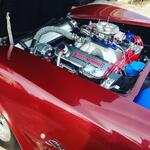
The engine was an alu donovan w/ 16 injectors, Haltech, batten heads . The thing was built by Norwood Autocraft from Dallas.
Marck
[Modified by Twin_Turbo, 5:34 AM 10/25/2002]
[Modified by Twin_Turbo, 6:49 AM 10/25/2002]

Burning Brakes


Joined: Jan 2002
Posts: 1,206
Likes: 62
From: Redondo Beach CA
C2 of Year Finalist (performance mods) 2019
Re: increasing rpm limit (MoMo)
I wish someone would design a 4-valve head system for use on any small block (big block too) converting it to an overhead cam design, driven off a kind of double-"groove" crank gear, using belts instead of chains. Then have one belt go up around the 2 cam gears on one head, and the other belt go to the 2 cam gears on the other head.
I think this is the old "Dominator" or "Dominion" head. The company that made those went out of business, whcih might indicate the feasibility of the 4 valve retrofit...
