



Heads Flowrate vs performance.
Thread Starter
Le Mans Master


Joined: Apr 2000
Posts: 6,341
Likes: 1
From: Shelton CT
 Heads Flowrate vs performance.
Im running Dart "Iron eagle" heads right now with .500 lift around 220/170cfm and .400 lift around 200/160cfm.
Increasing the intake flow #'s by 15-20% and exhaust flow #'s by 5-10% would yield what sort of performance differences?
Just a guesstimate.
ps. I'm running the stock cam, so around .434 max lift. I will be changing to a set of 1.6 ratio rockers soon too before switching to a new cam.
Increasing the intake flow #'s by 15-20% and exhaust flow #'s by 5-10% would yield what sort of performance differences?
Just a guesstimate.
ps. I'm running the stock cam, so around .434 max lift. I will be changing to a set of 1.6 ratio rockers soon too before switching to a new cam.

Race Director


Joined: Jan 2000
Posts: 13,018
Likes: 2,261
From: Corsicana, Tx
2020 C2 of the Year - Modified Winner
2020 Corvette of the Year (performance mods)
C2 of Year Winner (performance mods) 2019
2017 C2 of Year Finalist
Re: Heads Flowrate vs performance. (MrNuke)
Just a SWAG ( Scientific Wild A** Guess) but the common numbers folks throw around are in the 1.8-2.2 HP per cfm. It depends on *IF* the engine can use the added airflow..meaning cam, exhaust and rpm range are within the heads range.
So a good serious port job that gave you airflow numbers you said could get you 35-40 hp or so. Maybe a little more.
How's that for a guess?
JIM
So a good serious port job that gave you airflow numbers you said could get you 35-40 hp or so. Maybe a little more.
How's that for a guess?
JIM
Race Director
Joined: Nov 2000
Posts: 11,872
Likes: 12
From: Waterloo ontario Canada
Re: Heads Flowrate vs performance. (MrNuke)
The horsepower that a head can support is CFM x .257 x 8 cylinders. That is assuming no intake loss. The normal intake carb loss is in the 20% range and if over 25% you should look for a new intake.
This is all theory of course.
This is all theory of course.
Thread Starter
Le Mans Master
Joined: Apr 2000
Posts: 6,341
Likes: 1
From: Shelton CT
Re: Heads Flowrate vs performance. (427Hotrod)
I have my stock 350 shortblock with stock cam (1.52rr right now though).
Max lift is a paultry 434 on the cam.
Looks like I won't be putting the new heads on until winter, so I'll have to make 'due' with the ones on there now.
The Superram on teh intake and accel lower manifold should be good for
280cfm, which supports a possible 560HP or more. The heads can flow right at the 280cfm range at 500 -600 lift (which I'll get to ones the new cam mayeb next year that goes in). Just trying to see what difference these heads would make now. Sounds good though.. I was counting on about 20-25HP over the Darts on there now at my current lift.
Max lift is a paultry 434 on the cam.
Looks like I won't be putting the new heads on until winter, so I'll have to make 'due' with the ones on there now.
The Superram on teh intake and accel lower manifold should be good for
280cfm, which supports a possible 560HP or more. The heads can flow right at the 280cfm range at 500 -600 lift (which I'll get to ones the new cam mayeb next year that goes in). Just trying to see what difference these heads would make now. Sounds good though.. I was counting on about 20-25HP over the Darts on there now at my current lift.

Pro

Joined: Feb 2002
Posts: 500
Likes: 0
From: sebastopol ca
Re: Heads Flowrate vs performance. (MrNuke)
if you're increasing the flow rate, why not get a better cam while your at it, you'll get much better performance, and cams dont cost that much compared to porting.
Thread Starter
Le Mans Master
Joined: Apr 2000
Posts: 6,341
Likes: 1
From: Shelton CT
Re: Heads Flowrate vs performance. (OatBoy)
I was planning to put the new heads on this weekend and see whats the absolute MAX I can get out of the car before the season ends on the stock '85 shortblock/cam, but looks like I will be doing it over the winter. Then I'll probably drop a new cam in. Nothing crazy though, as I enjoy driving the car as a daily driver whenever I want to, and not only race it.
Drifting

Joined: Jul 2001
Posts: 1,897
Likes: 0
From: La Fontaine Indiana
Re: Heads Flowrate vs performance. (norvalwilhelm)
The horsepower that a head can support is CFM x .257 x 8 cylinders. That is assuming no intake loss. The normal intake carb loss is in the 20% range and if over 25% you should look for a new intake.
This is all theory of course.
This is all theory of course.
ANyone have a formula for figuring how much the flow increases for every pound of boost that is applied
Corvette Stories
The Best of Corvette for Corvette Enthusiasts

Top 10 Most Expensive Corvettes Ever Sold on Bring A Trailer
Brett Foote
10 Things Every Corvette Owner Needs (2026 Edition)
Michael S. Palmer
8 Most "Only Corvette Owners Understand" Quirks and Problems
Pouria Savadkouei
10 Reasons the C6 Z06 is Still A Performance Benchmark After 20 Years
Joe Kucinski
How Much Horsepower Every Corvette Engine "LOST" in 1972
Joe Kucinski
Top 10 DOs and DON'Ts for Protecting Your Convertible Top!
Michael S. Palmer
Top 10 Most Explosive Corvettes Ever Made: Power-to-Weight Ratio Ranked!
Joe Kucinski
150 hp to 1,250 hp: Every Corvette Generation Compared by the Specs That Matter
Joe Kucinski
8 Coolest Corvette Pace Cars (and Replicas) of All Time
Verdad Gallardo
Drifting
Joined: Jun 1999
Posts: 1,874
Likes: 1
From: Garden Grove CA
Re: Heads Flowrate vs performance. (MrNuke)
Bart, you may want to check in one of the well written books by Corky Bell for the serious math. Here is the crude math: divide the boost psi by 14.7, that will be the potential % increase in flow over the n/a numbers. I have to emphasize "potential % increase" because boost psi as measured in the intake manifold is really a measure of backed up airflow, rather than actual airflow.
Suprisingly, the crude math gets pretty close if the total engine combo is decently matched. My supercharged 468 for example: at 17.1 peak boost psi that would represent a 116% gain over the n/a power. N/A power was in fact ~ 480, the fuel supply limited 951 peak supercharged hp recorded could have been close to 1,000 +/- hp with fuel system changes.
Thomas
Suprisingly, the crude math gets pretty close if the total engine combo is decently matched. My supercharged 468 for example: at 17.1 peak boost psi that would represent a 116% gain over the n/a power. N/A power was in fact ~ 480, the fuel supply limited 951 peak supercharged hp recorded could have been close to 1,000 +/- hp with fuel system changes.
Thomas
Race Director
Joined: Nov 2000
Posts: 11,872
Likes: 12
From: Waterloo ontario Canada
Re: Heads Flowrate vs performance. (The Green Rocket)
My supercharged 468 for example: at 17.1 peak boost psi that would represent a 116% gain over the n/a power.
The Green Rocket what are you running for a supercharger? What is your compression to start with? Is your block oringed?
Do you run a Boost timming retart system.
I know alot of questions. :) :)
The Green Rocket what are you running for a supercharger? What is your compression to start with? Is your block oringed?
Do you run a Boost timming retart system.
I know alot of questions. :) :)
Drifting
Joined: Jun 1999
Posts: 1,874
Likes: 1
From: Garden Grove CA
Re: Heads Flowrate vs performance. (norvalwilhelm)
Norval, I'll only hijack this post a little - if you are building an engine and need technical help just email me with further specific questions.
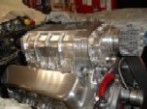
The blower is a ProCharger D2R centrifugal (rated to be capable of ~ 34 psi of sustained boost). Compression ratio is ~ 8.3:1. Big blocks are good to ~ 20 +/- psi before o-ringing of the cylinder heads is needed. Big blowers run better with locked out advance on the distributor, this engine runs mostly between 28 to 32 degrees depending on boost & fuel.
Thomas
The blower is a ProCharger D2R centrifugal (rated to be capable of ~ 34 psi of sustained boost). Compression ratio is ~ 8.3:1. Big blocks are good to ~ 20 +/- psi before o-ringing of the cylinder heads is needed. Big blowers run better with locked out advance on the distributor, this engine runs mostly between 28 to 32 degrees depending on boost & fuel.
Thomas
Race Director
Joined: Nov 2000
Posts: 11,872
Likes: 12
From: Waterloo ontario Canada
Re: Heads Flowrate vs performance. (The Green Rocket)
Green Rocket I have been running my present 8-71 blown big block for 4 years. I start with 8 to 1 compression, run a maximum of 12 pounds of boost for an effective compression of close to 15 to 1. I run 43 degrees of timming with a boost master pulling the timming out as the boost builds.
I also O ringed the block to be safe.
I was just curious how it works with 17 psi of boost.

I also O ringed the block to be safe.
I was just curious how it works with 17 psi of boost.
Drifting
Joined: Jun 1999
Posts: 1,874
Likes: 1
From: Garden Grove CA
Re: Heads Flowrate vs performance. (norvalwilhelm)
Norval, that is one cool ride you have - many long years ago my dream car was exactly what you have. My engine had a Weiand 8-71 on it before the ProCharger, ran 17 lbs boost with that too.
Thomas
Thomas
Race Director
Joined: Nov 2000
Posts: 11,872
Likes: 12
From: Waterloo ontario Canada
Re: Heads Flowrate vs performance. (The Green Rocket)
Norval, that is one cool ride you have - many long years ago my dream car was exactly what you have. My engine had a Weiand 8-71 on it before the ProCharger, ran 17 lbs boost with that too.
Thomas
Thanks Green Rocket. Why did you dump the 8-71? I really like the down low grunt of the motor. Boost is at any rpm. I can also run on any gas as long as I don't push it.
Double click to enlarge

Thomas
Thanks Green Rocket. Why did you dump the 8-71? I really like the down low grunt of the motor. Boost is at any rpm. I can also run on any gas as long as I don't push it.
Double click to enlarge
Drifting
Joined: Jun 1999
Posts: 1,874
Likes: 1
From: Garden Grove CA
Re: Heads Flowrate vs performance. (norvalwilhelm)
I didn't dump the 8-71, there is a crazy story about how I got this engine. I bought the 468 (minus the 8-71 and related gear) from a crazy Chevelle guy who wigged out when a little oil leaked out of the engine. I know the people who installed the engine, it had less than 50 actual street miles at the time and they tried to assure him that it was no problem to reseal the intake. He would have no part of that, he said that he lost faith in the engine. So he had them yank the engine and build a new 540 (he spent ANOTHER $17,000+ on the new engine and trans etc.), onto which he placed the same 8-71 blower (driven slower than when it was on the 468). When the 8-71 was on the 468 running ~ 17 lbs boost I believe it was never dynoed past 5,000 rpm; made like 734 hp and 774 tq, all by 5,000 rpm (more rpms would have seen more boost and more power). At that boost level the instant off idle torque of a roots blower made his '69 Chevelle undriveable - it required eggshell throttle operation. His wife would not get in the car.
I had a few tuning ideas that I wanted to try with a centrifugal, and I wanted less off idle torque to make hooking up an easier task.
Now that they have the new air-loc rotors for the roots blowers I wish I had a good excuse for building another blower engine - but I haven't even installed this engine in a car yet!
Thomas
I had a few tuning ideas that I wanted to try with a centrifugal, and I wanted less off idle torque to make hooking up an easier task.
Now that they have the new air-loc rotors for the roots blowers I wish I had a good excuse for building another blower engine - but I haven't even installed this engine in a car yet!
Thomas
