



Considering a solid cam,need some input.

Thread Starter
Melting Slicks


Joined: Jun 2002
Posts: 2,844
Likes: 99
From: Orrtanna Pa.
 Considering a solid cam,need some input.
Currently I'm running a Comp XE-284 with 1.60 rockers and RPM intake on the 406.Not a bad overall combination,but I've developed a leak on the rear of the intake,and planned on switching over to a Vic Jr intake in the spring anyway.All said,I figure if the intakes off I'm half way into a cam swap,so I'd like to explore my options.Everwhere I look,the rage is roller this or roller that.The expense to convert to a roller cam is not an option at this time,and to be honest I don't think a roller is needed to pull the hp I want.
In researching this I read a solid needs to be sized about 10 degrees larger than a hydraulic to perform equally.I read a comparison article that showed idle speed/vacuum,as well as the resulting dyno pulls.(The solid did pull some 30hp more than the hydraulic,but was sized 10 degrees larger)
Anyway,with 240/246@.050 I run now with the RPM intake,how much of a cam can I get away with once the Vic Jr is on?I've got my eye on a Comp 306S (260@.050 lift .555 I/E) I suppose a vacuum can could be added if I have to,but I'd like to keep this beast a daily driver
Any thaughts or comments from those who have similar built engines would be great.I have a dyno tested 383 write up that shows 560hp,but I have no idea how nasty the idle/ low speed would be.
In researching this I read a solid needs to be sized about 10 degrees larger than a hydraulic to perform equally.I read a comparison article that showed idle speed/vacuum,as well as the resulting dyno pulls.(The solid did pull some 30hp more than the hydraulic,but was sized 10 degrees larger)
Anyway,with 240/246@.050 I run now with the RPM intake,how much of a cam can I get away with once the Vic Jr is on?I've got my eye on a Comp 306S (260@.050 lift .555 I/E) I suppose a vacuum can could be added if I have to,but I'd like to keep this beast a daily driver
Any thaughts or comments from those who have similar built engines would be great.I have a dyno tested 383 write up that shows 560hp,but I have no idea how nasty the idle/ low speed would be.

Melting Slicks

Joined: Dec 2000
Posts: 2,041
Likes: 0
From: Wichita, KS
You need to watch your dynamic compression ratio (DCR) when you make a cam change to be sure that you don't create a dog or a car that needs race gas. You can download a copy of the calculator from http://cochise.uia.net/pkelley2/DynamicCR.html
Solid lifter cams that I looked at for my 406 included;
COMP CAMS
P/N 12-678-4
Lift .520/.540
@.015 282/290
@.05 244/252
Lobe sep 110
P/N 12-336-4
Lift .501/.510
@.006 292/296
@.05 244/246
Lobe sep 110
CRANE
P/N 114681
Lift .518/.536
@.020 280/288
@.05 244/252
CROWER
P/N 00322
Lift .504/.528
@.006 282/292
@.05 248/252
Lobe sep 112
For my engine I settled on a Lunati cam with the following specs.
P/N 00013
Lift .500/.515
@.006 300/310
@.05 256/270
Lobe sep 112
This cam gives me 10 inches of vacuum at a 1000 RPM idle.
Solid lifter cams that I looked at for my 406 included;
COMP CAMS
P/N 12-678-4
Lift .520/.540
@.015 282/290
@.05 244/252
Lobe sep 110
P/N 12-336-4
Lift .501/.510
@.006 292/296
@.05 244/246
Lobe sep 110
CRANE
P/N 114681
Lift .518/.536
@.020 280/288
@.05 244/252
CROWER
P/N 00322
Lift .504/.528
@.006 282/292
@.05 248/252
Lobe sep 112
For my engine I settled on a Lunati cam with the following specs.
P/N 00013
Lift .500/.515
@.006 300/310
@.05 256/270
Lobe sep 112
This cam gives me 10 inches of vacuum at a 1000 RPM idle.
Thread Starter
Melting Slicks
Joined: Jun 2002
Posts: 2,844
Likes: 99
From: Orrtanna Pa.
79Toy,
I assume with that cam you are running a single plane intake.How's the low speed torque.Are you running an automatic or a stick?Sounds like elementry questions,but the truth is,most cam companies only test with 350's,since they are the most common.Also dynoe's don't tell you how a combination behaves in a real car.You look at a read out and "guess" how it will run on the street.
My 406 with the RPM is in my opinion "daily driver",meaning rumpity idle,but no problem jumping into cold in the morning,firing it up and commuting 40 miles to work.What I'm wanting to hear from those that are running large cams in a 406,is the overall streetability.Describe the low end,light throttle cruising.This is where most of the real street driving is done. I'm fully aware this will be a jeckle and hyde engine.Already blew one transmission to prove it.
Also like to see cam specs and CR's for comparison.
I assume with that cam you are running a single plane intake.How's the low speed torque.Are you running an automatic or a stick?Sounds like elementry questions,but the truth is,most cam companies only test with 350's,since they are the most common.Also dynoe's don't tell you how a combination behaves in a real car.You look at a read out and "guess" how it will run on the street.
My 406 with the RPM is in my opinion "daily driver",meaning rumpity idle,but no problem jumping into cold in the morning,firing it up and commuting 40 miles to work.What I'm wanting to hear from those that are running large cams in a 406,is the overall streetability.Describe the low end,light throttle cruising.This is where most of the real street driving is done. I'm fully aware this will be a jeckle and hyde engine.Already blew one transmission to prove it.
Also like to see cam specs and CR's for comparison.

Team Owner


Joined: Apr 1999
Posts: 21,953
Likes: 1,445
From: Reno Nevada
2024 C3 of the Year Finalist- Modified
This is wonderful cam. I've used it. 238/248 114 lc. I used 1.6 rockers with good heads and 155# closed pressure springs and I was able to spin 7800 rpm in a 355 ci. Lt1er here on forum set his redline at 7000 and it's a go getter for a 355 ci 4 speed.
Your 406 will tame it down. Crane valve events are the equivolent of 4 degrees retarded when compared to other manufacturers. That's why they give the 3000-6500 rating for 350 or so ci motor.
Part Number: 113841 Grind Number: F-278-2 (REPLACES CC-278-2)
Engine Identification:
Start Yr. End Yr. Make Cyl Description
1957 1987 CHEVROLET 8 FAIR IDLE, MODERATE PERFORMANCE USAGE, GOOD MID-RANGE HP, BRACKET RACING, 3400-3800 CRUISE RPM, 10.0 TO 11.5 COMPRESSION RATIO ADVISED. BASIC RPM 3000-6500
Engine Size Configuration
262-400 C.I. V
Valve Setting: Intake .022 Exhaust .022 HOT
Lift: Intake @Cam 320 @Valve 480 All Lifts are based
on zero lash and theoretical rocker arm ratios.
Exhaust @ Cam 3334 @Valve 500
Rocker Arm Ratio 1.50
Cam Timing: TAPPET @.018
Lift: Opens Closes ADV Duration
Intake 29.0 BTDC 69.0 ABDC 278 °
Exhaust 82.0 BBDC 26.0 ATDC 288 °
Spring Requirements: Triple Dual Outer Inner
Part Number 99893
Loads Closed 120 LBS @ 1.875 or 1 7/8"
Open 296 LBS @ 1.415
Recommended RPM range with matching components
Minimum RPM 3000
Maximum RPM 6500
Valve Float 6800
Cam Timing: TAPPET @.050
Lift: Opens Closes Max Lift Duration
Intake 10.0 BTDC 48.0 ABDC 109 238 °
Exhaust 63.0 BBDC 5.0 ATDC 119 248 °
Your 406 will tame it down. Crane valve events are the equivolent of 4 degrees retarded when compared to other manufacturers. That's why they give the 3000-6500 rating for 350 or so ci motor.
Part Number: 113841 Grind Number: F-278-2 (REPLACES CC-278-2)
Engine Identification:
Start Yr. End Yr. Make Cyl Description
1957 1987 CHEVROLET 8 FAIR IDLE, MODERATE PERFORMANCE USAGE, GOOD MID-RANGE HP, BRACKET RACING, 3400-3800 CRUISE RPM, 10.0 TO 11.5 COMPRESSION RATIO ADVISED. BASIC RPM 3000-6500
Engine Size Configuration
262-400 C.I. V
Valve Setting: Intake .022 Exhaust .022 HOT
Lift: Intake @Cam 320 @Valve 480 All Lifts are based
on zero lash and theoretical rocker arm ratios.
Exhaust @ Cam 3334 @Valve 500
Rocker Arm Ratio 1.50
Cam Timing: TAPPET @.018
Lift: Opens Closes ADV Duration
Intake 29.0 BTDC 69.0 ABDC 278 °
Exhaust 82.0 BBDC 26.0 ATDC 288 °
Spring Requirements: Triple Dual Outer Inner
Part Number 99893
Loads Closed 120 LBS @ 1.875 or 1 7/8"
Open 296 LBS @ 1.415
Recommended RPM range with matching components
Minimum RPM 3000
Maximum RPM 6500
Valve Float 6800
Cam Timing: TAPPET @.050
Lift: Opens Closes Max Lift Duration
Intake 10.0 BTDC 48.0 ABDC 109 238 °
Exhaust 63.0 BBDC 5.0 ATDC 119 248 °

Safety Car

Joined: May 1999
Posts: 3,651
Likes: 5
From: Atlantis
Cruise-In I Veteran
I don't have much I can pass on about this except:
1) I personally don't like the noise the valve lash makes.
2) I personally don't like adjusting the lash being an item on my 'standard maintanence list'
The valve covers are a ROYAL PITA to take off on a C4 Vette.
I realize other folks may not be bothered about these two items at all and may, indeed, enjoy both activities.
JMHO.
1) I personally don't like the noise the valve lash makes.
2) I personally don't like adjusting the lash being an item on my 'standard maintanence list'
The valve covers are a ROYAL PITA to take off on a C4 Vette.
I realize other folks may not be bothered about these two items at all and may, indeed, enjoy both activities.
JMHO.

Race Director


Joined: Jan 2000
Posts: 13,015
Likes: 2,260
From: Corsicana, Tx
2020 C2 of the Year - Modified Winner
2020 Corvette of the Year (performance mods)
C2 of Year Winner (performance mods) 2019
2017 C2 of Year Finalist
Just a couple of thoughts....
First I love solid lifters sounds! And if you have to set them that often...something is wrong. They shouldn't be moving around that much.
You're in the right area on increased duration. But I think you should get WAY past the 294S/306S series of cams. They are good cams, but I think of them as good baseline ones. I really like some of the milder roundy-pounder type cams for small block street stuff. They have fast ramp speeds (make Xtreme Energy stuff look lame) short durations and tight LSA. With the tight LSA and advanced intake opening and relatively small durations they have fantastic street manners and pull like crazy. A buddy has a little Crower in his 327 with like 236@.050 and 268 adv with a 107 LSA. It idles very well and never needs adjustments.
With your heads I'd be looking for something in the .600 lift range at least. No need to give up power and longevity is fine in that range. Plus the increased lift can actually help longevity (to a point) by allowing the cam designer more time to slow valve at peak and more time to accelerate it on th eclosing side and to slow it down to close. Think about it. The hardest thing you can do is have a fast ramp with a short duration. It's hard on stuff!
Also, I wouldn't give up on the RPM intake just yet. It is a great design and with an auto in a realtively heavy car, it can help. The Victor will outdo it up top, but in the range you spend the most time in even wt WOT, it will spank it. I'd be surprised if the Victor ran any better overall unless you really twist it, and 3.70's aren't going to get it up where it wants to be I don't think.
Gkull's advice is good. He has been running his with a 700R4 for a long time with lots of combo's. He would know it's characteristics well..but I still think you could go a little wilder. But you know me.....
JIM
First I love solid lifters sounds! And if you have to set them that often...something is wrong. They shouldn't be moving around that much.
You're in the right area on increased duration. But I think you should get WAY past the 294S/306S series of cams. They are good cams, but I think of them as good baseline ones. I really like some of the milder roundy-pounder type cams for small block street stuff. They have fast ramp speeds (make Xtreme Energy stuff look lame) short durations and tight LSA. With the tight LSA and advanced intake opening and relatively small durations they have fantastic street manners and pull like crazy. A buddy has a little Crower in his 327 with like 236@.050 and 268 adv with a 107 LSA. It idles very well and never needs adjustments.
With your heads I'd be looking for something in the .600 lift range at least. No need to give up power and longevity is fine in that range. Plus the increased lift can actually help longevity (to a point) by allowing the cam designer more time to slow valve at peak and more time to accelerate it on th eclosing side and to slow it down to close. Think about it. The hardest thing you can do is have a fast ramp with a short duration. It's hard on stuff!
Also, I wouldn't give up on the RPM intake just yet. It is a great design and with an auto in a realtively heavy car, it can help. The Victor will outdo it up top, but in the range you spend the most time in even wt WOT, it will spank it. I'd be surprised if the Victor ran any better overall unless you really twist it, and 3.70's aren't going to get it up where it wants to be I don't think.
Gkull's advice is good. He has been running his with a 700R4 for a long time with lots of combo's. He would know it's characteristics well..but I still think you could go a little wilder. But you know me.....
JIM
Thread Starter
Melting Slicks
Joined: Jun 2002
Posts: 2,844
Likes: 99
From: Orrtanna Pa.
I have an interest in the oval track grinds as well,and like what I see the tighter LC's do.But this seems to be unchartered water,and I want to hear from guys that actually have run some of them.One of the forum guys did a Desktop Dyno comparison for me once and showed a 107 degree LC(circle track solid) pull 17hp and 30 lbs more torque than my current XE-284,so I know there's power to be had. I just don't know how the thing will behave on the street.
I've run into a few buildups in the 400 CI range,running cams in the 250-260 degree range,all run Vic Jr intakes,and all pushing well over 500 hp.Kind of tempting,but I'm not diving in,till I know how deep the water is.(If you know what I mean.)
Keep up the suggestions,I and others will definately benifit from the knowlege others have to offer.
I've run into a few buildups in the 400 CI range,running cams in the 250-260 degree range,all run Vic Jr intakes,and all pushing well over 500 hp.Kind of tempting,but I'm not diving in,till I know how deep the water is.(If you know what I mean.)
Keep up the suggestions,I and others will definately benifit from the knowlege others have to offer.
Corvette Stories
The Best of Corvette for Corvette Enthusiasts

Top 10 Most Explosive Corvettes Ever Made: Power-to-Weight Ratio Ranked!
Joe Kucinski
150 hp to 1,250 hp: Every Corvette Generation Compared by the Specs That Matter
Joe Kucinski
8 Coolest Corvette Pace Cars (and Replicas) of All Time
Verdad Gallardo
Top 10 Corvette Engines RANKED by Peak Torque (70+ Years of Muscle!)
Joe Kucinski
Corvette ZR1X Will Be Pacing the Indy 500, And Could Probably Race, Too!
Verdad Gallardo
Top 10 Corvettes Coming to Mecum Indy 2026!
Brett Foote
Top 10 C9 Corvette MUST-HAVES to Fix These C8 Generation Flaws!
Michael S. Palmer
10 Revolutionary 'Corvette Firsts' Most People Don't Know
Joe Kucinski
5 Reasons to Upgrade to an LS6-Powered Corvette; 5 Reasons to Stay LT2
Michael S. Palmer
Le Mans Master


Joined: Feb 2002
Posts: 5,970
Likes: 20
From: San Marcos Texas
Since were on a disscusion of roller cams...I am thinking of going bigger on my motor. Something with a split pattern in the range of 244/250 and .610 lift with a lsa of 107. What do you think? The cam I have right now is Compcams Street roller 12-702-8 236/236 and .580lift with LSA of 110. I am making good power, 440hp to the tires and 121mph in the 1/4mile. Just looking for more power. I think it is a little small for my combo, it idles very well. Any opionions on what would work good with my tunnelram and still not be too big and crazy... 

Le Mans Master
Joined: Feb 1999
Posts: 6,172
Likes: 11
From: somers, ny
Chris, i'm runing a 246/246 solid roller with 112 LSA on a 105 ICL. It's fairly streetable. The idle is a bit rough, but nothing crazy. With the SR it wouldn't idle below 800, but with the single plane it will idle at 400 if it had to. The idle vacuum at 900 rpms is about 12 inches. The only complaints i have is it's way rich at idle due to the overlap (but heck my 219 wasn't much better in that respect) and it does some wierd bucking when the converter is lockup up and cruising under 2000 rpms....but you could probably drive around it with a stick. I'm actually thinking of trying a smaller cam. I'm looking at a 235/235 with slightly more aggressive ramps than yours. With my stock exhaust, i'm sorta capped at the top end anyway. Still haven't decided on my plans yet tho
Thread Starter
Melting Slicks
Joined: Jun 2002
Posts: 2,844
Likes: 99
From: Orrtanna Pa.
I'm more interested in the old fashioned flat tappet solids,due to cost of replacement,but welcome any input here.Does anyone know if there's a formula or comparison that can be made between roller cams and flat tappets?My guess is a a flat tappet cam with 8-10 degrees more duration ,but running similar lift will come within 10hp of a roller if you try to match lift and duration fairly close.In otherwords use 1.60RR and try to make the flat tappet cam "lift" like a roller.
The springs I got with the AFR 195's have a seat pressure of 120,and are 325 lbs/in rate,with .550 max lift,so the cam I pick I'd like to be able to reuse the same springs.(Again to reduce the cost of any performance increase.)The Comp 294S lift is .525 with 1.5 RR, rockers(I'd like roller rockers anyway)Take the .525 lift,use 1.60 RR for a .560 lift,subtract .022 for lash and get .538 lift and 248 @ .050.I'm guessing mid 6000 rpm range in my 406,and still keeping a "decent" idle.
The springs I got with the AFR 195's have a seat pressure of 120,and are 325 lbs/in rate,with .550 max lift,so the cam I pick I'd like to be able to reuse the same springs.(Again to reduce the cost of any performance increase.)The Comp 294S lift is .525 with 1.5 RR, rockers(I'd like roller rockers anyway)Take the .525 lift,use 1.60 RR for a .560 lift,subtract .022 for lash and get .538 lift and 248 @ .050.I'm guessing mid 6000 rpm range in my 406,and still keeping a "decent" idle.

Melting Slicks
Joined: Dec 2001
Posts: 2,025
Likes: 1
From: Billings MT
I made the change on my 406 (Also with AFR 195 Heads and Victor Jr) from a comp XR288 hydraulic roller to a comp XR280R solid roller.
Before
230 / 236 @ .050
.520 / .540"
110LS
After
242 / 242 @ .050
.570 / .576"
110LS
I like the solid roller a lot better. It has shorter seat-to-seat duration giving it a better idle. Car idles at ~900rpm with 13-14" vacuum, brakes and lights work just fine.
Pulls HARD past 7000rpm. (My heads have been ported, intake = 208cc)
As far as adjustments? I have not had to make an adjustment in nearly 4000 miles of hard use. A good stud girdle will help lock everything into place.
I can hear my valvetrain over my open exhaust going down the highway, if that doesn't matter to you go for it!

Before
230 / 236 @ .050
.520 / .540"
110LS
After
242 / 242 @ .050
.570 / .576"
110LS
I like the solid roller a lot better. It has shorter seat-to-seat duration giving it a better idle. Car idles at ~900rpm with 13-14" vacuum, brakes and lights work just fine.
Pulls HARD past 7000rpm. (My heads have been ported, intake = 208cc)
As far as adjustments? I have not had to make an adjustment in nearly 4000 miles of hard use. A good stud girdle will help lock everything into place.
I can hear my valvetrain over my open exhaust going down the highway, if that doesn't matter to you go for it!
Team Owner
Joined: Apr 1999
Posts: 21,953
Likes: 1,445
From: Reno Nevada
2024 C3 of the Year Finalist- Modified
Don't ever run springs on the edge. They are such cheap insurance. I learned my lesson when I had a tranny failure with my foot on the floor. I had valve to piston contact in half the cylinders and the keepers had mushroomed the stems on my manley valves that i couldn't pound them through the guides. I ended up using an air wheel cutter to chop off all the valve stems.
Valve float is a bad deal! Spring fatigue is causes by heat and running them near the edge. Your better off to get the cam/springs/lifters/retainers as a package deal. I always went for 20-35 pounds of seat pressure over what they list. So if 120# give valve float at 6800 rpm on the cam card. 140 # seats will give you something like a 7250 rpm safety margin.
If I intended to lift the valve .540 I went with .600 max lift combo. No coil bind and the spring last longer.
I buy good springs like K-motion. These last ones were for .700 lift and i was only doing .630/.644 and as installed 195# seat. In a little over one year they were already fatigued down to @ 175#.
Valve float is a bad deal!
Spring fatigue is causes by heat and running them near the edge. Your better off to get the cam/springs/lifters/retainers as a package deal. I always went for 20-35 pounds of seat pressure over what they list. So if 120# give valve float at 6800 rpm on the cam card. 140 # seats will give you something like a 7250 rpm safety margin.If I intended to lift the valve .540 I went with .600 max lift combo. No coil bind and the spring last longer.
I buy good springs like K-motion. These last ones were for .700 lift and i was only doing .630/.644 and as installed 195# seat. In a little over one year they were already fatigued down to @ 175#.
Last edited by gkull; Dec 21, 2004 at 08:43 PM.
Thread Starter
Melting Slicks
Joined: Jun 2002
Posts: 2,844
Likes: 99
From: Orrtanna Pa.
VETDRMS,
Since you only changed 12 degrees @ .050,can you notice much of a difference.I ask this because I read somewhere a solid needs to be sized about 8-10 degrees larger than a hydraulic in order for it to run about the same.They said the ramps are measured differently between solids and hydraulics,so to get a good comparison between how the same engine would run with a hydraulic vs. solid,you need more duration on the solid.I'm guessing I'd need 20 degrees more just to raise my torque peak 500 rpms.(Which is all I'm wanting to do.)
Also did you notice throttle response being quicker?
Since you only changed 12 degrees @ .050,can you notice much of a difference.I ask this because I read somewhere a solid needs to be sized about 8-10 degrees larger than a hydraulic in order for it to run about the same.They said the ramps are measured differently between solids and hydraulics,so to get a good comparison between how the same engine would run with a hydraulic vs. solid,you need more duration on the solid.I'm guessing I'd need 20 degrees more just to raise my torque peak 500 rpms.(Which is all I'm wanting to do.)
Also did you notice throttle response being quicker?

Race Director
Joined: May 2000
Posts: 12,712
Likes: 2,270
Comparing lifter rise specs at .050" between hydraulic cams and mechanical lifter cams is apples and oranges. This is because essentially all of hydraulic cam lifter rise is converted into valve lift. On a mechanical lifter cam, a good part of the first .050" lifter rise is the clearance ramp taking up lash. In order to compare a mechanical lifter cam to a hydraulic, you need the .050" lifter rise ABOVE the top of the clearance ramps, but I'm not aware of any manufacturers who quote this spec.
As an example, the OE LT-1 cam is typically speced at 242/254 .050" lifter rise duration. The top of the clearance ramps on the inlet/exhaust lobes are .012"/.017" above the base circle, so the duration comparison to a hydraulic lifter cam at .050" lifter rise should be taken at .062"/.067" lifter rise. This yields durations of 231/239.
The "ten to fifteen degrees" rule of thumb more duration on a mechanical lifter cam compared to a hydraulic lifter cam is a reasonable approximation for cams with recommended clearances in the range of .020" to .030", but will be less with "tight lash" mechanical lifter cams.
Duke
As an example, the OE LT-1 cam is typically speced at 242/254 .050" lifter rise duration. The top of the clearance ramps on the inlet/exhaust lobes are .012"/.017" above the base circle, so the duration comparison to a hydraulic lifter cam at .050" lifter rise should be taken at .062"/.067" lifter rise. This yields durations of 231/239.
The "ten to fifteen degrees" rule of thumb more duration on a mechanical lifter cam compared to a hydraulic lifter cam is a reasonable approximation for cams with recommended clearances in the range of .020" to .030", but will be less with "tight lash" mechanical lifter cams.
Duke
Last edited by SWCDuke; Dec 21, 2004 at 11:25 AM.
Melting Slicks
Joined: Dec 2001
Posts: 2,025
Likes: 1
From: Billings MT
The Money Pit: It should be noted that head heads were ported at the same time the cam was changed. Between the two, the solid has a lot more mid-range torque and pulls harder past 6500rpm. Throttle response is crisp and instantaneous. I have a 4000rpm stall so low-end torque is hard to gauge.
I run valve-lash at .018".
Best way to find out is through personal experience, but it sure sucks when you make the wrong choice.
I run valve-lash at .018".
Best way to find out is through personal experience, but it sure sucks when you make the wrong choice.

Team Owner
Joined: Apr 1999
Posts: 21,953
Likes: 1,445
From: Reno Nevada
2024 C3 of the Year Finalist- Modified
I was just thinking about the statements about H-flat to H-solid.
If you look at the .050 duration you have a pretty true comparision.
Just think about it? You have lifted the rocker arm .050. In a H cam with minimal slop the .050 will happen faster with the same ramp profile Because of not having to take up lash. That's not the measurement. .050 is. Your gross number taken by cam vendors of say 300 duration are at .006 or something.
So a H cam might be 10+ degrees hotter at that point. But not at .050 because it's in the lift range.
So when you buy a cam think about .050 and valve event numbers. Look at the lobe. Ramp speed and how long it holds the valve at max lift. The S-Flat cam for the same .050 duration has more cylinder filling than a H-flat cam.
The cam I beat up is a smaller .930 base circle Crane billet the new one I run now has even more degrees of max valve opening with simular lift

If you look at the .050 duration you have a pretty true comparision.
Just think about it? You have lifted the rocker arm .050. In a H cam with minimal slop the .050 will happen faster with the same ramp profile Because of not having to take up lash. That's not the measurement. .050 is. Your gross number taken by cam vendors of say 300 duration are at .006 or something.
So a H cam might be 10+ degrees hotter at that point. But not at .050 because it's in the lift range.
So when you buy a cam think about .050 and valve event numbers. Look at the lobe.
Ramp speed and how long it holds the valve at max lift. The S-Flat cam for the same .050 duration has more cylinder filling than a H-flat cam.The cam I beat up is a smaller .930 base circle Crane billet the new one I run now has even more degrees of max valve opening with simular lift
Team Owner
Joined: Apr 1999
Posts: 21,953
Likes: 1,445
From: Reno Nevada
2024 C3 of the Year Finalist- Modified
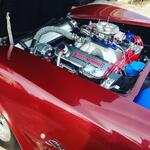
These pictures are of solid roller cams I run. That's why springs don't last.
Just look at a stock cam and look at the difference of how long it holds the valve open.
Solid flat cams have steeper ramps than H-flat. They just run so much better.
I have run 106 LC in a drag race motor and circle track. You really need to input the valve event numbers at .050 into DD2000 or some other program to see how a motor will react.
Just look at a stock cam and look at the difference of how long it holds the valve open.
Solid flat cams have steeper ramps than H-flat. They just run so much better.
I have run 106 LC in a drag race motor and circle track. You really need to input the valve event numbers at .050 into DD2000 or some other program to see how a motor will react.
Thread Starter
Melting Slicks
Joined: Jun 2002
Posts: 2,844
Likes: 99
From: Orrtanna Pa.
George,
I was struggling with the .050 comparison myself.I just didn't make sense that .050 on a solid was any different than .050 on a hydraulic,but that's what I thaught I read.Maybe one too many beers that night.
I'm hearing a lot of good things here,and am leaning more an more towards a solid.General opinions look like 240-250 @.050 for a 406 to remain streetable,but keep the combinations coming guys.That's what this forum was made for.
I was struggling with the .050 comparison myself.I just didn't make sense that .050 on a solid was any different than .050 on a hydraulic,but that's what I thaught I read.Maybe one too many beers that night.
I'm hearing a lot of good things here,and am leaning more an more towards a solid.General opinions look like 240-250 @.050 for a 406 to remain streetable,but keep the combinations coming guys.That's what this forum was made for.