When you click on links to various merchants on this site and make a purchase, this can result in this site earning a commission. Affiliate programs and affiliations include, but are not limited to, the eBay Partner Network.
If you or a guy you know, is good with fiberglass and bodywork, he could taper the edges of the damaged area, back it up with some smooth cardboard, or steel, and make a fiberglass patch using a combination of fiberglass cloth and random oriented strand. Do bodywork on the backside and fender lip. It would be strong and undetectable (if you sprayed some primer/black over the backside), if done right. It's actually a pretty simple fix a guy could do in an hour or two (incl tooling, but not incl the priming/paint work). The missing SS trim piece is available.
The paintwork could be handled a number of ways depending on what type of paint is on it now (Lacquer or B/C urethane), and other factors such as money and quality of car. If it's lacquer a guy could literally wetsand and blend new paint into the old. Then buff it out. If it's Single-stage urethane or enamel, a guy could also attempt to soften the existing paint and blend some new paint there using like a two-gun method. Pretty much the same if it's base/clear. Or, a guy could repaint the red part of the fender. A guy ought to be able to make the repair w/o doing a larger repaint. As I say, It all depends on the budget, goals, quality of car and so on.
As I said above, it's a simple repair to the guy who knows what he's doing.
Hi Mark, thanks for your prompt response. Although I have no experience with fiberglass, I'm willing to give it a try using your method since I couldn't find a local body shop willing to take on the job. Thank you!!!
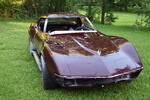
Hi Mark. I started doing it myself. Here is what I have so far. I'm stuck at this point.
If me, I would next blue painter's tape about an inch or so outside the repair so as to not let your repair area grow in size which is easy to do.
Next rough up and put a skim layer of Vette Panel Adhesive (VPA, also used as a great body filler)
Then blend into to shape, you might need a few iterations of VPA and blending to get there
Next SPI epoxy prime and then build prime (I like SPI 2K), sand in progressive grits to 400 and then paint as Mark describes above.
Thank you so much 20mercury, this is my first time doing any type of body work, so it's a bit nerve wracking. I will post my progression in the next week or so.
I would sand the repair down with a DA sander or even by hand with 80 grit. Get it mostly flat (remove the high spots). You need some 'teeth' there for the new filler to bite to. As small as it is, some two-part spot putty should work fine
. Don't over-harden it..that's a common mistake. Or underharden it either. For sure don't underharden it ...it'll never really set up. Read up on that..follow the directions.
So blow or wash it off (let *dry* THOROUGHLY), then put on your filler with a spatula or something flat. Then let it 'cure' overnight. Then come back to it and rub a rag saturated with acetone ...over it ...to remove any residue. That's a poor-man's way of making mediocre filler ...tack-free. Then start sanding it with some 80 grit wrapped around a straight paint stick. Then switch to like 180...and then 220 grit. The mask off and prime. Don't use spray can primer. Use some decent 2k primer out of a spray gun. You must know a buddy... who does paint work.
Ultimately there's going to need to be paint repair... when you get it close, let whoever do that. In fact, you might even just take it to whoever is going to do the paint worrk...just take it as-is right now.
Don't forget to 'tool' the backside of the repair so it matches the contour of the panels.... Do that while you're doing the outside.
You need to find someone who knows what he's doing on the paint work.
Note: fiberglass is ITCHY! Just like home fiberglass insulation is. Not a whole lot you can do about it, but just don't lay all over the couch affter you do all the sanding...and get fiberglass all over the place
Note: fiberglass is ITCHY! Just like home fiberglass insulation is. Not a whole lot you can do about it, but just don't lay all over the couch affter you do all the sanding...and get fiberglass all over the place
Good advice from Mark on fiberglass hazards. What I do now after many learnings (as the guy says this stuff is not going to make hair grow on your chest, so take precautions to keep out of your lungs and have itchy arms)
1. I try to do sanding of fiberglass outside. Sand in your shop and fiberglass dust will be everywhere forever.
2. Wearing a respirator 3M cartridge filter plastic mask is good, the little one pc white masks are worthless
3. I set up a fan blowing the fiberglass dust away from me while sanding which helps a lot
4. I try to wear long sleeves and cheep thin rubber gloves a lot but sometimes rubbing your bare hand over the curvature will help you dial it in. I also sometimes use a contour gauge to get to the right shape and compare to the other side too.
If you have a REAL machine buffer (I don't mean those cheap $5 Goodwill oscillating waxers), put a 7" 80# sanding disk on it and run it over the repair to grind the fiberglass back to the surface (or use good ole sandpaper on a wood block), then apply your filler and tool that properly. Then prime and block out. You should figure on the repaint area being much larger. If it's lacquer paint on there, then you can do some different things. If it's urethane, which it probably is, then you'll probably have to blend it and figure on repainting (clearing) at least to the top of the top trim.
On the paint, determine if it's lacquer or base/clear. Look up and watch some videos how to do it. If lacquer ...you could probably repair, if you have a compressor or spray gun. Like I say, if it's really lacquer paint. Or find someone who knows lacquer paint or do yourself. The problem of going to a bodyshop, they're going to want to use whatever they normally spray. And it won't be lacquer! Most guys at shops now have no idea what lacquer even is. Probably never even heard the word. But new lacquer would melt into the old lacquer and that would be a MUCH easier repair. Maybe even you could do it. That's one repair a newbie can do.
But if it's base/clear, then a good shop that does classic cars and knows how to do 'blends' should be able to repaint it nicely (and wetsand/buff if it needs it). They'd do a blend with the red paint and reclear the side of the fender probably to the trim (remove the trim of courese)... and do a blend ahead and behind the trim.






 !959 damaged fender repair help.