





Here it is... The Slave Cylinder EXPOSED. Pics inside.

Thread Starter
Race Director


Joined: Mar 2000
Posts: 17,602
Likes: 20
From: Palm City Florida
 Here it is... The Slave Cylinder EXPOSED. Pics inside.
After tons of speculation on Slave and how much fluid it contains and does it leach black from the rubber...
I have taken my old slave apart to prove once and for all the Slave contains VERY little fluid at all and does leach black from the rubber.
Ok here is a shot of the full slave.

Here is the Slave disassembled without the throwout bearing but just the Plastic plunger that rests on top of the thick rubber piston that the fluid pushes on. The inside edge of the plastic piston is all that makes contact with the rubber piston in the picture below.

Understand that this setup is the reverse of what one would expect. A hard aluminum piston with a rubber seal around it. In this case the piston IS the rubber seal. Here is the seal pulled up
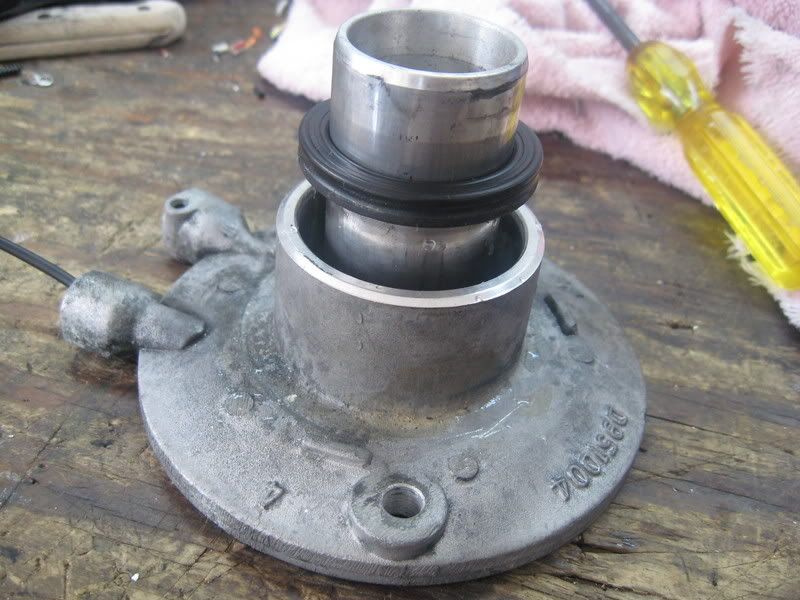
Here is proof that the black leaching is from the piston.

Here a shot of the size of the hole that the fluid enters. Its the same on both sides and it opens to a small channel under the rubber piston

Here is a pice of wire showing the entry point of the fluid.

Now for the question, how much fluid does the slave hold? EXACTLY 2 TABLESPOONS. Yes I used wifeys cooking measuring spoon.
I filled the whole thing up with water and plugged the holes.

I poured it out into a plastic dixie cup..to further demonstrate how little there is.

There you have it.. There is no more magic in the slave...the curtain has been pulled aside...
I have taken my old slave apart to prove once and for all the Slave contains VERY little fluid at all and does leach black from the rubber.
Ok here is a shot of the full slave.
Here is the Slave disassembled without the throwout bearing but just the Plastic plunger that rests on top of the thick rubber piston that the fluid pushes on. The inside edge of the plastic piston is all that makes contact with the rubber piston in the picture below.
Understand that this setup is the reverse of what one would expect. A hard aluminum piston with a rubber seal around it. In this case the piston IS the rubber seal. Here is the seal pulled up
Here is proof that the black leaching is from the piston.
Here a shot of the size of the hole that the fluid enters. Its the same on both sides and it opens to a small channel under the rubber piston
Here is a pice of wire showing the entry point of the fluid.
Now for the question, how much fluid does the slave hold? EXACTLY 2 TABLESPOONS. Yes I used wifeys cooking measuring spoon.
I filled the whole thing up with water and plugged the holes.
I poured it out into a plastic dixie cup..to further demonstrate how little there is.
There you have it.. There is no more magic in the slave...the curtain has been pulled aside...
Last edited by chuckster; Jul 21, 2007 at 12:01 PM.

Race Director


Joined: Aug 2000
Posts: 10,649
Likes: 32
From: Central Florida
Much appreciated Chuckster. 
Please continue the experiment.
Clean up that rubber seal.
Then cut it in half. Insert half in fresh DOT3 brake fluid, cap the container; and insert the other half in fresh DOT4 brake fluid, cap the container. Report back in a week on whether the color of the fluid in either container has changed.
Many thanks.
Ranger
Please continue the experiment.
Clean up that rubber seal.
Then cut it in half. Insert half in fresh DOT3 brake fluid, cap the container; and insert the other half in fresh DOT4 brake fluid, cap the container. Report back in a week on whether the color of the fluid in either container has changed.
Many thanks.
Ranger
Thread Starter
Race Director
Joined: Mar 2000
Posts: 17,602
Likes: 20
From: Palm City Florida
Much appreciated Chuckster.
Please continue the experiment.
Clean up that rubber seal.
Then cut it in half. Insert half in fresh DOT3 brake fluid, cap the container; and insert the other half in fresh DOT4 brake fluid, cap the container. Report back in a week on whether the color of the fluid in either container has changed.
Many thanks.
Ranger
Please continue the experiment.
Clean up that rubber seal.
Then cut it in half. Insert half in fresh DOT3 brake fluid, cap the container; and insert the other half in fresh DOT4 brake fluid, cap the container. Report back in a week on whether the color of the fluid in either container has changed.
Many thanks.
Ranger
Keep in mind as per the pictures.. The inside and outside of that seal are under a lot of friction rubbing up and down against the aluminum walls.. That alone would cause enough abrasion to release black particles.
But I am gonna see if one type of fluid causes more softening or leaching then another..
Last edited by chuckster; Jul 21, 2007 at 12:24 PM.

Team Owner


Joined: Sep 2001
Posts: 23,283
Likes: 906
From: Lake Elsinore, CA
Chuckster, you are my hero. 
Interesting dissection. The volume of fluid doesn't surprise me since it's displacement of an incompressible fluid over a certain distance that does the work and the necessary travel is obviously there. I dislike the setup the M6/12 have for the master/slave and the difficulty of flushing the system.
Keep us posted.
Interesting dissection. The volume of fluid doesn't surprise me since it's displacement of an incompressible fluid over a certain distance that does the work and the necessary travel is obviously there. I dislike the setup the M6/12 have for the master/slave and the difficulty of flushing the system.
Keep us posted.
Thread Starter
Race Director
Joined: Mar 2000
Posts: 17,602
Likes: 20
From: Palm City Florida
Much appreciated Chuckster.
Please continue the experiment.
Clean up that rubber seal.
Then cut it in half. Insert half in fresh DOT3 brake fluid, cap the container; and insert the other half in fresh DOT4 brake fluid, cap the container. Report back in a week on whether the color of the fluid in either container has changed.
Many thanks.
Ranger
Please continue the experiment.
Clean up that rubber seal.
Then cut it in half. Insert half in fresh DOT3 brake fluid, cap the container; and insert the other half in fresh DOT4 brake fluid, cap the container. Report back in a week on whether the color of the fluid in either container has changed.
Many thanks.
Ranger
The shiny rubber edge on the bottom half is the bottom of the slave where the fluid is. The dull worn edge on the top half is where it makes contact with the throwout components.


Team Owner


Joined: Mar 1999
Posts: 22,025
Likes: 192
From: At the beach in little Rhody
Here's a question, suppose the rubber "piston" stops sliding and starts to roll instead. Do you think this is possible based on your observations? If it stops sliding I would think it might start hanging.
Corvette Stories
The Best of Corvette for Corvette Enthusiasts

Top 10 Most Expensive Corvettes Ever Sold on Bring A Trailer
Brett Foote
10 Things Every Corvette Owner Needs (2026 Edition)
Michael S. Palmer
8 Most "Only Corvette Owners Understand" Quirks and Problems
Pouria Savadkouei
10 Reasons the C6 Z06 is Still A Performance Benchmark After 20 Years
Joe Kucinski
How Much Horsepower Every Corvette Engine "LOST" in 1972
Joe Kucinski
Top 10 DOs and DON'Ts for Protecting Your Convertible Top!
Michael S. Palmer
Top 10 Most Explosive Corvettes Ever Made: Power-to-Weight Ratio Ranked!
Joe Kucinski
150 hp to 1,250 hp: Every Corvette Generation Compared by the Specs That Matter
Joe Kucinski
8 Coolest Corvette Pace Cars (and Replicas) of All Time
Verdad Gallardo
Thread Starter
Race Director
Joined: Mar 2000
Posts: 17,602
Likes: 20
From: Palm City Florida

But I'd love to see someone pull apart a slave the experienced pedal hanging...
Last edited by chuckster; Jul 21, 2007 at 01:27 PM.

Thread Starter
Race Director
Joined: Mar 2000
Posts: 17,602
Likes: 20
From: Palm City Florida
Chuckster, you are my hero.
Interesting dissection. The volume of fluid doesn't surprise me since it's displacement of an incompressible fluid over a certain distance that does the work and the necessary travel is obviously there. I dislike the setup the M6/12 have for the master/slave and the difficulty of flushing the system.
Keep us posted.
Interesting dissection. The volume of fluid doesn't surprise me since it's displacement of an incompressible fluid over a certain distance that does the work and the necessary travel is obviously there. I dislike the setup the M6/12 have for the master/slave and the difficulty of flushing the system.
Keep us posted.

Tech Contributor


Joined: Oct 1999
Posts: 41,058
Likes: 9,820
From: Charlotte, NC (formerly Endicott, NY)
Many years ago I had a summer job in a rubber plant. The black that you see leaching out of the rubber is carbon black which is one of the materials used to make rubber.
Bill
Bill
Thread Starter
Race Director
Joined: Mar 2000
Posts: 17,602
Likes: 20
From: Palm City Florida
Chuckster, you are my hero.
Interesting dissection. The volume of fluid doesn't surprise me since it's displacement of an incompressible fluid over a certain distance that does the work and the necessary travel is obviously there. I dislike the setup the M6/12 have for the master/slave and the difficulty of flushing the system.
Keep us posted.
Interesting dissection. The volume of fluid doesn't surprise me since it's displacement of an incompressible fluid over a certain distance that does the work and the necessary travel is obviously there. I dislike the setup the M6/12 have for the master/slave and the difficulty of flushing the system.
Keep us posted.
Also means that for those flushing with a remote bleeder.. Just pump enough to fill the reservior once..
I can also see why folks get great results with the Mighty Vac bleeder.. Just need to suck hard enough to pull the rubber piston flat on the bottom of the slave..
Race Director
Joined: Aug 2000
Posts: 10,649
Likes: 32
From: Central Florida
Let's not get carried away here.
Anyone ever bleed the brakes after 3-4 20-minute sessions? Why does the fluid at the caliper get grossly discolored? Heat play a role in that color change?
Aggressive driving can bring the temperature at the slave to 400+F. That cooks the fluid, discoloring it.
Chuckster, Would be good were you to measure the fluid capacity of the hydraulic lines, the combination of the master and slave. We know the capacity of the slave itself and the reservoir.
Chuckster, which version of the slave it that? From memory, the C5 hydraulics were revised in 2001. Is that the original slave from your MY 2000 or the replacement from your later clutch swap?
Ranger
Anyone ever bleed the brakes after 3-4 20-minute sessions? Why does the fluid at the caliper get grossly discolored? Heat play a role in that color change?
Aggressive driving can bring the temperature at the slave to 400+F. That cooks the fluid, discoloring it.
Chuckster, Would be good were you to measure the fluid capacity of the hydraulic lines, the combination of the master and slave. We know the capacity of the slave itself and the reservoir.
Chuckster, which version of the slave it that? From memory, the C5 hydraulics were revised in 2001. Is that the original slave from your MY 2000 or the replacement from your later clutch swap?
Ranger
Last edited by Ranger; Jul 28, 2007 at 06:04 PM.


Thread Starter
Race Director
Joined: Mar 2000
Posts: 17,602
Likes: 20
From: Palm City Florida
Let's not get carried away here.
Anyone every bleed the brakes after 3 20-minute sessions? Why does the fluid at the caliper get grossly discolored? Heat play a role in that color change?
Aggressive driving can bring the temperature at the slave to 400+F. That cooks the fluid, discoloring it.
Chuckster, Would be good were you to measure the fluid capacity of the hydraulic lines, the combination of the master and slave. We know the capacity of the slave itself and the reservoir.
Chuckster, which version of the slave it that? From memory, the C5 hydraulics were revised in 2001. Is that the original slave from your MY 2000 or the replacement from your later clutch swap?
Ranger
Anyone every bleed the brakes after 3 20-minute sessions? Why does the fluid at the caliper get grossly discolored? Heat play a role in that color change?
Aggressive driving can bring the temperature at the slave to 400+F. That cooks the fluid, discoloring it.
Chuckster, Would be good were you to measure the fluid capacity of the hydraulic lines, the combination of the master and slave. We know the capacity of the slave itself and the reservoir.
Chuckster, which version of the slave it that? From memory, the C5 hydraulics were revised in 2001. Is that the original slave from your MY 2000 or the replacement from your later clutch swap?
Ranger
The lines will carry very little fluid as the insides are about the size of that wire I used to show the entrance to the slave.. All I have is the lower line.. I did not save the master or the line from it.
The turkey baster can easily measure the contents in the reservior and add a few tablespoons for the line + 2 tablespoons for the slave.. I am guessing the master cylinder hold the same amount of fluid that the slave does or else the master would over drive the slave..
The Slave is from the 1st time I had the entire system replaced by the dealer.. I had it done around 2003.. So it may very well be the redesigned one.
I have the latest slave design when I had the Cartek installed..
Last edited by chuckster; Jul 21, 2007 at 04:08 PM.

Burning Brakes

Joined: Nov 2004
Posts: 781
Likes: 0
I recently dissected the slave assy off of a 30,000 mile, 2000 C5 coupe (with a ProCharger). I also was dumbfounded by the small capacity, but not surprised by the somewhat compromised design based on its location, and lackluster performance.
On this particular unit, there were grooves wore into that inner sleeve where the plastic collar (that pushes on the throwout bearing) has been riding, and possibly binding up when, either, expanding from the heat, or getting slightly cocked from uneven force transferred from the hard rubber O-ring.
Part of this system's problem is the multiple contact points required for an engineered chain reaction. The fluid needs to accumulate, equally, pushing on the seal/O-ring, this rubber seal then compresses slightly before moving (making it grab the inner and outer sleeves even tighter creating more resistance to the hydraulic force), then pushes on the plastic collar that is probably (at some point) rubbing against the inner sleeve, which is locked onto the throwout bearing that has to accelerate with the pressure plate as it forces the bellville fingers against their loaded state. With the great amount of heat transfer and the small amount of fluid usage/displacement, it is a wonder that it even works (not to mention the mechanical pedal and hydraulic master cylinder/piston part of this equation).
I find it hard to believe the aftermarket has not yet come up with a much improved version of the slave and its inner workings.
Leaching from the O-ring is a legitimate assumption, as this black substance accumulates inside the slave's crevices and floats independantly of the fluid's concentration. This adds to the degradation of the seal/O-ring, which could create more drag/friction where it contacts both sealing surfaces, alter its expansion rate (lower its resistance to compression), and create inconsistencies in its lubrication as the O-ring 'gives way' during movement.
Kudos to Chuck for the good pics and useful tech.
Sorry for the partial hijack.
On this particular unit, there were grooves wore into that inner sleeve where the plastic collar (that pushes on the throwout bearing) has been riding, and possibly binding up when, either, expanding from the heat, or getting slightly cocked from uneven force transferred from the hard rubber O-ring.
Part of this system's problem is the multiple contact points required for an engineered chain reaction. The fluid needs to accumulate, equally, pushing on the seal/O-ring, this rubber seal then compresses slightly before moving (making it grab the inner and outer sleeves even tighter creating more resistance to the hydraulic force), then pushes on the plastic collar that is probably (at some point) rubbing against the inner sleeve, which is locked onto the throwout bearing that has to accelerate with the pressure plate as it forces the bellville fingers against their loaded state. With the great amount of heat transfer and the small amount of fluid usage/displacement, it is a wonder that it even works (not to mention the mechanical pedal and hydraulic master cylinder/piston part of this equation).
I find it hard to believe the aftermarket has not yet come up with a much improved version of the slave and its inner workings.
Leaching from the O-ring is a legitimate assumption, as this black substance accumulates inside the slave's crevices and floats independantly of the fluid's concentration. This adds to the degradation of the seal/O-ring, which could create more drag/friction where it contacts both sealing surfaces, alter its expansion rate (lower its resistance to compression), and create inconsistencies in its lubrication as the O-ring 'gives way' during movement.
Kudos to Chuck for the good pics and useful tech.
Sorry for the partial hijack.

Le Mans Master


Joined: Dec 2003
Posts: 5,561
Likes: 448
From: Atlanta metro Ga.
Wait, that should read "again, proof-positive that the GM TSB is correct (heck, they only designed your car) instead of YOUR theory that the fluid turning black is heat-related, despite numerous eye-witness postings to the contrary "I just changed my fluid and simply drove around town, no hard runs, and my fluid is black again".
Folks will respect you more if you acknowledge the manufacturer and first-hand experience. It's starting to feel like you have stock in brake and clutch fliud compaines.
P.S. - Even though the seal in the slave cylinder may in fact leech, the discoloration we are seeing is most likely coming from the master seals (same materials in use), not the slave. It's not like the fluid is constantly recycling.
Folks will respect you more if you acknowledge the manufacturer and first-hand experience. It's starting to feel like you have stock in brake and clutch fliud compaines.
P.S. - Even though the seal in the slave cylinder may in fact leech, the discoloration we are seeing is most likely coming from the master seals (same materials in use), not the slave. It's not like the fluid is constantly recycling.
Race Director
Joined: Aug 2000
Posts: 10,649
Likes: 32
From: Central Florida
I recently dissected the slave assy off of a 30,000 mile, 2000 C5 coupe (with a ProCharger). I also was dumbfounded by the small capacity, but not surprised by the somewhat compromised design based on its location, and lackluster performance.
On this particular unit, there were grooves wore into that inner sleeve where the plastic collar (that pushes on the throwout bearing) has been riding, and possibly binding up when, either, expanding from the heat, or getting slightly cocked from uneven force transferred from the hard rubber O-ring.
Part of this system's problem is the multiple contact points required for an engineered chain reaction. The fluid needs to accumulate, equally, pushing on the seal/O-ring, this rubber seal then compresses slightly before moving (making it grab the inner and outer sleeves even tighter creating more resistance to the hydraulic force), then pushes on the plastic collar that is probably (at some point) rubbing against the inner sleeve, which is locked onto the throwout bearing that has to accelerate with the pressure plate as it forces the bellville fingers against their loaded state. With the great amount of heat transfer and the small amount of fluid usage/displacement, it is a wonder that it even works (not to mention the mechanical pedal and hydraulic master cylinder/piston part of this equation).
I find it hard to believe the aftermarket has not yet come up with a much improved version of the slave and its inner workings.
Leaching from the O-ring is a legitimate assumption, as this black substance accumulates inside the slave's crevices and floats independantly of the fluid's concentration. This adds to the degradation of the seal/O-ring, which could create more drag/friction where it contacts both sealing surfaces, alter its expansion rate (lower its resistance to compression), and create inconsistencies in its lubrication as the O-ring 'gives way' during movement.
Kudos to Chuck for the good pics and useful tech.
Sorry for the partial hijack.
On this particular unit, there were grooves wore into that inner sleeve where the plastic collar (that pushes on the throwout bearing) has been riding, and possibly binding up when, either, expanding from the heat, or getting slightly cocked from uneven force transferred from the hard rubber O-ring.
Part of this system's problem is the multiple contact points required for an engineered chain reaction. The fluid needs to accumulate, equally, pushing on the seal/O-ring, this rubber seal then compresses slightly before moving (making it grab the inner and outer sleeves even tighter creating more resistance to the hydraulic force), then pushes on the plastic collar that is probably (at some point) rubbing against the inner sleeve, which is locked onto the throwout bearing that has to accelerate with the pressure plate as it forces the bellville fingers against their loaded state. With the great amount of heat transfer and the small amount of fluid usage/displacement, it is a wonder that it even works (not to mention the mechanical pedal and hydraulic master cylinder/piston part of this equation).
I find it hard to believe the aftermarket has not yet come up with a much improved version of the slave and its inner workings.
Leaching from the O-ring is a legitimate assumption, as this black substance accumulates inside the slave's crevices and floats independantly of the fluid's concentration. This adds to the degradation of the seal/O-ring, which could create more drag/friction where it contacts both sealing surfaces, alter its expansion rate (lower its resistance to compression), and create inconsistencies in its lubrication as the O-ring 'gives way' during movement.
Kudos to Chuck for the good pics and useful tech.
Sorry for the partial hijack.
TIA,
Ranger
Race Director
Joined: Aug 2000
Posts: 10,649
Likes: 32
From: Central Florida
Wait, that should read "again, proof-positive that the GM TSB is correct (heck, they only designed your car) instead of YOUR theory that the fluid turning black is heat-related, despite numerous eye-witness postings to the contrary "I just changed my fluid and simply drove around town, no hard runs, and my fluid is black again".
Folks will respect you more if you acknowledge the manufacturer and first-hand experience. It's starting to feel like you have stock in brake and clutch fliud compaines.
P.S. - Even though the seal in the slave cylinder may in fact leech, the discoloration we are seeing is most likely coming from the master seals (same materials in use), not the slave. It's not like the fluid is constantly recycling.
Folks will respect you more if you acknowledge the manufacturer and first-hand experience. It's starting to feel like you have stock in brake and clutch fliud compaines.
P.S. - Even though the seal in the slave cylinder may in fact leech, the discoloration we are seeing is most likely coming from the master seals (same materials in use), not the slave. It's not like the fluid is constantly recycling.
Originally Posted by GM Document ID# 1982105
source: http://forums.corvetteforum.com/show....php?t=1754740
Subject: Intermittent Spongy Clutch Pedal Sticking To The Floor During Hard Acceleration And High RPM Shifts - keywords contaminated fluid hydraulic #PIP4145 - (06/04/2007)
Models: 2005-2007 Chevrolet Corvette, Corvette Z06 Equipped with a Tremec 6-speed Transmission RPO MM6, MZ6
--------------------------------------------------------------------------------
The following diagnosis might be helpful if the vehicle exhibits the symptom(s) described in this PI.
Condition/Concern:
Some customers may comment about an intermittent spongy clutch pedal feel or clutch pedal sticking to the floor. This may be aggravated by aggressive driving and high clutch operating temperatures. Higher than expected levels of water in the clutch fluid greater than 2% may cause the clutch fluid to boil. The presence of water in the fluid lowers the boiling point significantly; when these conditions are present the driver may lose customary clutch pedal feel and performance.
Subject: Intermittent Spongy Clutch Pedal Sticking To The Floor During Hard Acceleration And High RPM Shifts - keywords contaminated fluid hydraulic #PIP4145 - (06/04/2007)
Models: 2005-2007 Chevrolet Corvette, Corvette Z06 Equipped with a Tremec 6-speed Transmission RPO MM6, MZ6
--------------------------------------------------------------------------------
The following diagnosis might be helpful if the vehicle exhibits the symptom(s) described in this PI.
Condition/Concern:
Some customers may comment about an intermittent spongy clutch pedal feel or clutch pedal sticking to the floor. This may be aggravated by aggressive driving and high clutch operating temperatures. Higher than expected levels of water in the clutch fluid greater than 2% may cause the clutch fluid to boil. The presence of water in the fluid lowers the boiling point significantly; when these conditions are present the driver may lose customary clutch pedal feel and performance.
Ranger
Last edited by Ranger; Jul 21, 2007 at 05:45 PM.